Contents:
Europeans and Americans are very much fascinated with Chinese coins. Even their simplest design decisions, like holes in the middle, create many questions.
Today, we will learn why there are Chinese coins with square holes in the middle, and what Chinese bits are rare and valuable.
Are you a collector? Then you need a free coin identifier. An app that helps you recognize all kinds of goons and provides you with valuable information.
What Is a Chinese Coin with a Square Hole
When we think about Asian coins, we often imagine a circular shape with a hole in the middle. This pattern is not exclusive to China. Some old Japanese coins also had similar holes.
A Chinese coin with a square hole in the middle is commonly known as a cash coin. Keep in mind that “cash” in this case came from the Sanskrit language, a word “karsa” that denoted coin units in general. In China, they go by the name “qian”.
A Chinese coin with a square hole in the middle is a traditional form of currency used in China for over two millennia. This design choice is symbolic and practical.
Symbolically, the round shape represents heaven, while the square hole symbolizes earth.
In practical terms, a hole allowed bits to be strung together, making them easier to carry, count, and store. You could create larger denominations with just a string and a few more coins.
“Symbolically, the square hole in Chinese coins has strong ties to Daoist cosmology. In ancient Chinese philosophy, the square hole represented the earth, symbolizing the material and finite world, while the round shape of the coin itself symbolized the heavens or the celestial sphere, representing the infinite and spiritual realm.”
— Joseph Calev
Ancient Coin Stories Website
By the 20th century, this design stopped appearing. The modern Currency, the Chinese yuan, is holeless. Funnily, Japanese modern currency still retains a hole (a 5 Yen coin has a hole).
Ancient Chinese Cash Coins
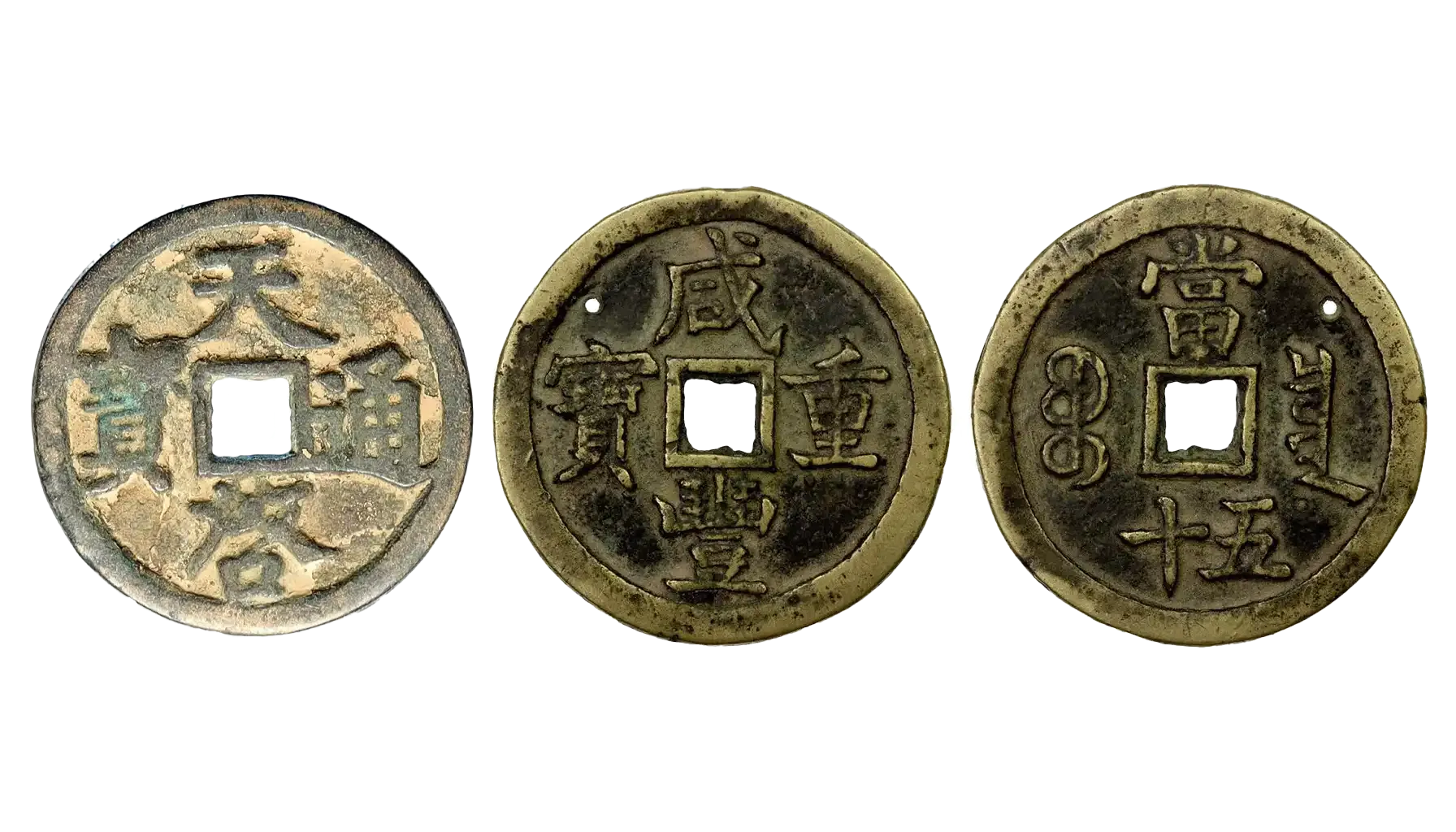
It’s not a secret that Chinese civilization is old. Therefore, many of their bits are ancient.
Ancient Chinese cash coins (i.e., the bits with holes) were already there by the time of the Qin Dynasty (221–206 BCE). The currency going by the name Ban Liang was one of the first unified Chinese currencies, and it already retained the typical “circle with a hole” design philosophy.
This design continued, with variations, through successive dynasties including the Han, Tang, Song, Ming, and Qing.
How can you know what era your Chinese coin came from? Cash bits typically had four Chinese characters on the obverse, indicating the reign title of the emperor and the phrase tong bao (circulating treasure) or yuan bao (original treasure).
As for the metal, these ancient issues were often copper coins, a metal very popular in Asia.
Rare Chinese Coins with Square Holes
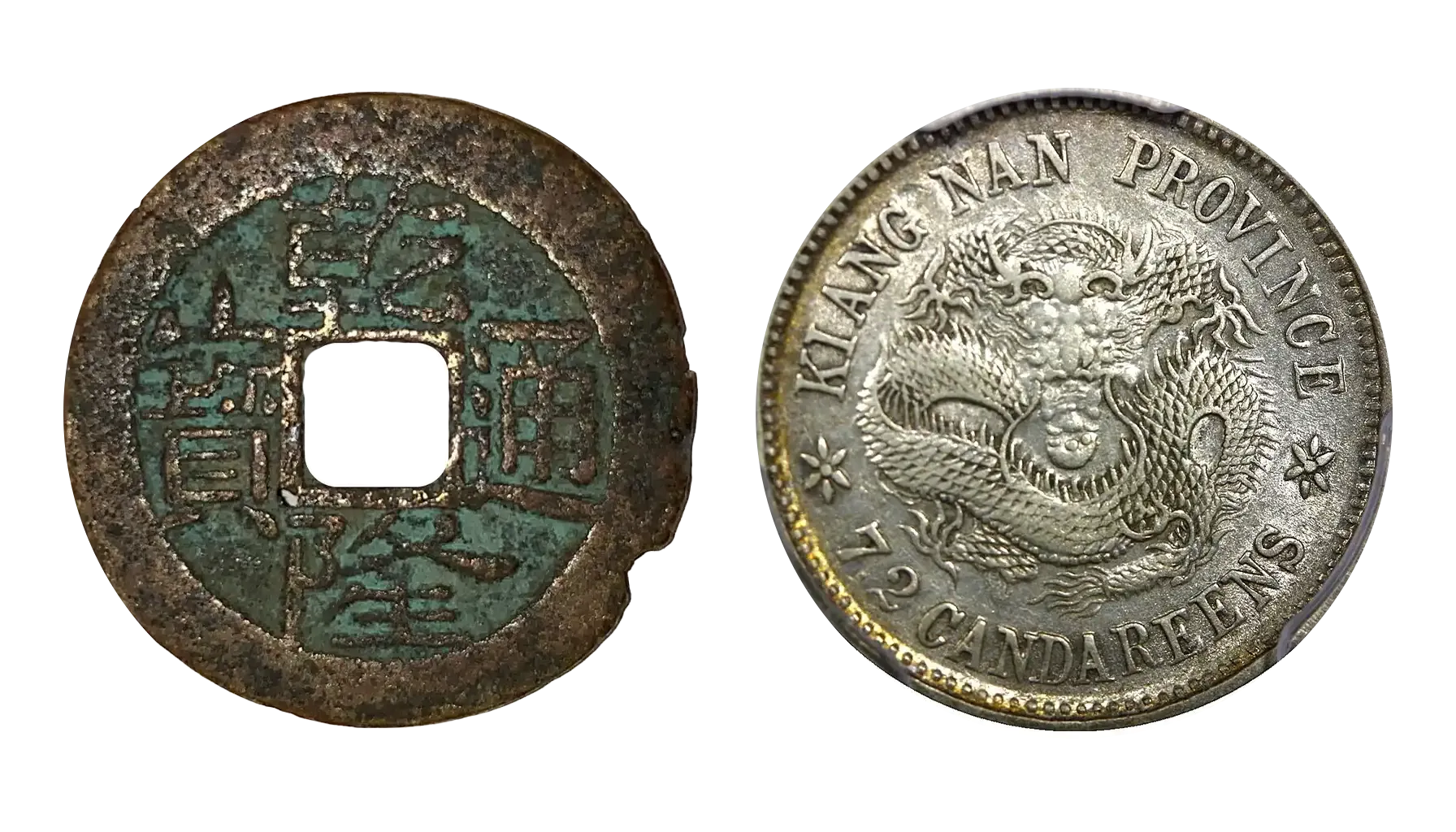
Many Chinese cash bits were produced in vast quantities. The Empire was expanding rapidly, and copper was ubiquitous.
Of course, certain issues were minted in smaller quantities than most and are considered rare and highly collectible today. A rare Chinese coin with a square hole usually corresponds to one of these groups:
Rarity may result from short reign periods. Commonly, bits were minted for their respective emperor, and the design changed when the emperor stepped down from their rule.
Experimental designs are also a curiosity for collectors. Many bits from the Xin Dynasty under Wang Mang (9–23 CE) included unusual denominations and inscriptions that differ from standard cash bits. One Chinese coin with a square hole and dragons (1902, 20 cents) was sold for over 1 million dollars.
Coins with errors, the ones with incorrect casting, such as incorrect characters or unusual metal compositions, can also increase rarity.
Old bits in excellent condition are a huge rarity, so even if a bit is common, only a few rare coins will have a good grade. Clear inscriptions, minimal corrosion, and original patina are all signs of great condition.
Chinese Coin with Square Hole Value
The value for such bits can range from a few dollars to tens of thousands, depending on several factors.
Common Qing Dynasty bits in average condition are widely available and relatively inexpensive. Around face value.
In contrast, early bits from the Qin or Han dynasties, or rare issues from short-lived reigns, can command high prices at auctions.
Here are some best-selling examples. All these bits have two things in common. They are all considered “cash”, i.e., have holes in the middle, and they are exceptionally valuable.
Coin | Date | Description | Price realized (USD) |
Xian Feng 20 cash | Qing, Xianfeng (1851–1861) | Old bit in excellent condition | $49,200 |
Duan Ping 5 cash | Southern Song (1234–1236) | Very old bit type from a noted collection | $3,750 |
Southern Song Jia Zi 10 cash (large type) | Southern Song (1208–1224) | A rare “large” 10-cash type in good condition | $1,800 |
Southern Song rare 5-cash | Song dynasty (various 12th–13th c.) | Rare cast variety from the Song period | $2,200 |
Wang Mang Da Quan Wu Shi (Daquan 50) | Xin (AD 7–23) | Historically important reform coin | $600+ |
How to Identify Old Chinese Coins
With so many mintages and dynasties, it can be hard to identify Chinese bits. Gladly, we can offer some tips on narrowing down the identification:
Study the inscription style and characters. Different dynasties used distinct calligraphic forms, and reign titles can often be matched to specific emperors.
The metal composition and casting quality are also important clues. Older bits tend to show seam lines or uneven surfaces.
Finally, make sure your bit has a patina (naturally aged metal) because many try to make counterfeit replicas.
Conclusion
China is a land of wonder, and it seems the bits from this country will remain popular among collectors.
What app can help you learn more facts about Asian coinage? Coin ID Scanner, an app that has a database of over 150,00 coins, and the app can scan them all and identify them for you.

 Facebook
  X (Twitter)
  Pinterest
  LinkedIn