Contents:
The 1796 Draped Bust Quarter stands as one of American numismatics' most legendary rarities. With only 6,146 originally minted, it represents both historical significance and extreme scarcity. It is a one year type coin and the only denomination of U.S. coinage issued for circulation which was not produced the year following its first issue.
This coin is not available to most collectors because of the limited number of issues. Are you perhaps the owner of a rare coin? Try the best app to check value of coins.
Historical Significance of the 1796 Quarter
The 1796 Draped Bust Quarter holds represents the first appearance of the quarter dollar as a circulating denomination in the United States. Before 1796, trade relied on half dollars, foreign silver coins, and local tokens. The quarter filled a practical gap in commerce.
Weight | 6.74 grams |
Mint | Philadelphia |
Metal | 89.2% Silver, 10.8% Copper |
Diameter | 27.50 mm |
Thickness | 1.75 mm |
Edge | Reeded |
Mintage | 6,146 |
PCGS | 5310 |
The Birth of US Quarter Dollar Coinage
The United States Congress passed the Mint Act in 1792, Philadelphia. The Mint prepared coinage types of cent and half dollar first. In 1796 mint workers struck the first US quarters. They based this quarter on the Draped Bust design. The 1796 Draped Bust Quarter inaugurated the quarter denomination in silver for daily commerce.
Minting Context and Production Challenges
Mint laborers operated under primitive tools and limited dies. The Philadelphia Mint lacked modern presses, dies wore quickly. Planchets varied, some had lamination flaws or porosity. Silver purity and alloy composition varied.
Mint officials used copper-silver alloys that resemble later standards, but struck under heat stress and slow die cooling. Workflows forced reuse of dies, producing die cracks, double impressions, and uneven strikes. Survivors often show weak centers or flat stars where dies wore.
Design Characteristics and Varieties
Each surviving specimen illustrates the experimental stage of early U.S. minting. The quarter shows how the Mint balanced artistic vision and mechanical limits.
Its introduction demonstrated that the United States could issue coinage equal in precision and dignity to European standards. The 1796 issue marked the beginning of the quarter’s long legacy as a standard denomination that supported trade, wages, and savings.
Draped Bust Obverse Design Details
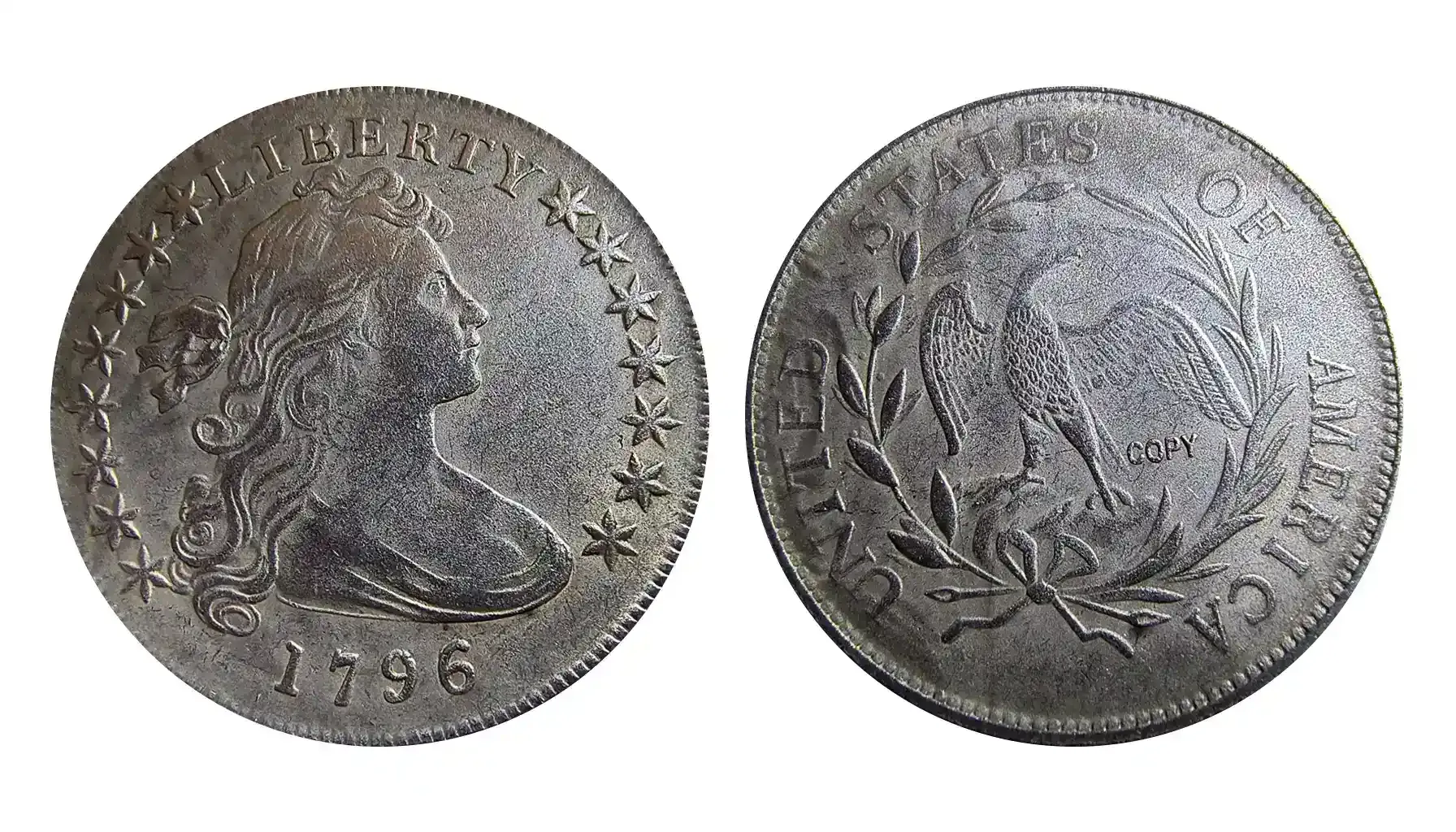
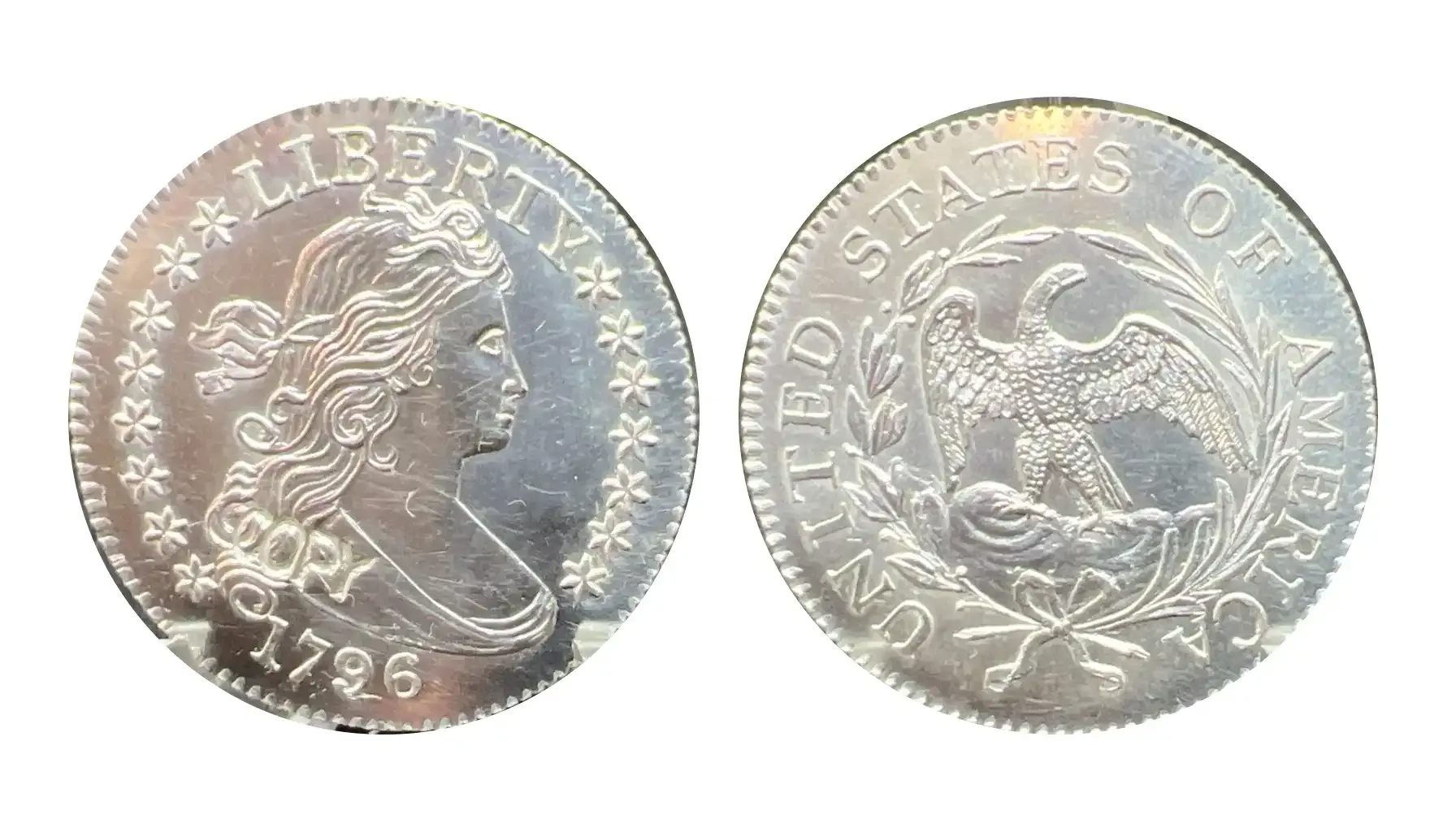
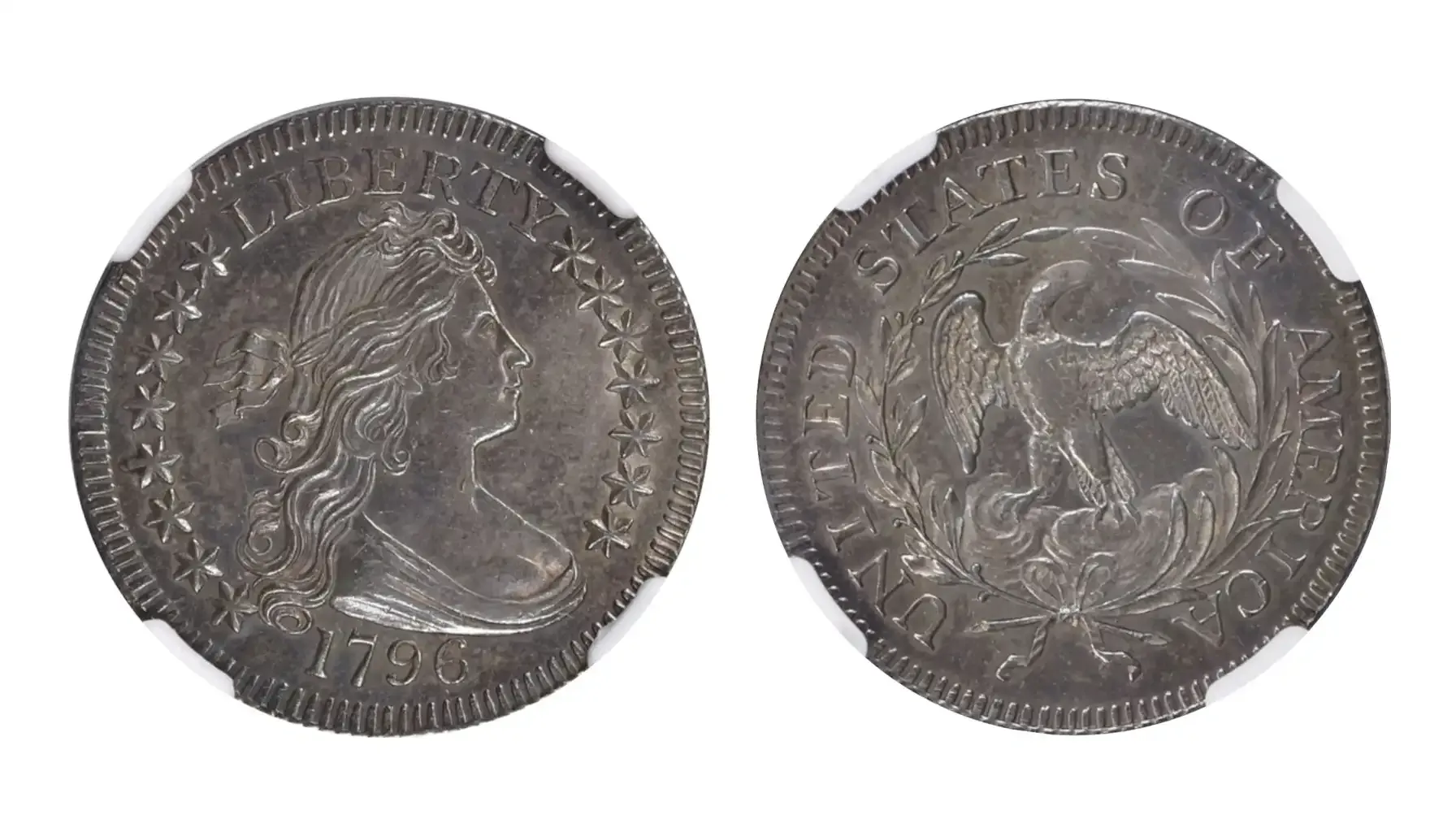
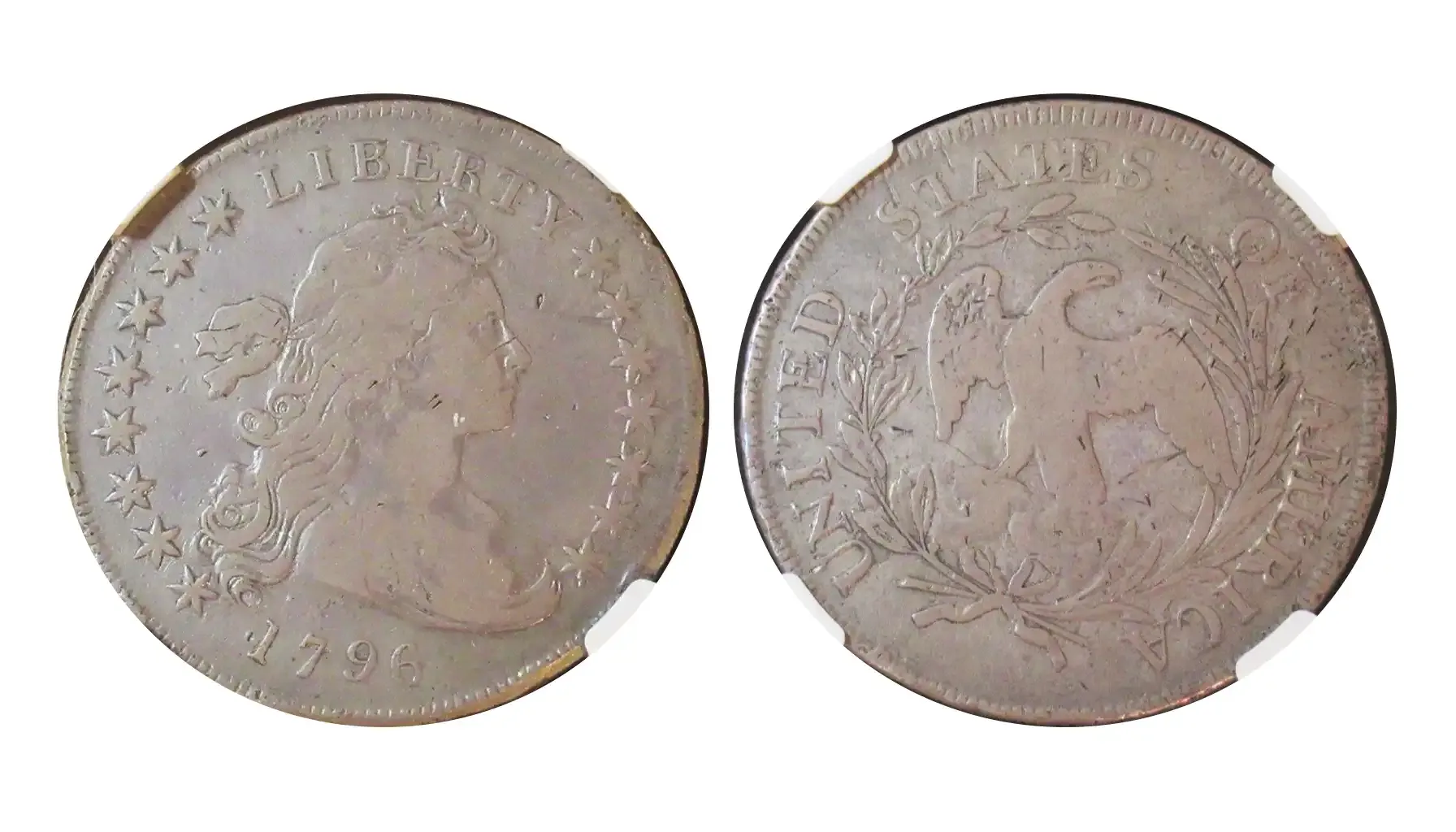
The obverse shows Liberty facing right. She wears flowing hair bound by a ribbon. She drapes a cloth over shoulder. Eight stars appear to the left, seven to the right of Liberty. The word “Liberty” arcs above the bust. The year 1796 appears in the lower part.
The design painter Robert Scot engraved with fine detail. Early dies show sharper curls and deeper relief, later dies show softened details.
Small Eagle Reverse Features
The reverse displays a small perched eagle above a small cloud or base. The inscription “United States of America” surrounds the design. Edge remains reeded. Reverse dies sometimes show misalignment.
“The 1796 Draped Bust Quarter stands as one of the most fascinating achievements of early American minting. Each surviving coin carries the very spirit of the nation’s first efforts in silver coinage.”
– Q. David Bowers, former president of the American Numismatic Association (ANA) and the Professional Numismatists Guild (PNG)
A Guide Book of United States Coins
Known Die Varieties and Their Rarity
A die variety is a variation in the normal design of a coin, usually caused by the preparation or maintenance of dies. Typical die varieties include:
double dies
repunched mint marks or dates
changes to die surface from over-polishing
die clashes
You can see inconsistencies and darkening on other dime coins with presidents. Perhaps the most famous die variety is the 1955 double die obverse (DDO) Lincoln cent.
Authentication Guide for 1796 Quarters
Coin identification shows distinctive features that separate it from counterfeits and later restrikes. A true example displays precise die alignment, sharp lettering and correct readed edge. Real pieces show signs of silver-copper alloy, not plated or base metal composition.
Remember: Any large deviation from these figures raises doubt about authenticity. Artificial shine, casting bubbles, or unusual color tones often signal forgery.
Key Diagnostic Features of Genuine Specimens
Weight: 6.74 grams
Diameter: 27.50 millimeters
Metal: 89.2% Silver, 10.8% Copper
Surface: light grey, silver or olive natural tone, without unusual gloss
Common Counterfeit Types and Detection Methods
Cast Copies: Small bubbles, seam lines, or sand marks under magnification.
Restrikes on Planchet: Wrong die alignment or over-sharpened detail in wrong places.
Plated Base Metal Cores: Sometimes peels or shows uneven color.
Professional Grading Importance
Certification by PCGS, NGC or equivalent seals authenticity, protects buyer and seller. Graders inspect material composition, strike quality, surface preservation, and toning.
High grade Mint State examples with CAC approval command premiums. Auction houses and registries trust graded slabs. Uncertified coins risk being undervalued or misrepresented.
Market Value Analysis and Investment Potential
The coin maintains one of the strongest positions in the early American market. Its low mintage, one-year type status, and historical background create steady demand among advanced buyers and new investors alike.
Current Market Valuation by Grade
Condition | Auction Price (2025) |
Poor / Fair | ~$2,300 USD |
Fine | ~$55,000 |
About Uncirculated | ~$144,000 |
Near Mint State | ~$600,000-$750,000 |
Mint State | ~$1,700,000 |
Historical Price Trends and Performance
How much is a 1796 Quarter worth? The value curve of this coin over decades shows strong appreciation. Auction prices remain volatile for low grade, but top grade rises steeply. The 5-year gain for About Uncirculated (AU-58) and higher grades exceeds 50-100% in some cases. The coin from Pogue Collection graded MS-66 by PCGS sold for $1,740,000 setting a benchmark for future sales.
Auction Records and Notable Sales
MS-66 example fetched ~$1,700,000
AU-55 example sold for $144,000
AU58 example sold for ~$78,000
This information is relevant for 2025. Low end examples in poor condition still bring several thousand dollars
Collecting Strategies for 1796 Quarters
A successful strategy begins with a clear budget. Lower-grade pieces allow entry into this field without excessive risk, while high-grade examples demand significant capital. Investors often compare prices across auctions and private sales to identify realistic benchmarks.
Grade vs Budget Considerations
Beginner Collector: Extremely Fine (XF) or AU coins. These offer substantial visual appeal and historical presence without the MS coins price.
Advanced Collector: MS-60+ with true rare characteristics.
Preservation and Conservation Best Practices
Store coins in stable environments with low humidity and neutral pH surfaces.
Use inert materials for holders (mylar, acrylic).
Avoid polishing or cleaning.
Training in handling by edges prevents oils and wear.
Keep documentation of provenance.
Photograph coins under controlled light to document conditions.
Insurance and Security Considerations
High 1796 Draped Bust Quarter value items require trusted storage (safe deposit box or approved vault). Insure full value with appraisals. Maintain records: grading certificates, auction provenance, and high resolution images. Use tamper-evident packaging for transport or transit.
Modern Tools for High-Value Coin Management
Collectors and investors now rely on specialized tools to record, verify, and protect their assets. Digital platforms, analytical software, and secure storage systems transform how rare coins are handled and documented. These methods reduce the risk of fraud and improve the transparency of market transactions.
Professional Valuation Services
PCGS
NGC
ANACS
These firms supply third-party grading. Some of them publish population reports. Experts use their census data to assess rarity and relative 1796 quarter value.
Portfolio Management Applications
Software tools allow cataloguing coins, tracking cost basis, provenance, certificate numbers. Some tools connect to live auction data and market indices for early US coins. The crucial benefits of software are real-time tracking, security and market insights.
Auction Participation Platforms
Heritage Auctions
Stack’s Bowers
GreatCollections
David Lawrence Rare Coins
These auctions and others facilitate bidding, help establish market benchmarks.
FAQ
How many 1796 quarters still exist?
Experts estimate that fewer than 700 genuine 1796 Draped Bust Quarters survive today out of the original 6,146 minted. Only around 125 to 150 pieces remain in higher grades, with the majority showing moderate wear from early circulation.
What is the most expensive 1796 quarter worth ever sold?
The most expensive 1796 quarter MS-66 sold for $1,700,000.
How does grade affect 1796 quarter value?
Grade has a direct and dramatic impact on price. A worn but authentic coin in Fine (F-12) condition trades around $50,000–$60,000, while About Uncirculated (AU-55) examples reach $145,000 or more. Mint State pieces rise exponentially in value – MS-63 coins bring over $600,000.
Where can I view genuine 1796 quarters?
Authentic examples appear in major numismatic museums and private collections. The Smithsonian Institution, American Numismatic Society (ANS), and Money Museum in Colorado Springs (ANA) each display verified specimens. Auction houses such as Heritage Auctions and Stack’s Bowers also exhibit certified 1796 quarters before high-profile sales, allowing collectors to study genuine pieces firsthand.
What authentication services are most trusted?
The most trusted authentication services are Professional Coin Grading Service (PCGS), Numismatic Guaranty Company (NGC), and ANACS.
For any collector considering a 1796 quarter, professional authentication and expert consultation are not just recommended – they are essential for protecting your investment.
If you need an AI assistant for coins detection – take a photo of the coin in the Coin ID Scanner app. You will get all the answers and distinguish real 1796 Draped Bust Small Eagle Quarters from fake ones.
Get access to over 150,000 coins
Manage your coin collection
Find numismatic news

 Facebook
  X (Twitter)
  Pinterest
  LinkedIn