Contents:
Silver! A precious metal, that’s good in so many ways, from production to jewelry and currency. In the US, silver was a go-to metal before the Mint switched to more manageable copper. Though you can find silver pieces even today…
What coins are made of silver? You can find the answer in our article. We will go over the years of silver coins, some of the most notable examples, and which ones are worth all the money.
Identify coins in your collection with the power of AI. Artificial Intelligence today can recognize all kinds of pieces, and is doing a great job.
Silver Coins in the US
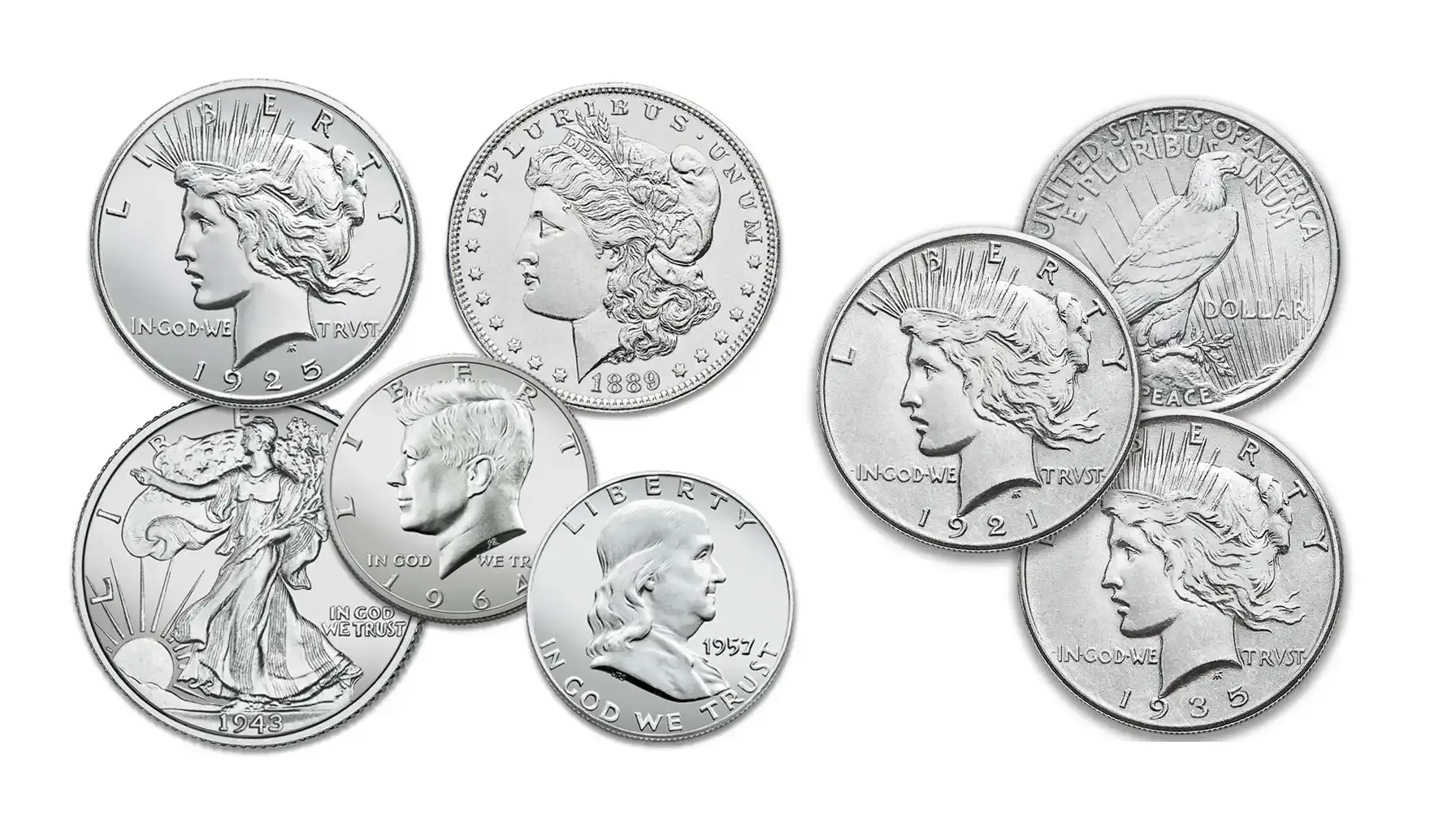
Let’s first review silver pieces in America. This country is fond of the metal, and some releases even bear the name of the metal, like 2025 Silver Eagle.
What US coins are silver? Here’s a chart for you!
Type | What Year Coins Are Silver | Purity | Notes |
Dime (10¢) | 1796–1964 | 90% | Roosevelt dimes before 1965 are 90% silver. Then they switched to copper. |
Quarter (25¢) | 1796–1964 | 90% | Washington quarters before 1965 are 90% silver. Then they switched to cupronickel. |
Half Dollar (50¢) | 1794–1970 | 90% (pre-1965), 40% (1965–70) | Includes Walking Liberty, Franklin, and Kennedy halves. |
Dollar ($1) | 1794–1935 | 90% | Morgan and Peace dollars are the most famous. |
Smaller coins | 1794–1873 | Various | Early half dimes, three-cent pieces, etc., contained silver. As the US Mint system got more unified, these “auxiliary” pieces disappeared. |
These silver coins were originally made for everyday circulation, but since the mid-20th century, they’ve been mostly produced for collectors or investors. Most just switched to a different metal. For example, dimes were switched to copper dimes post-1965.
What dollar coins are silver today? Nowadays, only one series is still going strong in this metal and is highly collected. It is an American Silver Eagle series, containing 99.9% (1 troy ounce) of this precious gray metal.
Fun faсt: Did you know that in the US, precious metals were not just currency, but also a political push? Some precious metal releases were pushed by powerful people to promote various groups and activities. Thus, Congress forced the Treasury to mint the 1878 Morgan Silver Dollar to satisfy the silver mining states.
Foreign Silver Coins
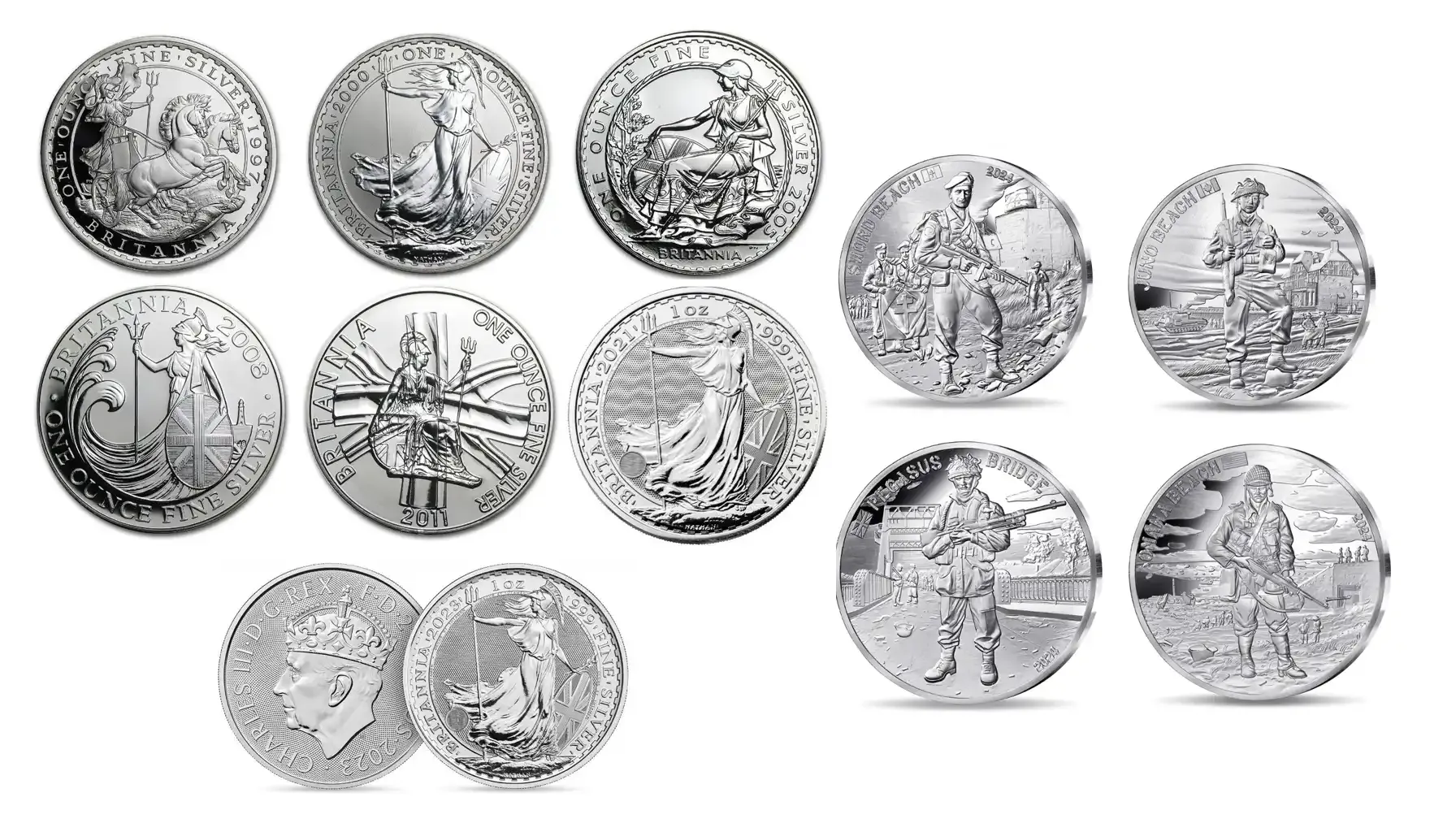
It would be impossible to encompass all the countries without making this article many times longer. Therefore, while we can't look at each denomination and country, we will go over a few notable countries and the years when most silver pieces were minted.
What year coins are silver in other countries? Let’s see.
Country | Years of Silver Content | Notes |
United Kingdom | 1551–1946 | The production began under Edward VI (sterling standard, 92.5%). In 1920, fineness was reduced to 50%, and after 1946, silver was removed entirely from circulation coins. |
Germany (and earlier states) | 1871–1939 | Under the German Empire, marks and thalers were 90% silver. The precious metal was gradually phased out during the late 1930s, replaced by base metals before WWII. |
France | 1795–1969 | Introduced silver francs after the Revolution (5 franc coins especially). The last circulating silver bit was the 10 franc piece (0.835 fine) in 1969, replaced by nickel bits afterward. |
Italy | 1861–1967 | Silver lira and later higher-value denominations (500 lire) circulated. The last circulating piece was 500 lire (0.835 fine), issued in 1967 before switching fully to base metals. |
Russia / USSR | 1839–1931 | Silver rubles and smaller coins were used in the Imperial period. Early Soviet coins briefly retained silver (10, 15, 20 kopeks) until 1931, after which production shifted to copper-nickel. |
You might also ask now: what foreign coins are silver today? The situation is the same as in the US. While no “main” lines feature this rare metal, now and then, speciall proof and collector’s issues pop up with various compositions of our favorite gray metal.
99% VS 90% VS 40% Composition
As we were "travelling" around the world, you might have noticed that these coins had different compositions of this precious metal. The amount of precious metal is also called fineness sometimes.
The composition is shown in percentage, usually:
“.999 fine” = 99.9% precious metal. Very bright, soft, and scratches easily.
“.900 fine” = 90% precious metal. Slightly harder, with a duller gray tone
“.400 fine” = 40% precious metal. Grayish and hard.
Logically, the coins with more precious metals are worth more. What coins are pure silver?
Most collector pieces are made of pure metal. For example, the modern Eagle Series. Some collector series are also pure metal. For example, 2016 Beautiful Quarters by themselves are clad (mainly copper), but they launched simultaneously with silver proof variants, and those were pure.
What Silver Coins Are Worth Money
Now it’s time to see the cream of the crop. The pieces that are worth hundreds and thousands of dollars, and their metal composition is a big price factor.
Coin | Country | Year(s) | Purity | Approx. Value | Description |
1794 Flowing Hair Silver Dollar | USA | 1794 | 90% | $10–12 million | Widely believed to be the first U.S. silver dollar ever struck. Extremely rare and historically important. |
1804 Draped Bust Dollar | USA | 1804 (struck 1834–35) | 90% | $4–7 million | Struck as presentation pieces. Only 15 known examples exist. |
1895 Morgan Dollar (Proof) | USA | 1895 | 90% | $100,000–1,500,000+ | Only 880 proofs were minted. |
1894-S Barber Dime | USA | 1894 | 90% | $1.5–2 million | Only 24 were minted. One of the rarest small in existence. |
1652 Massachusetts “Pine Tree” Shilling | Colonial America | 1652 | 92.5% | $300,000–500,000+ | One of the earliest American precious metal bits. Highly important colonial issue. |
1898/99 British Trade Dollar (Proof) | United Kingdom | 1898–1899 | 90% | $50,000–150,000 | Rare proof issues struck for overseas trade. Has limited surviving examples. |
U.S. silver coins dominate the high-end market due to strong collector demand and documentation. While most of the coins on our list are valuable due to the precious metal, other factors play in, like rarity, condition, and historical context.
As of now, and likely for a long time, the 1794 Flowing Hair Dollar will stay a legend.
Why Is the 1794 Flowing Hair Dollar so Valuable?
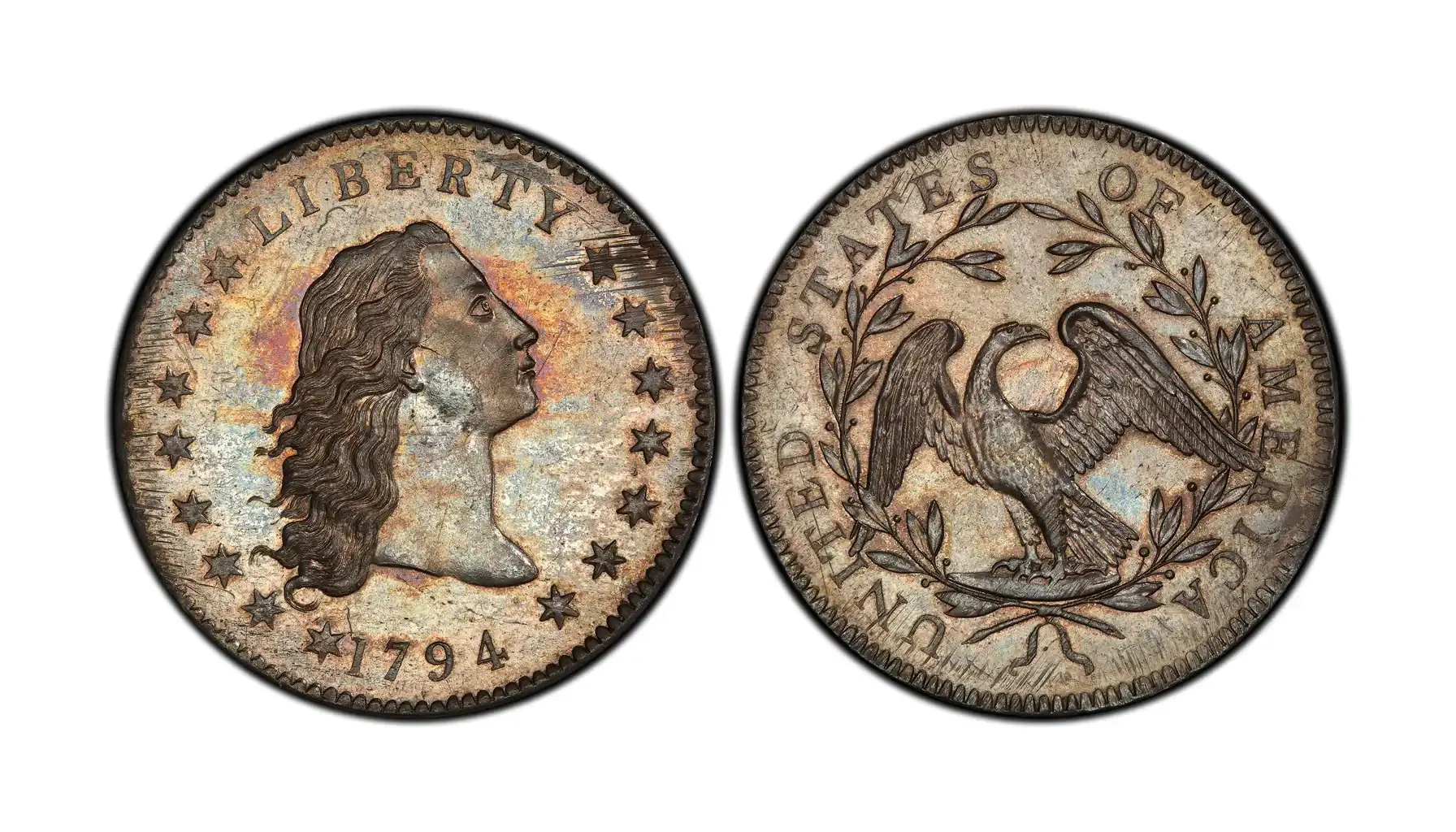
The 1794 Flowing Hair Silver Dollar is valuable not only because it has precious metal. A few other factors make it so much more valuable:
1. It’s the First U.S. Silver Dollar
The 1794 Flowing Hair Dollar was the first silver dollar ever struck by the United States Mint, established only two years earlier (in 1792).
Collectors view it as a foundational artifact of the country’s financial history.
2. Extremely Low Mintage and Survival
Only 1,758 bits were struck in 1794 at the Philadelphia Mint.
Because of production issues and hand-striking methods, many were poorly struck, and few survive today in good condition.
Experts estimate that only about 120–130 examples still exist, most with wear or minting defects.
3. Historical and Symbolic Design
Fans of the classical Liberty design would love to have this piece.
Symbolically, it represents the birth of a Mexican monetary system.
5. Condition and Provenance
Due to erosion and old age, only a few high-grade pieces survived, making them even more valuable and rare.
The record-breaking specimen (graded SP66 by PCGS) is nearly flawless and has mirror-like proof surfaces, suggesting it was struck with special care as a presentation piece.
6. Market Dynamics
The market is kind to the old bits, and with time, they become more and more expensive.
Flowing Hair Dollar is also often talked about, giving it coverage and attention whenever it gets on the auctions.
Learn About Coinage
If you are a collector, you likely have many different bits, from different years, metals, and denominations. Back in the day, you’d have to buy and extensively read books to learn about these pieces. Today, just one app has all the necessary data.
Coin ID Scanner
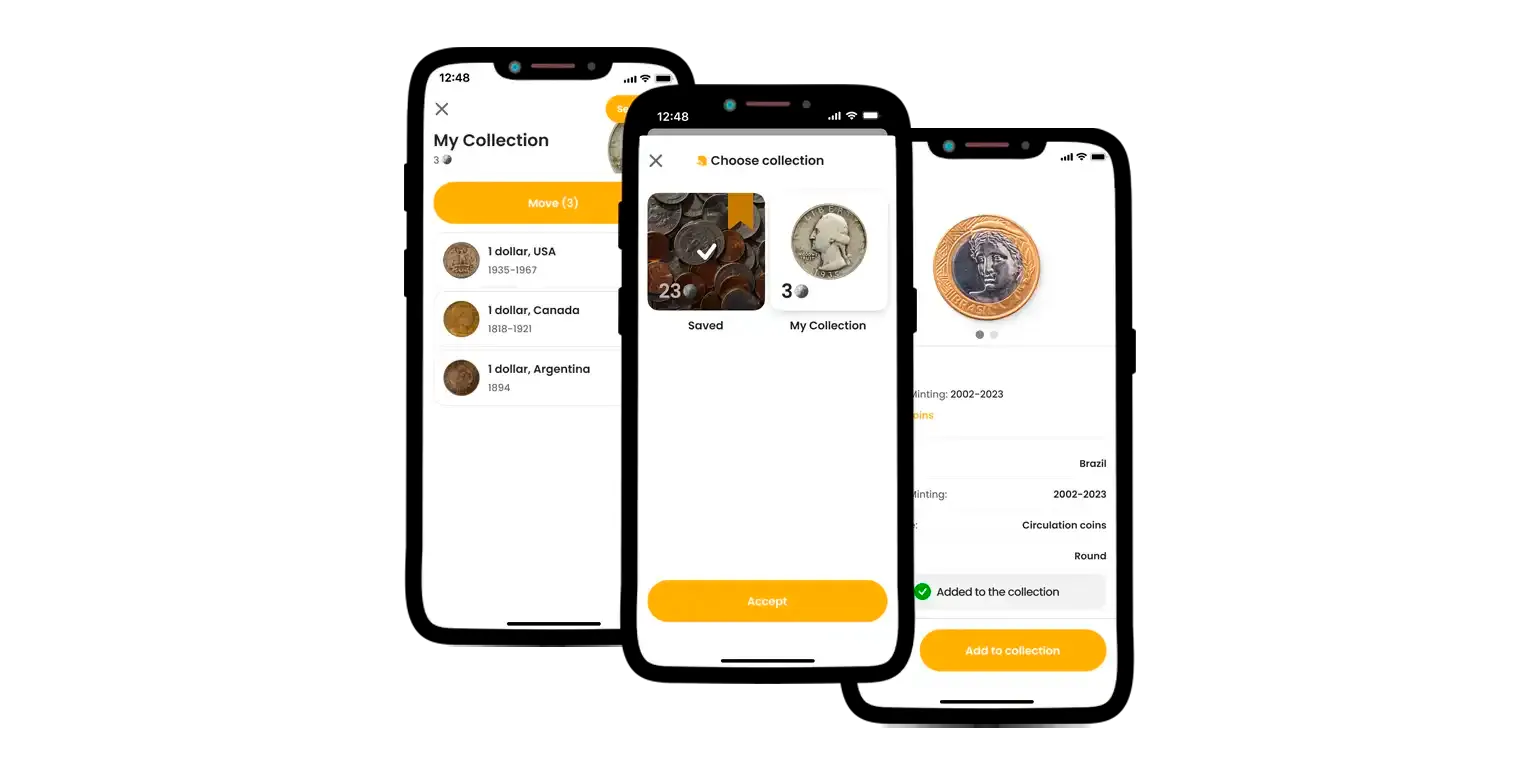
Coin Identifier is a mobile app that uses image recognition and Artificial Intelligence to identify coins. The app allows you to take or upload photos of bits, and then provides information such as the collectible’s country, denomination, year, composition, and approximate market value.
Let’s have a better look at some of the core functions:
Photo Identification: You can take a picture of a bit’s front and back, and the app will automatically try to match it to its database of coin types.
Database Coverage: The developers claim it recognizes over 150,000 different pieces, including ancient, historical, and modern issues from many countries.
Value Estimates: After identification, the app gives a rough estimate of the collectible’s market price or collector value based on rarity and general condition.
Collection Management: Users can save identified bits to a personal “My Collection” area, organize them by country or type, and add notes or photos.
AI Assistant: A built-in virtual assistant can answer numismatic questions, give collecting advice, and provide background information.
Educational Content: The app includes articles and news about numismatics, mintage history, and collecting tips.
Coin ID Scanner works on iPhone and Android devices, and it is free to download!

 Facebook
  X (Twitter)
  Pinterest
  LinkedIn