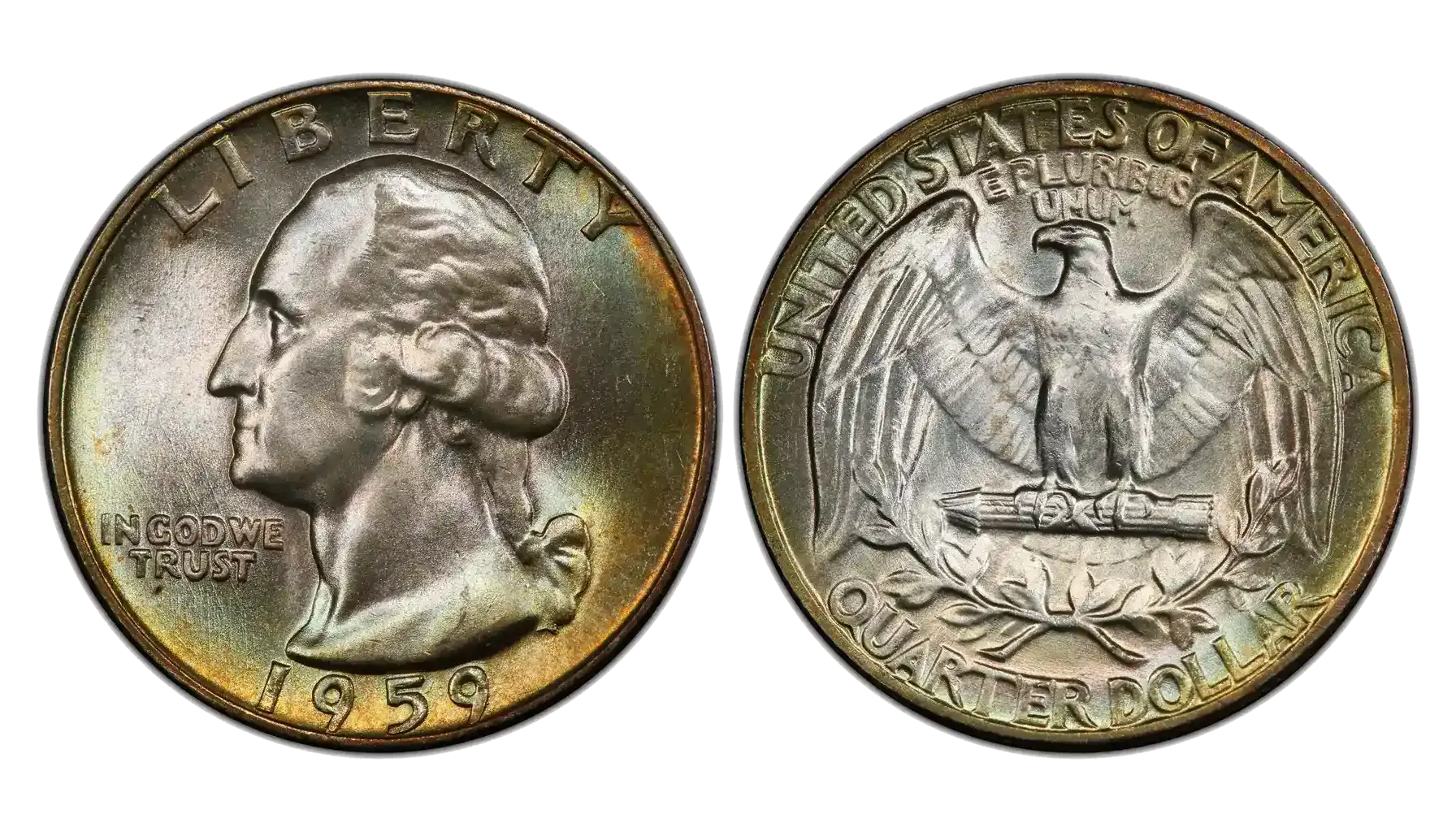
The 1959 Washington Quarter is a part of the long-running series first introduced in 1932 to honor the bicentennial of George Washington’s birth. By 1959, this design was well-established and struck every year at the U.S. Mint.
It was intended as a one-year commemorative but became the permanent replacement for the Standing Liberty issue. In 1959, the coin was produced in a period of strong post-war U.S. growth. It still carried its classic details: Washington’s profile on the obverse and the heraldic eagle on the reverse, both created by sculptor John Flanagan.
Quarters of this year were struck in 90% silver and 10% copper, weighing 6.25 grams with a diameter of 24.3 mm. This was the standard composition until 1964, after which silver was replaced by clad copper-nickel.
So, how much is a 1959 silver quarter worth? And what is the best app to check coin value?
Specification | Details |
Year | 1959 |
John Flanagan | |
Composition | 90% Silver, 10% Copper |
Weight | 6.25 grams |
Diameter | 24.3 mm |
Thickness | 1.75 mm |
Edge | Reeded |
Mint Marks | 1959 quarter D (Denver), none (Philadelphia) |
Silver Content | 0.1808 troy oz silver |
Mint Marks
In 1959, three distinct types entered the market. The first came from the Philadelphia Mint, which at the time did not place a mint mark on its coins. Collectors can recognize a Philadelphia issue by the plain reverse: beneath the wreath, above the “R” in QUARTER DOLLAR, there is no additional lettering. What is the 1959 quarter value no mint mark? These coins were struck in large numbers and remain widely available today, mostly valued for their silver content unless found in exceptionally high grades.
The second variety was produced by the Denver Mint, and these carry a small “D” placed just above the final word of the denomination, i.e. 1959 D Washington quarter. The positioning is subtle, but it distinguishes Denver issues from their Philadelphia counterparts. What is the 1959-D quarter value? Denver specimens of 1959 are equally accessible in most grades, though sharp Mint State examples with strong luster tend to draw more collector attention.
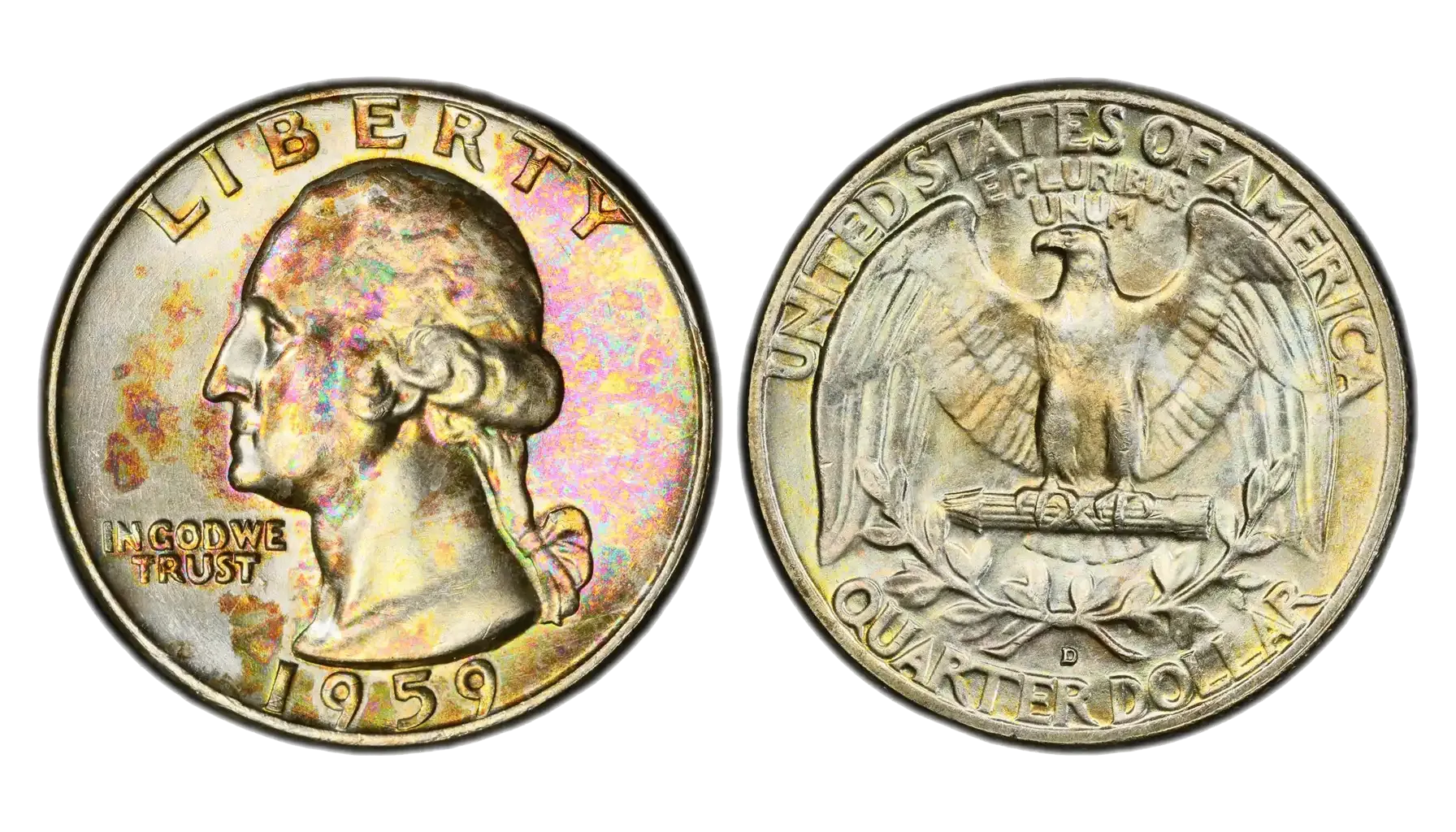
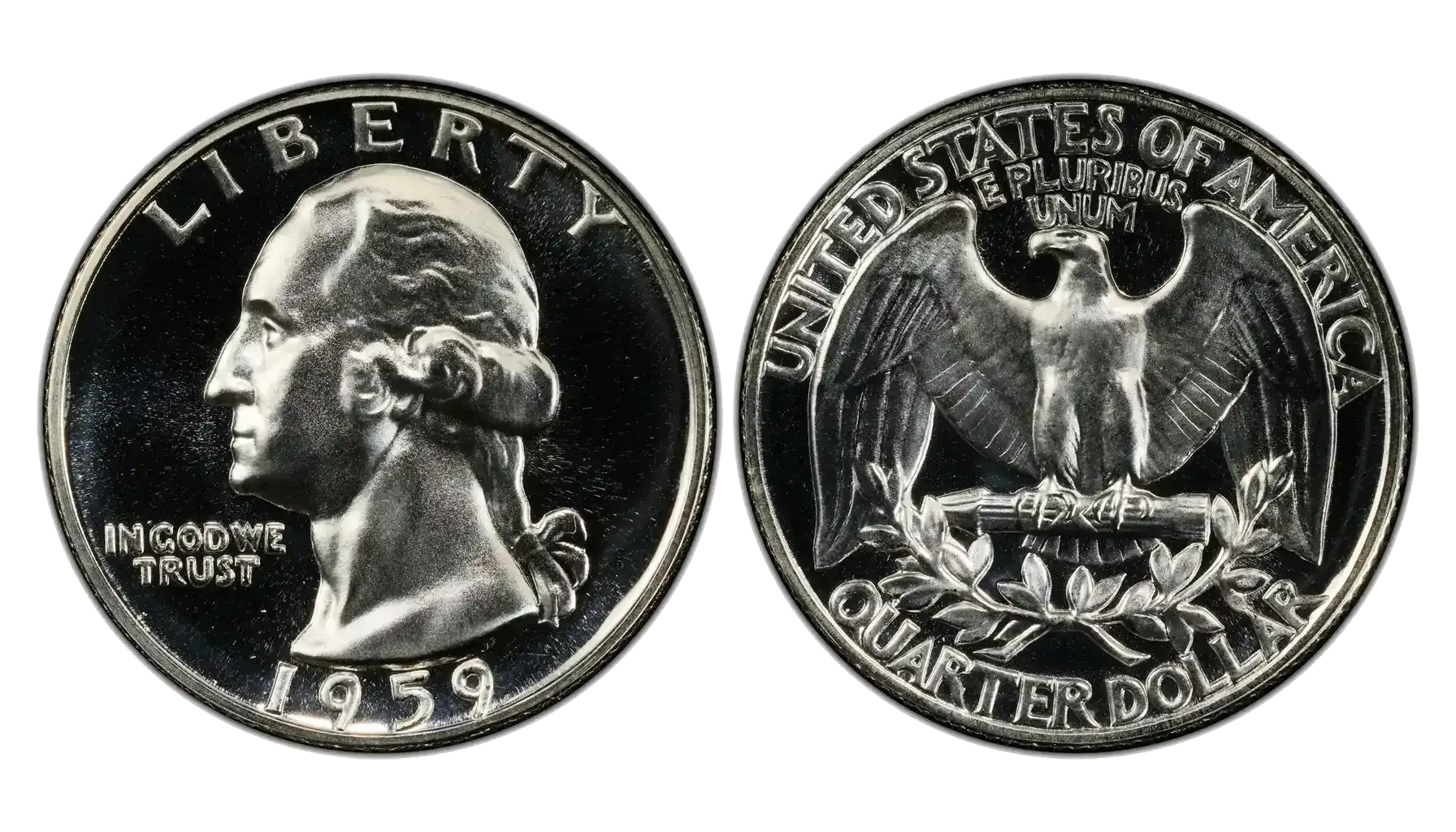
Finally, 1959 was a proof year, with specialized coins made only in Philadelphia. Proof coins bore no mint mark but can easily be identified by their mirror-like fields and precision strikes. These pieces were not released into circulation but sold directly to collectors as part of annual proof sets.
1959 Quarter Value Today (Oct, 2025)
Grade | 1959 quarter no mint mark value | 1959 D quarter value | 1959 Proof quarter value |
Good (G-4) | $6 (silver melt) | $6 (silver melt) | – |
Extremely Fine (XF-40) | $7 | $7 | – |
About Uncirculated (AU-50) | $8 | $8 | – |
Mint State 63 (MS63) | $15 | $15 | – |
$45 | $40 | – | |
Mint State 67 (MS67) | $250+ | $200+ | – |
Proof 65 | – | – | $30 |
Proof 67 | – | – | $75–$100+ |
Disclaimer: Values reflect both silver bullion worth and collector premiums as of current market trends.
The coin is 90% silver, 10% copper. Its melt (intrinsic) value, i.e., 1959 quarter silver value, is based on current silver price. The melt range for a 1959 silver quarter is about $3.25 – $3.75 (Oct, 2025; silver price predictions for 2030 are here).
Do Not Confuse!
The 1959 US Quarter is often misunderstood because the date “1959” appears on several different coins. Only one is the actual silver piece struck that year, but others feature the date as a reference to statehood or as their own year of issue. Here are the main coins that cause confusion:
1959 Washington one (of the topic): The circulating piece minted in Philadelphia and Denver, made of 90% silver. Features George Washington’s bust on the obverse and the heraldic eagle on the reverse.
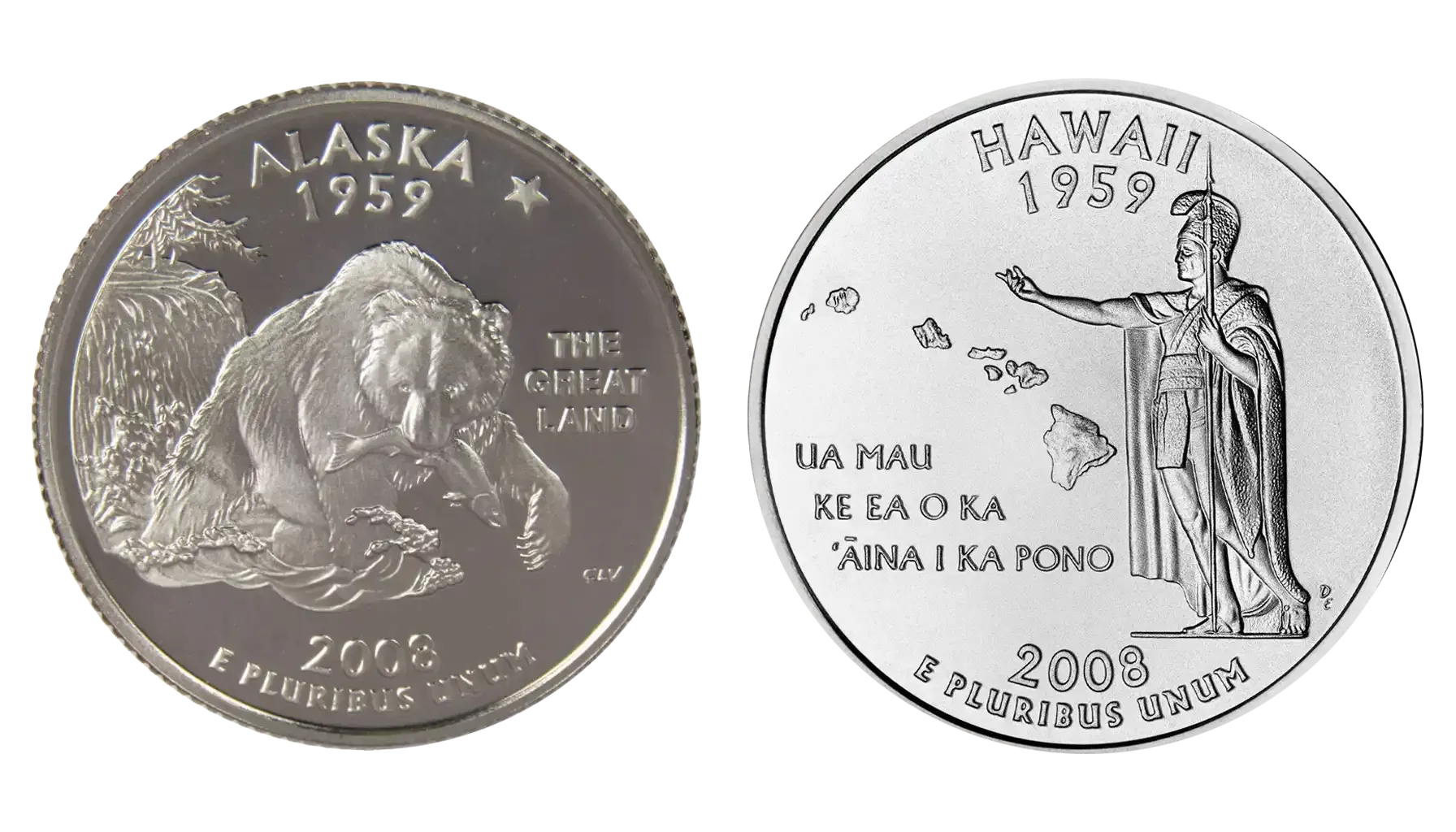
Alaska State Quarter (2008), i.e. 1959 Alaska Quarter: Part of the 50 State Quarters Program, struck in copper-nickel clad. Its reverse shows a grizzly bear catching a salmon, with the dual dates “1959” (Alaska’s statehood) and “2008” (year of minting). If you want to find out the Alaska 1959 quarter 2008 value, try to check it in the Coin ID Scanner app.
Hawai‘i State Quarter (2008): Also carries the date “1959” because Hawai‘i entered the Union that same year. The design shows King Kamehameha I pointing to the islands with the motto Ua Mau ke Ea o ka ʻĀina i ka Pono. Like the Alaska issue, it is copper-nickel clad and not a silver one, which influences the total Hawaii 1959 quarter worth.
What Is a 1959 Impala Quarter Panel?
On a car, the quarter panel is the large sheet-metal body section located behind the rear doors (or rear fenders on a two-door). It stretches from the rear of the door opening to the trunk and typically includes the wheel arch. On the 1959 Chevrolet Impala, this part is especially interesting because of its sweeping “batwing” fins and horizontal cat’s-eye tail lamps.
1959 Quarter Error List
Although the coin is a relatively straightforward issue, collectors have identified several error types that can raise its 1959 silver quarter value far beyond metal content.
Doubled Die Obverse (DDO)
Some display doubling on the obverse, especially around the motto IN GOD WE TRUST and the date. This doubling comes from a misalignment during hubbing, and examples with strong, visible separation are prized by collectors.
Doubled Die Reverse (DDR)
On certain coins, doubling appears on the lettering UNITED STATES OF AMERICA or QUARTER DOLLAR. The effect can range from minor distortion to clear doubled strokes, and the more visible examples attract a strong premium.
Repunched Mint Mark (RPM) – 1959 D Quarter Error
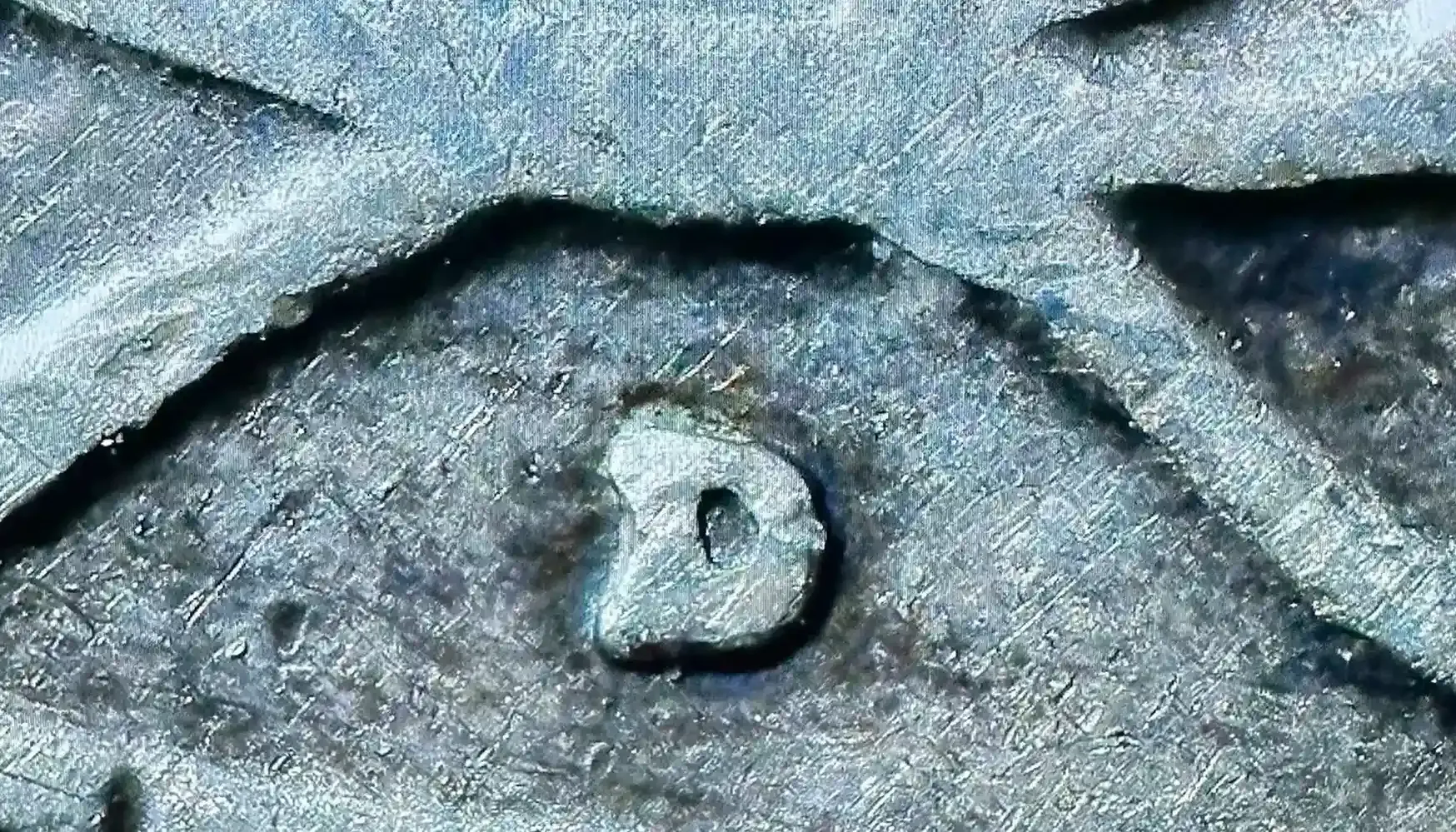
Because mint marks in 1959 were still applied by hand, some Denver coins show evidence of repunching. The “D” may appear doubled, tripled, or shifted slightly. This produces a visible variety that specialists actively seek out, and would like to pay double 1959 D silver quarter value.
Off-Center Strikes
An off-center strike occurs when the coin blank is not properly seated in the press. For 1959 specimens, slight off-centers of 5–10% add curiosity value, but bigger off-centers with full visible dates can cost significantly more.
Clipped Planchets
A clipped planchet error results from an improperly cut blank that leaves the coin with a missing curved or straight portion. On silver coins like those of 1959, these clips are easy to spot and often collected as curiosities.
Struck-Through Errors
Occasionally, grease or foreign material blocked parts of the die, leaving certain areas of the coin weakly struck or even blank. These “struck-through” errors are less dramatic but still collectible.
There are also other errors, e.g., die cracks and cuds.
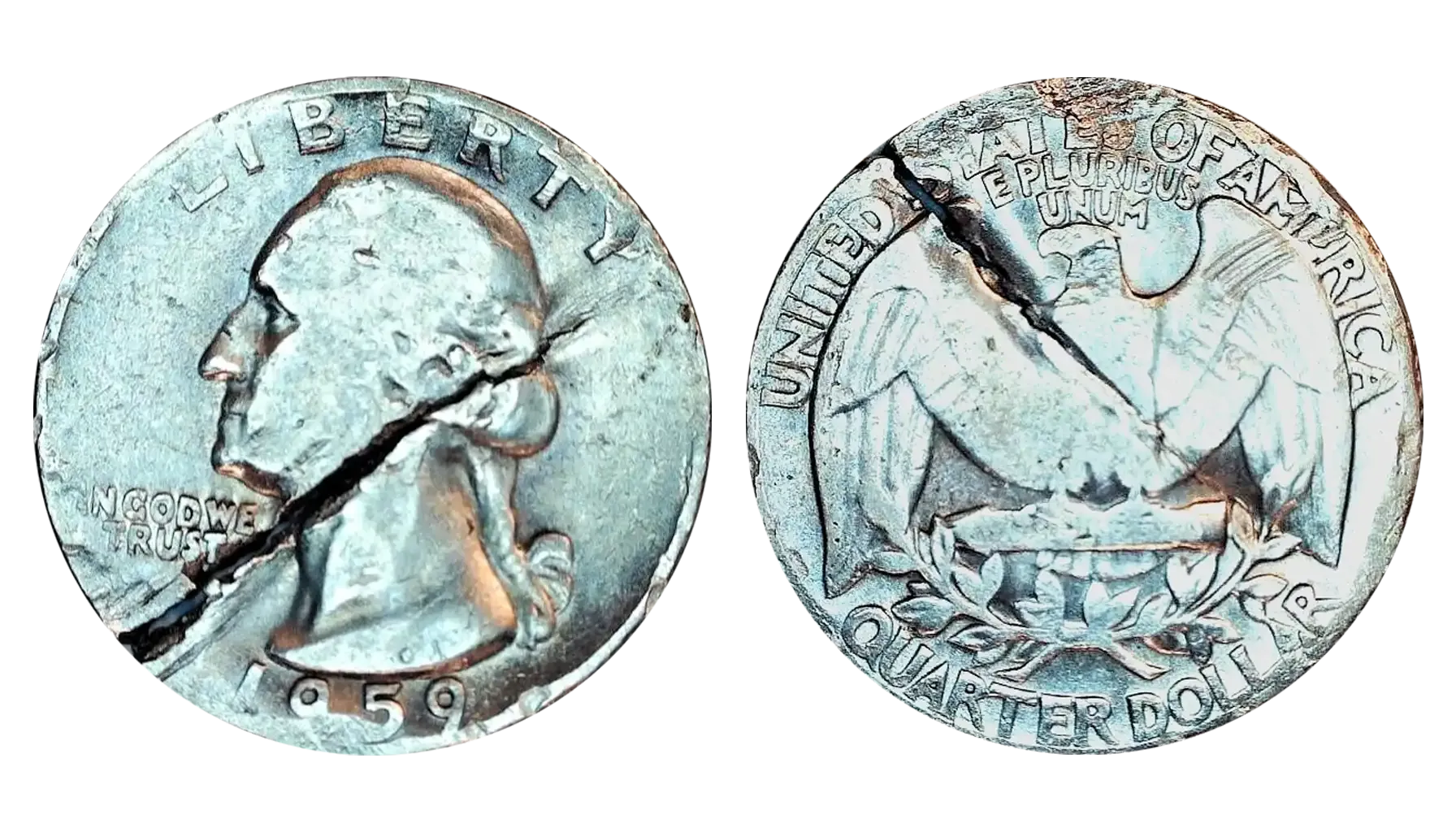
Error Value Range
Error | How much is a 1959 quarter worth? |
Doubled Die Obverse | $75 – $300+ |
Doubled Die Reverse | $50 – $200+ |
Repunched Mint Mark (RPM) | $25 – $150 |
Off-Center Strike | $50 – $500 |
Clipped Planchet | $40 – $150 |
Struck-Through Grease/Material | $20 – $75 |
If you’re dealing with a coin and want to check its authenticity, silver content, or potential price, a quick way is to use the Coin ID Scanner app. You take a photo, and the app identifies the coin, shows its specs, mint details, and even highlights values. Now, it’s easier to know whether you have just a common silver piece or something rare.

 Facebook
  X (Twitter)
  Pinterest
  LinkedIn