Contents:
Even the smallest denominations may be worth thousands – this is the truth of numismatics which is not concealed but still underestimated. For dozens of years, cents have been seen as everyday, nearly worthless coins used in minor daily transactions, with no potential to "grow big". Nevertheless, what is small in size can be great in value, and this is exactly what happened to the 1889 US penny.
When mintages are high, but the time of production is long gone, even common coins may turn into something genuinely precious. This, however, also depends on conditions, strike quality, designations, and rare mistakes. So, how much is an 1889 penny worth, what does it look like, and which features identify this coin as a true treasure? Let us check.
A Brief Historical Note
So iconic are the coins of the past! They carry stories within their metal cores, they share the feelings of the people who used them, they reflect the history, culture, and society of their time. The Indian Head cent is among the most legendary numismatic creations in the US, first introduced in 1859 as a response to the need for a smaller, more practical coin to replace the large cent.
Originally, it was designed by James B. Longacre, who masterfully depicted Liberty wearing a Native American headdress (a legend has it that the engraver’s daughter served as his muse for the iconic design). It was an absolute success: over the following fifty years, this variation would dominate US coinage until 1909, when there was released 1909 VDB penny.
Design Features and the Main Characteristics of the 1889 Penny
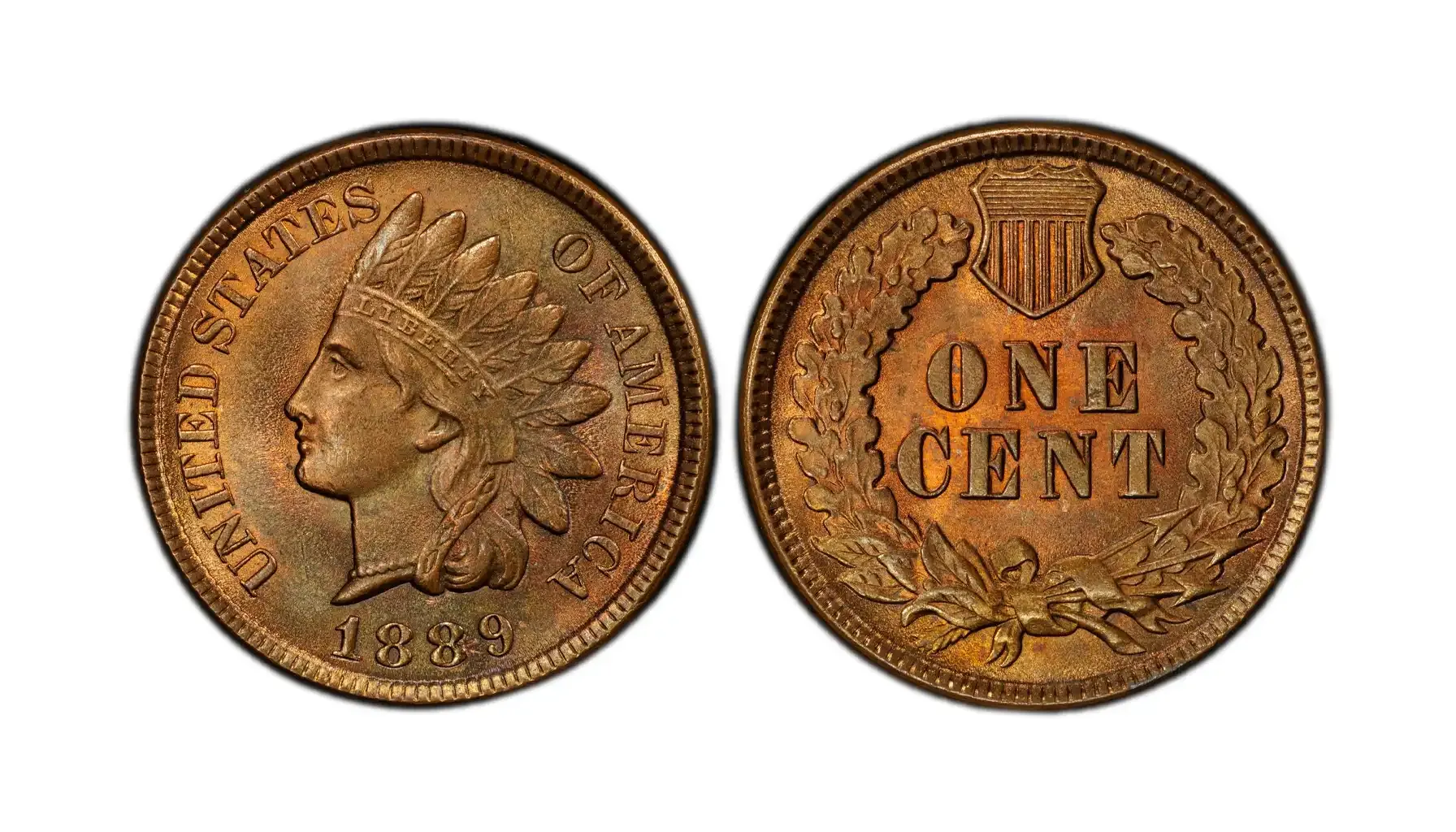
Obverse Design: Features a left-facing portrait of Liberty wearing a Native American feathered headdress inscribed with the word “LIBERTY” across the band, surrounded by the words “UNITED STATES OF AMERICA”, and the date “1889” placed along the lower rim, right below the profile.
Reverse Design: Presents a wreath of oak leaves tied with a ribbon at the bottom, along with the denomination “ONE CENT” at the center and a federal shield by the upper rim.
The Main Features of the Indian Head Penny 1889 | |
Designer | James Barton Longacre |
Composition | 95% copper, 5% tin and zinc (bronze) |
Weight | 3.11 grams |
Diameter | 19.05 millimeters (0.75 inches) |
Thickness | Approximately 1.55 millimeters |
Edge | Plain |
Mint Mark | None (Philadelphia Mint only) |
1889 Indian Penny Types by Mint
1889 1C
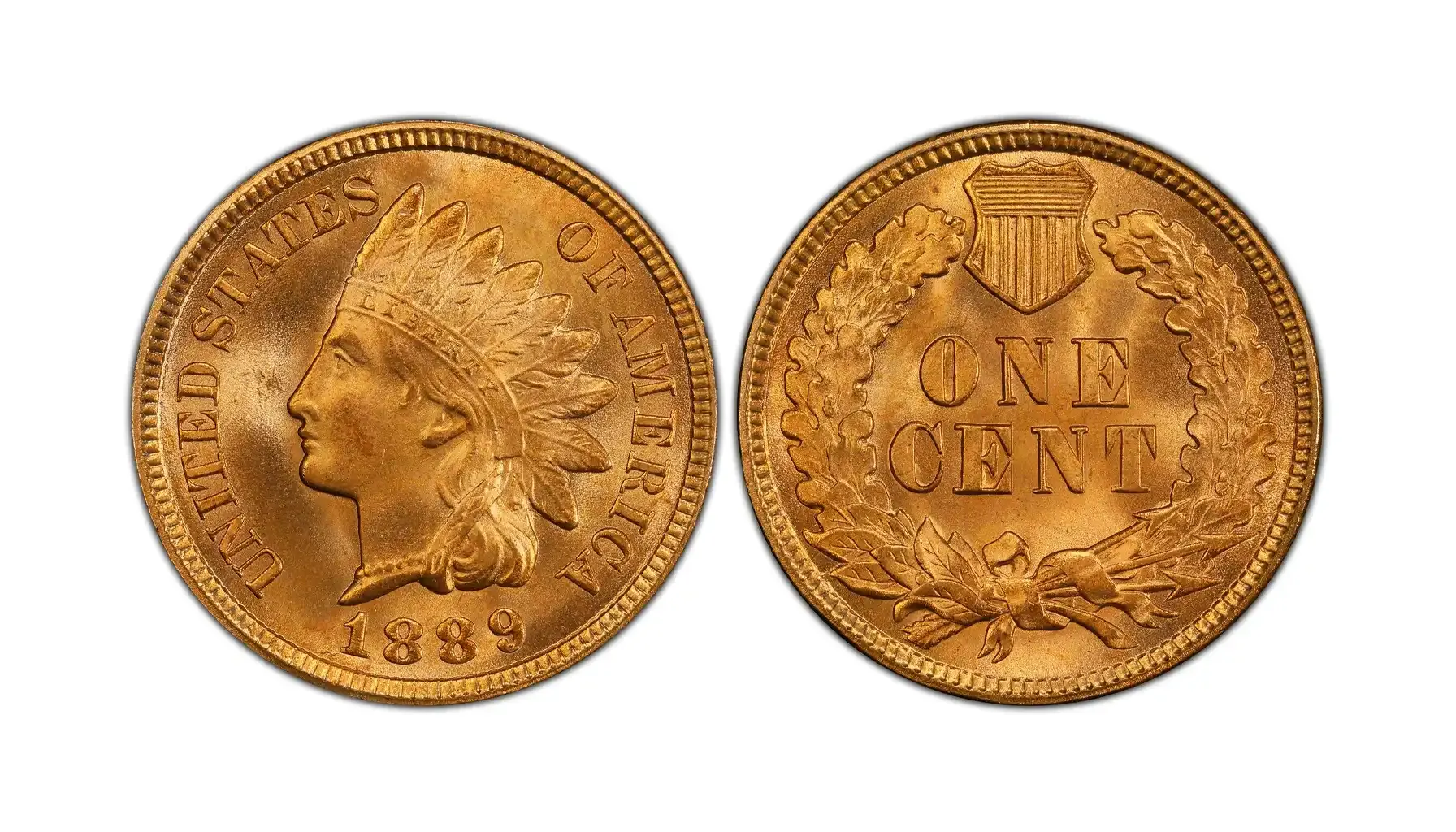
Produced by: Philadelphia Mint
Mintage: 48,866,025
Auction Record: $1,880 for AU55BN
The regular penny 1889 is one of the most available issues in the entire series, which is possible thanks to its high mintage of more than 48 million coins produced. According to Jaime Hernandez, instances in circulated grades are quite widespread, especially up to MS63, though coins with original red luster (RD designation) are notably scarcer.
Higher Mint State examples with RD designations may still be worth thousands, but in MS65 and higher, the 1889 cent is a true rarity, with only a few dozen examples known to exist.
1889 1C Proof
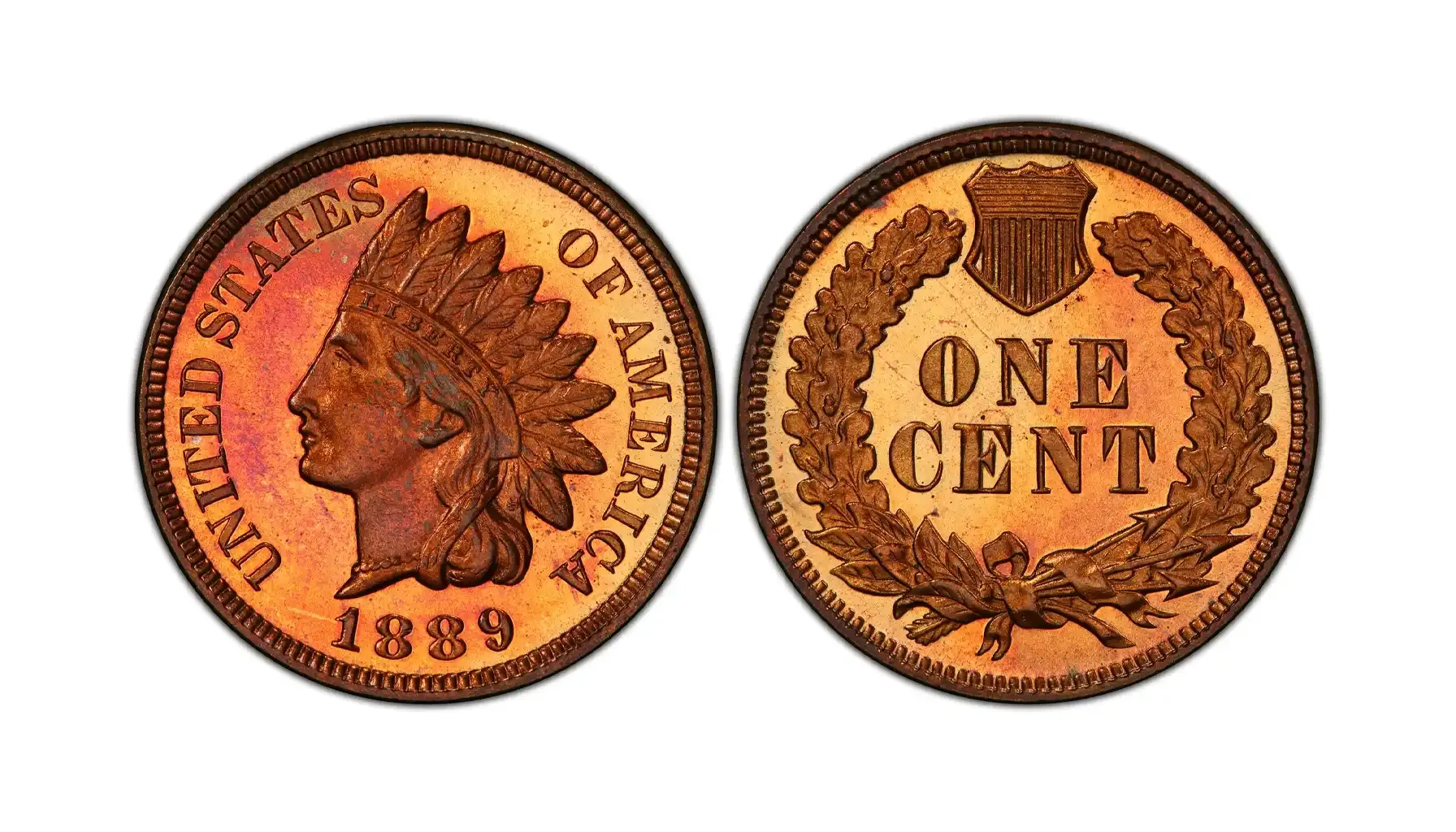
Produced by: Philadelphia Mint
Mintage: 3,336
Auction Record: $3,300 for PR67BN
Another iteration of the same coin comes down to its proof version, minted by the Philadelphia Mint in 1889. Though its mintage is comparably small, a fair number of proofs have survived, thanks to its original purpose – to serve as a display collectible, not intended for use. Coins are found in varying color designations, i.e., BN (Brown), RB (Red-Brown), RD (Red), and Cameo (CAM) pieces, with the latter showing frosted design elements contrasting against reflective fields.
1889 Indian Head Penny Errors and Their Appeal
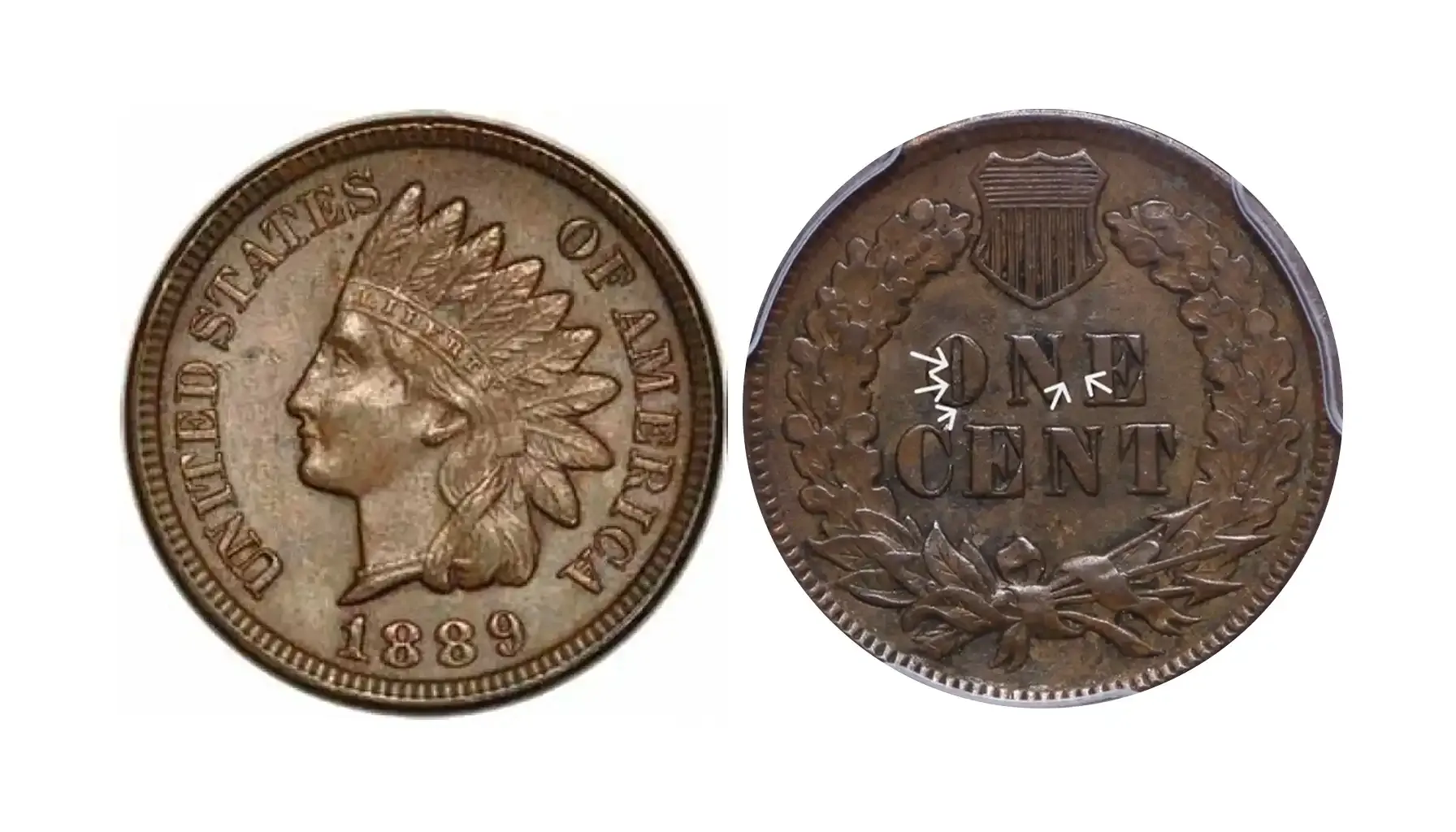
Reverse Die Clash
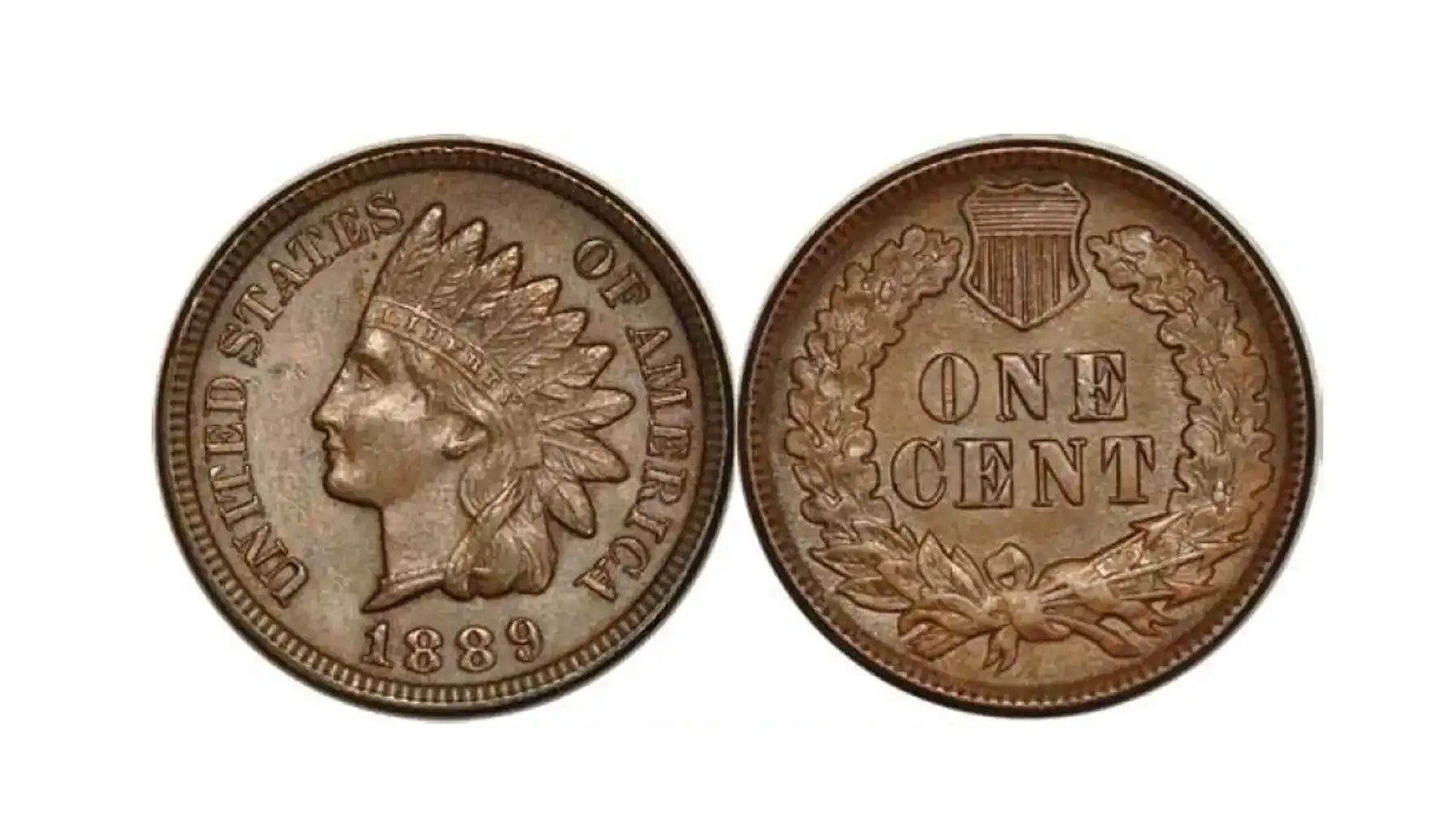
Estimated value: $295 (approx.)
Although the 1889 penny value should not be limited to the errors only, they do constitute a major part of the coin’s overall appeal among collectors. The reverse die clash is one of the most visually intriguing of these mint-made varieties, which occurs when the obverse and reverse dies strike each other without a planchet properly placed in between.
Clash marks, which boost the 1889 Indian Head penny worth, may range from fine hairline scratches to distinct, readable secondary elements, and the more recognizable they are, the more they cost. In fact, it denotes the minting-stage accident, which is a rare occasion and which usually leads to the disposal of these pieces instead of the release.
Off-Center Strike/Off-Center Clash (OCC)
Estimated value: $270 (approx.)
When it comes to traditional minting deviations, one may instantly think of off-center strikes, i.e., an error that consists in occasional misalignment during the process of striking – the result is a partially struck design and an area of blank planchet. When the same problem coincides with a die clash, collectors may call it an off-center clash (sometimes abbreviated OCC).
Missing portions of the headdress or wreath, truncated date or legends, and unusual overlaps make a casual, yet really old coin precious, but its value is still dependent on how severe the misalignment is. For instance, a lightly off-center 5-10% strike is common and may not be worth much; a 30-60% or greater off-center strike that displays large blank fields or nearly complete reverse on the obverse is much more collectible.
Doubled Die (Obverse or Reverse)
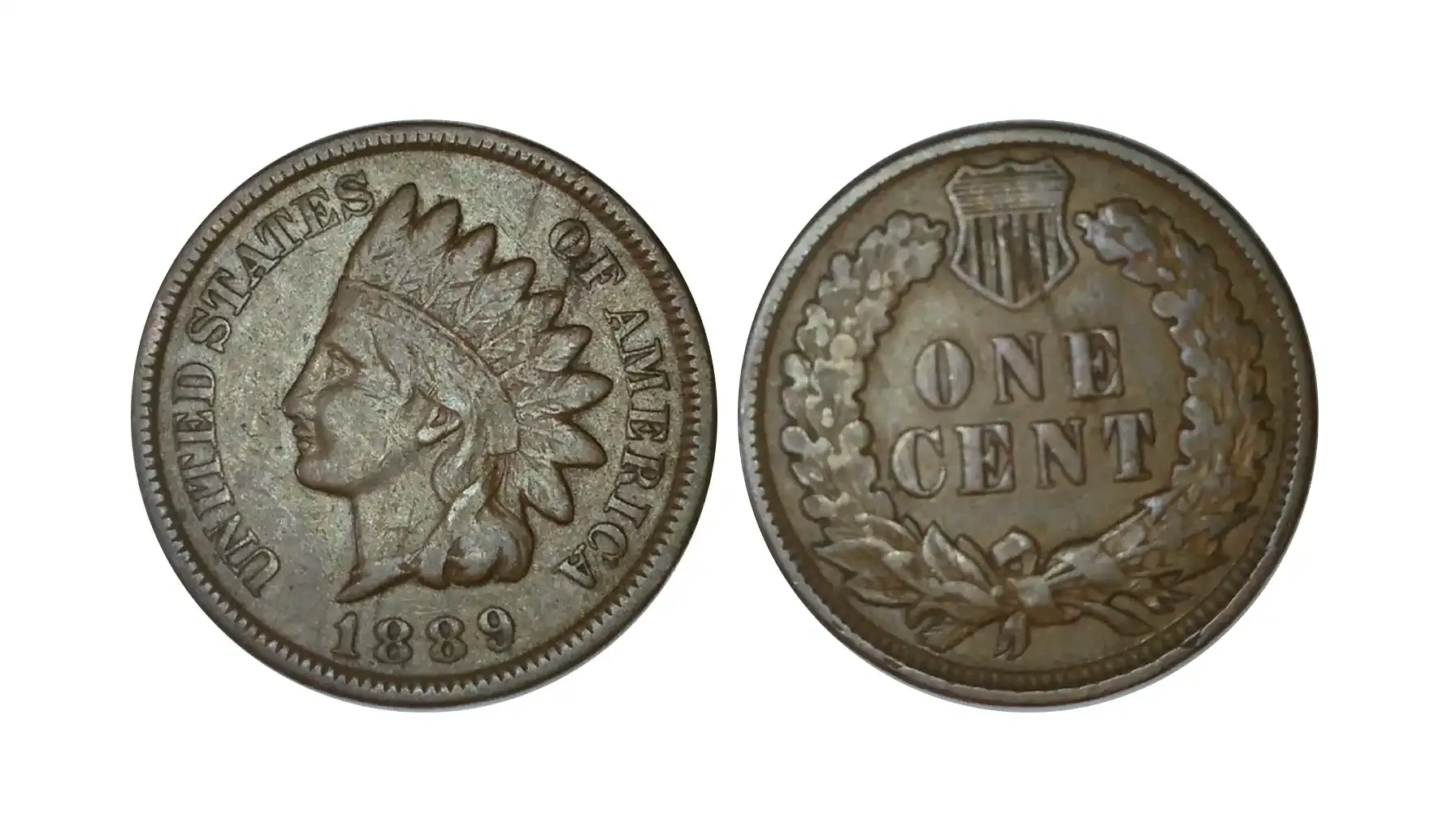
Estimated value: $75 (approx.)
A true double die is a great opportunity to explore the most widespread error and see the 1889 Indian Head wheat penny value grow. This usually results from a misalignment or shift during the die-hubbed impression process, so the working die itself carries doubled design elements. In the case of the 1889 cent, the doubling may be found on the date, the word LIBERTY, or the surrounding legends.
Besides, the severity of the doubling is also important, for subtle (micro-doubling) is usually less valuable than bold, with clearly separated secondary devices. So as to identify even the least obvious doling, it is important to pay attention to distinct, raised secondary devices with separation and doubling in multiple nearby elements in the same direction.
Peeling Lamination Error
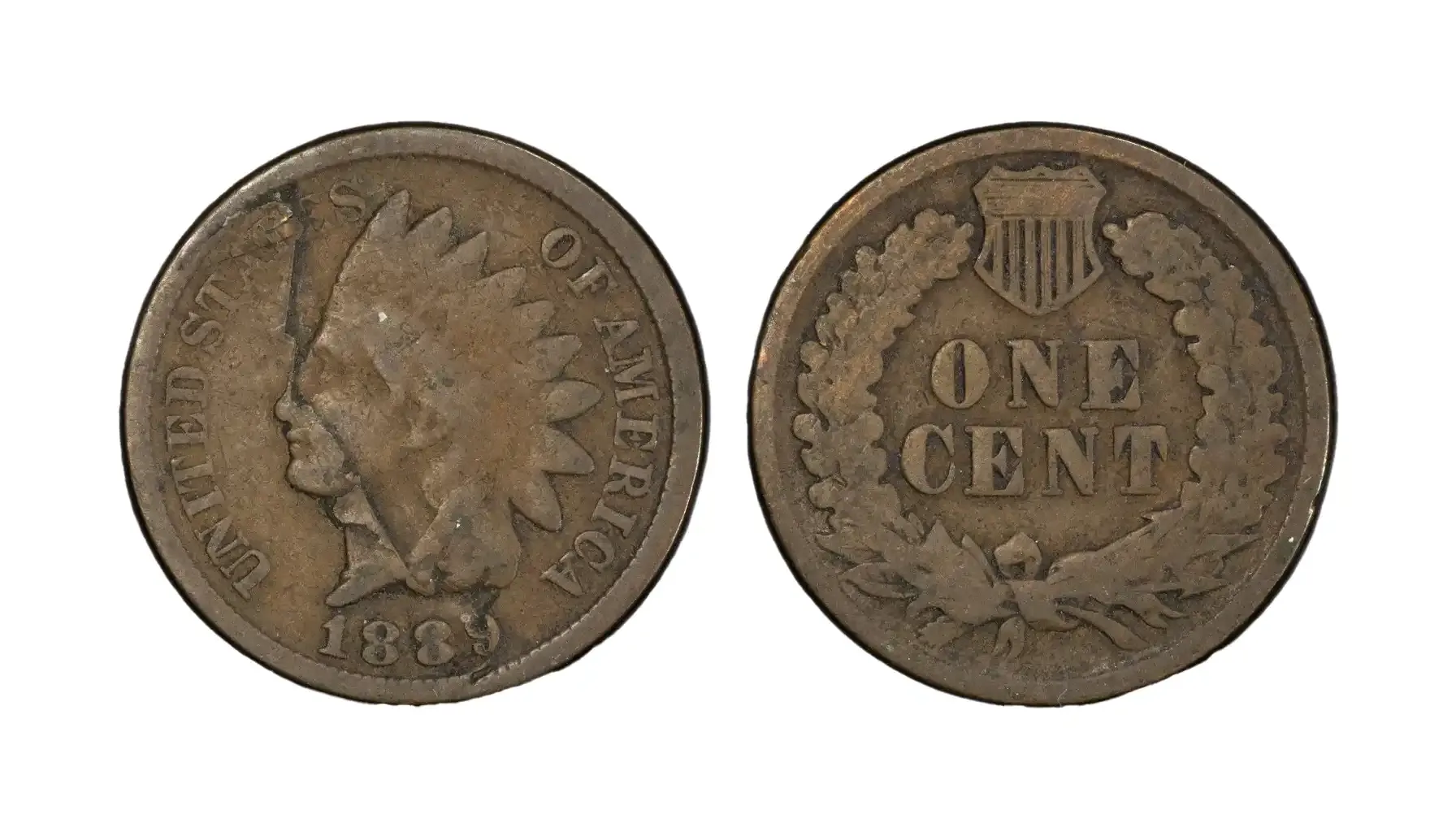
Estimated value: $72 (approx.)
Sometimes, errors may be mistaken for wear, but it is a genuine skill to distinguish one from the other. A peeling lamination error occurs when a thin layer of metal on the coin’s surface separates or flakes away due to impurities or bonding flaws in the planchet. When compared to wear by circulation or environmental damage, this defect originates before striking, during the planchet preparation stage.
On the 1889 cents, a lamination error appears as a raised blister, a missing patch of metal, or a curling strip that exposes the raw surface beneath. And the worth of such pieces is dozens/hundreds of times more than a decent ordinary coin.
Related article: US Penny Errors: Small Mistakes, Big Collectibles
How Much Is an 1889 Indian Head Penny Worth?
Although a cent may be small in size, its worth is far more immense than one could imagine. To be more precise, the Indian Head penny 1889 value depends on grade, color designation, and strike type. So, how much do these coins cost?
Values by Grade and Type
Grade | Circulation Strike | Proof Strike |
BN/RB/RD | BN/RB/RD | |
Good (G4) | $2 | – |
Very Good (VG8) | $3 | – |
Fine (F12) | $5 | – |
Very Fine (VF20) | $10 | – |
Extremely Fine (XF40) | $20 | – |
About Uncirculated (AU50) | $35 | – |
Mint State 60 (MS60) | $55 – $125 | – |
Mint State 63 (MS63) | $75 – $200 | – |
Mint State 65 (MS65) | $250 – $800+ | – |
Mint State 66 (MS66) | $450 – $1,000+ | – |
Proof 63 (PR63) | – | $200 – $350 |
Proof 64 (PR64) | – | $275 – $500 |
Proof 65 (PR65) | – | $400 – $900 |
Proof 66 (PR66) | – | $600 – $1,800 |
Proof 67 (PR67) | – | $900 – $3,000+ |
Cents are just 1/100 of the dollar, but within that fraction is the history of the entire era of coinage it was raised by. Explore and collect even the least noticeable pieces – they may tell more fascinating stories than we, humans, do.

 Facebook
  X (Twitter)
  Pinterest
  LinkedIn