Contents:
The Indian Head series was discontinued over 50 years ago, and yet it is still fondly remembered for many reasons. Some remember a peculiar design, others think of the metal composition that hasn’t been used for a long time now. The 1897 penny is a proud member of the series.
How much is a 1897 Indian head penny worth? Here we will also go over other valuable factors like common, rare, and error coins.
Today, you can identify coins with apps. It’s convenient and fast. You can focus on collecting and leave the boring parts to your smartphone.
About 1897 Penny
On the timeline, the 1897 cent was closer to the ultimate end of the Indian Head series, which would be replaced in 1909 with the Lincoln wheat penny.
The Indian cent was made for functionality foremost. When it was in its first years of production, the American Civil War was roaring. The Mint needed a way to make coins easier, with fewer hiccups, and a relatively manageable Indian Head design by James B. Longacre hit the right spot.
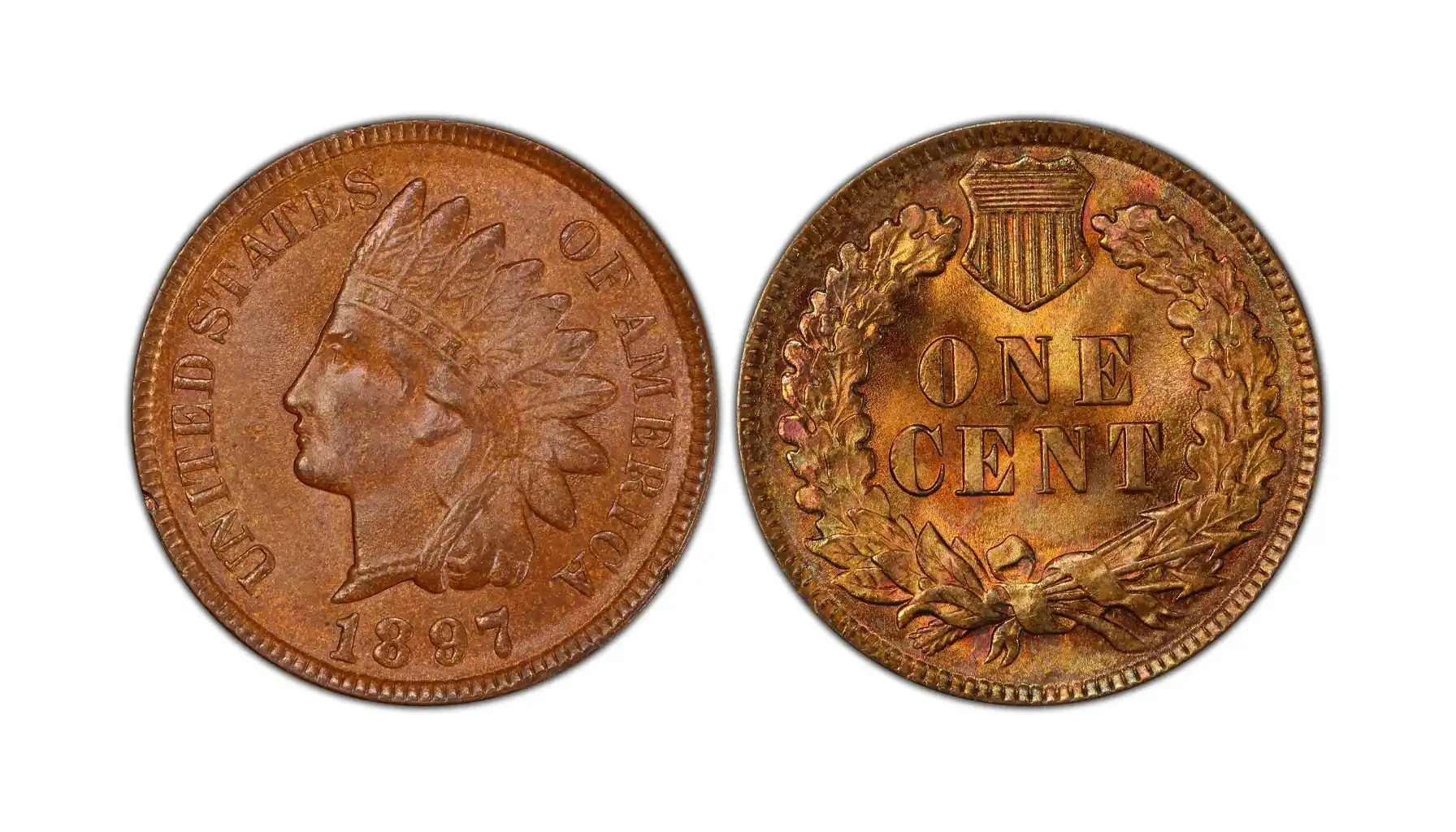
Obverse (Front): Features Lady Liberty wearing a Native American feathered headdress (not an actual Native American). The word "UNITED STATES OF AMERICA" surrounds Liberty. The date 1897 is below.
Reverse (Back): Shows a laurel wreath encircling the words "ONE CENT", tied at the bottom with a ribbon. A small shield is at the top. The shield was missing from the original designs.
1897 Indian Penny Overview | |
Country | United States |
Years of Minting | 1859–1909 |
Type: | Circulating |
Shape: | Round |
Composition and metal content | 95% copper, 5% tin, and zinc (bronze) |
Diameter | 19 mm. |
Weight | 3.11 g. |
Mint Facility | The Philadelphia US Mint |
Fun faсt: Did you know that Longacre took inspiration for the coin's design from his daughter? One day, she put on a feathered headdress and inspired him. In the US, children inspire coins, and in the UK, children's stories inspire coinage (Beatrix Potter 50p coins).
Mint Marks and Possible Varieties
This coin doesn't have mint marks, and the 1897 Indian head penny with no mint mark is the only variety. No “D” or “S” letters we’ve got used to seeing nowadays.
In fact, all Indian cents before the 1908 Indian Head cent were minted only in Philadelphia, so none carry a mintmark.
As for the Philadelphia mint, the facility produced 50,464,392 pieces, a relatively big number for that time.
What Makes a Penny Valuable
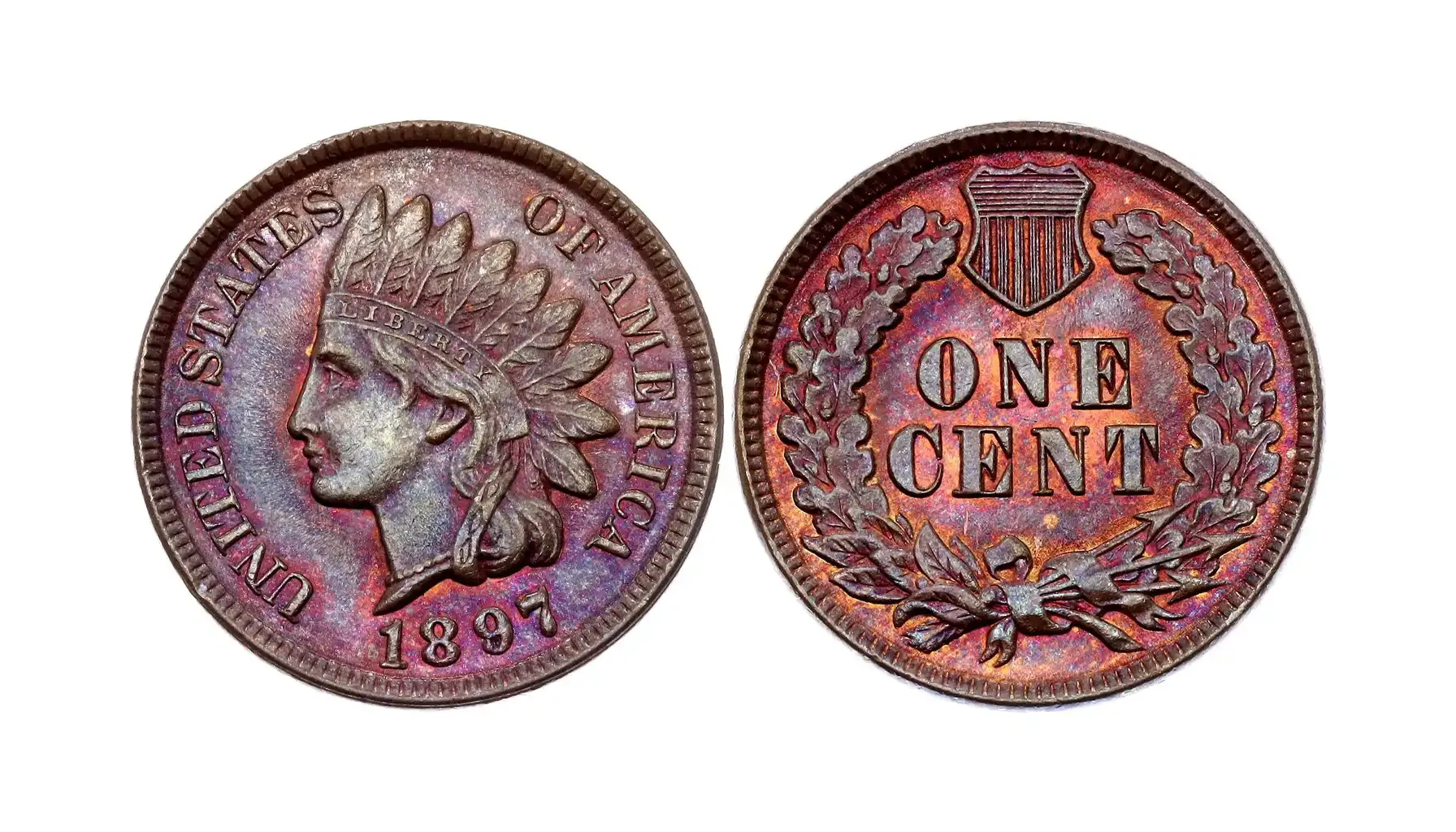
Now that we know the basics, we can start looking into the 1897 penny's worth. What could make this penny more valuable?
A few factors give a boost to the indian head penny 1897 value, so let’s look at them:
1. Condition (Grade):
Most 1897 cents are heavily worn due to a lower quality production and erosion, worth just a few dollars. In higher grades, values rise steeply.
All copper pieces have a secondary grading system according to their colour. Copper dimes and pennies all start with red coloration that turns brown with erosion. Collectors pay premiums for original color (bright red copper) and strong details.
2. Errors
Errors are relatively common for the old pieces, but still praise the value significantly.
Some errors, like the Repunched Date (RPD), where the digits were punched into the die more than once, are highly collectible.
3. Certification
A coin graded and encapsulated by PCGS or NGC (the top coin grading services) can sell for much more than a raw coin.
Collectors trust certified grades, especially for high-value red examples.
Grades and errors are especially important to the 1897 penny value, so let’s cover both of these factors.
1897 Penny Grading
Grading is something even the rookie collector should know.
Grading is the process of judging a coin’s condition and amount of wear. U.S. coins are graded on the Sheldon Scale, which runs from 1 (Poor) to 70 (Perfect Mint State).
Grade | Description |
Good (G-4) | The outline of Liberty’s head is visible, but the details are very worn. The word “LIBERTY” on the headband is not visible. |
Fine (F-12) | More detail shows. “LIBERTY” is partially visible on the headband. |
Very Fine (VF-20) | Full “LIBERTY” is readable, though weak. Feathers show some detail. |
Extremely Fine (EF-40) | “LIBERTY” is sharp, with most feather details visible, only light wear on the cheek and hair. |
About Uncirculated (AU-50) | Only slight wear on the highest points (cheek, hair). Nearly full detail. |
Mint State (MS60–MS65) | No wear at all, may have bag marks. MS65 has a sharp strike, great eye appeal, and is often certified. |
1897 Indian Head Penny Errors
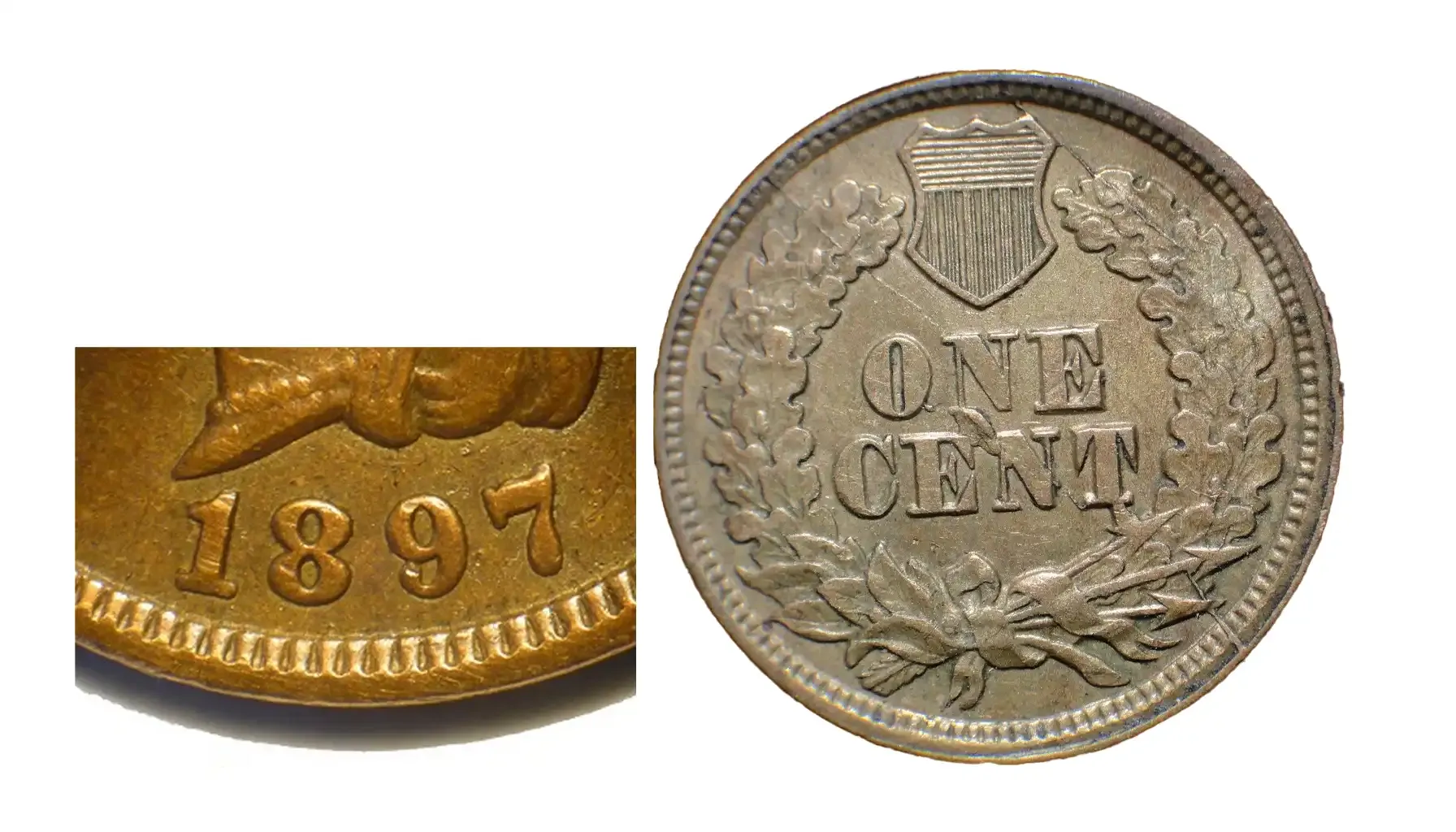
Like many old pieces, the Indian cent has a variety of errors:
1. Repunched Date (RPD):
One of the most collectible "errors" on 1897 cents.
It happens when the date is punched into the die more than once at slightly different angles/positions.
A shadow or extra “1” or “7” appears under/around the main digits. Doubling may also occur near the “8” or “9.”
Value can jump from $30 in low grade to $200+ in high grade.
2. Die Cracks, Cuds, & Breaks:
Caused by the die (the tool striking the coin) cracking or chipping.
Look for raised lines (die cracks) or blobs (cuds) on the coin.
Minor die cracks are neat but not rare; big cuds can bring $50–$200+.
3. Off-Center Strikes
Part of the design is missing because the coin wasn’t centered under the press.
The further off-center (while still showing the date), the more valuable.
4. Double Strikes
Coins are struck twice, creating overlapping or ghosted designs.
Value depends on severity, and could be $100+.
5. Clipped Planchets
A piece of the coin’s blank (planchet) was missing when struck. Looks like a curved "bite" taken out of the coin’s edge.
Small clips are worth $30+, and dramatic clips $60+.
6. Broadstrikes / Partial Collars
Happens when the collar (the part that shapes the rim) malfunctions.
Broadstruck coins are wider and flatter than normal.
Usually around $50, but could be worth more depending on the grading.
1897 Indian Head Penny Value Today
Now we can finally observe the values in their full glory. We present to you a table with the approximate numbers according to the grades and coloration.
Grade / Condition | Brown (BN) | Red-Brown (RB) | Red (RD) |
Good (G-4) | $2–3 | — | — |
Very Good (VG-8) | $4–5 | — | — |
Fine (F-12) | $6–8 | — | — |
Very Fine (VF-20) | $10–12 | — | — |
Extremely Fine (EF-40) | $15–20 | — | — |
About Unc. (AU-50) | $25–35 | — | — |
MS60 | $40–60 | $75–100 | $150+ |
MS63 | $75–100 | $150–200 | $250–300 |
MS65 | $200+ | $400–500 | $600–800 |
MS66 | Rare ($500+) | Scarce ($1,000+) | $2,000+ |
Red pennies are exceptionally scarce for old coins, and only a few dedicated collectors own them. But even if you have a brown old penny, it still offers a respectable value. Not the highest compared to most older pieces, but still a respectable one.
Coin ID Scanner
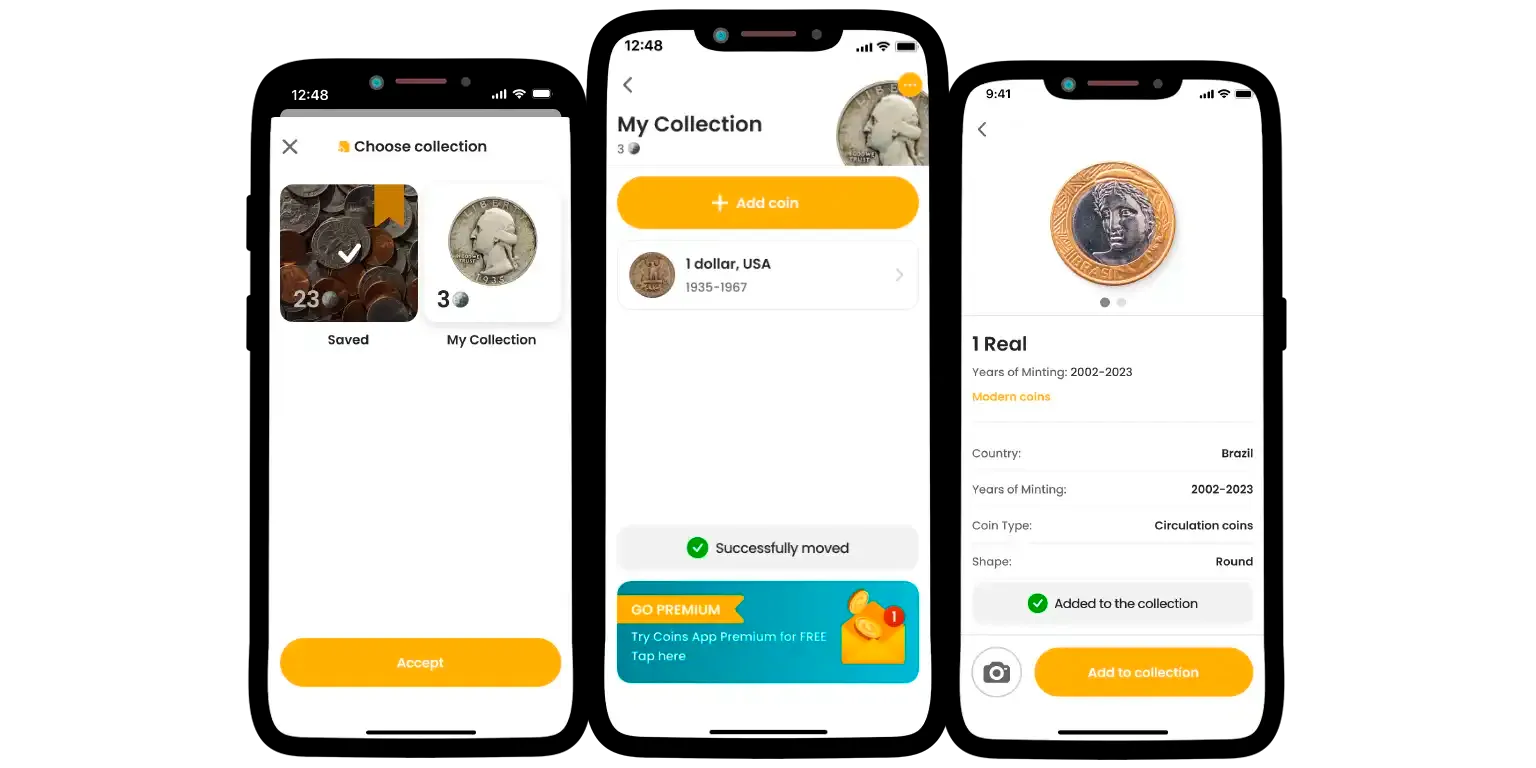
The Coin ID Scanner is a mobile app and a tool for beginner and experienced collectors. What is the main function of the app?
Coin ID Scanner lets you take or upload a photo of a coin, and then identifies the piece using the AI and a database of 150,000+ coins. After a quick scan, the app gives your coin an overview, with its country, denomination, year, estimated values, and more.
After you're done scanning, the app lets you save and manage your coin collection. This way, your bits can stay with you even after trading.
As a bonus, the app includes grading guides and numismatic news, which would be greatly appreciated by anyone beginning their collecting hobby.
Coin ID Scanner works on iPhone and Android. The best part? It is free to download.
FAQ
Which Penny Existed In 1897: Indian Head Wheat Penny?
We are talking about two different series. In 1897, the U.S. one-cent coin was the Indian Head cent. The first Lincoln cent was introduced in 1909, and the series is still going strong. If you have a 1897-dated penny, it’s definitely an Indian Head cent, not a Wheat penny.
What Is the 1897 Wheat Penny Value?
Unfortunately, there was never a 1897 Wheat penny. The Wheat cent design simply did not exist yet. An 1897 Indian Head penny in circulated grades is worth $2–20, and in uncirculated grades can range from $40 to $800+, depending on condition and color.
Is the 1897 Penny Value Today High?
Generally, this coin has an average value. At least when we compare it to old pieces. The 1897 cent is a common date because over 50 million were minted. However, it's worth more when it is uncirculated with full red color (worth hundreds to thousands) or has a rare error, like Repunched Date (RPD).
How Can I Know if My Coin Is Valuable?
If it seems that your collectible has sharp details, reddish colour, or has a sign of errors, it might be worth a lot. If you're unsure, you can get your coin certified by professionals. With such a “verdict”, you can even sell the coin for a higher price.

 Facebook
  X (Twitter)
  Pinterest
  LinkedIn