Contents:
Design-wise, Indian Head pennies are likely the most unique among circulated US series. Rarely does Lady Liberty switch up her looks, and even more rarely do indigenous motifs appear on the US coinage. No surprise that many people would like to own such a unique piece.
How much is a 1899 penny worth? This article will help you know the value, errors, and no mint mark variety of this piece.
Have you ever tried an AI Coin Identifier? It’s a great tool if you want to save time on recognizing coinage and instead want to spend this precious time on collecting.
About Indian Head Penny 1899
The Indian Head penny from 1899 is part of one of the most famous U.S. coin series, minted from 1859 to 1909. The series is not the longest-running, but it was full of changes and other events.
The piece was designed by James Barton Longacre, Chief Engraver of the U.S. Mint. He was influenced by neoclassical art and America’s growing interest in Native American culture during the 19th century.
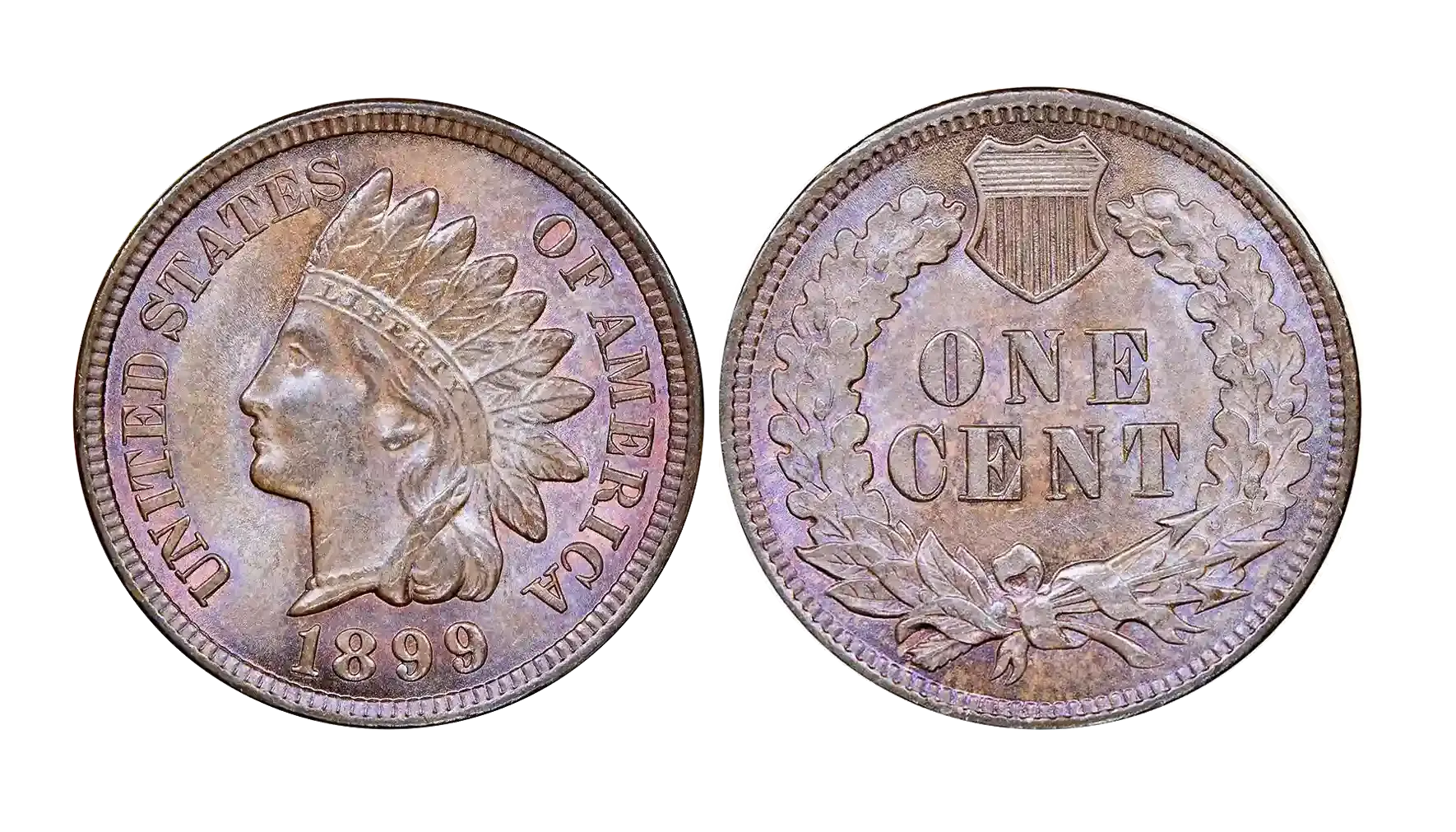
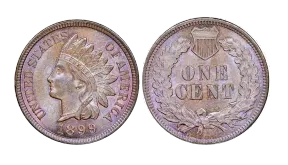
Obverse (Front): Lady Liberty wearing a feathered headdress (war bonnet) inscribed with the word “LIBERTY.” Around the edge lies an inscription “UNITED STATES OF AMERICA.” Below you’ll find the date 1899.
Reverse (Back): An oak wreath surrounds the central denomination “ONE CENT.” At the base of the wreath is a ribbon tying it together. At the top sits a federal shield, representing national unity and defense. This shield design was adopted starting in 1860 (earlier Indian Head cents, 1859, had a laurel wreath without the shield).
1899 Indian Penny Overview | |
Country | United States |
Years of Minting | 1859-1909 |
Type: | Circulating |
Shape: | Round |
Composition and metal content | 95% copper, 5% tin, and zinc (bronze) |
Diameter | 19 mm. |
Weight | 3.11 g. |
Mint Facility | The Philadelphia US Mint |
Fun fact: Allegedly, the headdress was inspired by Longacre’s daughter, Sarah, who supposedly once tried on a Native-style headdress during a studio visit. In the UK, they do coins inspired by children's book characters (Beatrix Potter 50p Coins), and in the S, there’s a coin inspired by a designer’s child.
Mint Varieties
Modern coins have it good. They have big mintage numbers, and they come from multiple facilities.
Indian Head Penny had no such luxury. Only one facility produced the coin, the Philadelphia Mint.
About 53,598,000 pieces were produced, which was a formidable number a century ago. For this reason, the coin is not considered exceptionally rare among the old pieces.

Although there was only one mint facility, there is one more variety: Proof Indian cent. While most coins circulated, proof cents were instead reserved only for trading and gifting.
Only 2,031 proofs were ever produced, making them valuable and rare. The proof value of 1899 Indian Head penny could be $1,000+, depending on how well they were preserved.
1899 Indian Head Penny Errors
Collectors love rare coins, and most rare pieces show some kind of error. In the past, more coins would come out of the presses with some kind of mishap, so we have a plethora of errors to choose from.
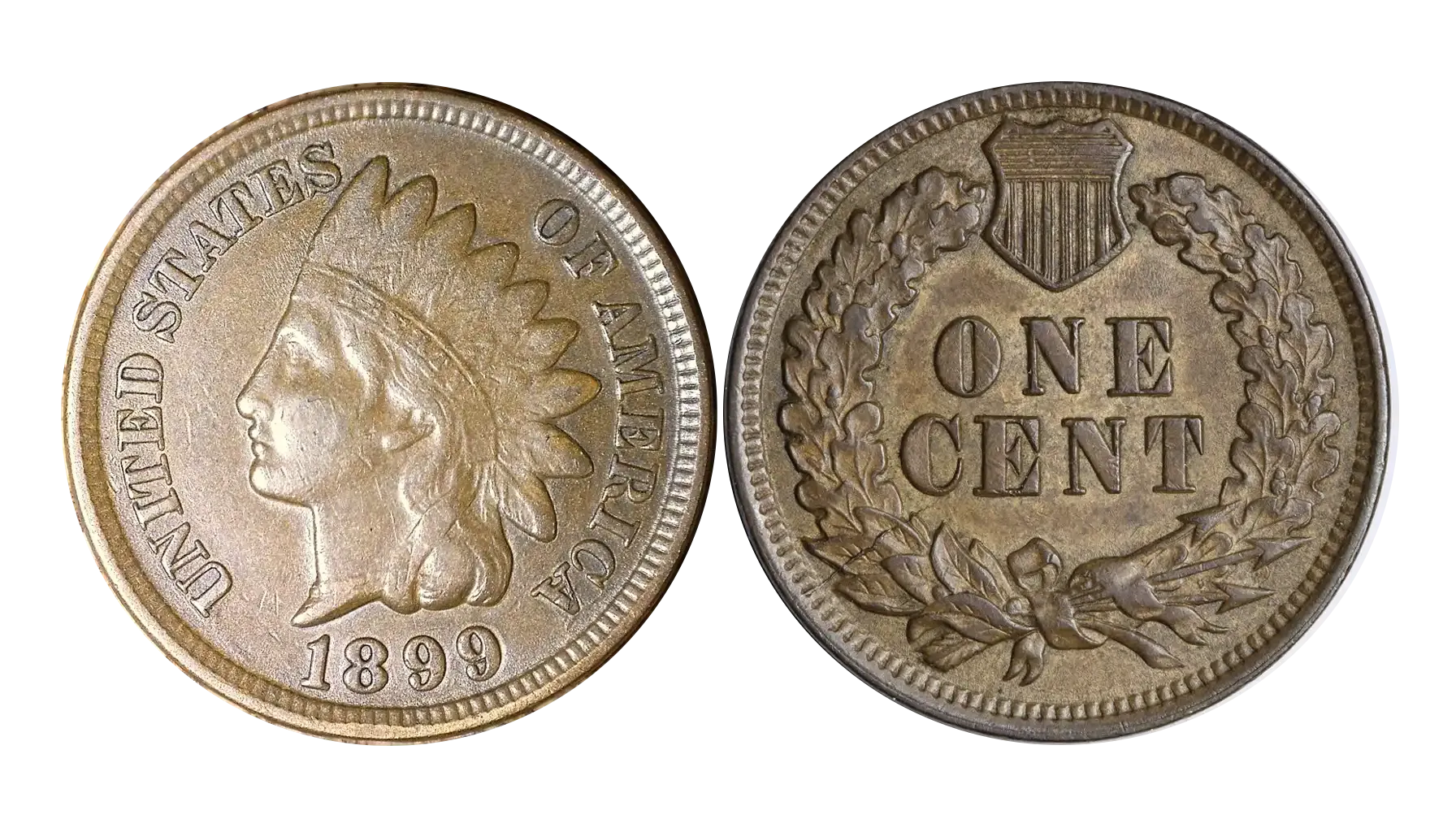
Try to inspect your collectible and look for errors like:
1. Repunched Date (RPD): The most notable variety for 1899. The digits of the date (especially the 9s) may show doubling or traces of being punched more than once. This happened because the date was hand-punched into the die, and sometimes it didn’t align perfectly.
2. Off-Center Strikes: Part of the design is missing because the coin was not centered properly when struck. Value depends on how dramatic the misalignment is (5% off-center might be minor, 50% is very collectible).
3. Die Cracks / Cuds: Raised lines or blobs where the die cracked or broke during use. Larger cuds (where part of the die broke away) are much scarcer.
4. Clipped Planchets: A section of the coin’s edge is missing because the blank (planchet) was cut incorrectly. Creates a “bite” taken out of the coin.
5. Double Strikes / Brockage: Very rare, but occasionally coins were struck more than once or struck against another coin, producing dramatic errors. Very valuable.
Good luck finding coins with errors! Perhaps you are one of the very few people owning an error variety.
1899 Indian Head Wheat Penny Value
Two important factors influence the value of copper coins: their grading (state) and their colour, though both factors are usually working in tandem, i.e., a high-grade coin is usually red.
Grading refers to how well preserved and defined the coin is. Most pieces have great details when they are minted, but due to erosion, they often lose their luster and details. If the coin was preserved excellently, the details stay, and due to eye appeal and rarity, it gets a high value.
The colors are similar. Copper pieces start reddish, but with rough handling, they lose their colour. Collectors want bright red pieces.
Grade / Condition | Brown (BN) | Red-Brown (RB) | Full Red (RD) |
Good (G-4) | $2 – $3 | – | – |
Very Good (VG-8) | $3 – $5 | – | – |
Fine (F-12) | $5 – $8 | – | – |
Very Fine (VF-20) | $10 – $15 | – | – |
Extremely Fine (XF-40) | $20 – $30 | – | – |
About Uncirculated (AU-50) | $35 – $50 | – | – |
Mint State 60 (MS-60) | $50 – $70 | $100+ | $200+ |
Mint State 63 (MS-63) | $100 – $150 | $175 – $225 | $300 – $400 |
Mint State 65 (MS-65) | $250+ | $400+ | $500 – $800+ |
All in all, the 1899 penny value is big and small at the same time. It’s significant when compared to its face value, but not exceptional when compared to other old coins, such as the 1890 Indian Head penny.
Bonus: Grading Guide
Now you know that grading is very beneficial to any coin. But who and how do you determine the guide?
We can go about it two ways. Firstly, you can try to determine the grade yourself. You can follow this chart and assess your coin via it:
Grade | What to Look For |
Good (G-4) | Very worn. Liberty’s portrait is flat, no “LIBERTY” visible on headband, wreath, and feathers, mostly smooth outlines. |
Very Good (VG-8) | Heavy wear. Some feather outlines are visible, parts of the wreath clearer, but “LIBERTY” is completely gone. |
Fine (F-12) | Moderate wear. Portrait sharper, wreath details more distinct, a few faint letters of “LIBERTY” may show. |
Very Fine (VF-20) | Moderate wear. All letters of “LIBERTY” are visible (though weak), most feather lines and wreath details show. |
Extremely Fine (XF-40) | Light wear. LIBERTY sharp and clear, feather tips slightly worn, wreath and shield well-defined. |
About Uncirculated (AU-50) | Nearly full detail. Only the highest points (cheek, feather tips) show slight wear; much original luster remains. |
Mint State (MS-60 to MS-65+) | No wear at all. Sharp strike, original mint luster intact. Color (Brown, Red-Brown, or Red) determines value — full Red is most valuable. |
Now, does your collectible seem to be a high-grade piece? Or perhaps you’re confused and want to be sure? Then we recommend the second option: getting it officially graded!
NGC grading service and PGC grading can help determine the state of your coin. Both platforms have proven themselves official and reliable. The best part of grading, perhaps, is that with the PGC/NGC stamp of approval, you can confidently sell your coin, and authenticity lets you raise the 1899 Indian Head penny worth a bit.
Now, there’s one great help for a collector.
Coin ID Scanner
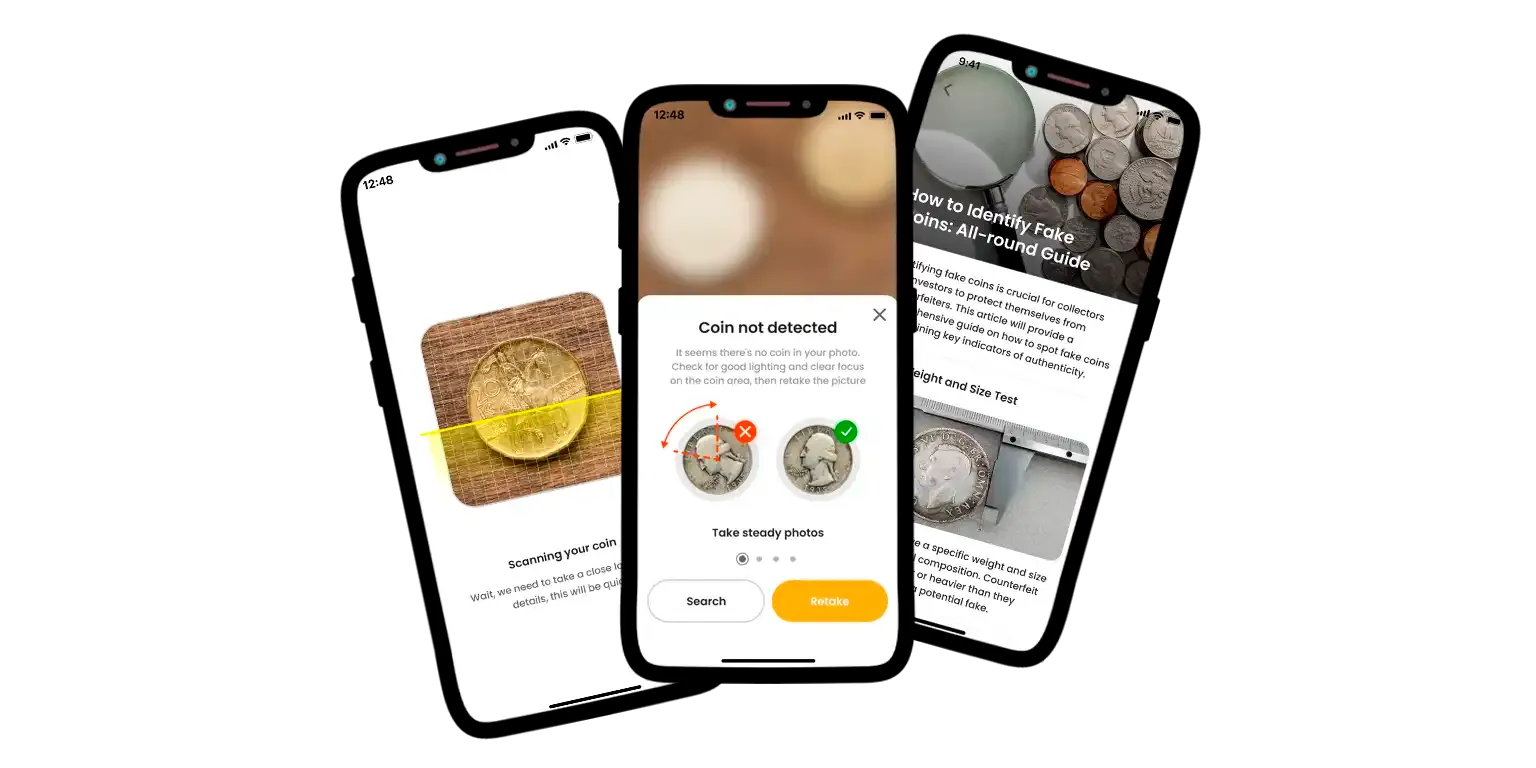
The Coin Identifier (Coin ID Scanner) app is designed to help collectors quickly identify coins using image recognition.
You take or upload a photo of your coin, and the app attempts to match it to a large database (over 150,000 coins). Once matched, it can provide details such as the country, denomination, composition, rarity, and estimated value.
The app also has features like coin collection management (saving your coins into “My Collection”), grading guides, and access to coin news and articles, from coin overviews to grading guides and more.
The app is free, available on iOS and Android devices.
FAQ
What Is the 1899 Wheat Penny Value?
There is no 1899 Wheat Penn. The Wheat cent (also called the Lincoln Wheat penny) was first issued in 1909, the centennial of Abraham Lincoln’s birth, after the Indian series. In 1899, the U.S. was still producing Indian Head cents, so if you see a “1899 wheat penny,” it’s likely a mix-up.
Is the Indian Head Penny Silver?
Unfortunately, this penny was never silver. In the early years (1859–1864), it had a copper-nickel alloy (88% copper, 12% nickel), giving it a lighter, whitish look. In later years (1864–1909), including 1899, it had a bronze alloy (95% copper, 5% tin, and zinc). So the 1899 Indian Head penny is 95% copper, not silver.
What Penny Came Before the Indian Head?
The last type before the Indian Head was the Flying Eagle Cent (1856–1858), which was a small-sized cent and a direct predecessor. Unfortunately, due to the complications with the design, Flying Eagle was quickly discontinued and replaced with the Indian penny.

 Facebook
  X (Twitter)
  Pinterest
  LinkedIn