Contents:
1864 seems like such a faraway date, but many "artifacts" carried over to our time, including coins. Today, we will cover one of the most unique penny series, the Indian Head cent.
Would you like to know how much is a 1864 Indian head penny worth? We will give this coin an overview, covering its rare “L” variety, possible errors, and mintages.
If you have such a century-old piece, you will need a free old coin value checker. Such apps can analyze the coin, tell its value, denomination, and much more.
1864 Penny Design and Overview
This coin is a member of the Indian Head series that lasted for 50 years. It was made soon after the Flying Eagle cent (most popular among them was the 1857 cent), which was shortly discontinued due to technical difficulties.
As for the design, the Indian Head cent was designed by James Barton Longacre (Chief Engraver of the U.S. Mint). His goal was simplicity and functionality, but even in these constraints, he perhaps made one of the most unique-looking penny designs.
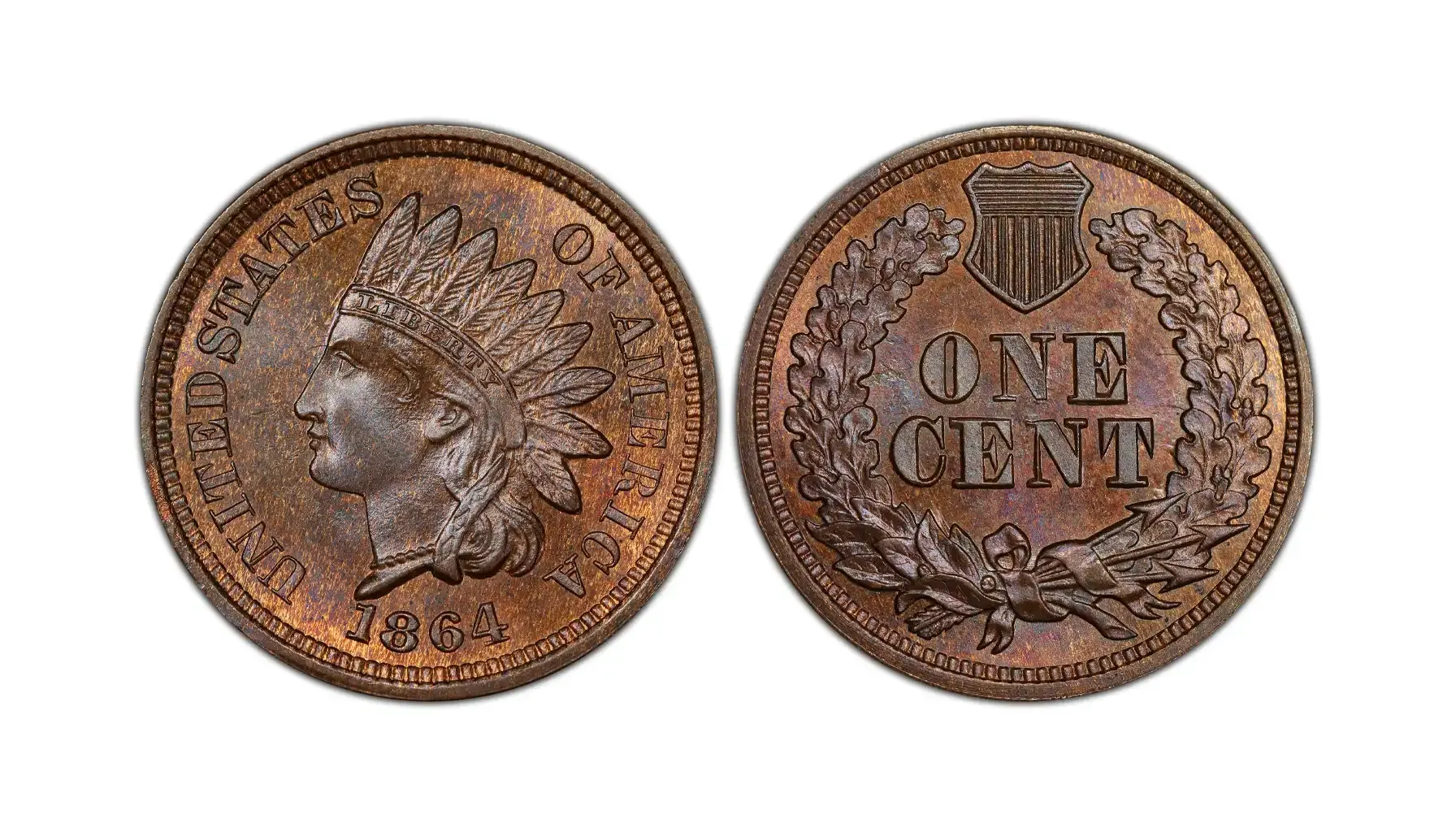
Obverse (Front): Lady Liberty is depicted wearing a Native American feather headdress. The word “UNITED STATES OF AMERICA” encircles Liberty. The date 1864 is at the bottom. Please note that this is not meant to represent a Native American person. Instead, it’s Liberty in a feathered war bonnet.
Reverse (Back): An oak wreath wrapping around the denomination “ONE CENT”. At the very top of the wreath is a small Union Shield (added at the start of the Civil War). The shield symbolized strength and unity of the states, which was very relevant during the Civil War era (1861–1865).
The 1864 Indian Head Penny is a fascinating coin, mainly because it represents an important transition in U.S. cent history. Before, copper was widely used for many coins and pennies. From 1864, they started adding zinc, making it now bronze.
1864 Indian Penny Overview | |
Country | United States |
Years of Minting | 1859 to 1909 |
Type: | Circulating |
Shape: | Round |
Composition and metal content |
|
Diameter | 19.05 mm |
Weight | Copper-Nickel: 4.67 grams. Bronze: 3.11 grams |
Mint Facilities | The Philadelphia US Mint |
Fun faсt: Pennies are not the only ones transitioning. Later down the line, silver dimes, too, transitioned into Copper dimes.
Varieties and Mint Marks
According to mint marks, this penny doesn't offer much variety. As was common for old bits, only the Philadelphia Mint made them, and they gave no mint marks. About 13,740,000 bits came out from Philadelphia presses.
And yet, there are more varieties to this coin.
L Penny
As you remember, James Barton Longacre designed the piece. Often, designers would leave their initials on the coin's surface. A famous 1909 Lincoln penny has VDB letters, referring to its designer, Victor David Brenner.
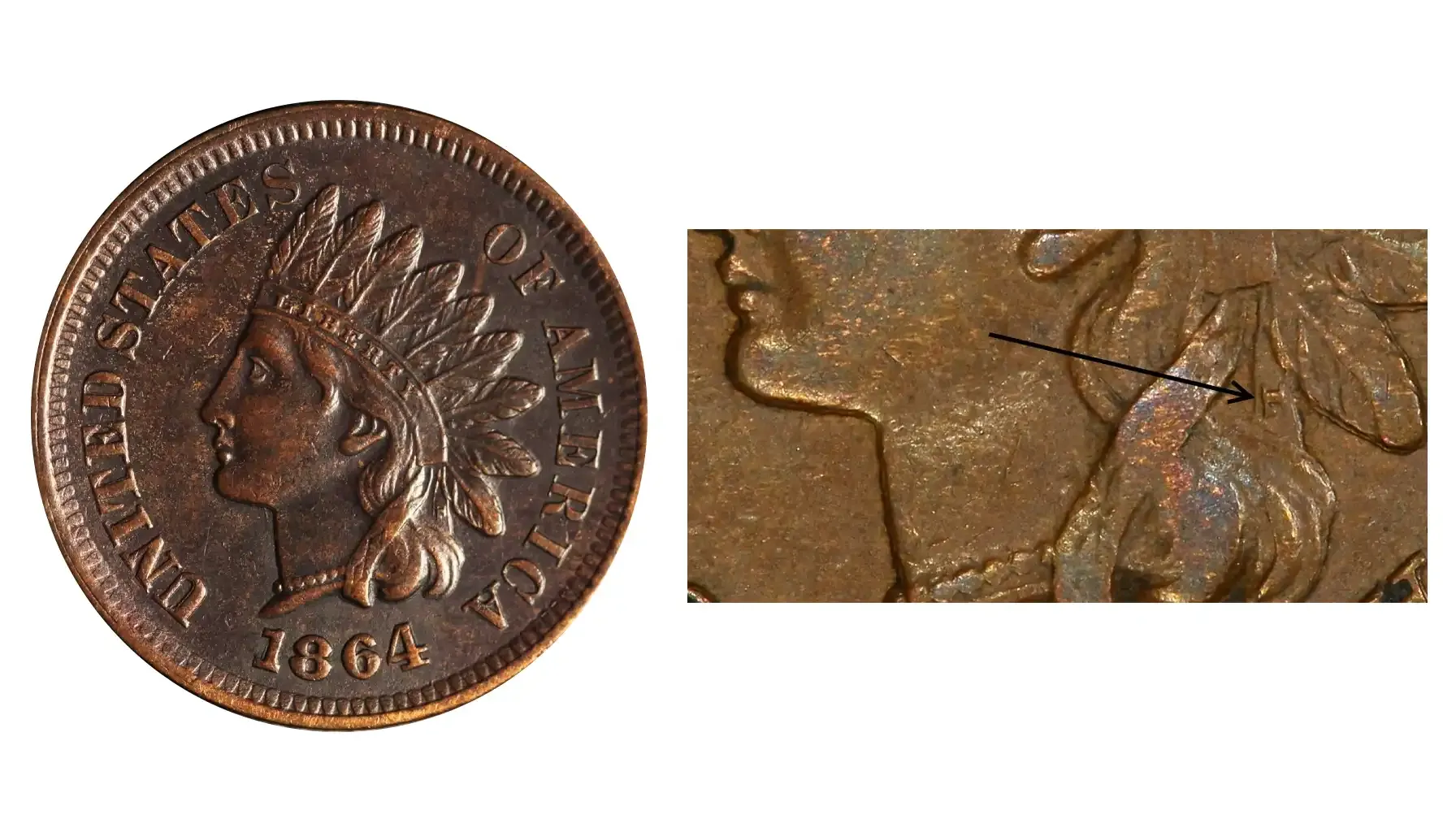
Longacre also left his “L” initial. It should have been on the obverse, on the small ribbon close to the lowest part. Unfortunately, the imperfect minting technique and erosion erased most of the “L” letters. It is also rotated.
If you find an “L” on the obverse, then congratulations! You have an 1864 L Indian head penny. While this coin is not exceptionally rare, it is definitely a great investment.
Bronze VS Copper Pennies
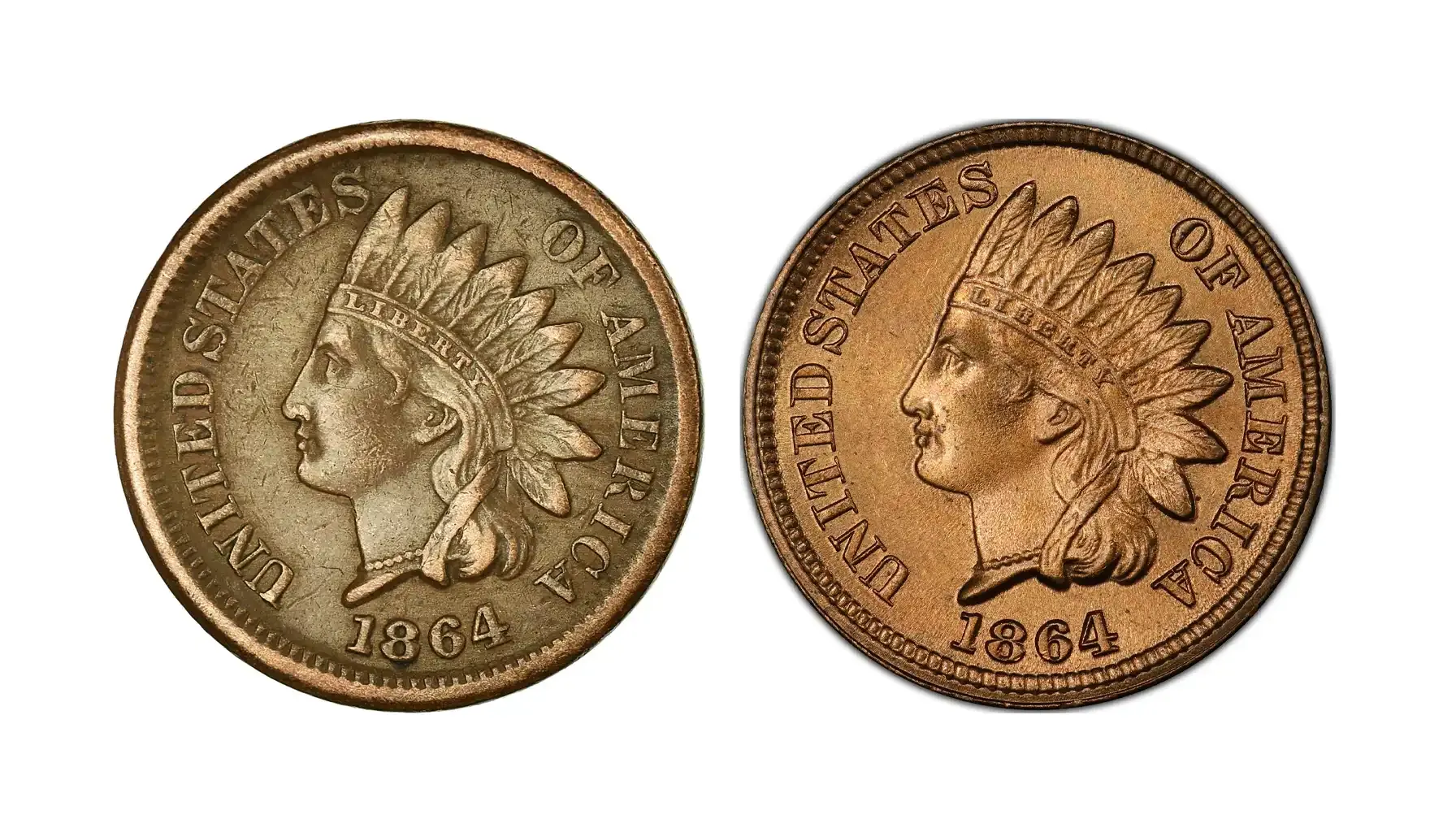
It was a transitional coin. Initially, they were minted in an old copper-nickel alloy, but about half a year into production, they switched to bronze.
The old copper-nickel composition is rarer to find, and therefore slightly more valuable. How do you discern one from another?
Trait | Copper-Nickel (CN) | Bronze |
Composition | 88% copper, 12% nickel | 95% copper, 5% tin & zinc |
Weight | 4.67 g (slightly heavier) | 3.11 g |
Thickness | Thicker, “chunkier” feel | Thinner, more like later pennies |
Color | Lighter. Pale, whitish-brown or grayish tone (sometimes golden with wear) | Reddish-brown to chocolate brown (can show red luster if uncirculated) |
Strike Quality | Often, a weaker detail (harder metal, difficult to strike fully) | Sharper details (softer alloy took impressions better) |
Varieties | Doesn’t have an “L” | Some may have an “L” |
1864 Penny Errors
Don’t forget the time of this penny, as it was minted during the Civil War. Because the Civil War years saw heavy coinage demand, quality control wasn’t always perfect.
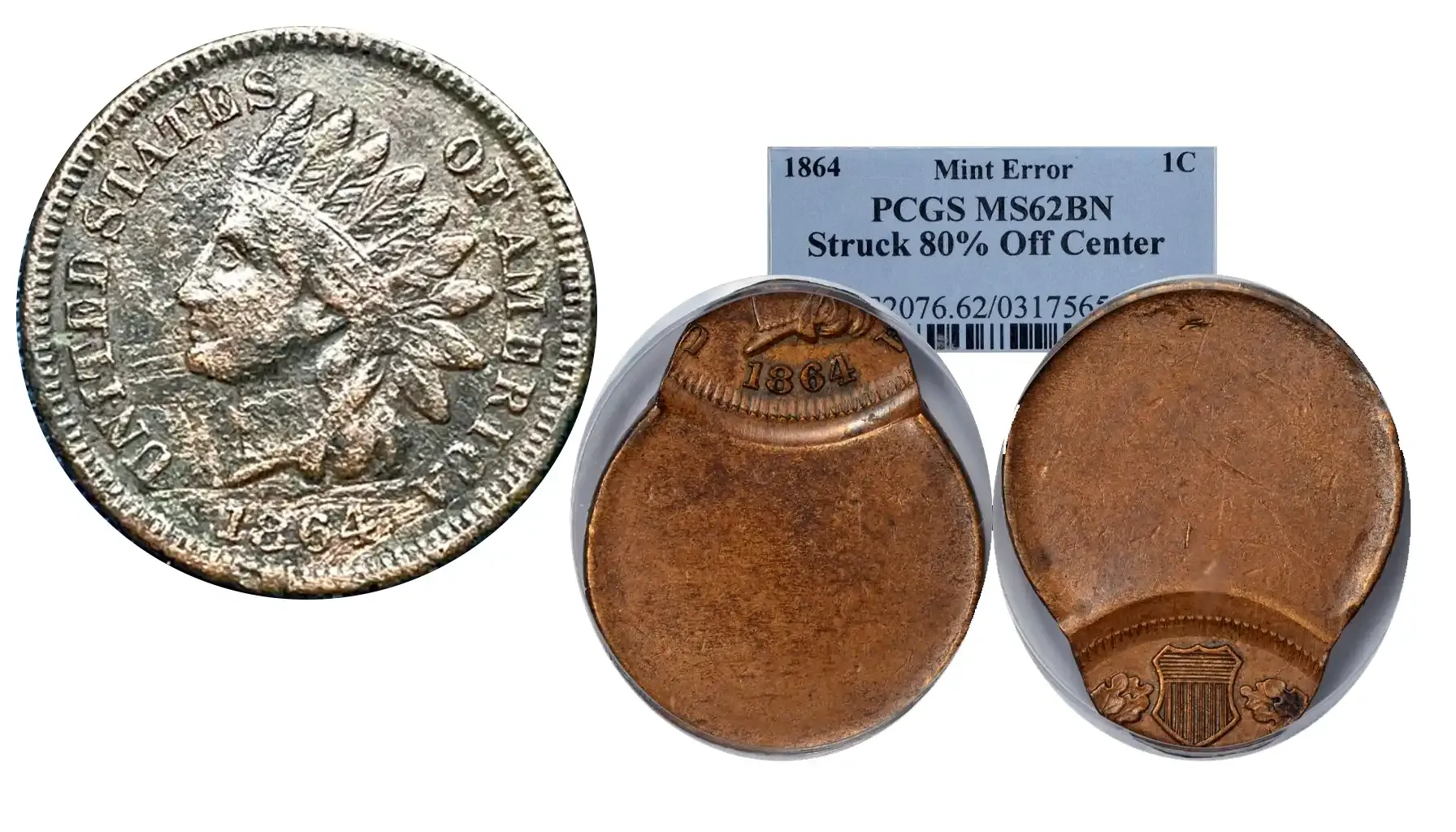
Some of the most encountered 1864 indian head penny errors:
Off-Center Strikes
Part of the design is missing, and instead, you’ll see a blank planchette.
Value depends on how far off-center and whether the date is visible.
Die Cracks & Cuda
The die was cracked or broken, and as a result, blobs and cracks appeared on the coin.
Cracks and cuds were common in this period, but collectors enjoy dramatic ones.
Double Strikes / Multiple Strikes
Coins are struck more than once, sometimes with visible overlapping images.
Extremely valuable. Many pieces in the top 100 pennies worth money have double strikes.
Clipped Planchets
Crescent-shaped clips where the blank was mispunched from the metal sheet.
Rotated Dies
The reverse is misaligned when you flip the coin.
Encountered more often with the old pieces.
Struck Through
Foreign material (grease, cloth, wire, wood fragment, etc.) between die and planchet, leaving impressions or weak spots.
If your coin has these errors, it’s good news. Collectors may pay hundreds of dollars sometimes for a dramatic, eye-appealing error.
Penny Grading
Errors are an excellent value booster, but unfortunately, they are an exception to the rules. We would not be able to make a value table according to the errors. Instead, usually when numismatists create value charts, they turn to grades.
Coin grading reflects the quality of the pieces and how well the details were preserved. The grading scale commonly used is the Sheldon Scale (1–70), where 1 is barely identifiable and 70 is a flawless mint state coin.
Grade | Description (Key Features) |
Good (G-4) | Date readable, Liberty head worn flat, outline visible, but no details. The reverse wreath is faint, and the shield is nearly gone. |
Very Good (VG-8) | Headband visible, but LIBERTY not readable. Feathers only have an outline. The wreath is clearer but worn. |
Fine (F-12 to F-15) | 3–4 letters of LIBERTY visible. Feather details are visible but worn. The wreath and shield are moderately defined. |
Very Fine (VF-20 to VF-30) | LIBERTY is fully visible. Wreath details on the reverse are sharp. |
Extremely Fine (EF/XF-40 to XF-45) | Bold LIBERTY, hair strands and feather tips sharp. The shield and wreath are well-detailed. Light wear only on the highest points. |
About Uncirculated (AU-50 to AU-58) | All details sharp, minor rub on cheek, curls, or feather tips.Preserves a bit of luster. |
Mint State (MS-60) | No wear, but has dull luster, and some marks. |
Mint State (MS-63 “Choice”) | No wear. Good strike with moderate luster and minor marks. |
Mint State (MS-65 “Gem”) | Strong strike, full luster, very few marks, excellent eye appeal. |
Mint State (MS-67–70 “Superb”) | Nearly perfect coin. The sharpest strike with clear luster. |
If grading seems confusing to you, then we suggest getting your coin graded by NGC or PGC.
1864 Penny Value
Now, with all we know, we can make a table and understand the prices. How much is a 1864 penny worth? This table below can tell you:
Variety | Grade (Good G-4) | Fine (F-12) | Extremely Fine (XF-40) | About Uncirculated (AU-50) | Mint State (MS-63) | Mint State Gem (MS-65) |
Copper-Nickel (88% Cu, 12% Ni) | $10 | $20 | $50 | $150 | $400+ | $1,500+ |
Bronze (No “L”) | $20 | $35 | $65 | $100 | $240+ | $425 |
Bronze (“L” on Ribbon) | $65 | $160 | $280 | $340 | $750+ | $2,000+ |
The 1864 L Indian Head penny value is the highest among all varieties. Bronze without L is the lowest in value, although it can overtake copper-nickel composition on lower grades.
All in all, the Indian head penny 1864 is an excellent asset that would make any collector proud.
Coin ID Scanner
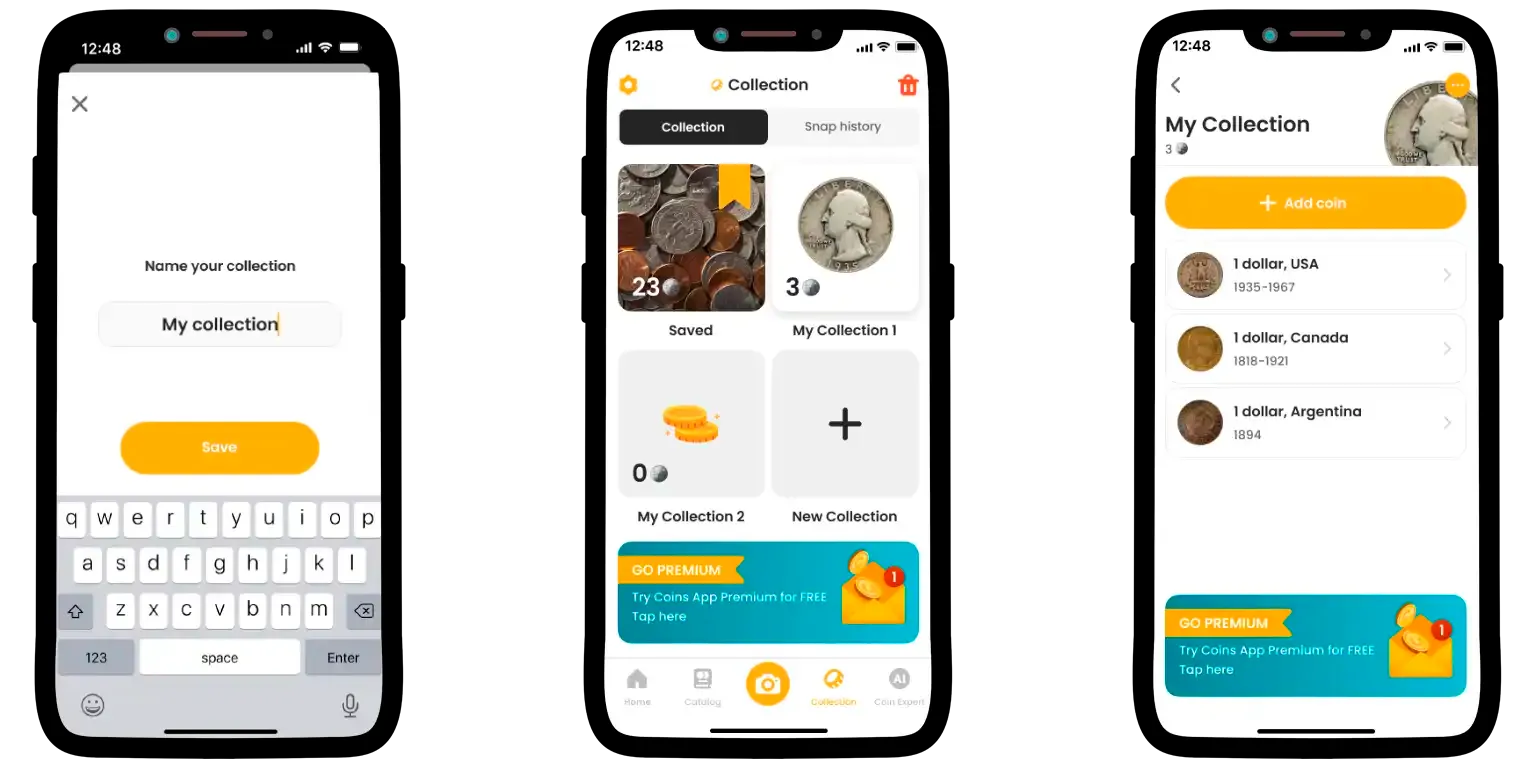
Coin ID Scanner is a free mobile app designed to help users identify coins from around the world.
With AI and an impressive 150,000+ coins database, this app can recognize most bits and then tell you about your collectible’s country of origin, denomination, year of minting, composition, and historical background.
The app has other neat side functions, like Collection Management, where you can organize and track your coin collection within the app. And if you want to follow numismatic trends, you can read the Numismatic News in the app. This way, you can stay updated with the latest trends and news in the world of coin collecting.
You can download Coin ID Scanner today on iPhone or Android devices.
FAQ
Is a 1864 Indian Head Penny Copper or Bronze?
It is both. Early 1864 coins are copper-nickel (88% copper, 12% nickel). Mid-to-late 1864 coins are bronze (95% copper, 5% tin & zinc. The bronze coins are usually thinner and redder, while the copper-nickel ones are thicker and paler.
Does the 1864 Cent Have Mint Marks?
No. All 1864 Indian Head cents were struck at the Philadelphia Mint, which did not use a mint mark at that time.
Where Is the L on the 1864 Cent?
You can find the “L” on Liberty’s ribbon, behind her neck, at the base of the headdress. The letter is very small, so you usually need magnification to see it clearly. The “L” is the designer James Barton Longacre’s initials.

 Facebook
  X (Twitter)
  Pinterest
  LinkedIn