Contents:
The Third Reich left behind a record of cruelty and destruction that still defines how we speak about the period. The whole world was pushed into the deadliest war in human history. Everything was controlled, monitored, and reshaped by the regime. Bombings silenced entire neighborhoods, people fled across borders, and millions never returned home. Even everyday objects from that time feel heavy because they come from a world built on violence and fear.
Among those objects are the coins struck during these years. They are small indeed, but they reflect the era with brutal honesty: early pieces still carry the silver of the pre-war economy, but later wartime issues are thin, dull zinc and aluminum (no gold Nazi coin specimens exist) – they show how quickly resources were drained by total war.
So, how can we identify coins of this type?
Overview of Nazi Germany Coins (1933–1945)
Early in the 1930s, the coinage still followed the Weimar system. Silver pieces were common, and metals such as nickel and copper-nickel were still available. Once the regime began rearmament, the mint had to adjust. Nickel and copper were redirected to industry, silver left circulation, and lighter metals took over. By the early 1940s, most specimens were made from aluminum or zinc.
Minting continued at the long-established German mints. The familiar letters A, D, E, F, G, and J remained in use. These marks help identify where a piece was made and show how production changed from year to year as the war progressed. Some dates had large outputs, while others were struck in much smaller numbers.
Nazi coin pieces remain collected today because of historical and other factors.
“One can gain some appreciation of what life under Nazi rule was like, simply by comparing Nazi-era coins to both pre- and post-Nazi German coins. Weimar Republic silver coins have this inscription on their edge: ‘Einigkeit und Recht und Freiheit’, translated ‘Unity and Justice and Freedom’. The Nazis replaced this with a new inscription: ‘Gemeinnutz geht vor Eigennutz’, or ‘Public-Interest comes before Self-Interest’”.
– User Ssuperdave
“Nazi Germany Coinage – Historical Perspective”, Coin Community Forum
Denominations and Designs of Nazi Coins
Older artistic styles and regional symbols disappeared. They were replaced by a single state emblem: the eagle above the swastika. This design was used across all denominations, from small pfennigs to the larger Reichsmark coins. Portraits never appeared on circulating money. 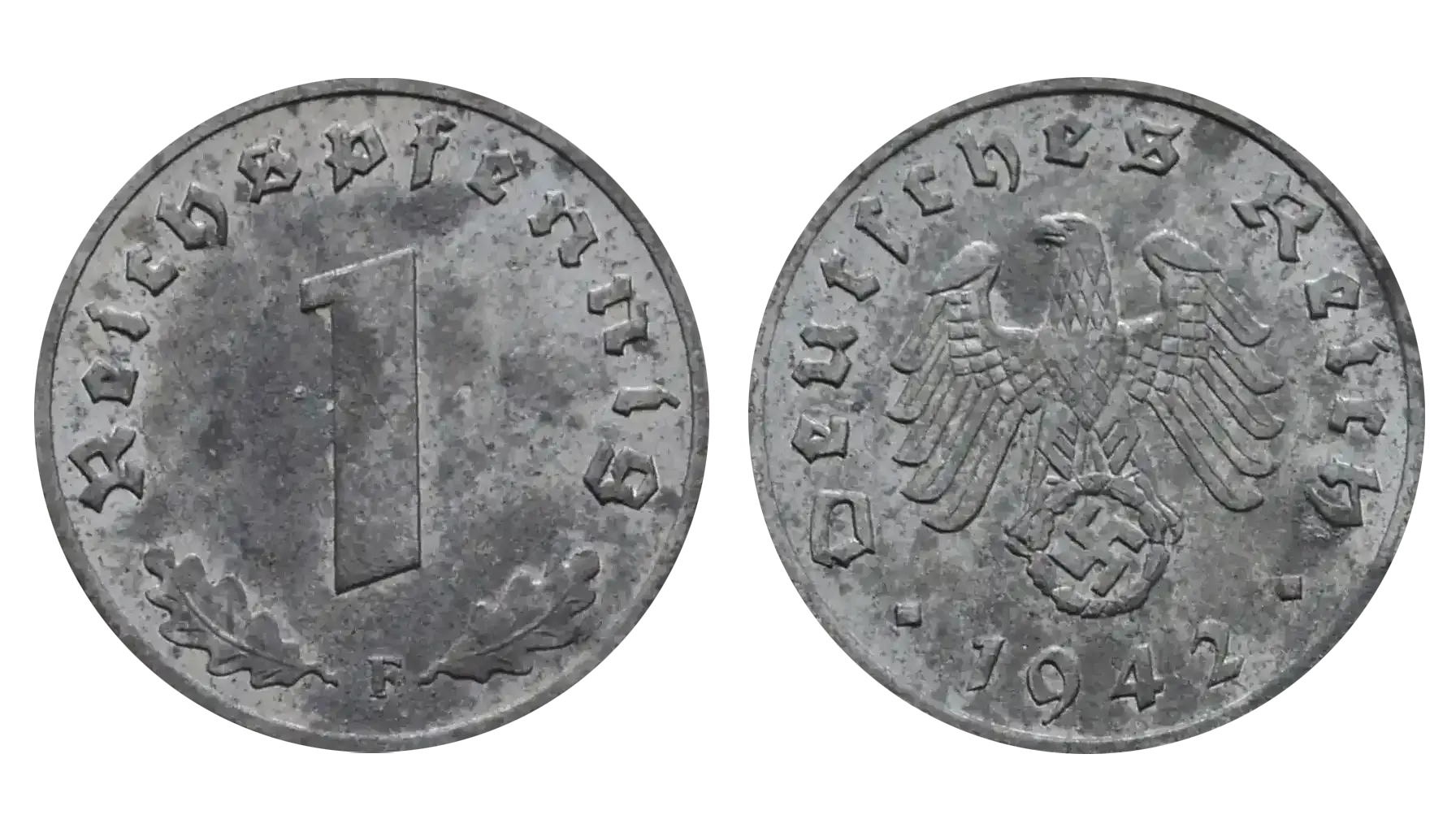
The regime did not officially issue Nazi gold coins during its rule. However, the term Nazi gold can refer to bars, bullion, seized assets looted or accumulated by Nazi Germany — e.g. from occupied countries, central bank reserves, or victims of persecution. That gold was stored, melted, or shipped — but not used to mint official money pieces. So, if you’ve found a Nazi gold coin, we recommend that you send it to professionals to be checked.
Denomination | Years Issued | Composition | Design Features |
1 Reichspfennig | 1940–1945 | Zinc | Obverse: Eagle above swastika, “Deutsches Reich” and year; Reverse: Denomination with two oak leaves and mint mark. |
5 Reichspfennig | 1940–1944 | Zinc | Obverse: Eagle with swastika; Reverse: “5 Reichspfennig” with oak leaves and mint mark. |
10 Reichspfennig | 1940–1945 | Zinc | Obverse: Eagle with swastika; Reverse: “10 Reichspfennig,” oak leaves, and mint mark. |
50 Reichspfennig | 1939–1944 | Aluminum | Obverse: Eagle and swastika; Reverse: Denomination with oak leaves and mint mark. |
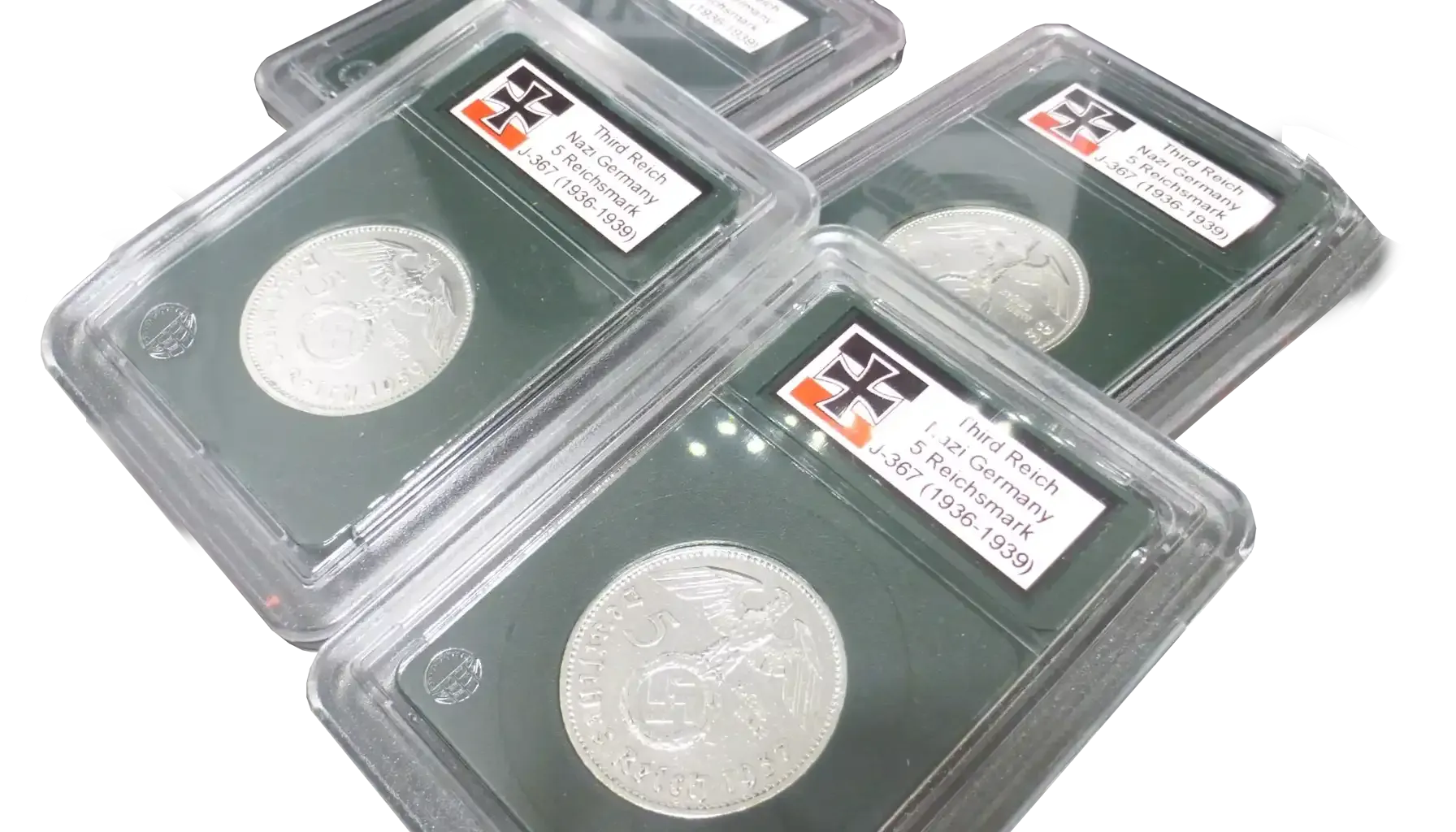
1 Reichsmark | 1933–1939 | 50% silver | Obverse: Eagle and swastika (later issues); Reverse: Denomination and wreath design. |
2 Reichsmark | 1933–1939 | 62.5% Ag (Nazi silver coin commemoratives) | Obverse: Designs vary by issue. Common types feature commemorative portraits (e.g., Luther), Reverse: Usually eagle, swastika, and denomination. |
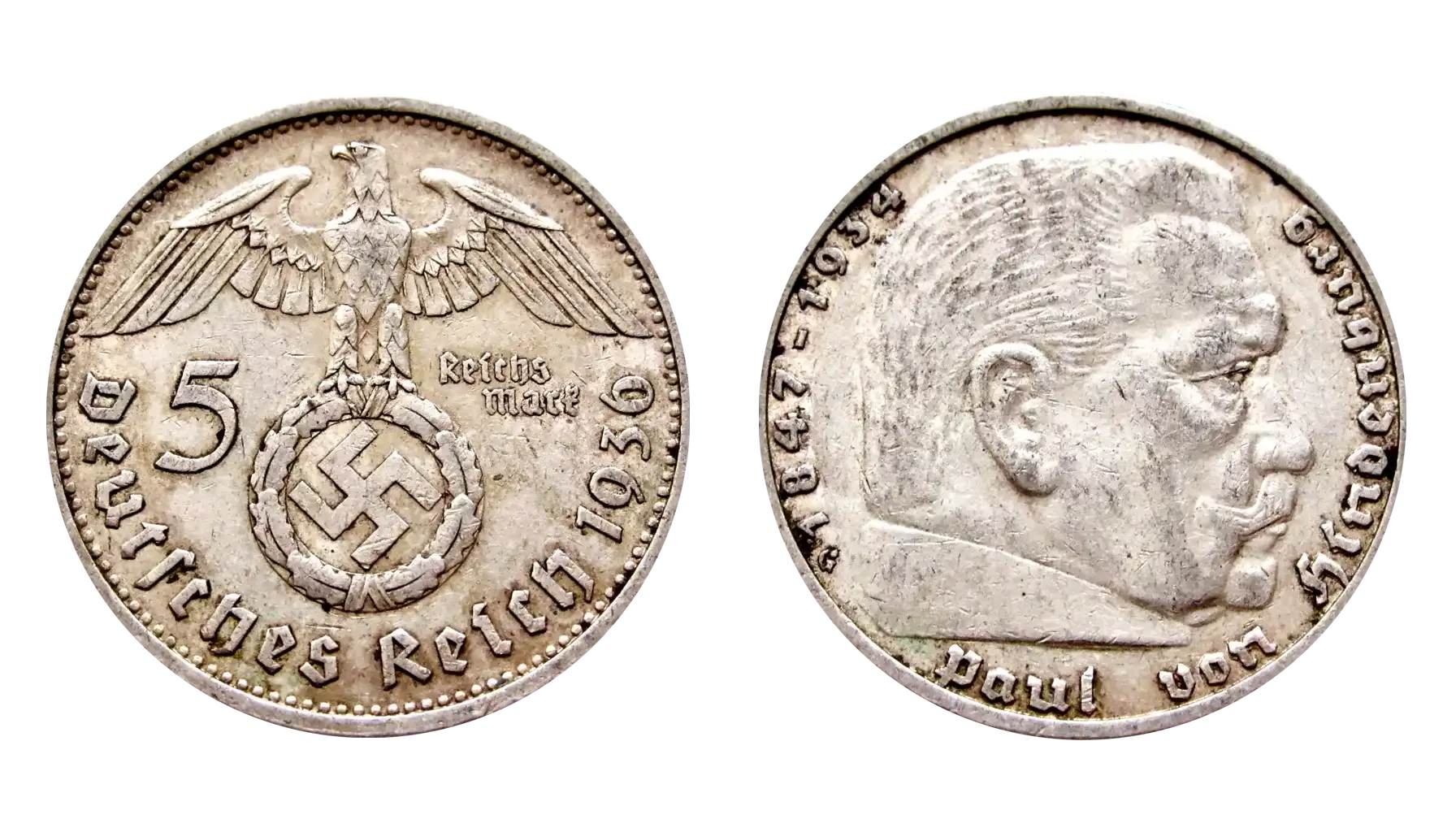
5 Reichsmark | 1934–1939 | 90% silver | Obverse: Early types show Potsdam Garrison Church; Later circulation types show Paul von Hindenburg profile; Reverse: Eagle with swastika and denomination. |
The “Nazi–Zionist Coin” Explained (Historical Clarification)
The object often described online as a “Nazi Zionist coin” is not a circulating monetary means at all. It’s a 1933 medal produced to mark the Haavara (Transfer) Agreement between German authorities and the Jewish Agency for Palestine. The agreement allowed some German Jews to emigrate to Palestine while transferring part of their assets through controlled channels.
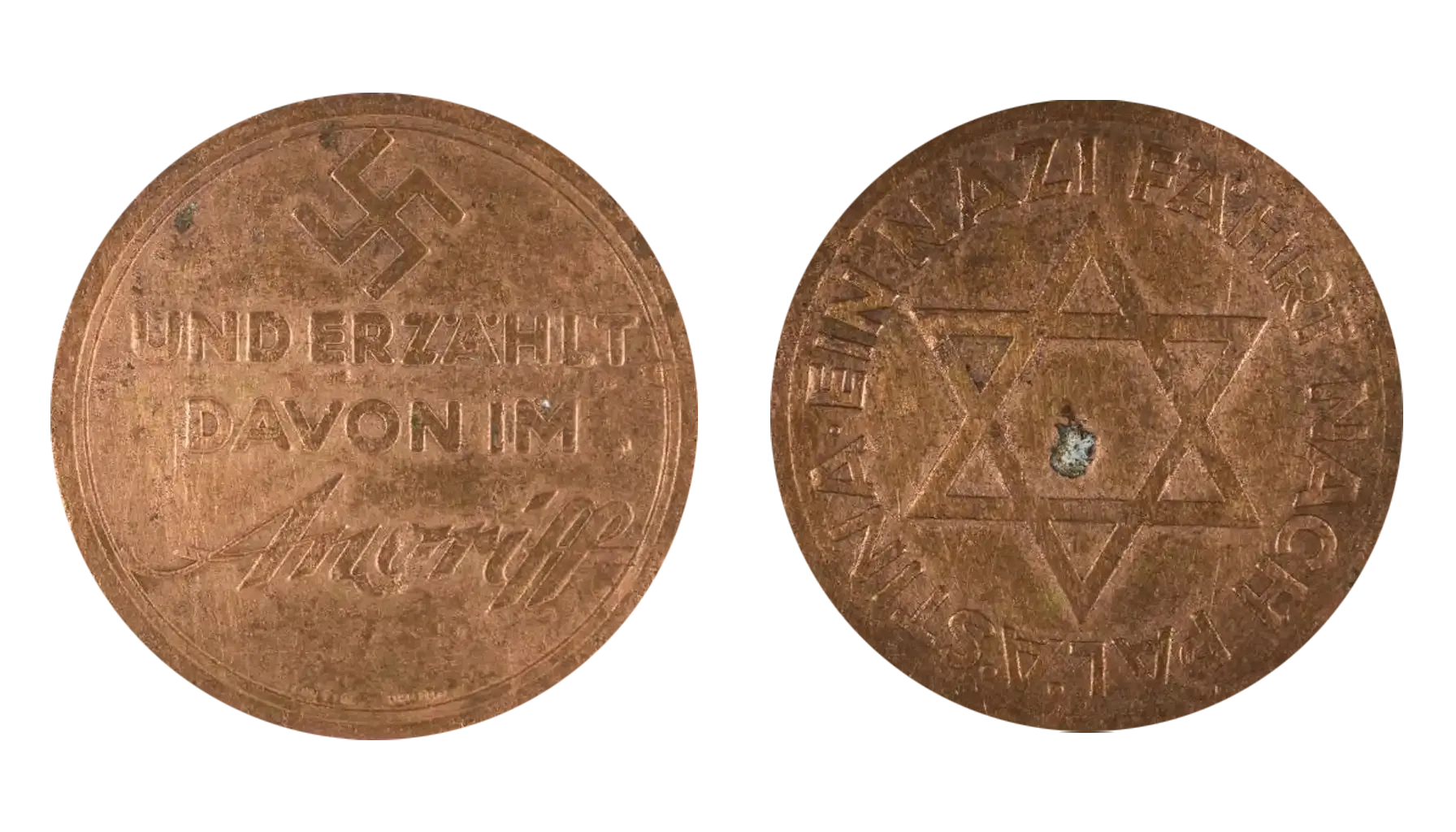
The medal was struck privately, not by the German state mint. One side shows a Star of David, the other shows a German eagle used during the early Nazi period. Because both symbols appear on a single piece, later generations sometimes misinterpret it as an official Zionist Nazi coin or as evidence of political unity between Nazi Germany and Zionist groups. In reality, it represents a specific economic arrangement during a short period in 1933 and does not symbolize ideological alignment.
The piece survives today as a historical artifact linked to emigration policy rather than monetary circulation.
Nazi Coins Value Guide
Type | Years | Typical Circulated Value | Nice Circulated (VF–EF) | Uncirculated (AU–UNC) |
1 Reichspfennig (zinc) | 1940–1945 | $0.20–$1 | $1–$3 | $4–$10 |
5 Reichspfennig (zinc) | 1940–1944 | $0.30–$1 | $1–$4 | $5–$12 |
10 Reichspfennig (zinc) | 1940–1945 | $0.30–$1 | $1–$5 | $6–$15 |
50 Reichspfennig (aluminum) | 1939–1944 | $0.50–$2 | $2–$6 | $8–$20 |
1 Reichsmark (50% silver) | 1933–1939 | $5–$10 | $10–$20 | $25–$45 |
2 Reichsmark (62.5% Ag, Nazi silver coins commemoratives) | 1933–1939 | $8–$15 | $15–$35 | $40–$120 |
5 Reichsmark (90% silver, Hindenburg type) | 1935–1939 | $12–$25 | $25–$45 | $50–$120 |
5 Reichsmark (Potsdam Church commemorative) | 1934–1935 | $15–$30 | $30–$60 | $70–$150 |
5 Reichsmark (rare proofs & scarce mint marks) | Selected dates | — | — | $400–$1,500+ |
How to Read This Table
Metal content drives the base value.
Silver coins (1, 2, and 5 Reichsmark) always have a melt-value floor. Zinc and aluminum ones do not.
Condition makes the biggest difference.
All Nazi coins for sale must be checked before any purchase. For example, a 5 RM that is dull or worn may sell for $15, while a sharp uncirculated piece of the same date may reach $100+.
Design type matters.
Luther 2 RM → common
Hindenburg 5 RM → common
Potsdam Church 5 RM → moderately better
Special commemoratives or proofs → higher premiums
Mint marks can change price.
Specimens with letters like A, D, E, F, G, J can vary in rarity depending on date and denomination.
Zinc ones are rarely expensive.
Even “rare” zinc dates often fetch only small premiums because millions were minted and many survive.
For WWII and other German coins—many of which have similar layouts and degraded zinc surfaces—Coin ID Scanner makes it easier to identify the piece correctly.
Nazi-era coins trace the move from early silver money to the light wartime zinc and aluminum pieces made under material shortages. Only a small number of issues reach high prices, and condition plays the biggest role in value.

 Facebook
  X (Twitter)
 : Values, Silver & Gold Issues, and Historical Facts) Pinterest
Pinterest  LinkedIn