Contents:
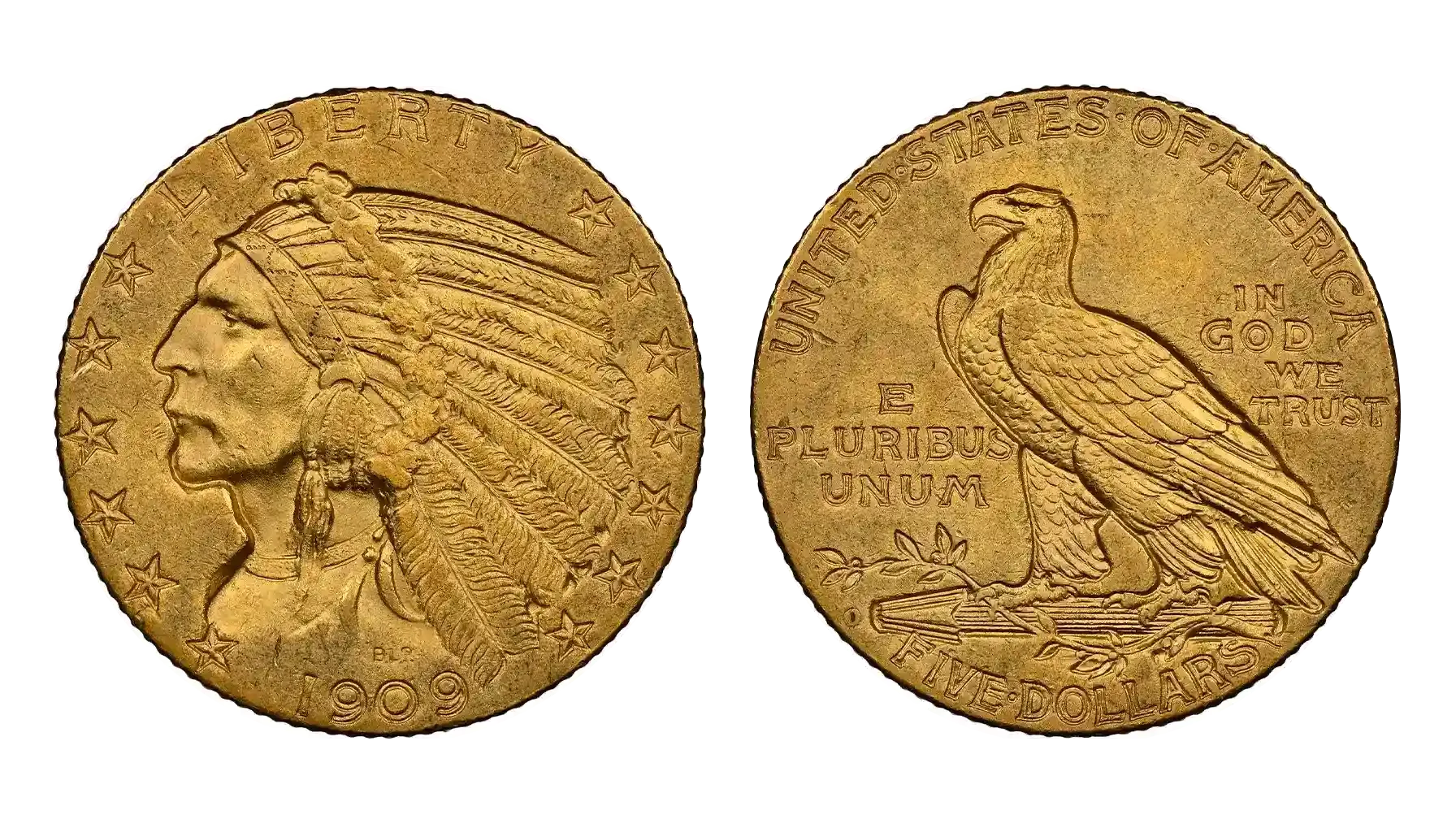
It is the very special 1909 Gold 5 Dollar Coin, which became unusual for all numismatists of that time. They often try to find it in the Coin Finder App. And now you will find out how to do it, but without using third-party sources.
What Is the 1909 Five Dollar Gold Coin?
The 1909 $5 dollar Indian Head gold coin value is high. Moreover, at that time, the design had not changed for 70 years, so the new copy with new elements and unusual relief was almost a breakthrough in the world of numismatics of that time.
“Critics such as Chapman were doomed to disappointment in their bid to derail the new coins, although they had an influential ally in the U. S. Mint’s chief engraver, Charles E. Barber. But in the final analysis, Roosevelt’s support was all that mattered.”
– unnamed page about Indian Head $5
NGC official website
President Roosevelt strongly disliked American coins of the late 19th and early 20th centuries. He was disappointed with both the quality and the design, and wanted to replace the existing ones with completely different ones that would reflect all the greatness of the nation.
Initially, it was entrusted to the famous sculptor Augustus Saint-Gaudens with his $20 coins. He needed to recycle all the gold coins, and although he managed to create good designs, he died before completing his work. And so his student, the sculptor Bela Lyon Pratt, set to work.
And despite all the features, one of the most common copies of this issue is the coins of 1909. The most special ones are the 1909 D 5 dollar gold coin from the Denver Mint, the San Francisco Mint, and the New Orleans Mint.
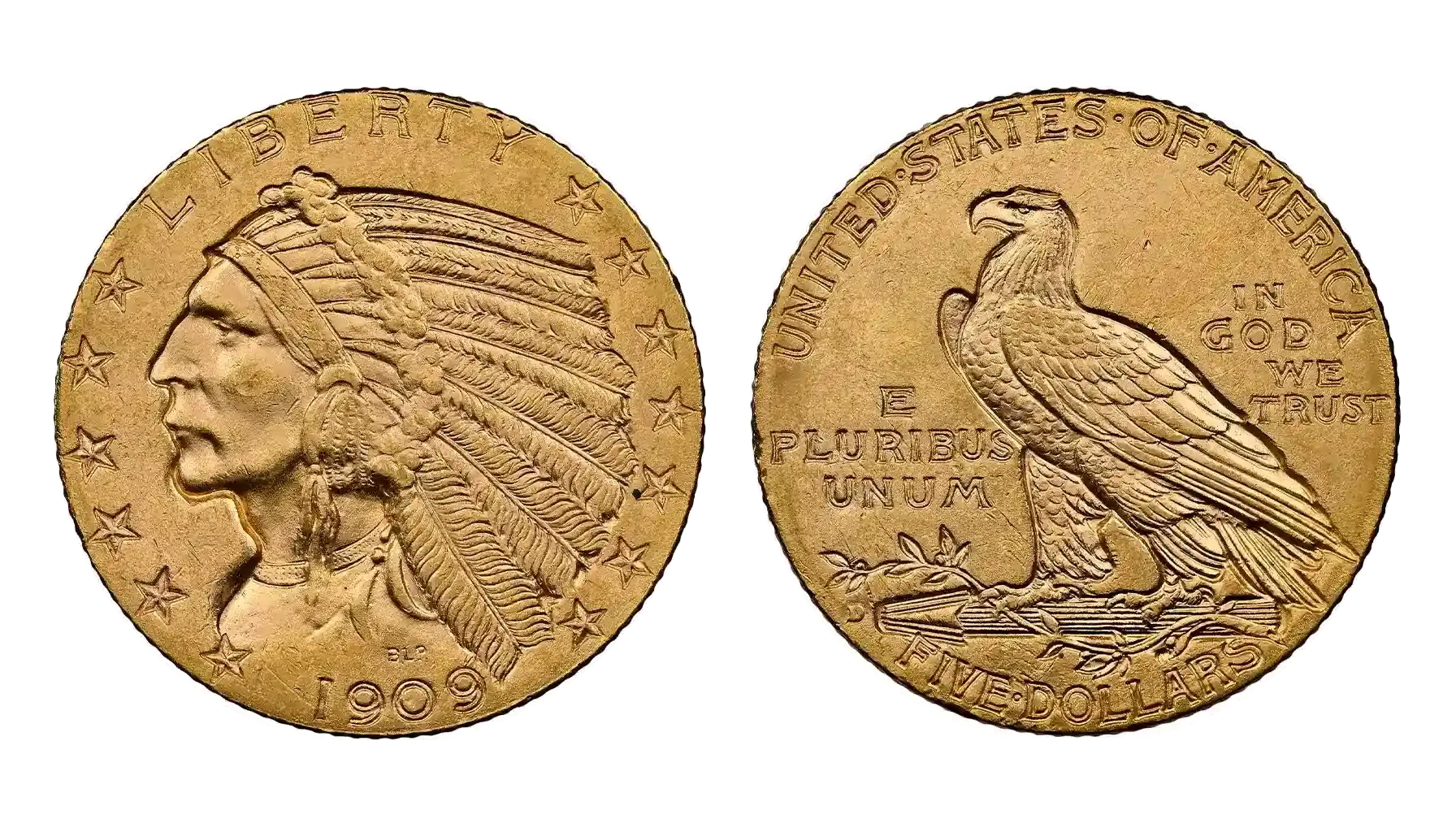
1909 Indian Head $5 Gold Coin Specifications
Designer | Bela Lyon Pratt | |
Metal composition | Gold | |
Fineness | 0.9 | |
Weight | 8.36g | |
Diameter | 21.6mm | |
Edge | Reeded | |
Mints | Philadelphia | 627 060 |
3 423 560 | ||
San Francisco | 297 200 | |
New Orlean | 34 200 | |
There were not many copies minted that year, but four mints were used. And especially the New Orleans Mint, which will cease to exist after a while.
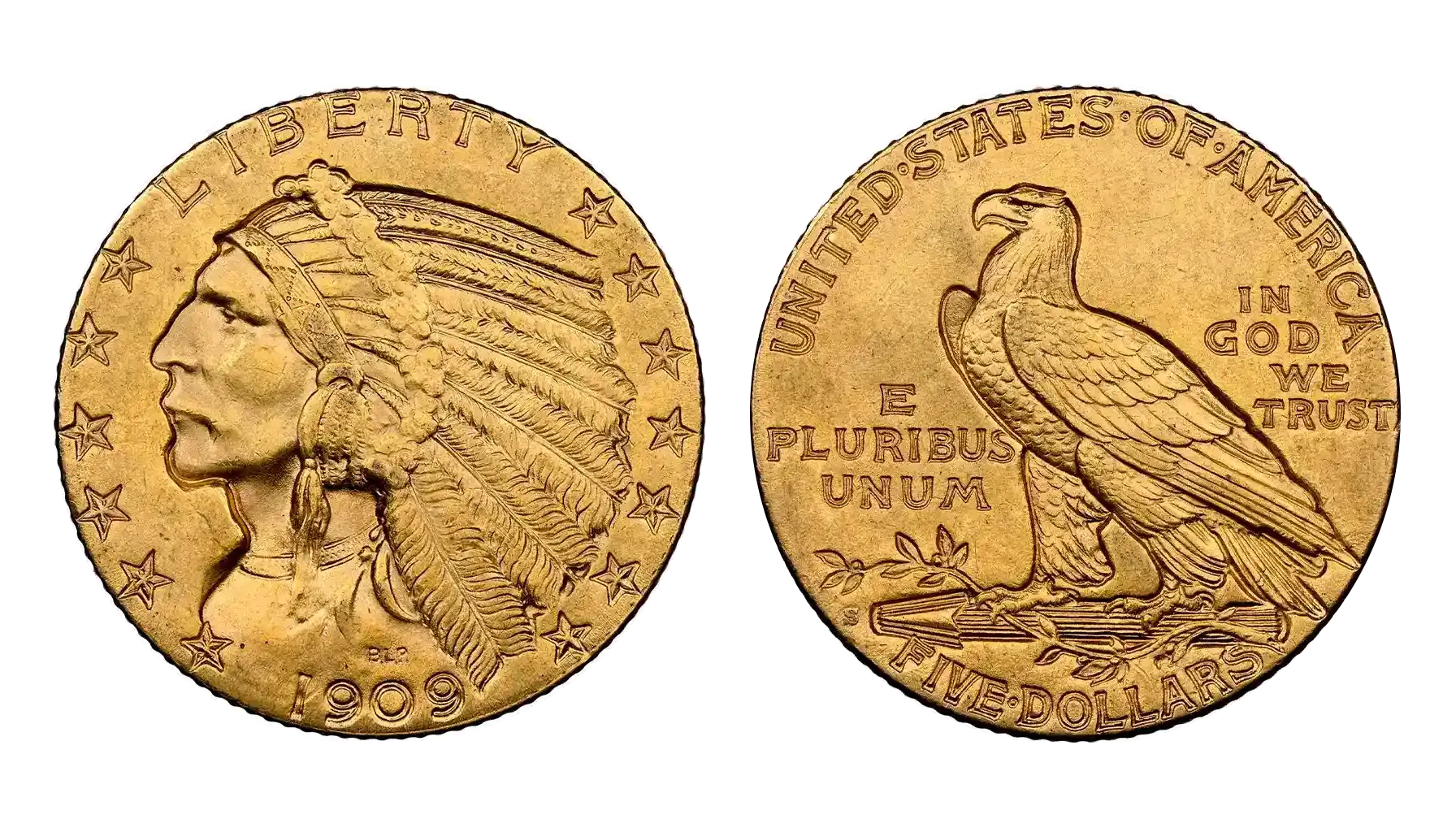
1909-D and Other Mint Mark Values
And as we can see by the number of copies, Denver had the largest circulation. However, this does not mean at all that the copies from this mint will be less or more expensive. It usually works the other way around. It is difficult to find well-preserved copies among the large print run.
Grade | 1909 five dollar gold coin value | 1909 5 dollar gold coin value D | 1909 Indian Head 5 dollar gold coin value O | 1909 dollar gold coin value S |
60 | $1,265 | $1,265 | $26,000 | $3,250 |
61 | $1,305 | $1,305 | $28,500 | $7,500 |
62 | $1,350 | $1,350 | $37,500 | $10,000 |
63 | $2,150 | $1,465 | $115,000 | $16,500 |
64 | $3,750 | $2,100 | $175,000 | $26,500 |
65 | $10,000 | $10,500 | $550,000 | $62,500 |
66 | $25,000 | $30,000 | $800,000 | $127,500 |
67 | - | - | - | $175,000 |
Thus, the most expensive copies turned out to be from New Orleans; however, in comparison between San Francisco and Denver, it is in Denver that the coins are more expensive.
Another feature that can be seen is that the San Francisco specimen is the only one preserved in the MS-67 grade. This is quite important. Therefore, we would recommend purchasing a copy from New Orleans in the MS-65 or MS-66 grade, as well as a copy from San Francisco in the MS-67 grade.
Collecting Indian Head Half Eagle Gold Coins
It is a truly historically significant specimen. It is one of the founders of the new century in the history of the American Mint. It is part of the Roosevelt coin renaissance. Also, its unique design distinguishes it from other copies.
Metal Content
In general, collecting gold coins is quite a valuable activity. Gold has always been valued throughout the history of mankind, especially in our time. Moreover, it is a truly historically significant specimen.
Its value is measured not only by the fact that it is a coin made of pure gold, but also that its price will depend not only on the face value, but specifically on the spot price of gold.
Therefore, if you collect these particular specimens, then you need to keep an eye on the precious metals markets, as they are constantly changing.

 Facebook
  X (Twitter)
  Pinterest
  LinkedIn