Contents:
Today, we will explore one of the most valuable coin families in the world, the $20 St. Gaudens gold coin. This bit often leads to coin value ratings, and almost every experienced investor and/or collector has heard of this coin.
What is the 20 St. Gaudens gold coin value? Is it really made of gold? What makes it valuable? The article will give us all the answers.
Many collecting tools are rather expensive, but not all of them. You can use a free coin identifier to help yourself recognize all kinds of coinage.
History of the St. Gaudens Double Eagle
In all of American numismatic history, the St. Gaudens Double Eagle’s name is one of the most renowned and heard. Iconic, even.
Saint Gaudens $20 gold coin was designed by sculptor Augustus Saint-Gaudens and first struck in 1907. The path to approval was not without some bumps. The sculptor had to change the reverse before the official release and make the coin flatter in general (it would be hard to produce many high-relief bits).
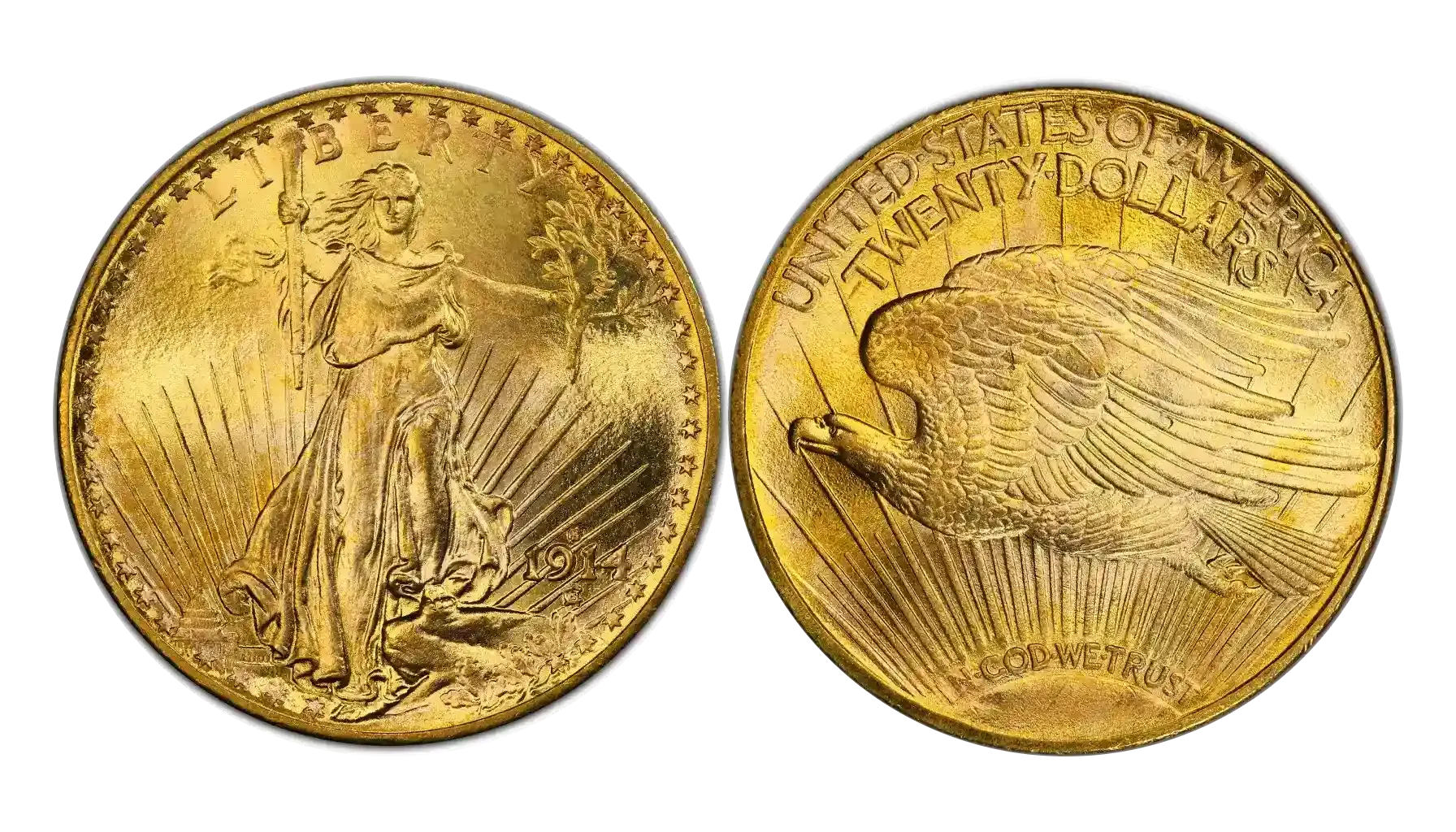
We cannot talk about the coin’s history without also looking into its design,
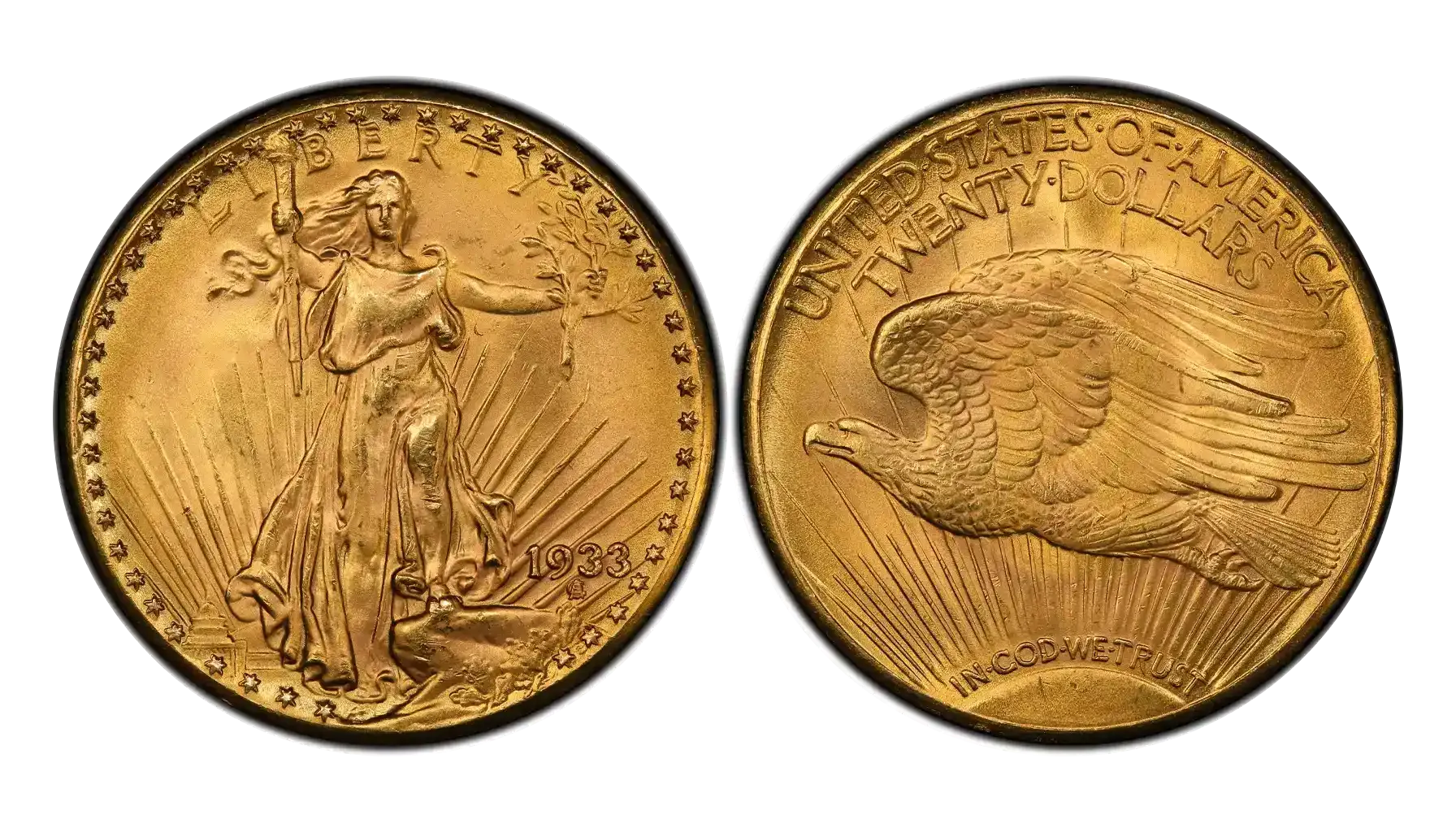
The obverse (front) features a Lady Liberty. She strides forward with a torch in one hand and an olive branch in the other. The rays of the sun are shining behind her.
The reverse shows an eagle in flight above a rising sun.
The initial release lacked the motto “IN GOD WE TRUST", which was omitted from the design. This sparked public backlash. In response, Congress made sure that the release post 1908 all had the motto.
“An exceptional example of US gold coinage, the MCMVII High Relief Double Eagle is universally considered one of the most beautiful coins from the US Mint.”
— Jeff Garrett
NGC Official Website
For a few decades, the U.S. produced the Double Eagle, until 1933, when U.S. gold coins were withdrawn from circulation. The Great Depression called for a gold recall, and in an effort to save resources, most gold coins were melted or not issued to begin with.
Luckily for us, a few 1933 issues survived melting, and those that did became exceptionally valuable coins. One 1933 Double Eagle would lead the charts of the top 100 most valuable coins in the world.
How Much Gold Is in a St. Gaudens Coin
While this coin technically has a $20 face value, it is much more valuable, all because it contains gold.
Each bit contains 0.9675 troy ounces of pure gold. The total weight is 33.436-gram, with the addition of 10% copper for durability (gold is too soft by itself). This composition is commonly called the .900 fine gold, and it was typical of U.S. gold coinage of the era.
Keep in mind that various restrikers, like the mini St. Gaudens gold coins, gave different gold compositions, and some have no gold at all, just replicating the same design themes.
If you own a 20 dollar St. Faudens gold coin and it is not 33 grams, perhaps it is not real gold, but a counterfeit. Keep in mind that gold is almost soft and makes a “bling” sound when you lightly strike it.
St. Gaudens $20 Gold Coin Weight and Specifications
As for the other technical details:
Attribute | Details |
Country (Issuer) | United States |
Years of Minting (Regular Issue) | 1907–1933 |
Type | $20 (nowadays, a historical bullion coin) |
Shape | Round |
Diameter | ~34.1 mm (1.342 in) |
Metal Composition | 90% gold, 10% copper (.900 fine) |
Weight (Total) | ~33.436 grams (1.0750 troy oz) |
Minting Facilities | Philadelphia mint, Denver Mint, San Francisco Mint, West Point mint |
Another technical peculiarity about this bit is that it was struck in both high relief and low relief. Only the first issue (1907) was made in high relief, making it artistically superior.
All editions, from 1907 to 1933, also had an edge insurrection, a rather rare design choice among the U.S. coinage. The injection read as “E PLURIBUS UNUM”.
St. Gaudens $20 Gold Coin Value Today
What about the modern $20 St. Gaudens gold coin value? In short, it is quite exceptional. Most coins have one of the two value actors describing them:
Intrinsic (Bullion) value: the value that depends on the metal content and its weight. Gold bits often fetch the highest value in this category, but silver and palladium-made pieces are also valuable.
Numismatic value: The value is dependent on rarity and historical importance. Old bits fit into this category, as well as pieces with a low mintage. Such coins are often made from a low-value metal (copper, zinc), but symbolically are too important to disregard.
Considering Double Eagle's ripe age, rarity, and gold content, it is valuable on all fronts:
Grade / Condition | Description | Approximate Value (2025) |
Circulated (VF/AU) | Has some wear. Rare examples still retain their brilliant surfaces | ~$4,100+ |
Higher Uncirculated Grades (MS64+) | Premium quality with minimal wear and clear luster | ~$4,500+ |
Scarce Dates / Key Mintmarks | Depends less on the condition. Includes Examples like 1908-S, 1921, and 1930-S | ~$25,000+ |
Of course, some examples are worth even more money, as the famous 1933 Double Eagle was sold for over a million dollars. The exceptional rarity of this coin made it desirable.
What Affects the Price of St. Gaudens Gold Coins
We already know that St. Gaudens 20 dollar gold coins are exceptionally valuable. But what exactly affects the value of St. Gaudens $20 gold coin? A few factors:
Gold spot price: Since these bits have nearly one ounce of gold, fluctuations in the gold market directly affect their value. Gold sets the base value, but other factors increase it further. To put it simply, these coins will minimally go for the spot gold price, but not lower.
Condition (Grade): Coins in better condition, especially those graded in Mint State (MS), bring higher prices. Grades from MS60 through MS65 and above vary widely in price.
Rarity: Certain dates and mintmarks are much rarer than others. For example, early issues or low-mintage San Francisco and Denver, or the scrapped 1933 issue.
Historical importance and provenance: Coins with known historical context and exceptional provenance (owned by important people) often have premiums.
Market demand: Collector interest changes, and when it’s at its all-time high, the value also rises. At the moment, the investors are interested in gold coins like Double Eagle, and collectors are interested in the old age of this bit. It means that this bit is highly in demand.
Authentication: Because attractive gold bits often become targets for counterfeits. Thus, authentication becomes crucial, but it costs money. A verified, authentic coin will always be worth significantly more than an uncertified piece.
Errors: These bits are exceptionally rare by themselves, so the instance of errors is almost impossible. However, some collectors could find errors on various issues. For example, strike-through errors were recognized (when the surface has imprints of objects). Most errors add at least $500 to the bill.
Conclusion
Perhaps one day we will see another piece reaching the same heights the St. Double Eagle once did. It might take a while, of course. Rarely can you find a bit that combines gold, age, and rarity in one neat package.
Would you like to learn more about valuable American bits? Coin ID Scanner is a master app when it comes to coinage. The app can scan bits, identify them, and even find values for them. Double Eagles and other valuable bits are already in its database, ready to be evaluated, found, and explored.

 Facebook
  X (Twitter)
  Pinterest
  LinkedIn