Contents:
Having been introduced in 1858, the Canadian nickel was repeatedly modified and reimagined in terms of composition, size, purpose, and design: new forms, commemorative issues, and non-circulating collectors-only options that may sell for €300 (silver bullion value) appeared.
The price of a common 5-cent coin (=nickel) from Canada rarely goes beyond the nominal worth. However, older versions (minted before 1922) were struck in silver, and the intrinsic, base value of them is usually set to be €2 per piece. So, what are the relevant coin prices across the full series? Why do bullion and numismatic values differ? And how have the coin’s specifications evolved?
Origins of the Canada 5 Cent Coin
The first Canadian 5-cent coin (along with Canadian pennies) was produced in 1858, when Canada adopted a decimal currency system based on dollars and cents, not the older pound sterling system instead. It was more of a compromise, for the coins continued to be produced by the Royal Mint in London, issued in the name of the British Crown, and simultaneously tied to the closer North American dollar standard.
At first, these numismatic creations were struck in silver, not nickel (as their name could suggest), and they also contributed to the formation of the stable decimalized currency framework, introduced in the Province of Canada before Confederation. Nonetheless, it took six monarchic iterations before the coin turned into the one we might encounter in circulation today:
1858–1901 5Cs (Victoria)
1902–1910 5Cs (Edward VII)
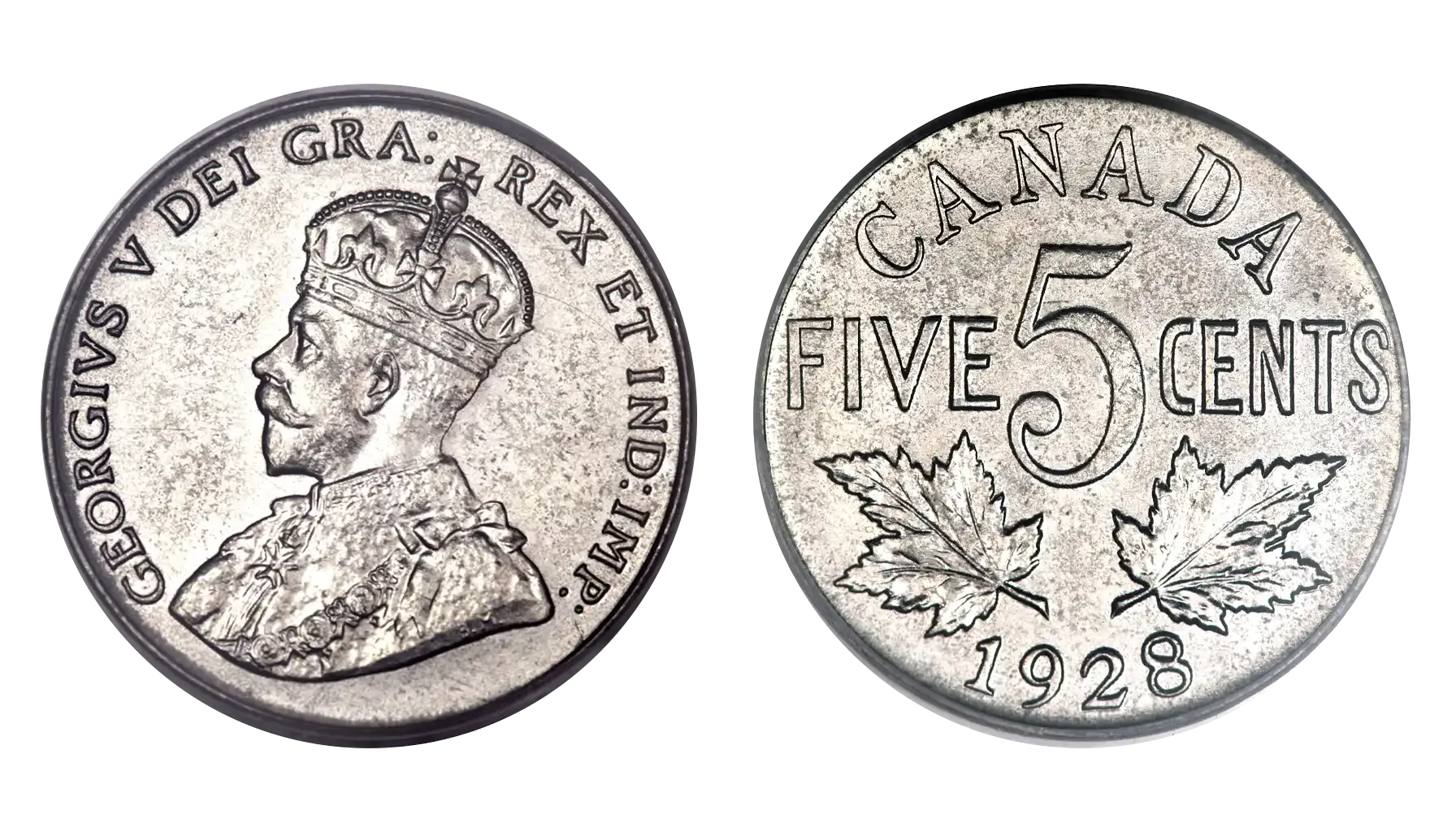
1911–1936 5Cs (George V, three standard circulation versions)
1937–1952 5Cs (George VI, roughly seven standard circulation versions)
1953–2022 5Cs (Elizabeth II, ten standard circulation versions)
2023–... 5Cs (Charles III)
The presence of commemorative types is always wider, as it is not strictly associated with regular circulation requirements.
“...From 1858 to 1921, the Canadian 5-cent coin was made of silver. To maintain silver content that is proportional to its value, <...> the coin was quite small, measuring 15.5 millimetres and weighing 1.16 grams. Because of their small size, these coins were often called “fish scales.” Yet, their purchasing power was significant. So losing these little coins was problematic...”
— David Bergeron, Canadian numismatics curator and writer
Bank of Canada Museum
5-cent Coin Canada Symbol and Design
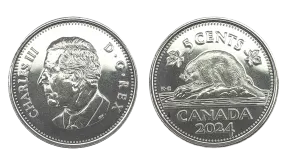
Obverse: Demonstrates the portrait of the monarch (long-running series, for instance, depicted various portrait versions along the way), namely Queen Victoria, Edward VII, George V, George VI, Elizabeth II, and Charles III (as per the chronological order).
Reverse: Shows the denomination of the coin, the year of mintage, the name of the country, maple boughs/leaves, heraldry, or a beaver on a rock (since 1937). Other details relevant to the monarch's reign may also appear.
The Main Specifications | |
Denomination | 5 cents |
Country | Canada |
Shape | Round, except 12-sided issues of 1942–1963 |
Edge | Usually plain |
Composition | 1858–1919: 92.5% silver, 7.5% copper 1920–1921: 80% silver, 20% copper 1922–1936: 99% nickel 1937–1942: 99.9% nickel 1942–1944: 88% copper, 12% zinc (tombac) 1944–1945: chromium-plated steel 1946–1981: 99.9% nickel 1982–1999: 75% copper, 25% nickel 2000–...: 94.5% steel, 3.5% copper, 2% nickel plating |
Weight | 1858–1910: 1.16 g 1911–1919: 1.17 g 1920–1921: 1.167 g 1922–1981: 4.54 g 1982–1999: 4.6 g 2000–...: 3.95 g |
Diameter | 1858–1919: 15.5 mm 1920–1921: 14.494 mm 1922–1999: 21.21 mm 2000–...: 21.2 mm |
Thickness | not officially stated for earlier versions 1922–1981: 1.7 mm 1982–present: 1.76 mm |
Canada 5 Cent Coin Value Today
The prices of the 5-cent coins cannot be fixed and universal, as they depend on the year, grade, and some extraordinary circumstances, such as the events that accompanied their issue or later affected their rarity. The Black Toonie, for example, was released in 2022, and this Canada Elizabeth II coin was meant to pay tribute to the legacy of the late queen, who had reigned for 70 years.
All in all, the Canadian 5 cent coin value varies significantly (up to a few thousand euros per piece).
5 Cent Canadian Coin Value by Date
Period | G | VG | F | VF | XF | AU | UNC |
1858–1901 | €2.40–€17 | €4.50–€16 | €5.20–€87 | €6.80–€110 | €8.40–€410 | €8.40–€590 | €77–€4500 |
1902–1910 | €2.10–€7.00 | €4.10–€7.00 | €4.40–€11 | €4.60–€19 | €5.50–€45 | €11–€77 | €43–€370 |
1911–1936 | €2.30–€4.10 | €4.40–€74 | €4.40–€130 | €5.40–€4300 | €8.10–€6600 | €8.10–€8800 | €240+ |
1937–1951 | €0.04–€0.52 | €0.05–€0.52 | €0.23–€23 | €0.41–€29 | €0.52–€55 | €0.52–€13 | €2.50–€170 |
1951–1952 | €0.05 | €0.14–€0.17 | €0.20–€0.35 | €0.41–€0.47 | €0.46–€0.67 | €1.20–€1.30 | €2.10–€6.80 |
1953–2022 | €0.03–€0.16 | €0.04–€0.16 | €0.05–€8.40 | €0.07–€8.40 | €0.09–€1.80 | €0.12–€1.40 | €0.50–€34 |
2023–2026 | – | – | – | €0.03 | €0.03–€0.06 | €0.31–€0.60 | €0.93–€6.70 |
How Much Is a 5 Cent Canadian Coin Worth? Auction Records
Although the average prices may be modest, there are exceptional pieces that occasionally appear on the online coin auctions (as per Heritage Auctions, for example):
1921 5C $115,000
1921 5C $50,400
1858 5C "Large Date" $31,200
1931 5C $21,150
1884 5C "Near 4" $19,550
Should you wish to learn more about exclusive coins, their backgrounds, interesting facts, and possible worth, try Coin ID Scanner and explore the numismatic world with a constantly available assistant installed on your phone.
Rare 5 Cent Canada Coin Errors
1943 5C Struck on the Wrong Nickel Planchet
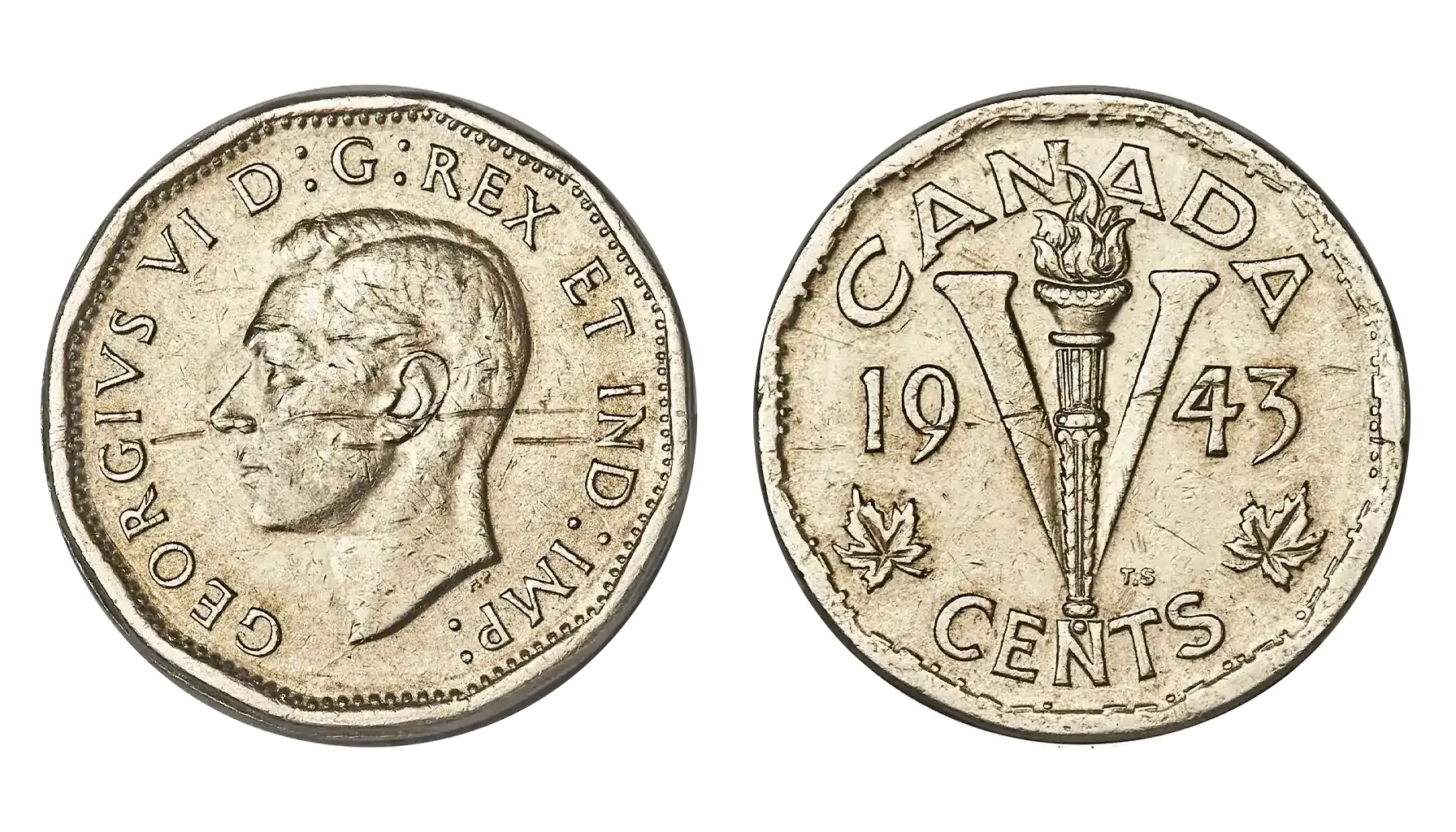
Estimated Value: $4,800
This is one of the most valuable error types in the series, as it represents the coins struck on the wrong nickel planchet relevant to the reign of George VI. In 1943, standard 5-cent pieces were not supposed to be struck on a nickel planchet (the regular issues were to be minted in tombac due to wartime changes in composition).
1988 5C Struck on a 1-Cent Planchet
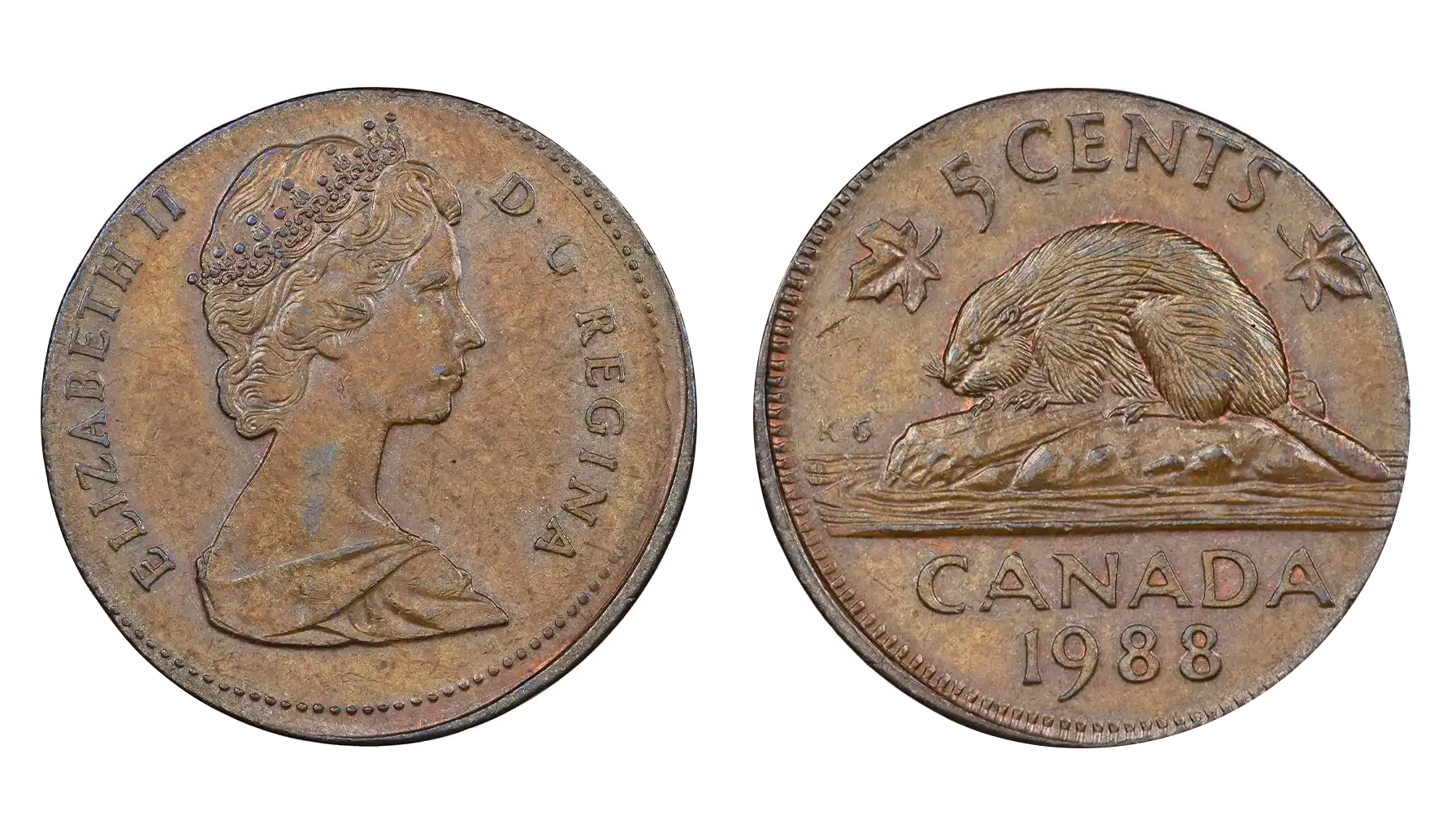
Estimated Value: $384
Here is another wrong-planchet anomaly, for this 5-cent coin was struck on a 1-cent blank instead of the proper one. Hence, the numismatic creation could boast a wrong metal base and an incorrect weight of 2.5 g.
1944 5C with Missing Chromium Layer
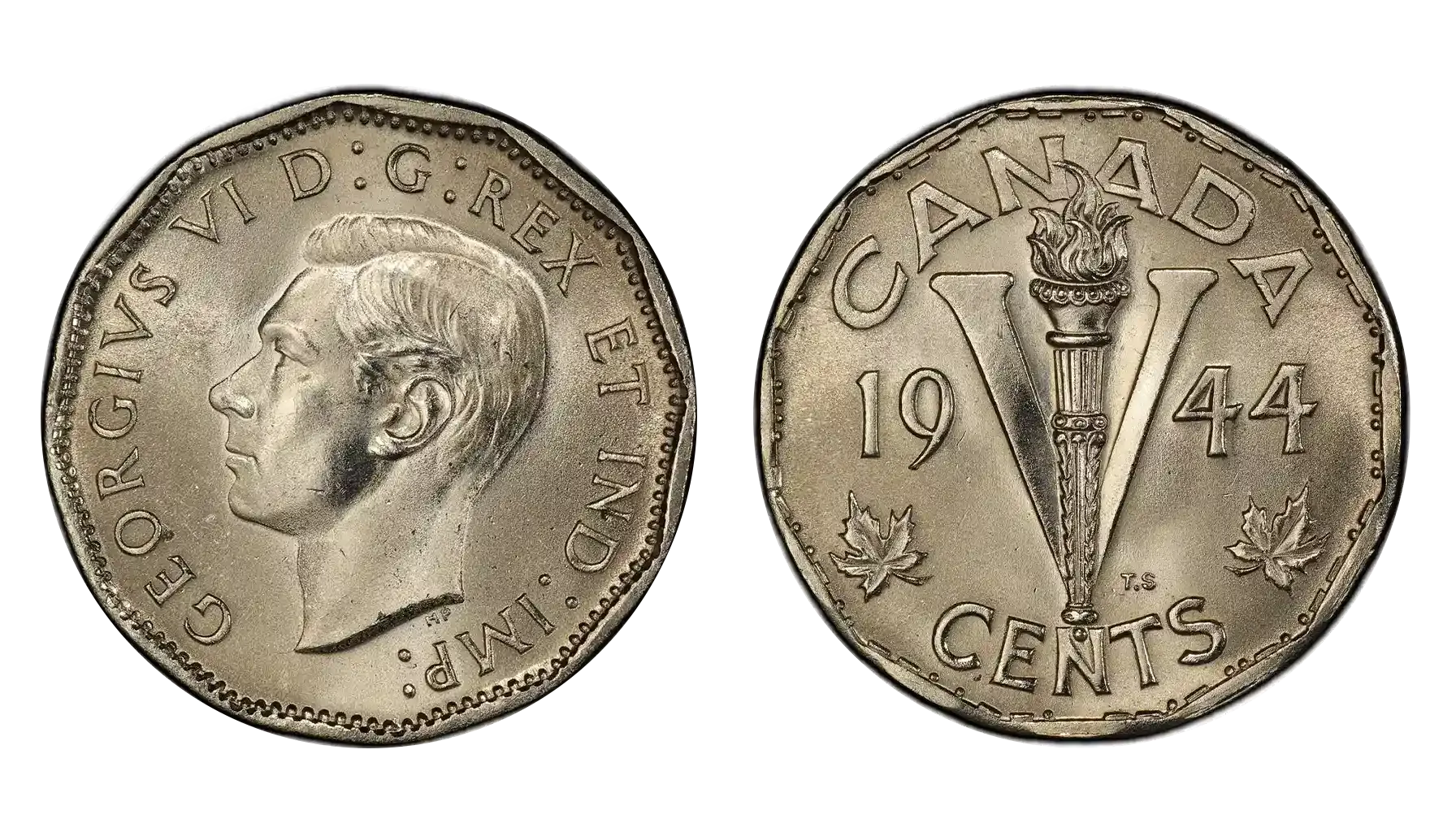
Estimated Value: $361
One may notice that the main part of errors was produced during World War II, as the Mint was to adapt coinage to wartime conditions, and it was not consistent all the time. In fact, the main part of wartime issues was made with a chromium-coated steel composition, yet, in this case, the chromium layer was missing. Without the coating, the surface looks light and less bluish in the end.
5-cent coins can be different, but their prices (even those that do not seem impressive) may grow anyway.

 Facebook
  X (Twitter)
  Pinterest
  LinkedIn