Contents:
The history of 2-dollar coins on the territory of Canada is long-standing: although it was first introduced in 1865 in Newfoundland, the modern 2 dollar Canadian coins (or, rather, toonies, similarly to “loonies”) were welcomed only in 1996 to replace the $2 bill. However, since it is a relatively recent release, the 2 Canadian dollar coins do not usually sell for more than their face value, which is $2 (or two hundred cents).
The prices at which the coin may be found on the numismatic market differ, according to the type of coin produced, the metal used, and the design depicted. As such, standard circulation units usually sell for €9.20+ in UNC grades; the commemorative issues made of gold may exceed €3,817 (the intrinsic worth, as per Numista). But what about numismatic value, and where to check coin value accurately?
Overview of the Canadian 2 Dollar Coin: The Present
So as to replace the 2 dollar bill, which wore out quickly and was a bit too expensive to produce, the Royal Canadian Mint introduced the modern $2 coin, widely known as the toonie (or twoonie as well). It was more of a practical initiative, as these units were designed for much longer use in regular circulation.
As of today, it is one of the most recognizable coins in Canadian currency, thanks to its distinctive design and bimetallic structure. Over the years, there appeared a few notable variations of the same unit of currency, as well as numerous commemorative coins, which pay tribute to the legacy and affluence of the Crown within the local culture.
“The Canadian two-dollar note had been around since before Confederation. But to a Western Canadian, a two-dollar bill was a relatively unfamiliar thing. As the story goes, this note became associated with the shadier dealings of the frontier era – specifically prostitution. Though this association is purely hearsay, the two-dollar bill was never popular out west…”
— David Bergeron & Graham Iddon, the representatives of the Bank of Canada Museum
“The Coming of the Toonie”, Bank of Canada Museum website
Design Features and Specifications
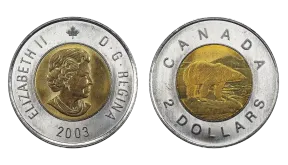
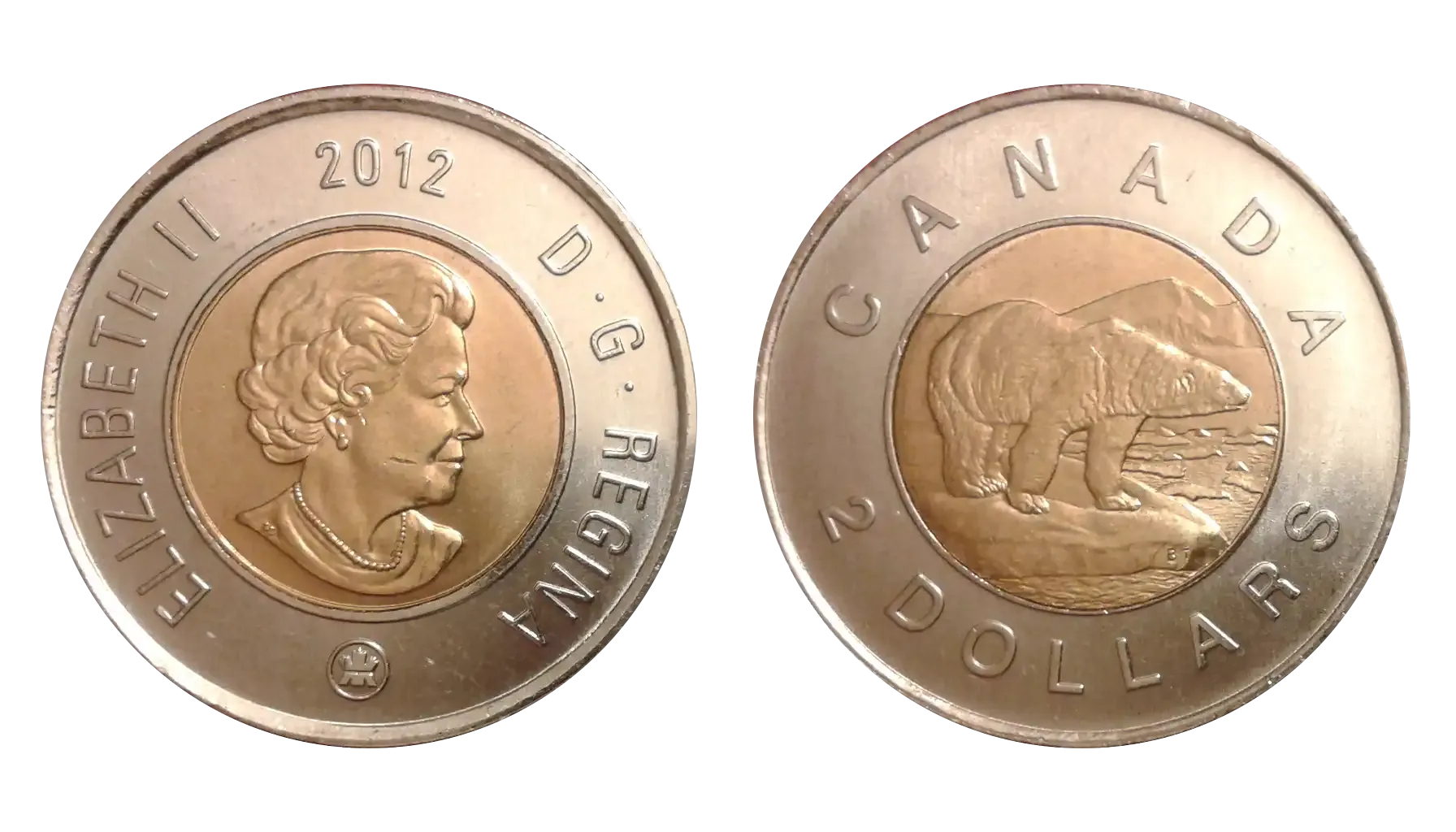
Obverse: Although designs changed, the overall obverse patterns remained the same. At first, from 1996 to 2003, the coins demonstrated the effigy by Dora de Pedery-Hunt. Since 2003 and well until 2022, one could observe the 4th portrait by Susan Taylor and Susanna Blunt, and after the untimely passing of the Queen, the surface welcomed the effigy of King Charles III.
As a rule, the design also includes the inscriptions “ELIZABETH II D·G·REGINA” or “CHARLES III D·G·REX”, along with the year of mintage running along the rim.
Reverse: When it comes to regular circulation coins of the modern period, the reverse design by Brent Townsend tends to show an adult polar bear in early summer on an ice floe. The arrangement is complemented with the inscription “CANADA” along the upper edge and the denomination below.
Commemorative and non-circulating editions frequently show different designs, as the scope of artistic willpower is greater and more well-pronounced.
Characteristic | 1996–2012 type | 2012–... type |
Composition | Outer ring: 99% nickel Inner core: 92% copper, 6% aluminum, 2% nickel | Outer ring: nickel-plated steel Insert: brass-plated aluminium bronze |
Weight | 7.3 g | 6.92/6.99 g |
Diameter | 28 mm | 28 mm |
Thickness | 1.8 mm | 1.75 mm |
Edge | Milled | Milled |
Security features | Bi-metallic locking mechanism | Laser marks and virtual-image maple leaves + bi-metallic structure |
Canadian 2 Dollar Coin Value by Year
Regular 2-dollar circulation coins, however beautiful they may be, are usually modest in terms of their value, since toonies are base-metal coins rather than precious-metal issues, and their mintage figures are rarely low. In this case, the numismatic worth, as a rule, is determined by the type of the coin, year of issue, composition, rarity, and, most importantly, grade.
The broad value pattern is fairly consistent: older bi-metallic issues from the first years of the series are worth a few euros/dollars in top grades, yet, on average, their prices are set to equal the face value only.
Grade | 1996–2003 | 2003–2006 | 2006–2012 | 2012–2022 | 2023–2026 |
G | €1.50 | €1.30 | – | – | – |
VG | €1.50 | €1.40 | €1.30 | €1.30 | – |
F | €1.50 | €1.40 | €1.60 | €1.50 | – |
VF | €1.60 | €1.50 | €1.60 | €1.50 | €1.30 |
XF | €2.00 | €1.60 | €1.60 | €1.50 | €1.40 |
AU | €2.20 | €1.70 | €1.60 | €1.60 | €2.20 |
UNC | €4.20–€7.40 | €3.80–€7.40 | €5.00–€9.20 | €2.30–€6.20 | €3.50–€6.20 |
Commemorative issues show greater results, as their bullion value is always at its highest. For instance, the 2018 $2 Elizabeth II coin was initially to cost ~$305. Nonetheless, the regional fees and additional costs also apply.
Black 2 Dollar Coin Canada Value
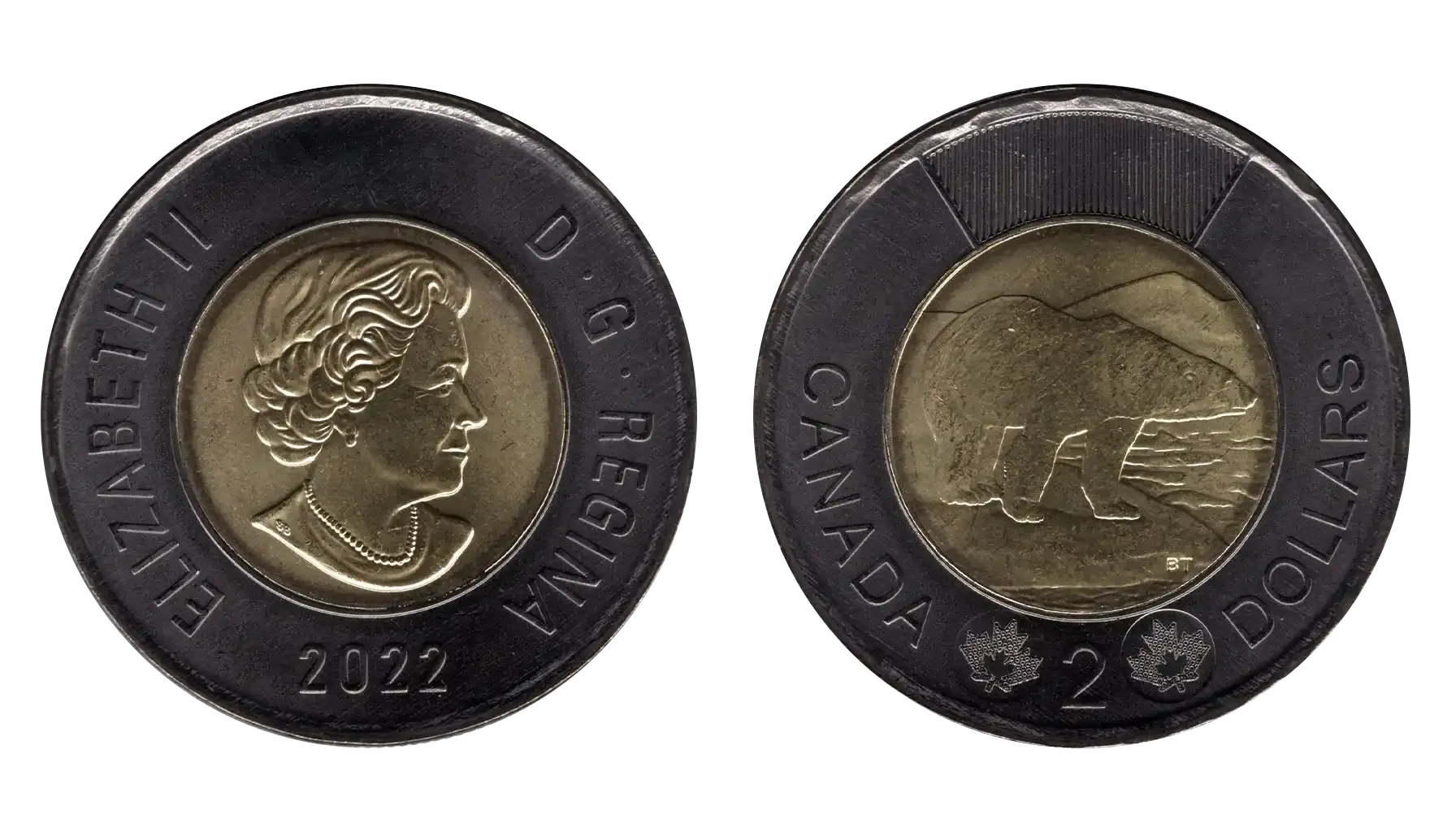
One of the most meaningful modern $2 coins is the 2022 black toonie, which was released as the Royal Canadian Mint’s memorial response to pay tribute to one of the greatest leaders of all time upon her passing, Queen Elizabeth II. The most distinctive feature of this issue is a black outer ring, which was meant to resemble a mourning armband and serve as an indicator of remembrance and respect.
It was a circulating commemorative coin, which means that the 2022 black toonie in lower grades should remain affordable anyway. When it reaches high grades, the prices grow, too:
F: €1.30
VF: €1.30
XF: €1.40
AU: €2.40
UNC: €4.10
Rare Canada 2 Dollar Coin Worth Money: The Past
Disclaimer: The rarest representatives usually relate to a much broader numismatic realm than the modern new 2 dollar coin Canada series only. These issues are far rarer, far older, and far more valuable.
1872 $2 Victoria Gold Specimen
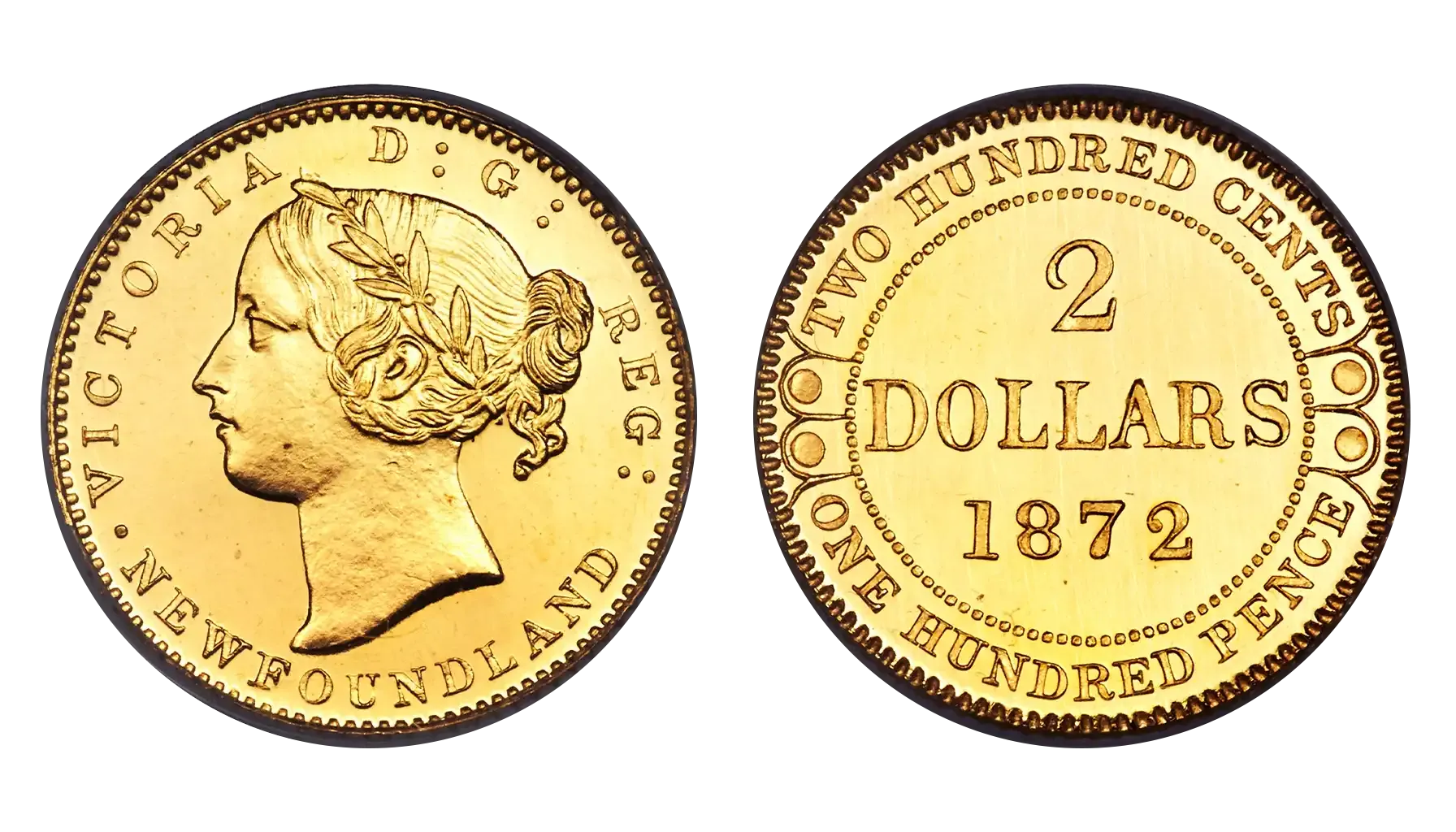
Mintage: ~10 pieces
Auction record: $35,250
Although it does not belong to the modern series, it is an extraordinary piece, struck at the London mint for official presentation purposes. The coin itself presents a laureate portrait of Queen Victoria on the obverse side and the date and the denomination within a beaded circle on the reverse. The mintage was extremely limited, but the survival rate is even lower than that. Hence, stumbling upon such a coin is a fortune not to miss.
1865 $2 Victoria Gold Specimen
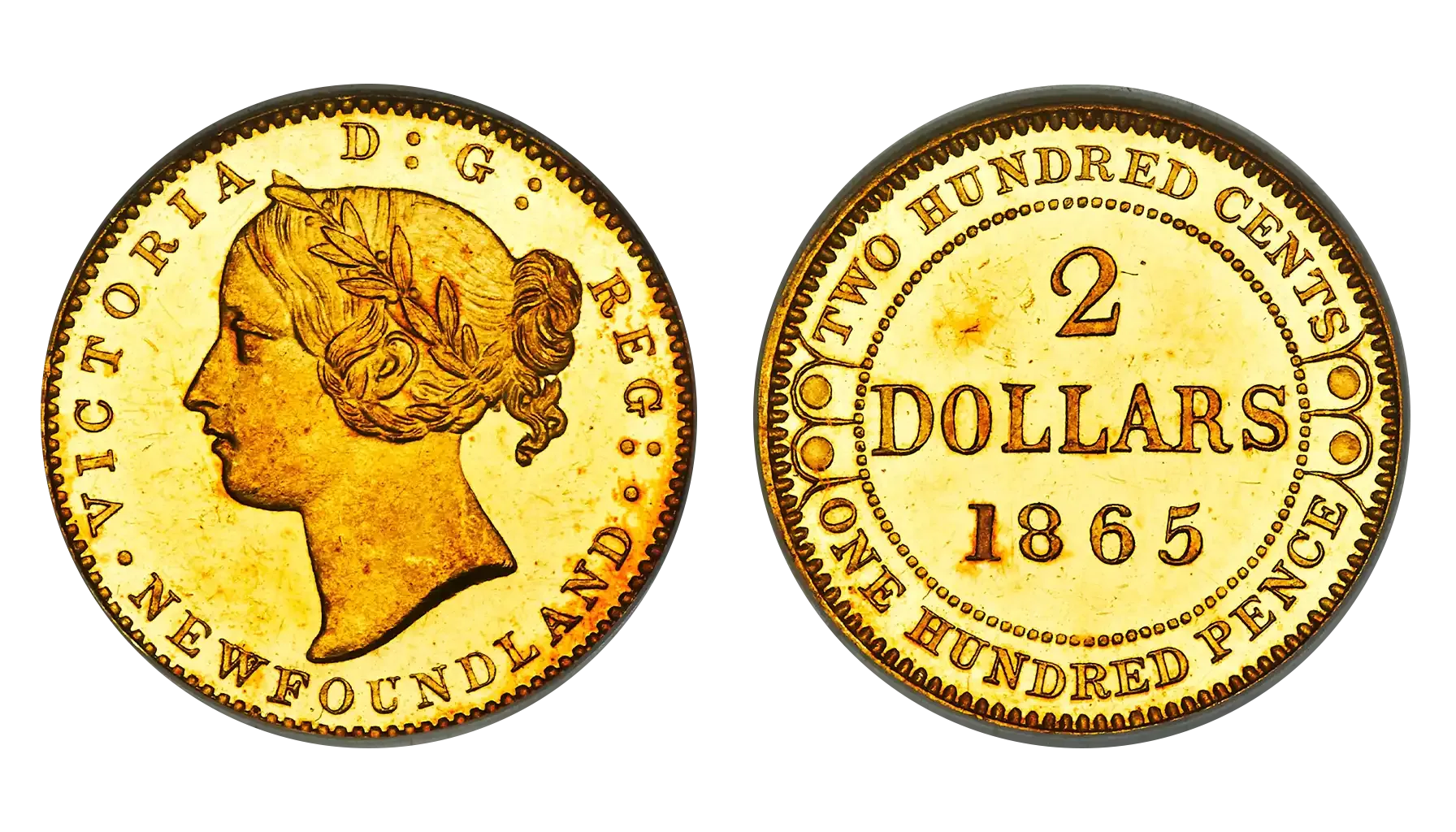
Mintage: ~5 pieces
Auction record: $22,800
As a first-year issue, the $2 coin from Newfoundland is a very special numismatic creation, crafted with medal alignment and refined finish, characteristic of specimens only. The design was classic yet still impressive because of the level of preservation (SP64) and the strong cameo contrast between its frosted details.
How to Check If Your 2 Dollar Canada Coin Is Valuable
It is far easier to check the status of the coin when there are appropriate tools with immediate access. So, start with the basics. Check the year of issue, for some dates are more collectible. Then look at the type of coin: a regular circulation toonie, a circulating commemorative issue, a non-circulating piece, or an unusual variety.
So as to analyze any numismatic creation on the spot, do not hesitate to use Coin ID Scanner, as the app may help you identify the coin and check its specifications and background in an instant.

Coin ID Scanner for $2 Values
Open the app and prepare your coin for scanning.
Take a clear photo of the obverse or reverse right in the app.
Let the app identify the coin and review the basic details.
Check the specifications, year, and issue type, history, design features, and possible value ranges.
Compare the coin’s features with its estimated value and collector background.
Save into your digital collection and review suggested materials to become more knowledgeable and confident in the sphere.
Most valuable Canadian coins are those that speak to your heart. Collect what you like, and let your collections thrive.

 Facebook
  X (Twitter)
  Pinterest
  LinkedIn