Contents:
Roosevelt dimes of the 1990s were hardly destined for admiration in numismatic circles: these were rather abundant in circulation, endlessly exchanged, and, thus, were seldom preserved by the public. Yet, as time has passed, once-neglected coins might have finally been reconsidered and turned into collectible artifacts, whose value in some cases rises thousands of times above their nominal denominations.
The 1993 dime belongs to the already mature, industrial era of the United States Mint, but 1993 as a year lacked "special moments" that could give it a flair of ceremonial significance or commemorative appeal. So, what exactly are these numismatic creations about? How to check coin value, and why would the 1993 D dime error list with pictures matter?
Overview of the 1993 Dime
A mere 10-cent coin has a long history, and its latter edition, i.e., the Roosevelt dime, is one of the most illustrative products of the mid-20th-century commemoration. The first coin with this design was released in 1946, soon after the passing of Franklin D. Roosevelt.
The life of the president ended abruptly, especially to the public, and so as to perpetuate his legacy in metal, the US Mint promptly developed a new design (though the previous Mercury dime was rather popular, thanks to its exquisite, somewhat eloquent appearance).
The 1946 Roosevelt dime laid the foundation for the whole series to be constantly present in the system (and be positively accepted by both the broader public and collectors, too). Nevertheless, there were released two major variations, and sometimes, these two types manage to coexist:
Type 1 (silver), struck from 1946 until 1964 + occasional releases afterward.
Type 2 (clad), introduced in 1965 upon the passage of the Coinage Act of 1965.
“SEC. 101. <...> The dime shall have a diameter of 0.705 inch; a cladding of an alloy of 75 per centum copper and 25 per centum nickel; and a core of copper such that the weight of the whole coin is 2.268 grams. <...> No standard silver dollars may be minted during the five-year period which begins on the date of enactment of this Act.”
— U.S. Congress, Coinage Act of 1965
Congress.gov
Design Features and Specifications
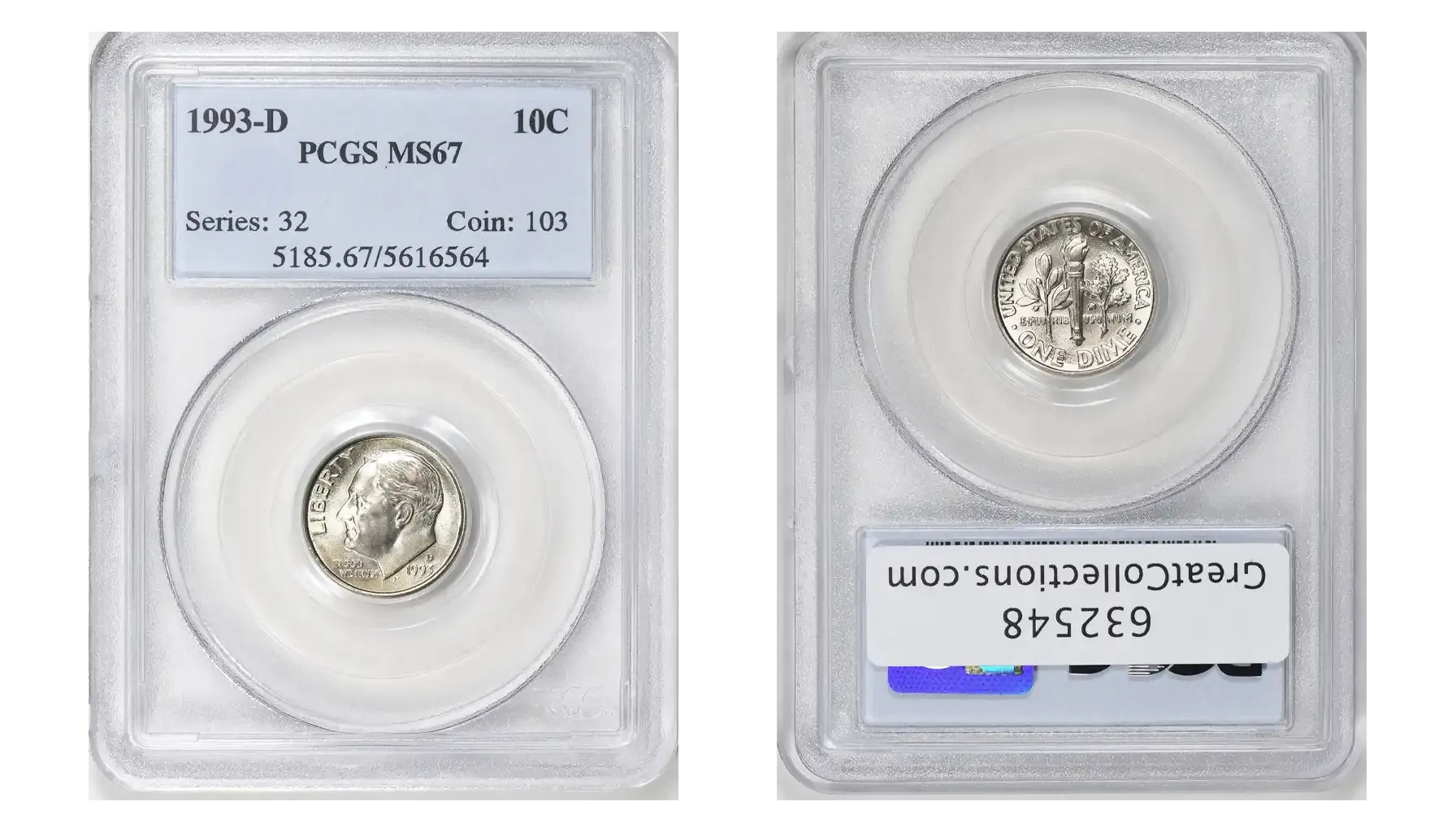
Obverse: Features a bust of Franklin D. Roosevelt, along with the inscriptions "LIBERTY" near the upper-left part of the rim, the motto "IN GOD WE TRUST" below Roosevelt's chin, a mint mark to the left of the portrait, and the year of mintage "1993" below.
Reverse: Displays a composition of three objects, i.e., a torch in the center, an olive branch to the left, and an oak branch to the right. As for the inscriptions, the design also demonstrates "E PLURIBUS UNUM" behind the composition (closer to the base), as well as "UNITED STATES OF AMERICA", and the denomination "ONE DIME" along the bottom rim.
The Main Features | |
Composition | Copper-nickel clad (outer layers: 75% copper, 25% nickel; core: pure copper) 90% silver, 10% copper (silver proof) |
Weight | 2.27 g 2.50 g (silver proof) |
Diameter | 17.90 mm |
Thickness | 1.35 mm |
Edge | Reeded |
Shape | Round |
Designer | John R. Sinnock |
Mint Marks | “P” for Philadelphia “D” for Denver “S” for San Francisco |
1993 Dime Types by Mint Mark and Composition
1993-P 10C
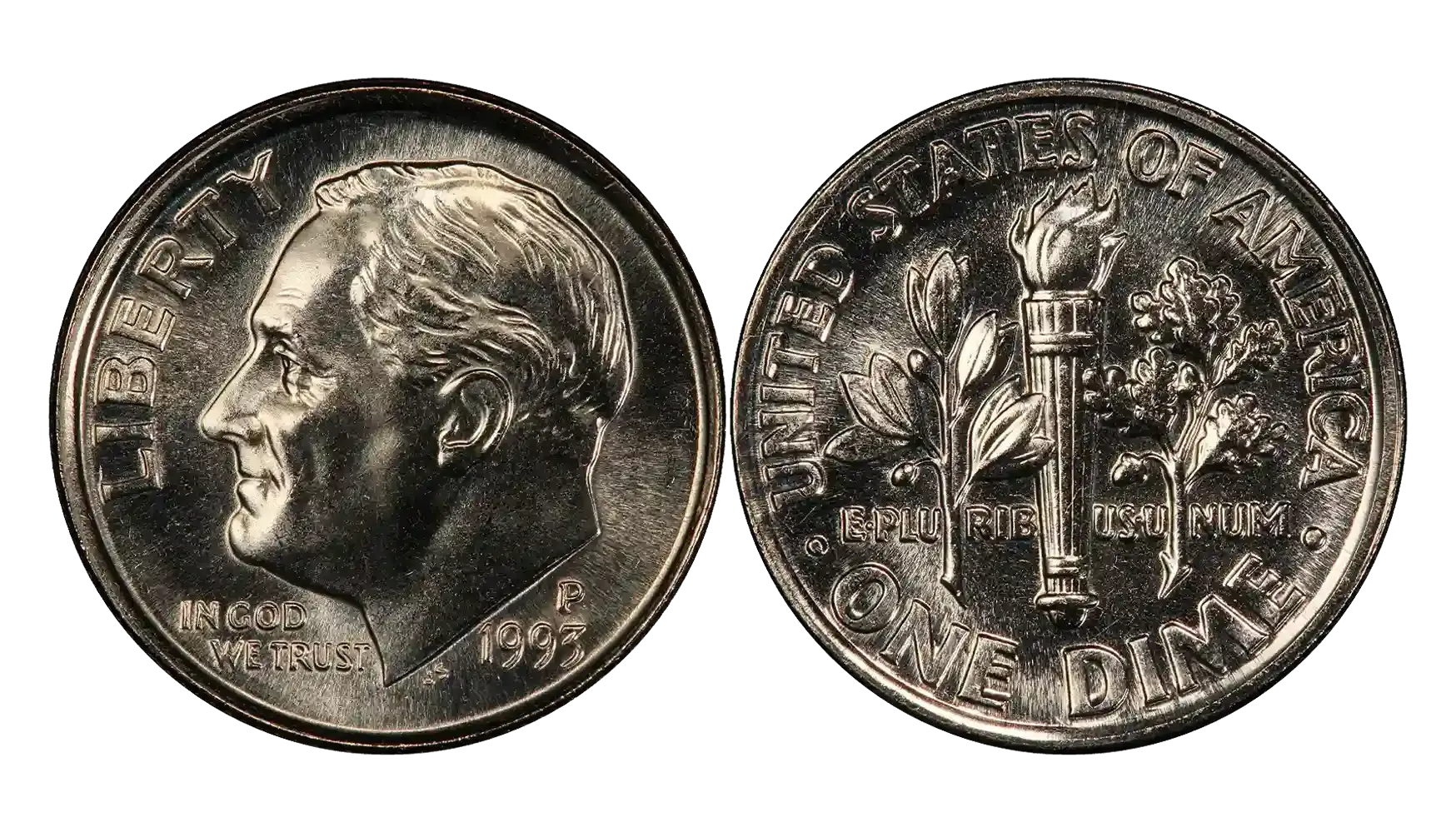
Produced by: Philadelphia Mint
Mintage: 766,180,000
Auction Record: $2,990 for MS62
The 1993-P variety is a high-mintage circulation issue, which was quite typical for early 1990s US coinage. Since these are abundant in circulated and lower Mint State grades, the 1993 P dime value in certified high-grade conditions may be immense (when compared to the rest).
1993-D 10C
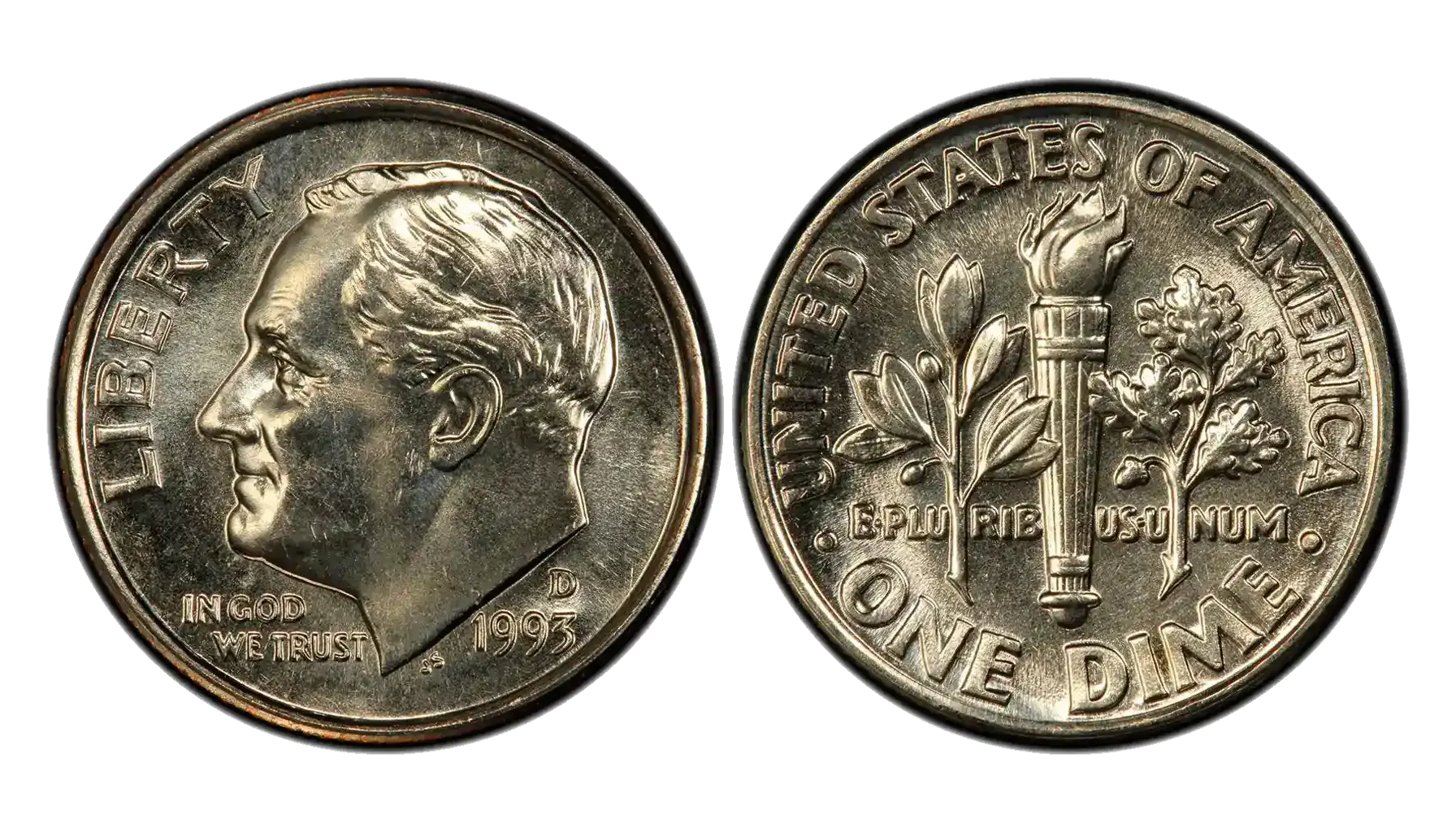
Produced by: Denver Mint
Mintage: 750,110,166
Auction Record: $700 for MS66FB
Although the overall quality of coins during the decade was gradually improving, the 1993-D dime was unfortunately associated with weaker strike characteristics, e.g., on the reverse torch bands. This was reported by multiple reputable numismatists, including Jaime Hernandez from PCGS, who checked the 1993 D dime value in real time.
1993-S 10C Clad (Proof)
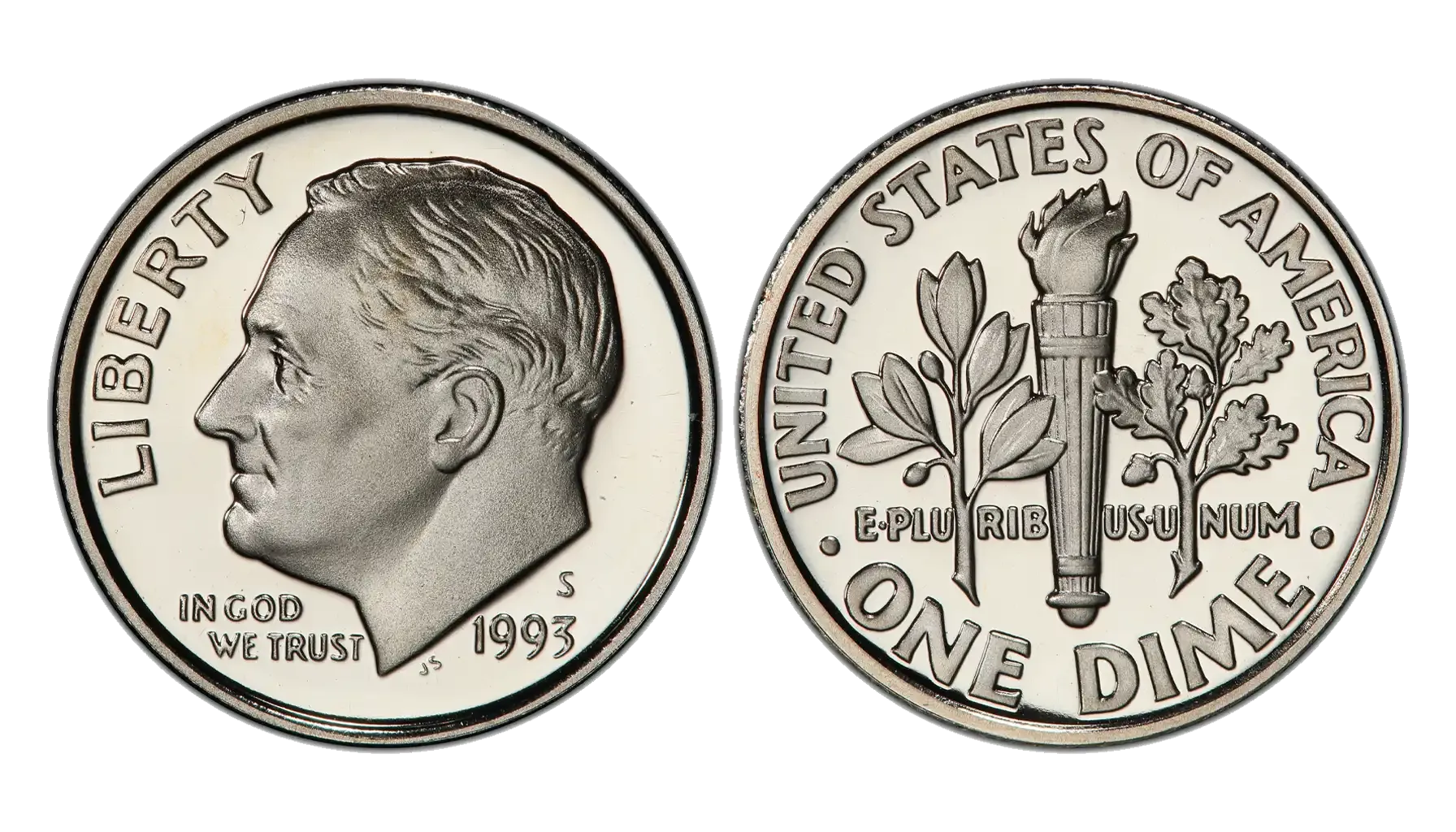
Produced by: San Francisco Mint
Mintage: 2,633,439
Auction Record: $633 for PR70
Proof editions of recent years tend to be less valuable from the collector's perspective, since they have been initially meant to be kept in collections in the end. This is why they are widely available across the grading spectrum (perfect condition included) – more than enough pieces were minted to meet the demand.
1993-S 10C Silver (Proof)
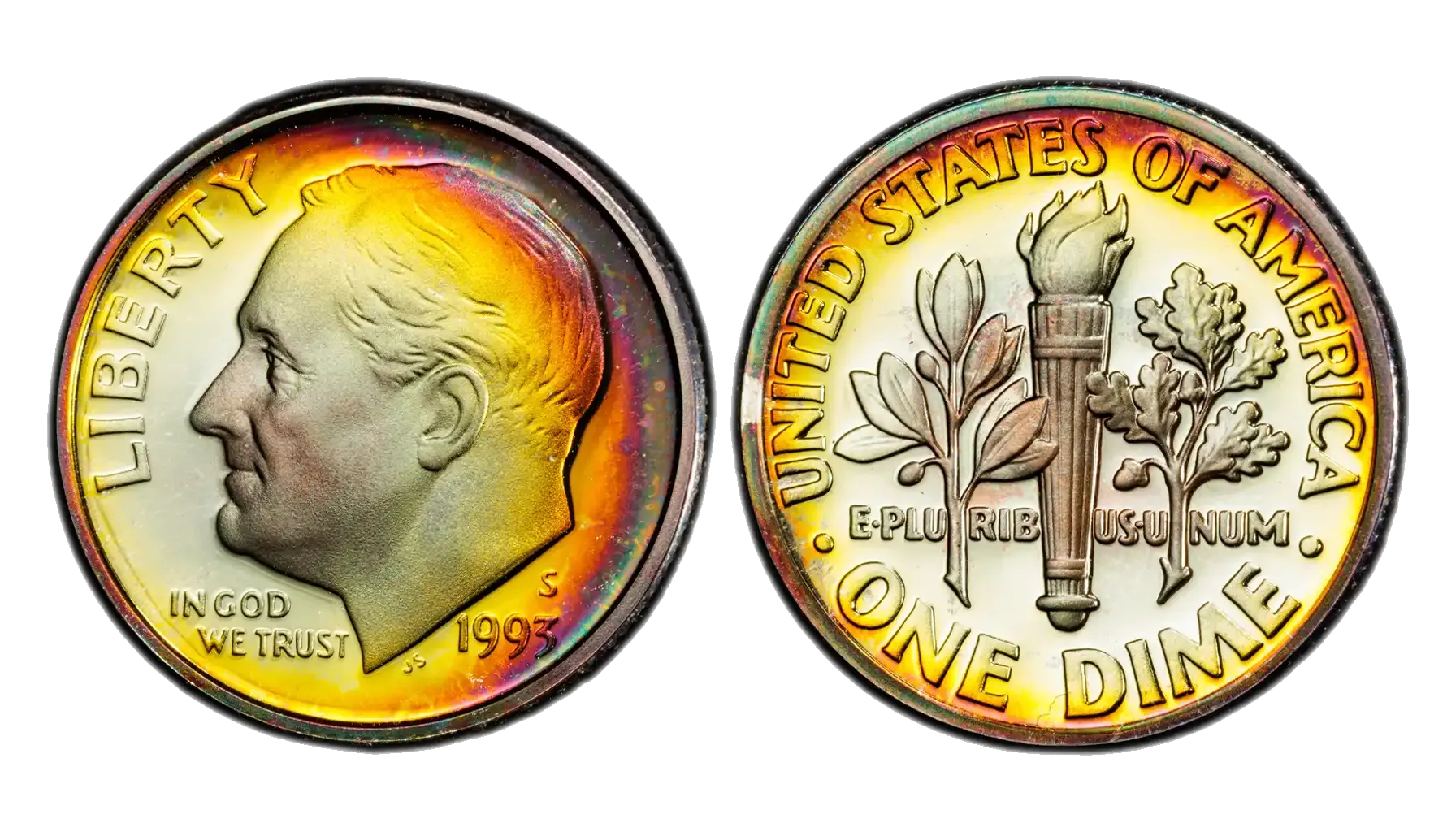
Produced by: San Francisco Mint
Mintage: 761,353
Auction Record: $414 for PR70
Interestingly enough, two dime types coexisted at the same time, and the silver variety was not the most valuable one. Nonetheless, its price is stable, thanks to the inherent (intrinsic) worth associated with its compositional characteristics.
How Much Is a 1993 Dime Worth
The price of these coins is not at its highest, since most examples were struck in large quantities. At the end of the day, it still depends on mint mark, strike type (circulation or proof), composition, and, most importantly, grade. So, how much could these numismatic creations cost today?
Coin Type | VG–XF | MS65/PR65 | MS67+/PR69+ |
1993-P 10C | $0.10 | $16 – $28 | $150 – $3,500 |
1993-D 10C | $0.10 | $24 – $65 | $1,550+ |
1993-S 10C Clad | – | $6 – $7 | $10 – $20 |
1993-S 10C Silver | – | $6 – $7 | $10 – $28 |
Prices may vary. For more relevant information and background details, please refer to Coin ID Scanner and other relevant software.
1993 Dime Error List with Values
An average 1993 P dime error list with pictures, as well as those referring to other types, usually includes the most popular coins that bear minting deviations, i.e., alterations from the standards that are considered rare. Since standard examples are so common, errors create precedents that distinguish select specimens from mass-produced issues and justify their numismatic appeal.
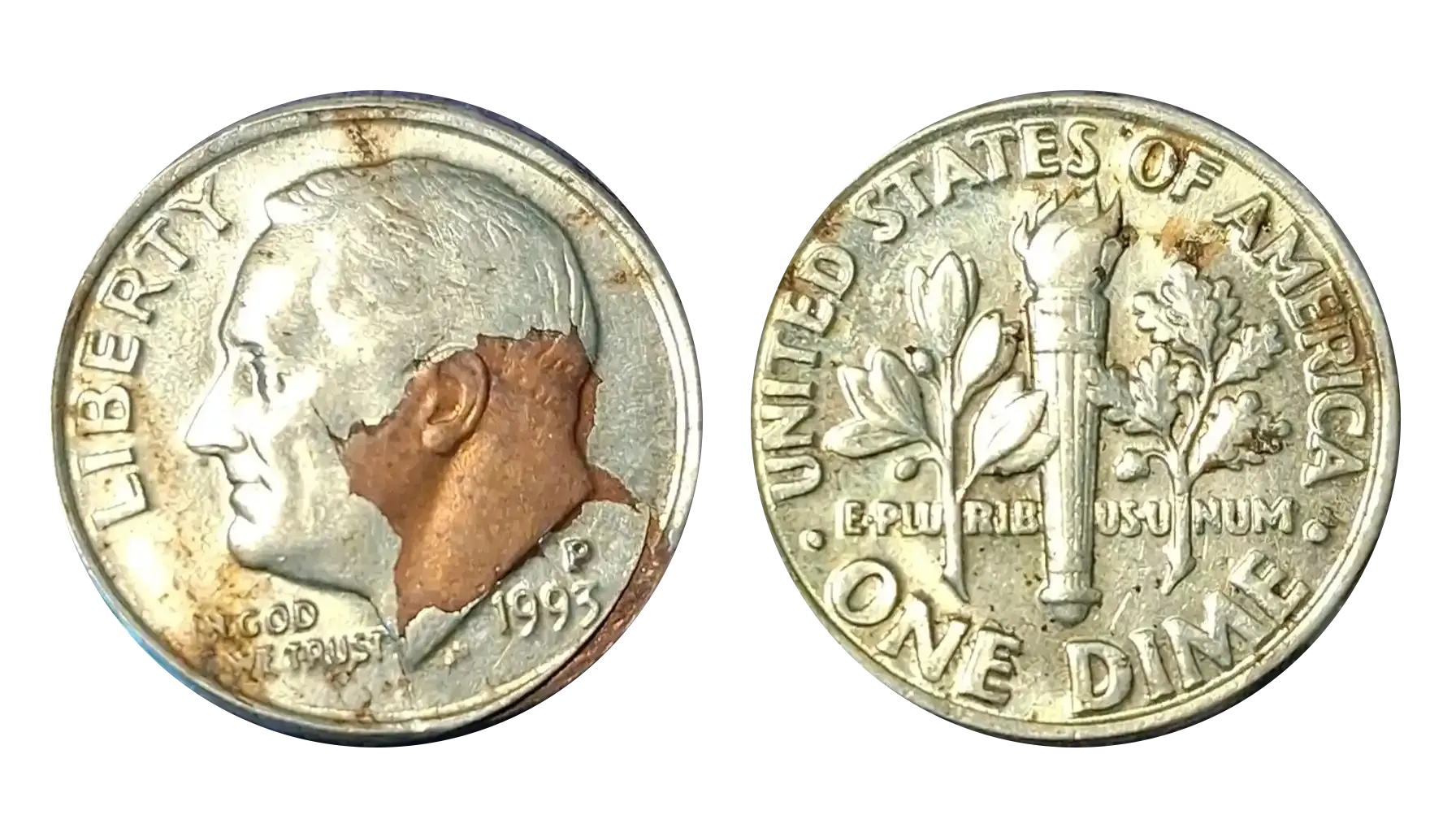
Common 1993 Dime Errors and Their Values Today
Double Denomination Error (Lincoln Cent on Roosevelt Dime) – up to $3,000
Off-Center Strike – up to $700
Missing Letters (Weak or Incomplete Design Elements) – up to $330
Erroneous Rims (Irregular or Distorted Edges) – up to $150
Broadstruck Errors – up to $100
Lamination Error – up to $75
Collections may start with the least noticeable samples. However, they may turn out to be the most valuable after all.

 Facebook
  X (Twitter)
  Pinterest
  LinkedIn