Contents:
An item as a denomination might be small, just 1/10 of a dollar. The old items from the iconic series, with history and a Roosevelt piece, might be just that. The MS-63 item is worth from $1.50 to $3.00 dollars on the online shop.
How Much Is a 1979 Dime Worth Today?
A collection would be very boring if the collectibles were all just plain and the same. Roosevelt pieces are worth today, just like almost any other item, and are distinguished by their mint marks.
A mint mark is a letter on the design, and it signifies the facility that made this item. Three facilities worked on this item:
Philadelphia – 1979 no mint mark dime.
1979-D (Denver): "D" mintmark.
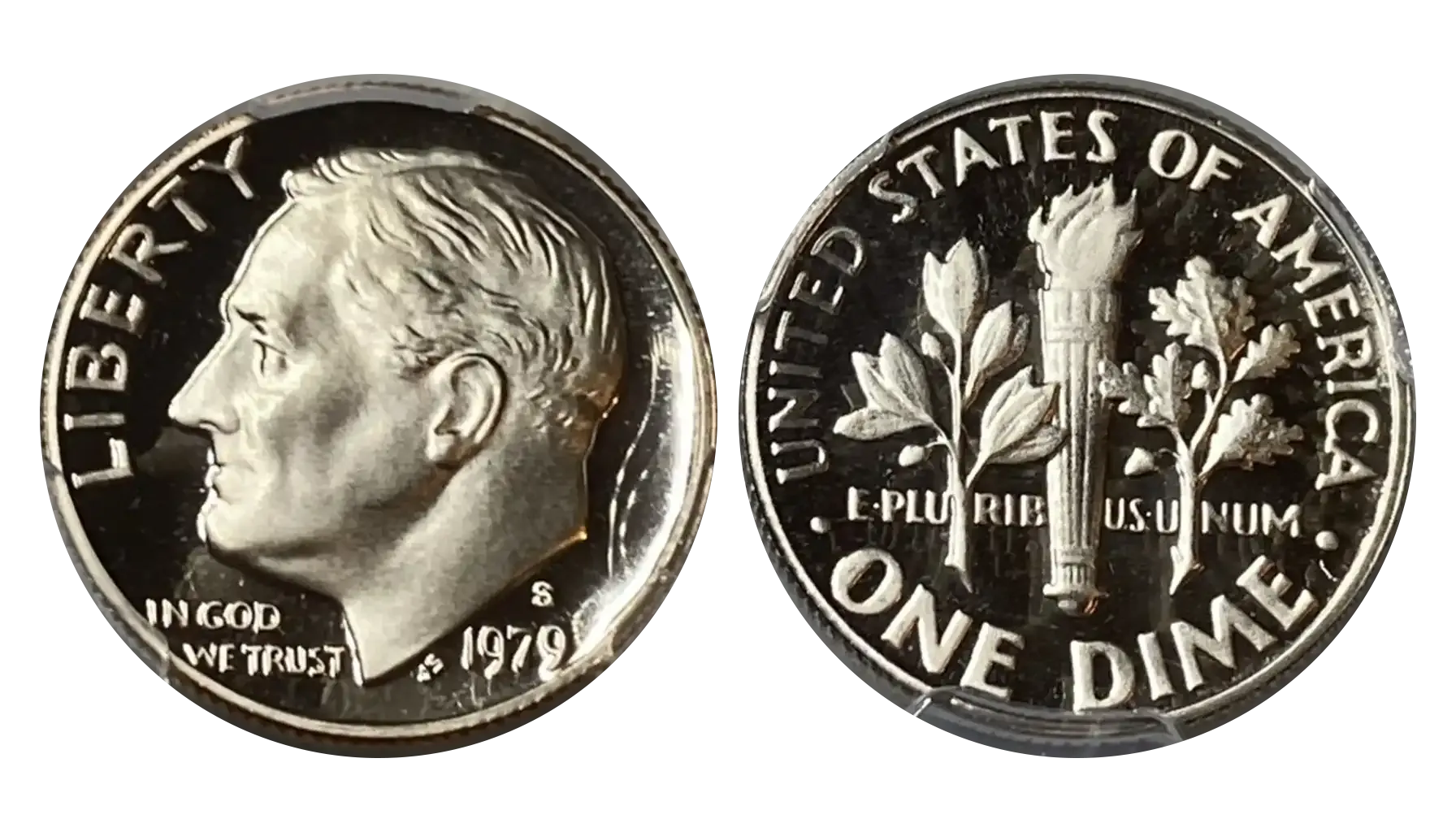
1979-S (San Francisco): Proof ones with "S" mintmark.
Collecting all the mint marks is hard but possible. Let’s now examine the differences among all these varieties.
1979 Dime No Mint Mark Value
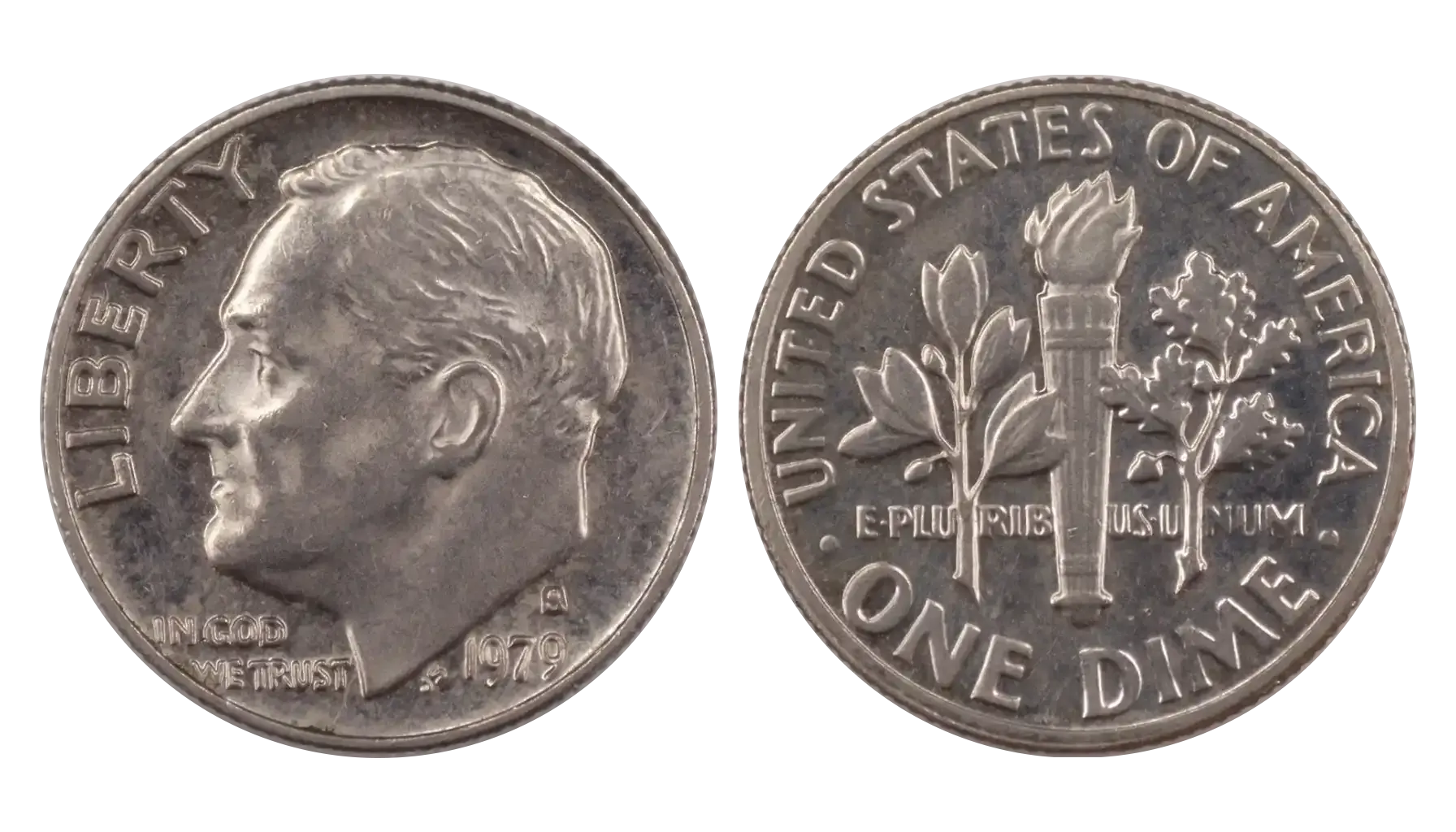
Look for: A blank space on the obverse under Roosevelt’s neck.
315,440,000
Estimated 1979 P Dime Value: $1.50–$10+
The Philadelphia ones had no mint marks, unlike Denver and San Francisco. Philadelphia made coins before them, and there was no need to distinguish the items from the older mint.
1979 D Dime Value
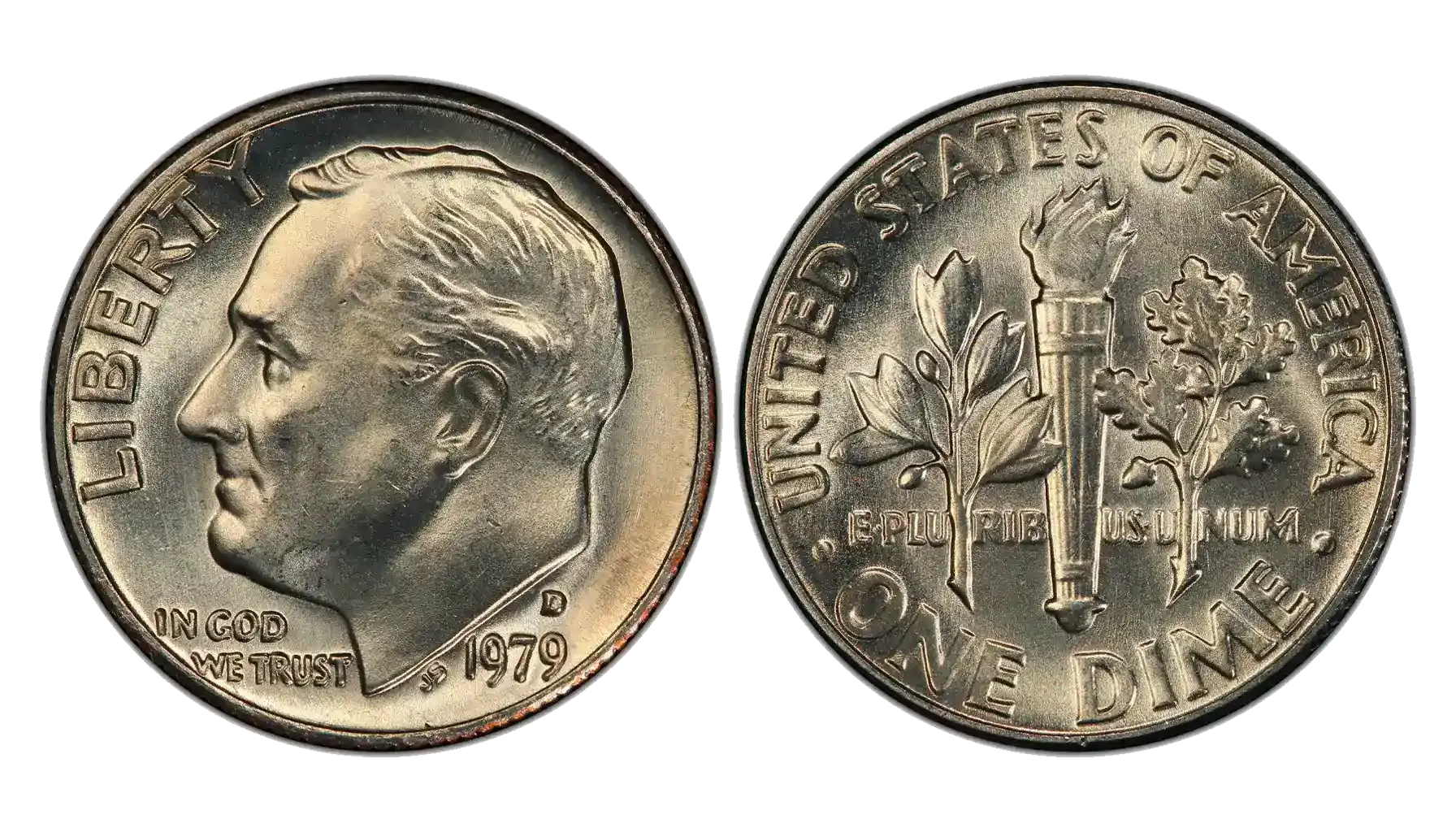
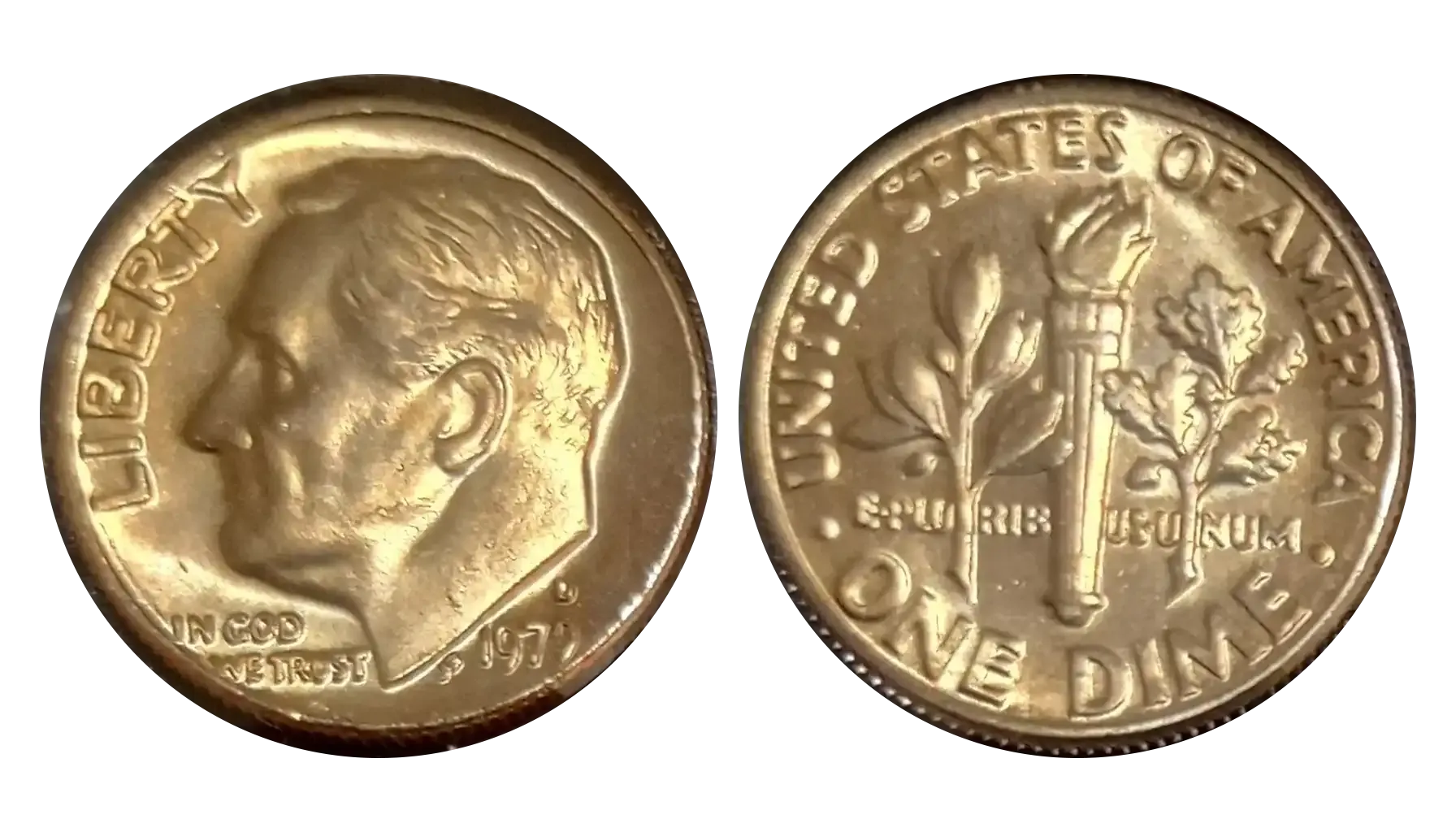
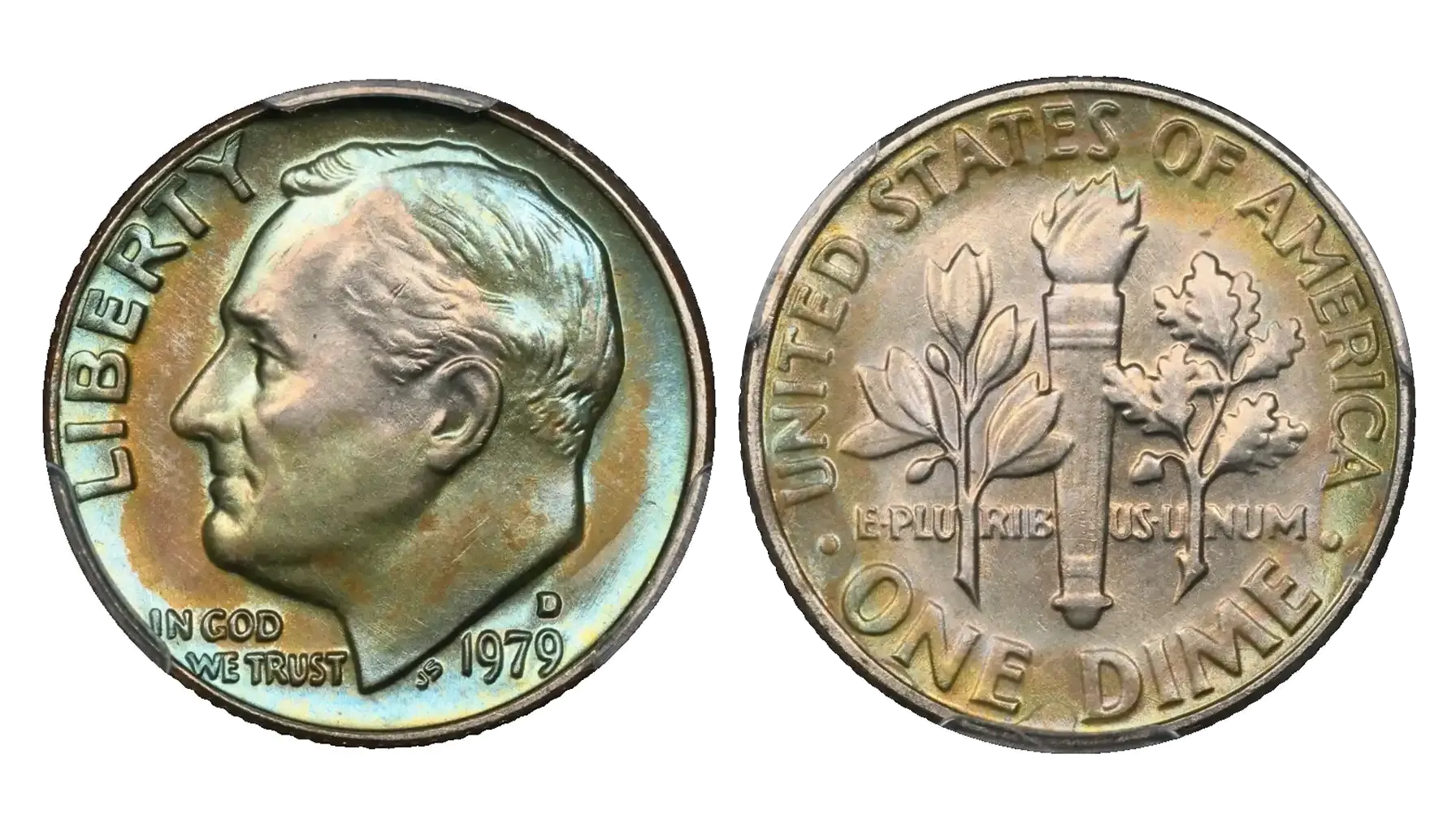
Look for: A “D” mark on the obverse under Roosevelt’s neck.
390,921,184
Estimated Value: $1.50–$10+
Denver made the most pieces in 1979. The mint facility expanded significantly in the late 1970s and 1980s.
1979 S Dime Value
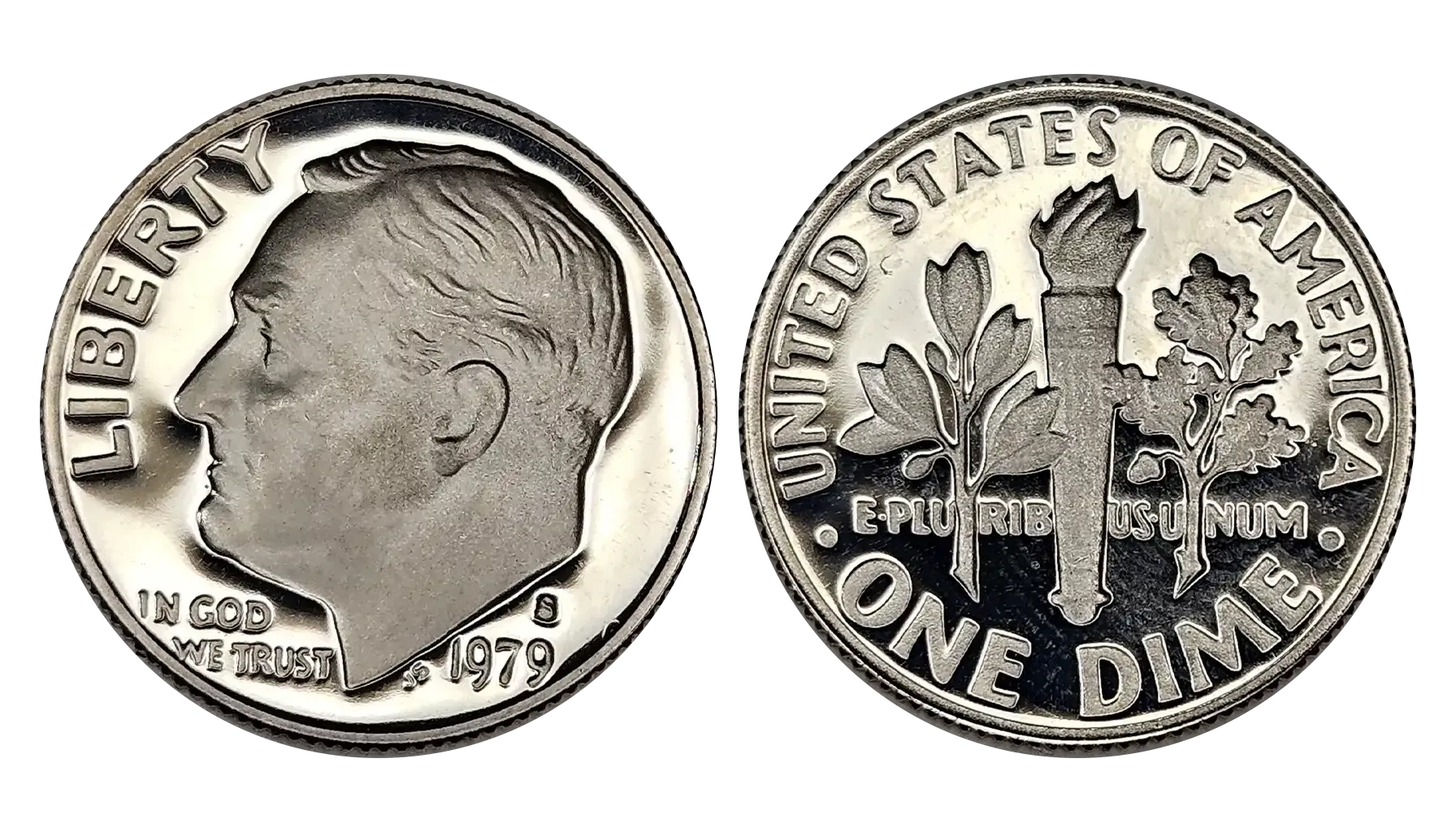
Look for: An “S” mark on the obverse under Roosevelt’s neck.
3,677,175
Estimated Value: About $3+ (filled), about $6+ (clear).
The San Francisco Mint had two different varieties. One had a filled-in S, and the other had a Clear S. The filled-in S pieces were more valuable. Having two different “S” was a common trend for these firms at that time. The 1981 dime also had filled and clear letters.
1979 Roosevelt Dime Overview
The Roosevelt series has been in continuous production since 1946, and is still used today, making it one of the longest-running U.S. designs.
Weight | 2.27 g |
Diameter | 17.90 mm |
Thickness | 1.35 mm |
Edge | Reeded |
Designer | John R. Sinnock |
Item Design
Who made this design and why Roosevelt? John R. Sinnock, the Chief Engraver of the U.S. Mint, designed both obverse and reverse. After President Roosevelt’s death in April 1945, there was a push to honor him on U.S. coinage. The president was very popular, pushing the country past the Great Depression and wars.
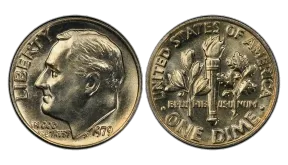
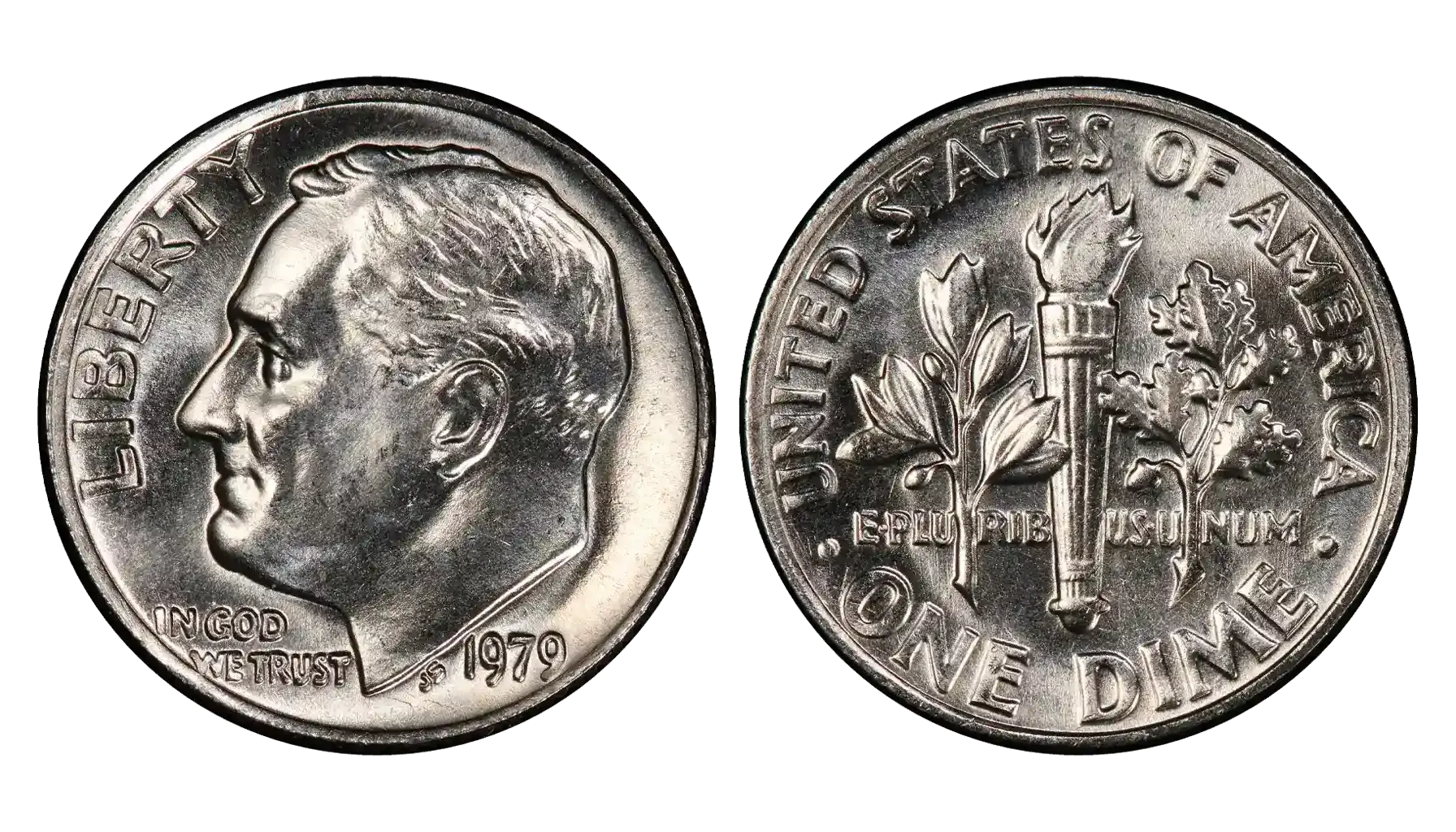
Obverse – portrait of Franklin D. Roosevelt. The inscriptions include "LIBERTY", "IN GOD WE TRUST", the year (1979), and the possible mintmark.
Reverse – features a torch in the center, flanked by an olive branch (peace) and an oak branch (strength and independence). Inscriptions include "UNITED STATES OF AMERICA", "E PLURIBUS UNUM", and "ONE DIME".
1979 Dime No Mint Mark Value: Is It Rare?
Before 1980, the Philadelphia Mint traditionally left the mint mark space blank on items. In that year, Philadelphia struck 706,361,184 of these coins. Because there are over 700 million in existence, they are extremely easy to find in circulation.
Grade | Philadelphia | 1979 D Dime Value |
MS-63 | $1.50–$3.00 | $1.50–$3.00 |
MS-65 | $8.00–$12.00 | $8.00–$12.00 |
MS-67 | $80–$100+ | $75–$100+ |
MS-68+ | $450–$800 | $500–$950 |
The S Proof Varieties
The San Francisco Mint produced two distinct types of S mint marks for the 1979 Proof sets. The Type 2 is significantly scarcer and more valuable.
Type 1 Filled S – The S is blobby or filled in. This is the common variety found in most 1979 Proof sets, $2–$15
Type 2 Clear S – The S is sharp, distinct, and has clear loops in the letter. This was a new mint mark punch introduced late in 1979, $30–$120+
1979 Dime Error List
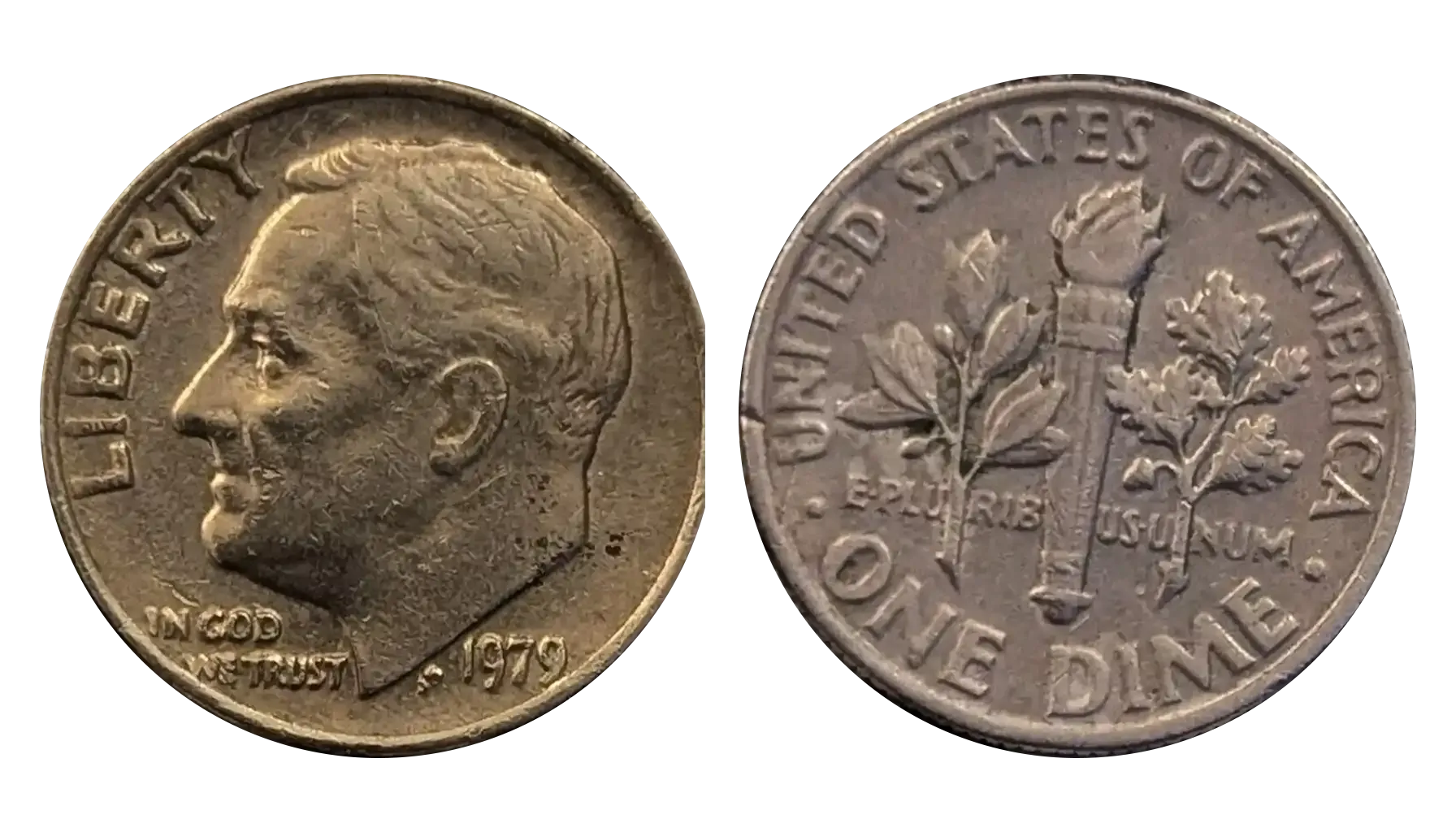
On top of grading, another factor greatly influences the value of the 1979 dime errors. Most items worth money have an error. Rare error items may have one or multiple mishaps, like:
Off-Center Strike
Clipped Planchet
Broadstrike
Double Die (Obverse or Reverse)
Die Breaks / Cuds
Transitional or Wrong Planchet Strikes
For better identification, look for the 1979 dime error list with pictures.
1979 Dime Error List With Identification Tips
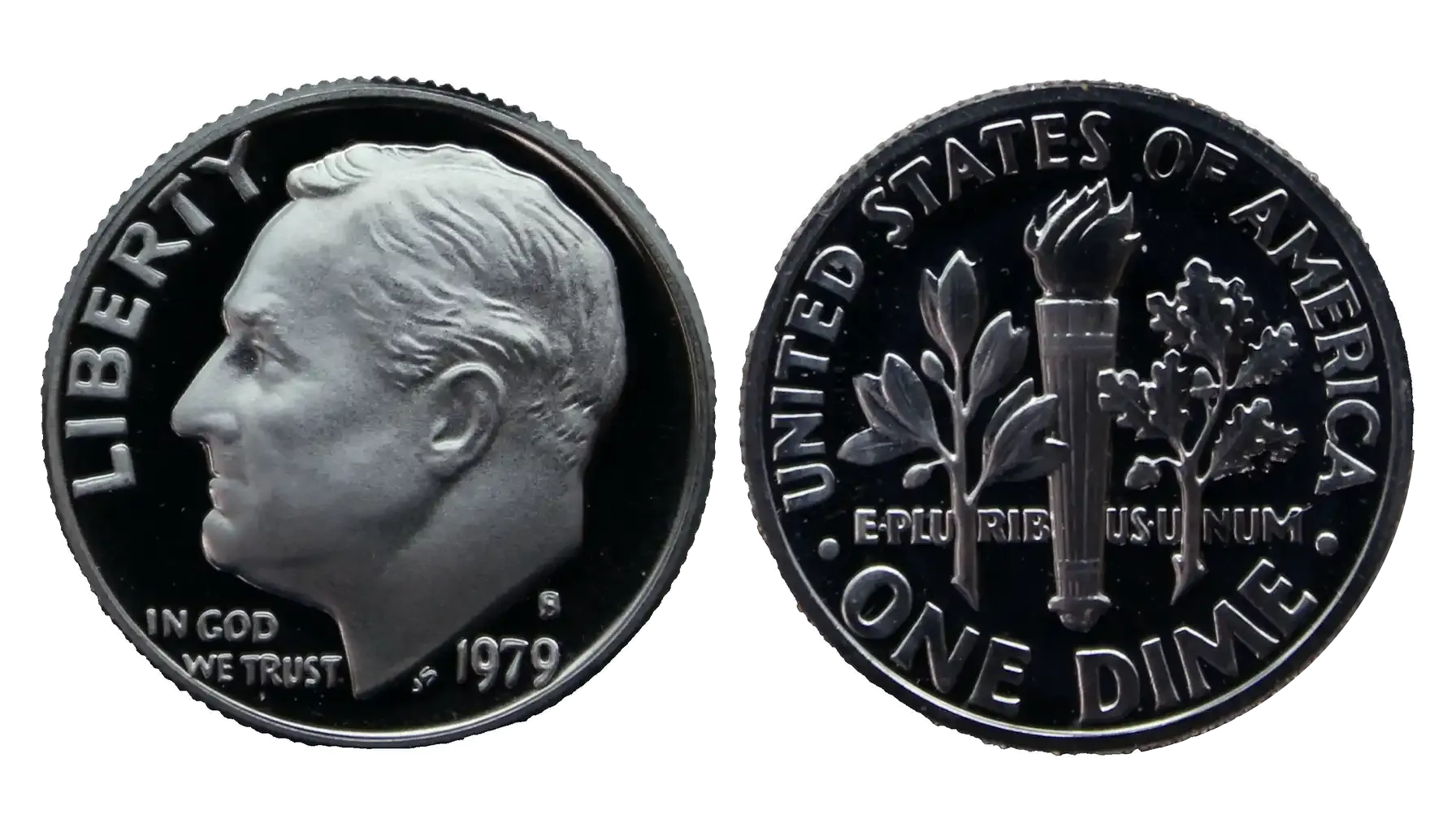
The No S Proof
This is the most significant error for 1979. It occurs only in Proof Sets. Look for an item with a deep, mirror-like finish and frosted details that lack an S mint mark.
Do not confuse this with a standard Philadelphia one. A common item has no mint mark but has a dull, satin finish. The No S error must have the mirror-polished surface of a collector's Proof coin.
$1,500–$2,500+
Off-Center Strike
This happens when the coin blank isn't centered when the dies hit it. Part of the design is missing, and a portion of the coin is blank. For the highest value, the date and the mint mark must still be visible on the 1979 D dime error list.
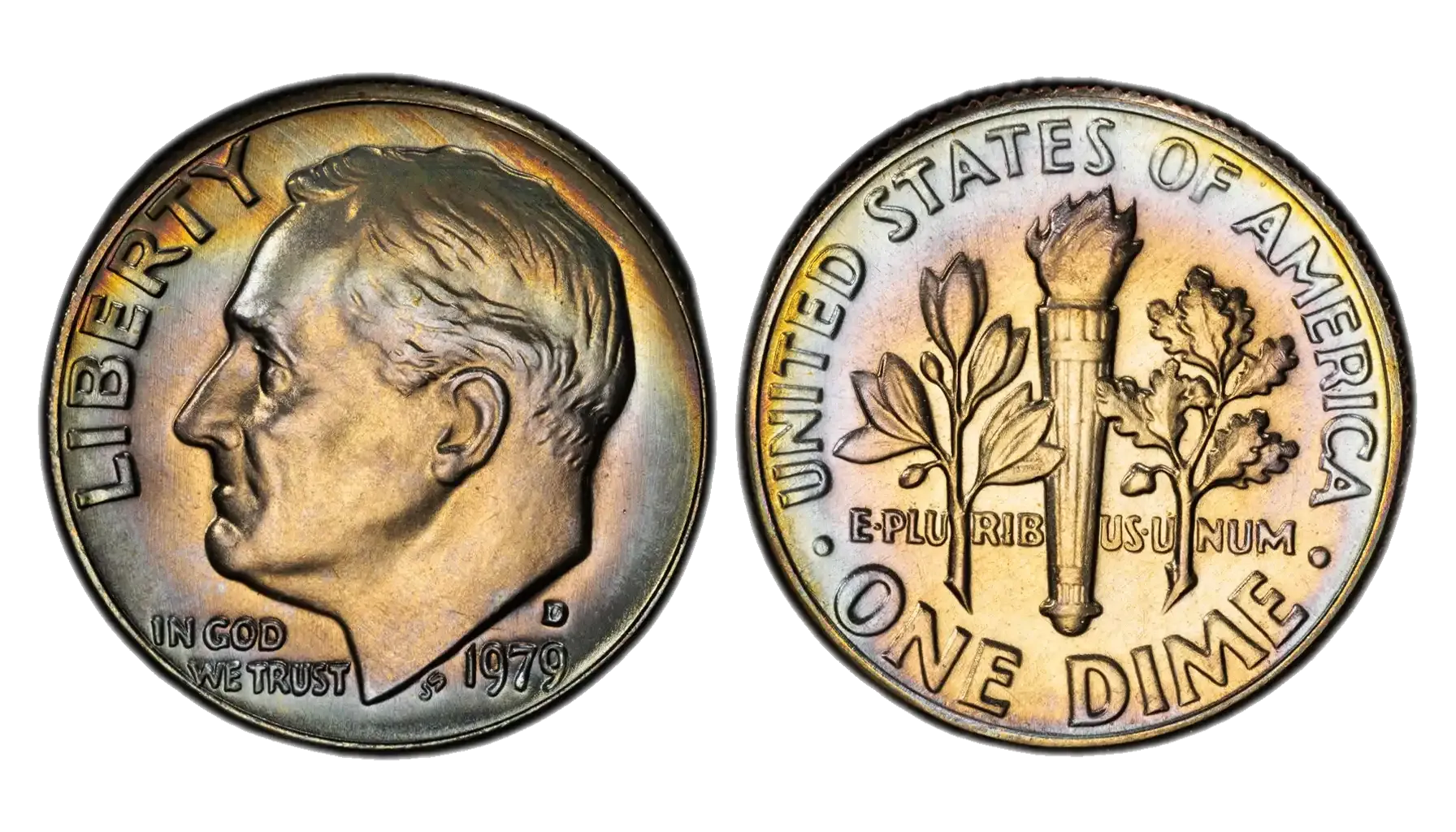
$20–$150+
Broadstruck Defect
This occurs when the collar is missing during the strike. The coin will be wider and thinner than a normal dime, and the edges will be smooth (no ridges/reeds). Compare it to a normal dime. If it’s significantly wider but the design is still fully present (not cut off), it’s a broadstrike.
$10–$50
Clipped Planchet
This happens when the machine that punches out the coin blanks overlaps with a hole already punched in the metal strip.
A crescent-shaped or straight piece is missing from the edge of the coin. Look for the rim directly opposite the clip, which will often be weak or flattened because the metal didn't have enough pressure to form correctly.
$15–$80
Die Cracks and Cuds
As the coin dies wear out, they develop cracks that fill with metal during striking. Raised, jagged lines of metal on the surface. If the crack is at the edge and forms a piece of metal, it is called a Cud. A die crack is raised. If the line is indented into the coin, it is just a scratch.
$5–$50
What Makes a 1979 Dime Valuable?
All of the mint marks we’ve just described are also graded. Grading helps determine the value of the coin and describes the overall state of the piece. The higher the grade, the more defined and appealing the coin is.
Feature | Details |
Date | Clear numbers |
Composition | Original metal mix |
Condition | Circulated or MS |
Full Torch | The horizontal lines on the reverse, which are separated |
Errors | Unique coin anomalies |
Clear S Type 2 Proof | Clear S mint mark |
Collectors Equipment
Optical Tools
The most valuable features of a piece, such as the shape of the "S" mint mark or the separation of the lines on the torch, are too small to see clearly with the naked eye.
10x Jewelers Loupe – is the industry standard. A 10x magnification is perfect for distinguishing a Type 1 (Filled S) from a Type 2 (Clear S).
Digital USB Microscope – many collectors use these to project the coin onto a laptop or phone screen. It is excellent for identifying die cracks or verifying the Full Torch (FT) lines on the reverse.
Measurement Tools
These are essential for identifying striking errors such as broadstruck coins or off-center strikes.
Digital Scale – a standard item should weigh 2.268 grams. If your coin weighs significantly more or less, it might be struck on a wrong planchet (a rare and valuable error).
Digital Calipers – to measure the diameter. A standard item is 17.91 mm. If the coin is wider than this and has a smooth edge, it confirms a Broadstruck error.
Specialized Lighting
Incandescent or LED Desk Lamp: Good lighting is critical to differentiate between a common 1979 dime value no mint mark, and the rare No S Proof. You need a strong light source to check if the fields of the coin have a mirror-like reflection, which is the hallmark of a Proof coin.
2026 Resources
AI Identification App like PCGS CoinFacts uses image recognition to help you identify varieties and provide instant access to the latest 2026 price guides.
High-Resolution Comparison Guides use sites like PCGS Photograde to compare your coin side-by-side with professional images of Mint State and Proof coins.
Check the 5 best free coin identification apps in 2026.
Is a 1979 Dime Worth Anything in Circulation?
Most everyday coins contain only a dime. A worn-out coin from a cash register or a parking lot won't pay for valuable purchases in today's world. Several factors increase the value of circulated coins compared to their face value.
First, the original luster and visible signs of wear. Second, if the coin has full bands on the reverse, it is valuable regardless of its appearance. Third, if the coin has a genuine coin defect, such as a double die or misaligned strike.
Advantages of Investing
The Condition Rarity – because items were workhorse coins for the economy, finding non-proofs in grades of MS-67 or MS-68 is difficult.
Low Entry Cost for Varieties – collectors can still find S Type 2 Clear S proofs at relatively affordable prices compared to older rarities. As more collectors attempt to complete sets, the demand is expected to remain steady.
Modern Accessibility – in contrast to the 19th-century rarities, items are still occasionally found in unsearched rolls or estate Proof sets.
FAQ
Is the 1979 dime worth anything?
For example, Denver 1979 dime D mint mark items in MS-68 reach $500–$950 dollars.
Does a 1979 dime have a mint mark?
The items have two main mint marks – D and S.
What is a 1979 dime made of?
1/4 of the item is copper.
Why are some 1979 dimes valuable to collectors?
Valuable item anomalies are a future investment for many professional numismatists.
Should a 1979 dime have a mint mark?
The pieces should have a mint mark, but the Philadelphia item is an exception.
What does a 1979 dime look like?
A metal composition gem with a Franklin D. Roosevelt portrait.

 Facebook
  X (Twitter)
  Pinterest
  LinkedIn