Contents:
In 1976, Canada became home to the Games of the XXI Olympiad, and to celebrate such a grandiose event, the Royal Canadian Mint introduced a vast series of Olympic coins. Among other things (5- and 10-dollar types, minted in silver), the program included two $100 units of currency, made of 14k and 22k gold.
The precious-metal content is the main constituent of the value formation of the 1976 Olympic 100 dollar gold coins, which gives them the intrinsic worth of approximately €973.76 (for 14k) or €1947.22 (for 22k) per piece. Nonetheless, the prices on the numismatic market may be far more impressive.
So, what is the main scope of the value of 1976 Canadian Olympic $100 gold coin 14k and 22k, and why may these figures significantly differ?
1976 Gold Olympic Coins Overview
The first Olympic Games ever held in Canada took place in the city of Montreal in 1976, but the national pride had already spread across the country before the competition even began. Although there were various media of public celebration and promotion, one of the most notable of them was the numismatic field. In fact, the Royal Canadian Mint released the first coin sets in the name of the Olympiad in 1973, and these came down to two $5 coins and two $10 types.
The idea behind the commemorative program was rather utilitarian: the government strived to raise funds to ease the financial burden of staging the Olympics and, at the same time, promote the event well ahead of the Games. The choice of numismatic creations, then, was predetermined, with higher denominations having been opted for within the program.
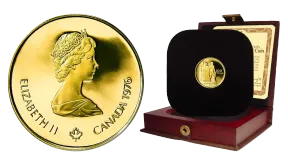
Even though the first Olympic issues date back to 1973, the special $100 gold issues were launched only in 1976, and there were two major types of the same denomination, i.e., the 1976 Olympic $100 gold coin 22k and the 14k varieties, sold by the Mint in brown or black leatherette cases and certificates of authenticity attached. In total, the 1976 program comprised 30 different commemorative types, two of which referred to Olympic gold.
“...The Mint planned to produce 30 coins, including 28 silver pieces <...>. It was the first time the Mint issued coins in denominations of $5 and $10. The coins were categorized into seven series, with each series configured into four-coin sets of two $5 coins plus two $10 coins.”
— The unknown author of the article “OTD: Montréal awarded 1976 Summer Games”
Canadian Coin News
Design and Specifications of the Gold $100 (1976)
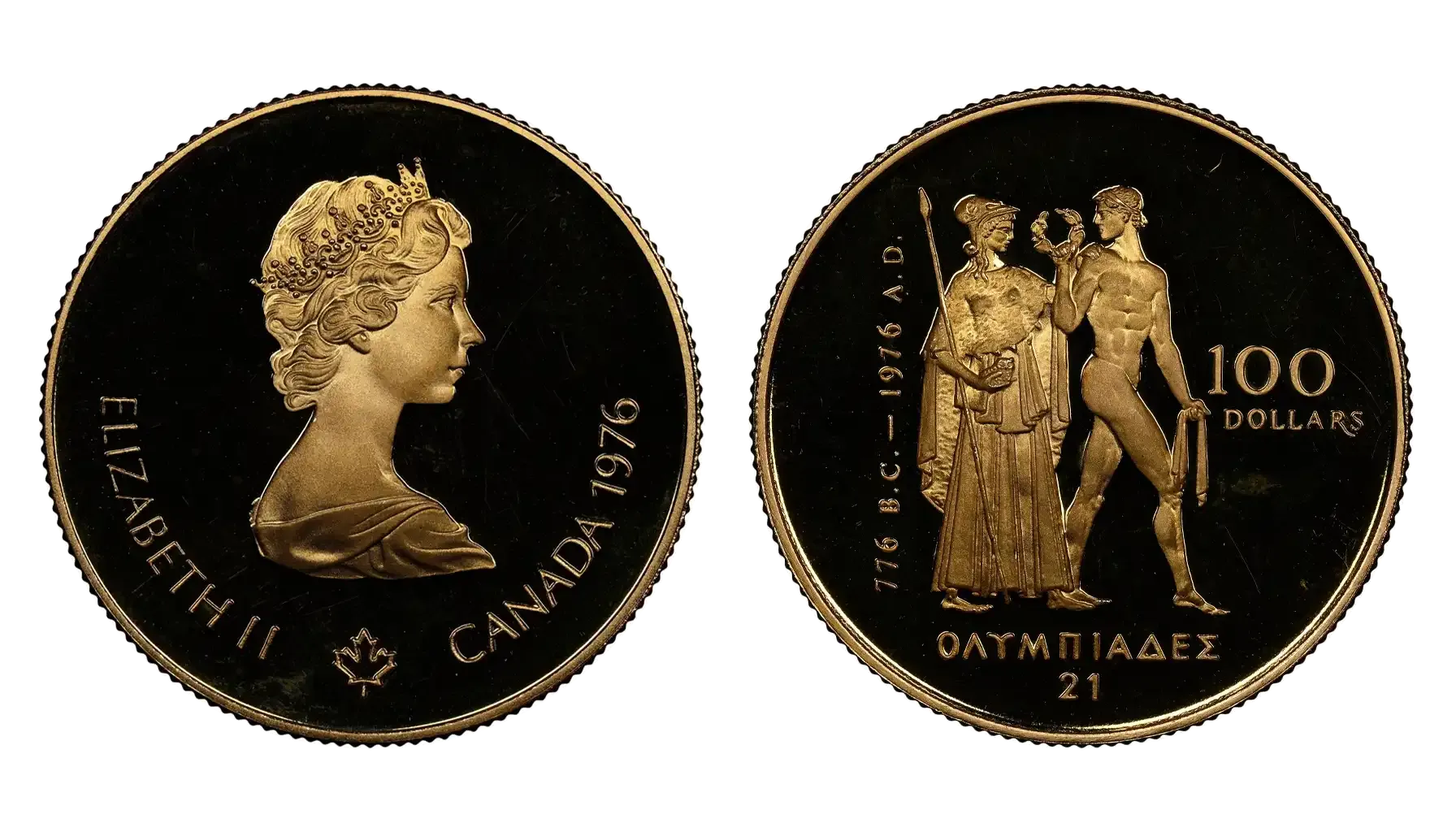
Obverse: Compatible with the other Crown-related issues of this type (e.g., the Olympic 50p coins from the UK), the obverse side of both types is the same, and it shows the classic portrait of Elizabeth II (as at 37 years of age) and the inscription “ELIZABETH II CANADA 1976”.
Reverse: The reverse, on its type, demonstrates the magnificent scene of a Greek maiden (presumably, Athena), approaching a naked athlete and leading him by hand, along with the denomination to the right of the composition, the date to the left, and the inscription “ΟΛΥΜΠΙΑΔΕΣ” below.
Feature | $100 Gold 14k | $100 Gold 22k |
Year | 1976 | 1976 |
Denomination | $100 | $100 |
Composition | 58.33% gold, 41.67% silver | 91.67% gold, 8.33% silver |
Gold purity | 14 karats | 22 karats |
Weight | 13.34 g | 16.97 g |
Fine gold content | 7.78006 g | 15.5527 g |
Diameter | 27 mm | 25 mm |
Thickness | 2.2 mm | 2.2 mm |
Edge | Serrated/reeded | Serrated/reeded |
Mintage | 650,000 | 350,000 |
1976 Canadian Olympic $100 Gold Coin Value
From the very beginning, the Canadian Olympic $100 gold coin Montreal 1976 was seen as a precious commemorative that was distributed only via the Royal Mint. Since the government intended to gain profit from selling the program's issues, the prices were standard and uniform, slightly above the face value. Today, however, the baseline worth is mainly determined by bullion content rather than the initial rate.
14k original issue price: $105
22k original issue price: $150
14k bullion value: €973.76
22k bullion value: €1,954.42
The bullion value is formed on the basis of the melt value of the precious metal, i.e., the actual gold weight multiplied by the current market price of gold. The rates fluctuate daily, and these figures may change, too.
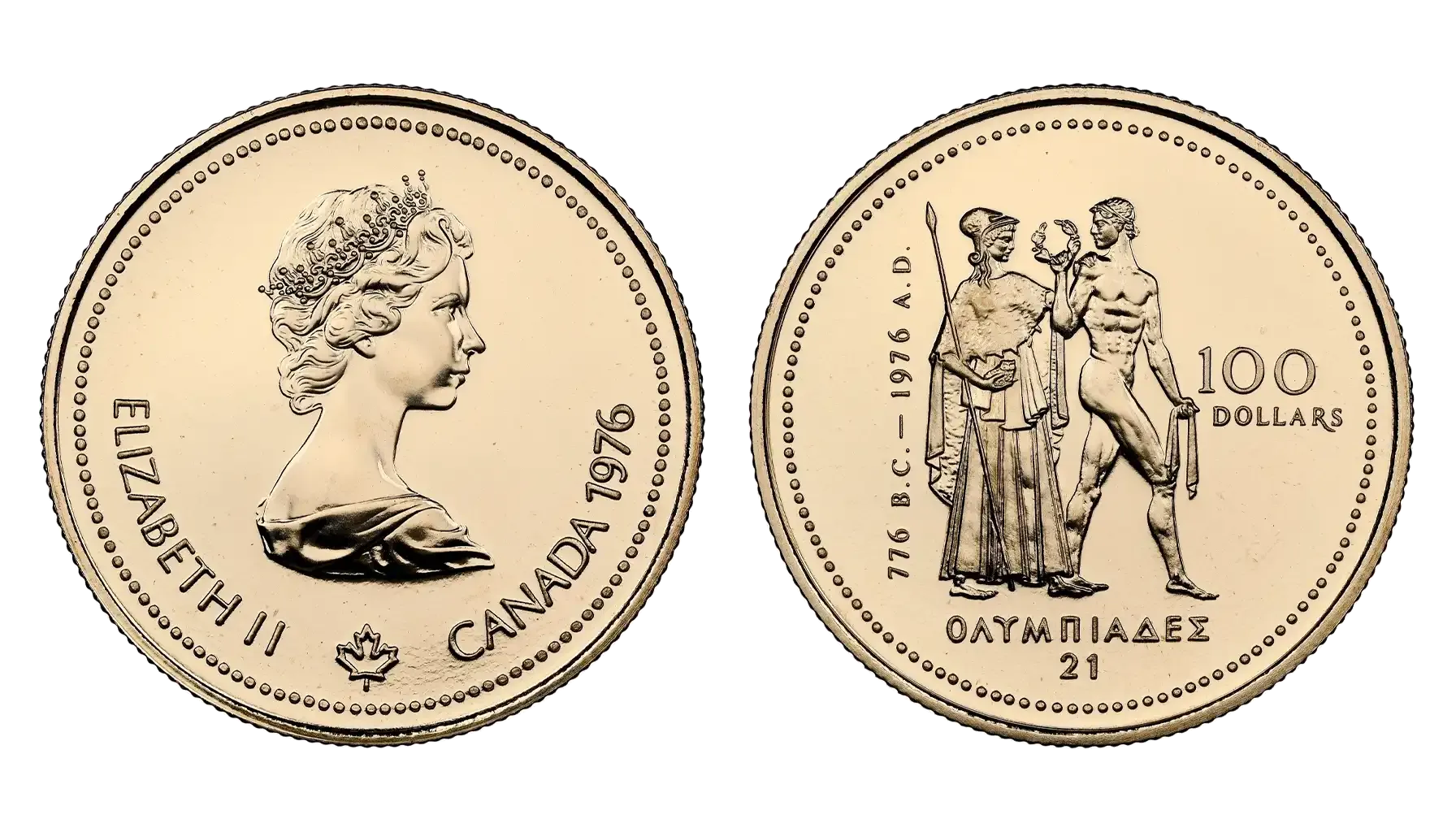
1976 Olympic Gold Coin Value 14k Uncirculated
The "least valuable" of those two varieties is the 1976 14k Olympic gold coin. Although it is not as expensive as its counterpart, the issue is still considered one of the best-known gold commemoratives from the Montreal Olympic program. The price figures are usually tied to its precious-metal content, as it is composed of .5833 fine gold, weighs about 13.34 grams, and bears 0.25 troy ounce of pure gold.
For uncirculated examples, auction prices may be a bit higher than the bullion value and its nominal worth. Public records from Heritage show that certified MS68–MS69 Deep Prooflike pieces have recently sold at the price of $700 and above, yet the current metal rates still matter.
Date | Auction platform | Grade/status | Realized price |
30 Dec 2025 | Heritage | MS69 Prooflike | $1,050 |
30 Dec 2025 | Heritage | MS69 Prooflike | $900 |
26 Oct 2025 | Heritage | MS69 Prooflike | $825 |
26 Oct 2025 | Heritage | MS69 Prooflike | $825 |
18 Sep 2025 | Heritage | MS69 Prooflike | $1,080 |
26–28 Mar 2026 | Coins NB E-Auction 55 | Unspecified | €940 |
25–30 Oct 2019 | Canadian Numismatic Company | Unspecified | C$425 |
1976 22k Olympic Gold Coin Value
Even though it is quite predictable, the 1976 Olympic gold coin 22k value may also show extraordinary results. This numismatic creation contains 0.5002 troy ounces of gold, so its value is much more heavily tied to bullion from the outset.
Auction records prove that some uncertified or raw instances may be sold for lower prices (above the average). The top-end, however, may offer fine coins of $1,800s to low-$1,900s per piece. According to the Numista statistics, the average worth of the UNC proof version is €2,000, which is ~$2,303.
Factors Affecting the $100 Olympic Gold Coin 1976 Value
Gold content and purity: The prices are based on how much precious metal each unit contains. Since the 22k variety is richer in gold, it usually carries the higher intrinsic value.
Current gold rates: As is connected with the previous factor, the prices of metal on the bullion market define a baseline value and can raise or lower it over time.
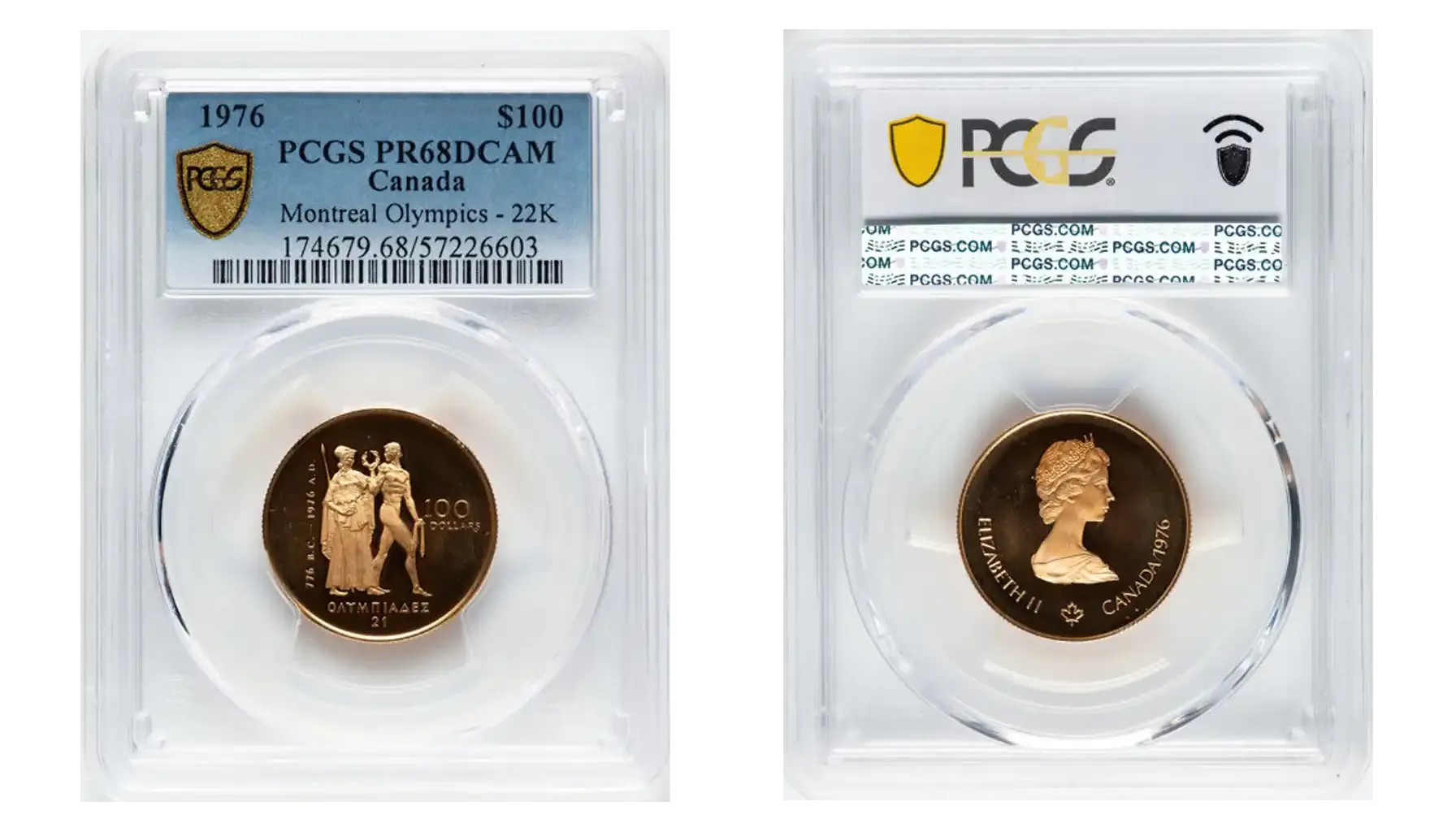
Certification and grade: All the coins within the series should have been graded and authenticated by the Mint itself, yet some may also bear presents from major grading services like NGC or PCGS.
Original packaging: The presence of the case and certificate of authenticity also proves the origin of the coin and boosts the prices for good.
Market venue: Different price levels may be formed because of dealer offers, private sales, and public auctions.
The Story of a Hidden Worth… How to Check the Coin Price?

Commemorative coins are also mysterious and complex, as their prices differ from the main course. Yet, this complexity is the reason why the value may be surprisingly low or high. To check the most basic features of the coin and understand its numismatic potential, there is no need to be an advanced specialist. Only the right tools may reveal hidden details.
Coin ID Scanner is an innovative application for iPhone and Android that may help one explore and analyze coins right on the spot – just take a picture of the item and watch it work. What Coin ID Scanner may offer is:
Coin identification by photo right in the app
Numismatic analysis and an extensive database (features, specs, background, and reference value ranges, according to the recent sales)
Collection management
Collecting materials for those who need to learn more
...and even more.
One story with two representations. Choose yours and rest assured: these coins will be even more valuable than ever; metals never depreciate.

 Facebook
  X (Twitter)
  Pinterest
  LinkedIn