Contents:
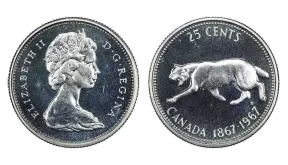
The quarter, along with the Canadian nickel, is one of the most common coins in Canada, and its first instance, which is completely different from those of modern circulation, entered the numismatic scene in 1870. Over the years, it went through six major design iterations (according to the ascent to the throne), numerous commemorative programs, and several changes in composition, mintage, and standard intrinsic worth.
Here is the record: in 2014, at the high end, Heritage Auctions sold the 1902-H 25C Edward VII Specimen at the tremendous price of $70,500 per piece. The average values for well-worn units from regular circulation, however, do not usually exceed the nominal price, i.e., 25 cents. So, what is the current 25 cent Canadian coin value, and which units of currency are the most profitable to own?
Overview of the Canadian 25 Cent Coin
The quarter coin was not among the first numismatic creations that appeared in the decimal numismatic framework in Canada. The initial attempts to standardize and simplify the monetary system were made in 1858, and by the late 1860s, it had become obvious that the earlier 20-cent pieces were not truly appropriate for everyday circulation.
Even though the denomination was associated with older colonial accounting, which seemed more reliable and coherent, it was mainly considered inconvenient in use and was also too often confused with the American quarter, recognized as part of the common monetary tradition of wider North American trade. As a response, after Confederation in 1867, the Dominion opted for a new decimal unit, i.e., the 25-cent piece that would replace its closely related 20-cent counterpart.
The first quarter was produced only in 1870 by the Royal Mint in Britain, for the Royal Canadian Mint did not exist yet. This was a major step, as Canada had to balance two influences, i.e., British colonial monetary traditions on one hand and the practical realities of North American trade on the other. The quarter, as well as other decimal denominations, was seen as a compromise between the inherited imperial standards and widespread commercial use.
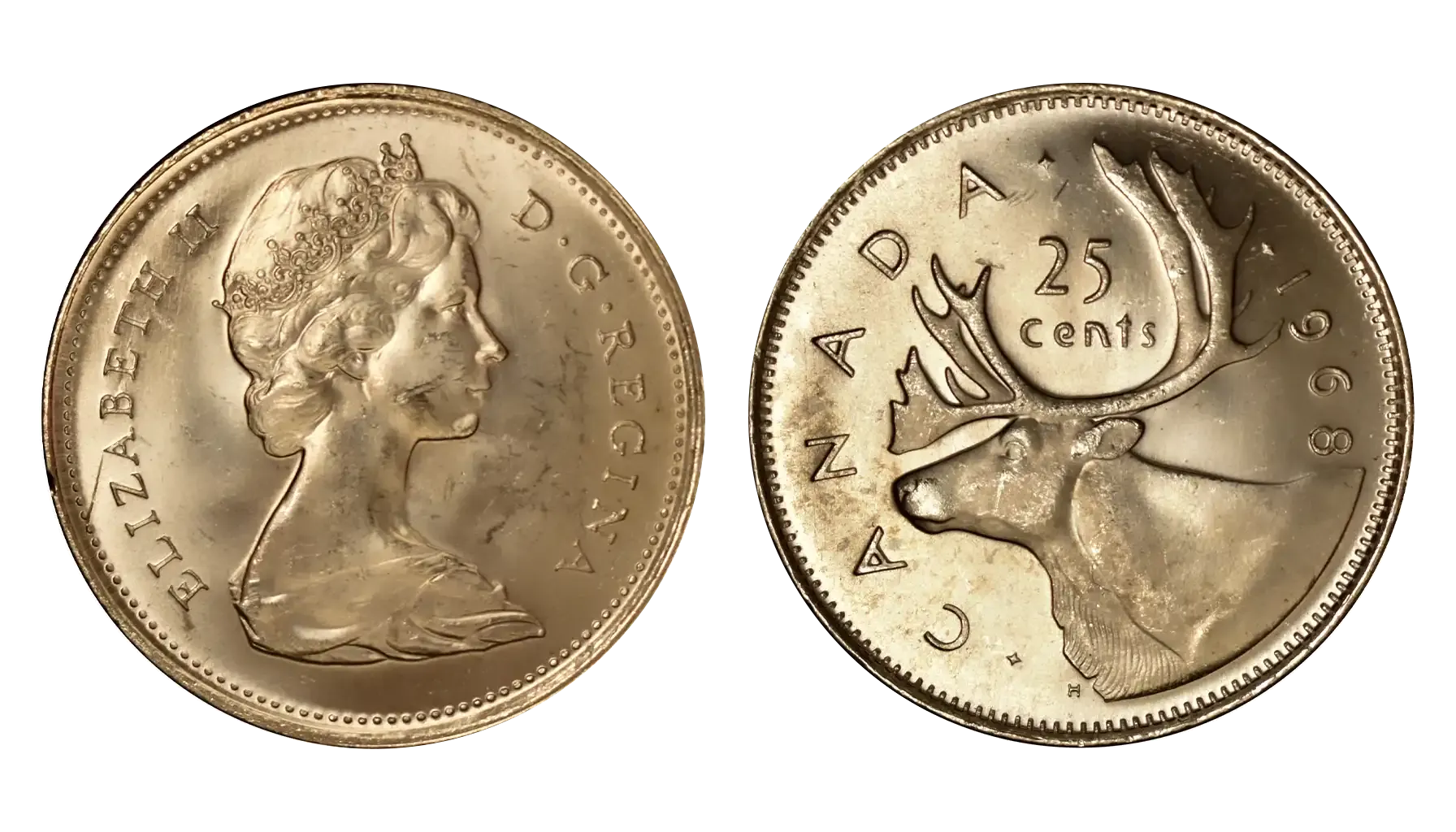
“The caribou on the 25-cent piece dates back to 1936 when a change in the sovereign's effigy image on circulation currency prompted the Canadian government to modify the designs on the reverse side of coins as well. The caribou design was created by Canadian artist Emanuel Hahn and was first used in 1937.”
— The unnamed representative of the Royal Canadian Mint
The Royal Canadian Mint, “25 CENTS” page
Main Quarter Types by Monarch
Victoria (1870–1901): The first Canadian quarters were issued during the reign of Queen Victoria, and they bore the image of the crossed maple boughs on the reverse side.
Edward VII (1902–1910): These units continued the general early format of the denomination, i.e., the reverse design, composition, and size.
George V (1911–1936): Although the 25-cent coins of this period initially followed the same pattern, a major composition change took place in 1920. The silver purity was reduced to .800.
George VI (1937–1952): In 1937, with the accession of George VI, the quarters were redesigned, as old maple boughs were replaced with a new caribou reverse by Emanuel Hahn.
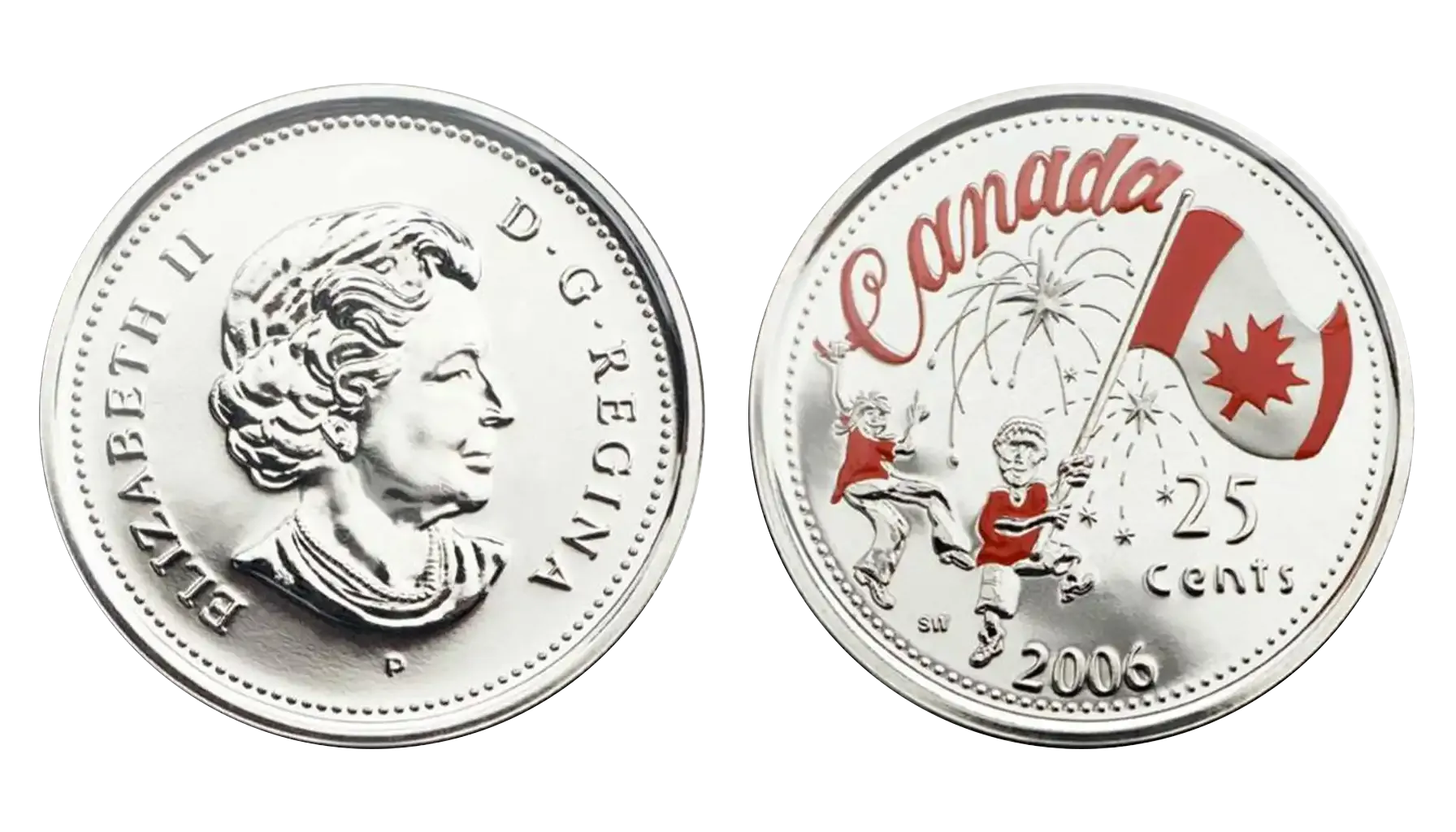
Elizabeth II (1953–2022): This is the largest and most diverse group of coins of its kind. It includes several obverse iterations, commemorative programs, special editions, Olympic coins, and extraordinary types.
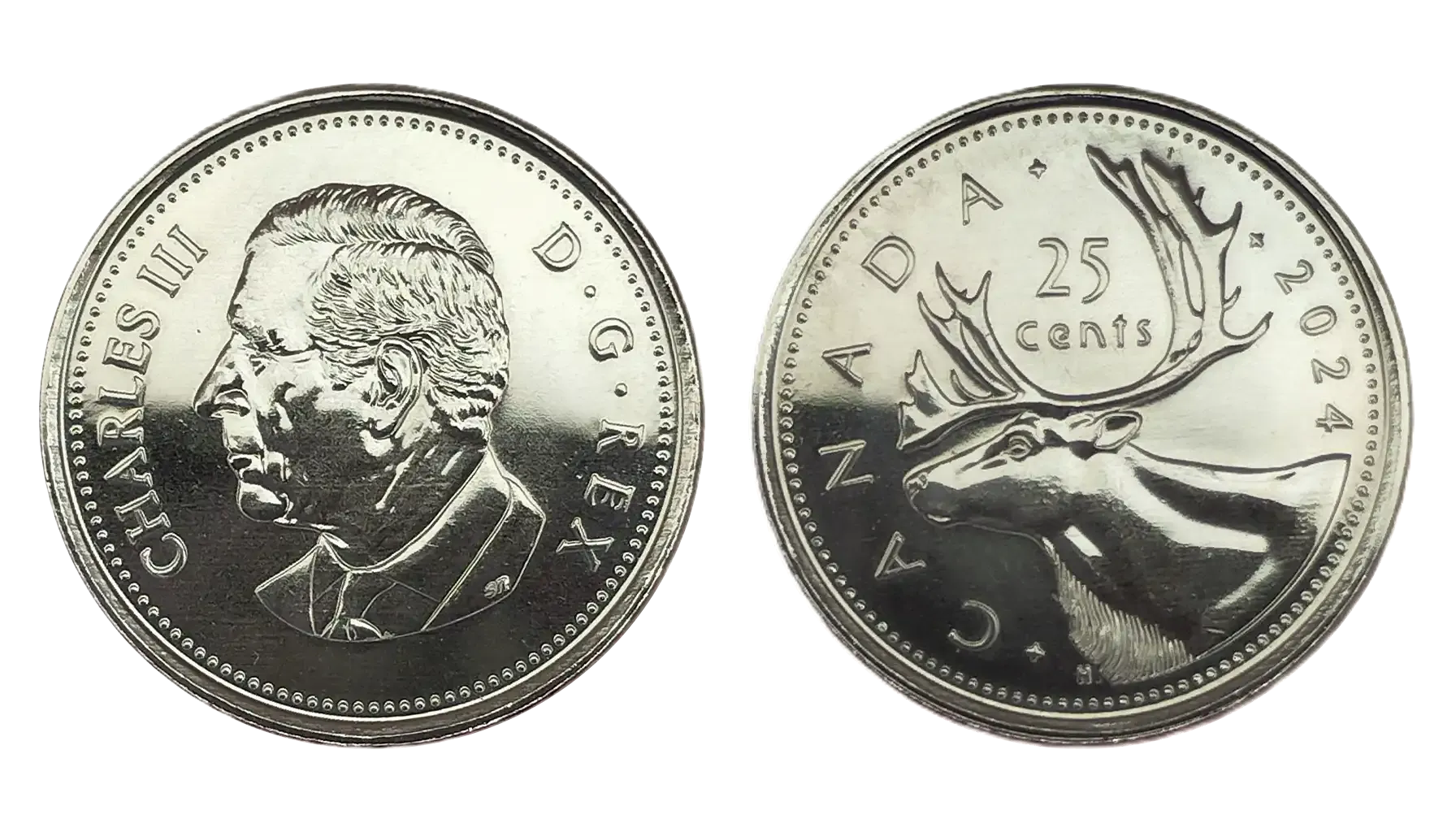
Charles III (2023–...): Here comes the current Canadian quarter series, bearing the portrait of King Charles III on the obverse and the already classic caribou on the reverse side.
Design and Specifications
Obverse: Usually carries the portrait of the monarch and the title of the sovereign (e.g., “CHARLES III D·G·REX”, standing for “Charles III, by the Grace of God, King”).
Reverse: Features either crossed maple boughs (for older versions) or the caribou design (since 1937), as well as the name of the county and the denomination “25 Cents”. Commemorative and special-edition coins may bear different designs, though (no standards applied).
General Features of 25-Cent Coins | |
Denomination | 25 cents |
Country | Canada |
Years of issue | 1870–present |
Shape | Round |
Edge | Reeded/milled |
Diameter | 1870–1952: 23.62 mm 1953-...: 23.88 mm |
Thickness | ~1.3–1.8 mm |
Weight | 1870–1910: 5.81 g 1910–1967: 5.83 g 1967–2001: 5.05 g 2001–...: 4.40 g |
Composition | 1870–1919: 92.5% silver, 7.5% copper 1920–1967: 80% silver, 20% copper 1967–1968: 50% silver, 50% copper 1968–2001: 99.9% nickel 2001–...: 94.0% steel, 3.8% copper, 2.2% nickel plating +special editions, made of silver and gold of different purity levels |
Canada 25 Cent Coin Value by Year
As a rule, the prices of numismatic creations of regular circulation should not exceed the face value or the intrinsic worth, based on the current metal rate. However, when it comes to more prominent, interesting pieces, the value revolves around the date, rarity, and grades.
Years | VG | F | VF | XF | AU | UNC |
1870–1901 | €19–€34 | €21–€190 | €27–€920 | €65–€1,200 | €150–€1,700 | €450–€36,000 |
1902–1910 | €11–€21 | €14–€25 | €19–€38 | €63 | €190–€360 | €490–€6,400 |
1911–1936 | €10–€30 | €13–€52 | €15–€32 | €22–€100 | €70–€1,600 | €250–€9,100 |
1937–1952 | €6.20–€9.70 | €8.50–€12 | €10–€16 | €11–€22 | €12–€100 | €18–€700 |
1953–1968 | €4.60–€9.20 | €5.80–€10 | €5.80–€12 | €6.10–€19 | €6.20–€30 | €9.80–€33 |
1968–2022 | €0.16–€0.19 | €0.16–€0.23 | €0.17–€0.26 | €0.18–€0.38 | €0.18–€0.86 | €0.69–€22 |
2023–2026 | – | – | €0.17 | €0.17 | €0.16–€0.27 | €1.00–€4.20 |
Note: These figures reflect approximate market ranges for regular circulation coins by grade group. Exceptional varieties, errors, proofs, specimens, and special editions may sell for much more.
Rare Canadian 25 Cent Coin Value
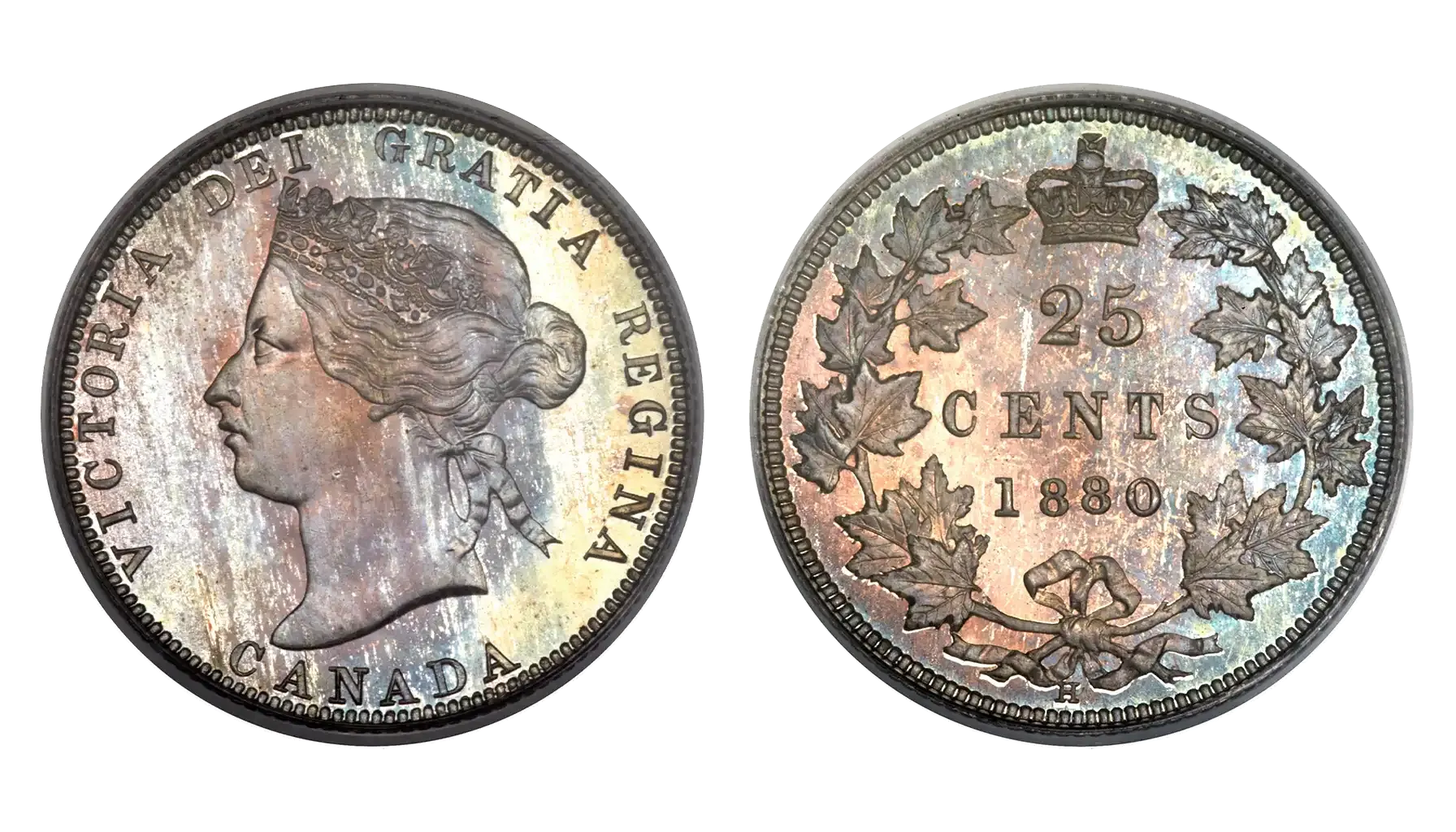
The rarest coins in the group usually come down to those that were minted during the early years of the series production, and their values are determined more by the legacy, scarcity, and importance to collectors in general. This is why auction records may seem impressive when compared to the average prices listed above.
Notable auction records for Canadian 25-cent coins include:
1936 George V 25C — $80,500
1902-H Edward VII Specimen 25C — $70,500
1875-H Victoria Specimen 25C — $70,500
1906 Edward VII “Small Crown” 25C — $38,400
1880-H Victoria Specimen “Wide 0” 25C — $30,550
These are only auction records, and they should not be treated as standard market references, for auctions are subject to bidder competition and short-term market preferences.
Most Valuable 25 Cent Coin Canada: The 1936 25C
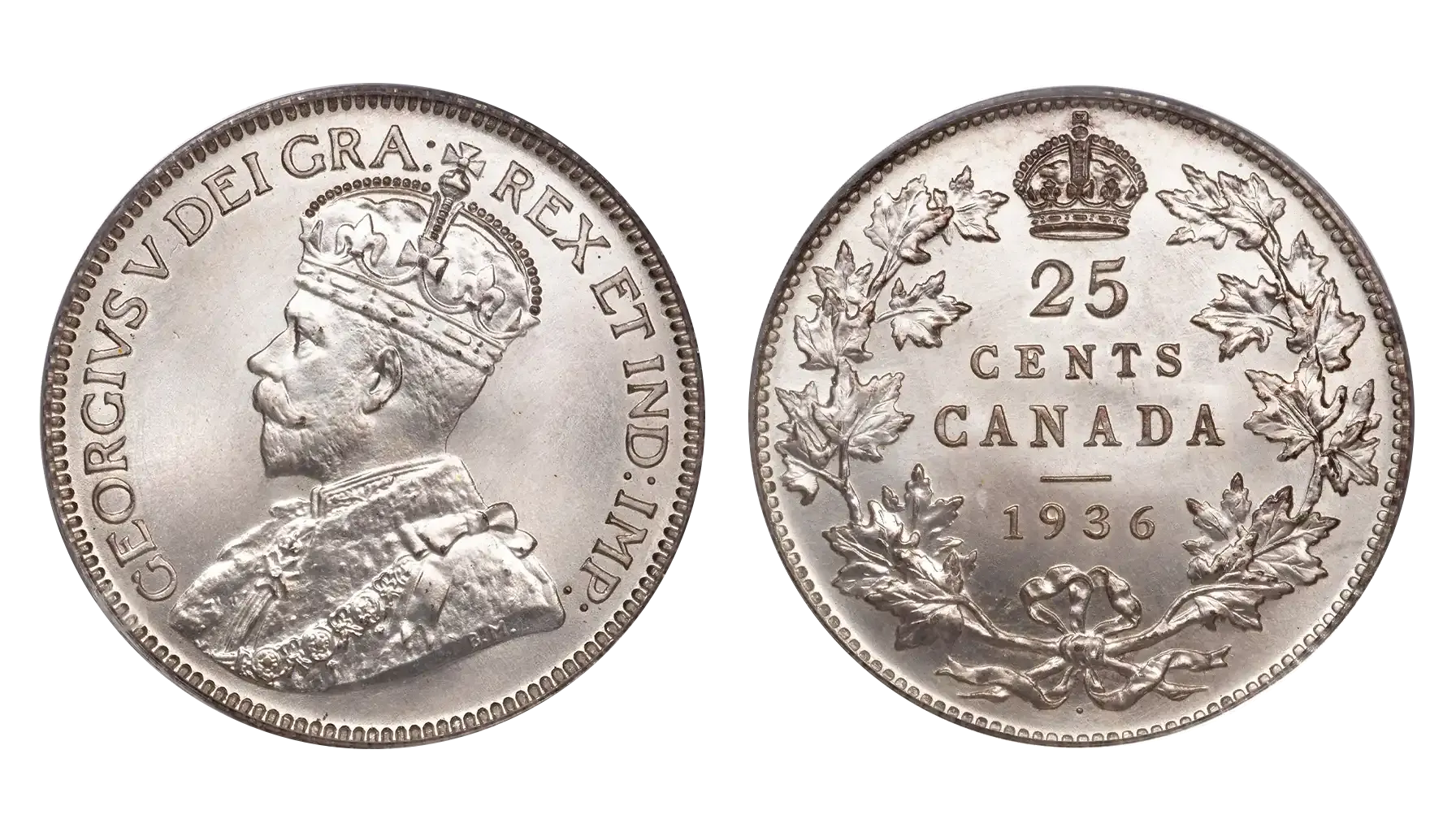
Mintage: 153 322
Auction record: $80,500
The famous dot quarter is one of the greatest Canadian rarities of the 20th century. It was created during the transitional period, and this piece served as a presentational coin with the dot, minted under the date.
Errors and Varieties That Increase Value
The range of errors and varieties may be extensive, as misprinted coins are exclusive to some extent. Yet, the main categories are usually universal. These include:
Repunched dates
Doubled letters or design elements
Die cracks and cuds
Off-center strikes
Clipped planchets
Wrong planchet errors
Brockages
Misaligned strikes
Transitional errors
Recognized design varieties (such as Small Crown pieces, "Dot" types, specimens, etc.)
How to Check If Your 25 Cent Canadian Coin Is Valuable
Should you be fortunate enough to own a Canadian quarter, it might be reasonable to check its potential and possible numismatic price as well. The best approach so far is to examine it step by step.
Step 1. Check the date Start with the year on the coin. Earlier quarters, especially those struck in the late 19th and early 20th centuries, are usually more collectible than modern circulation pieces. |
Step 2. Identify the monarch and coin type Look at the portrait on the obverse to determine under which monarch the coin was issued to correctly define the category it belongs to. |
Step 3. Examine the reverse design Since the reverse design may differ even within the same group, it is important to check if it is a regular circulation unit, commemorative issue, or special-edition release. Coins of regular circulation usually bear maple boughs or a caribou. |
Step 4. Evaluate the condition Try to define if it is a worn example or a well-preserved one. For better results, consult grading services to get a proper evaluation on the spot. |
Step 5. Check the composition Since precious-metal coins are intrinsically more expensive, do not forget to check the composition, as it may add value, especially when combined with a better date or grade. |
Step 6. Use a coin identification tool To make this process smoother and more precise, use apps like Coin ID Scanner to learn more about the type, background, origin, composition, and reference prices by scanning the unit via the camera on your phone. |
The value of a quarter is a flexible variable. Always know your coin to the core, and see what it may offer in turn.

 Facebook
  X (Twitter)
  Pinterest
  LinkedIn