Contents:
- Background of the 1977 Coin
- Design Features of the 1977 Silver Jubilee Coin
- What is the 1977 Coin Made Of?
- How Can You Tell if a 1977 Jubilee Coin is Silver?
- 1977 Silver Jubilee Coin Value – Cupronickel vs Silver
- What is the Value of a 1977 Silver Jubilee Coin Today?
- Collecting the 1977 Queen Elizabeth II Coin
- FAQ
In 1977, Britain celebrated Queen Elizabeth II’s Silver Jubilee: 25 years since her coronation in 1952. For this, the Royal Mint struck a special commemorative crown coin.
Millions were given to schoolchildren, sold in presentation packs, or kept as souvenirs. That’s why almost every family in the UK seems to have at least one tucked away in a drawer.
But here’s the big question people ask: What is the value of a 1977 Silver Jubilee coin today? Two versions exist: a standard cupronickel coin struck in the tens of millions, and a limited sterling silver proof edition issued for collectors.
You should know which one you have because the prices are very different. If you need to know right away, then you should probably try to identify the coins with a Coin ID Scanner powered by artificial intelligence. This app can give you the coin's name, type, and the price in a matter of seconds.
But you should also read this guide: here we explain the coin’s history, its design, the 1977 Silver Jubilee coin silver content, and how to check whether your coin is silver or not.
Background of the 1977 Coin
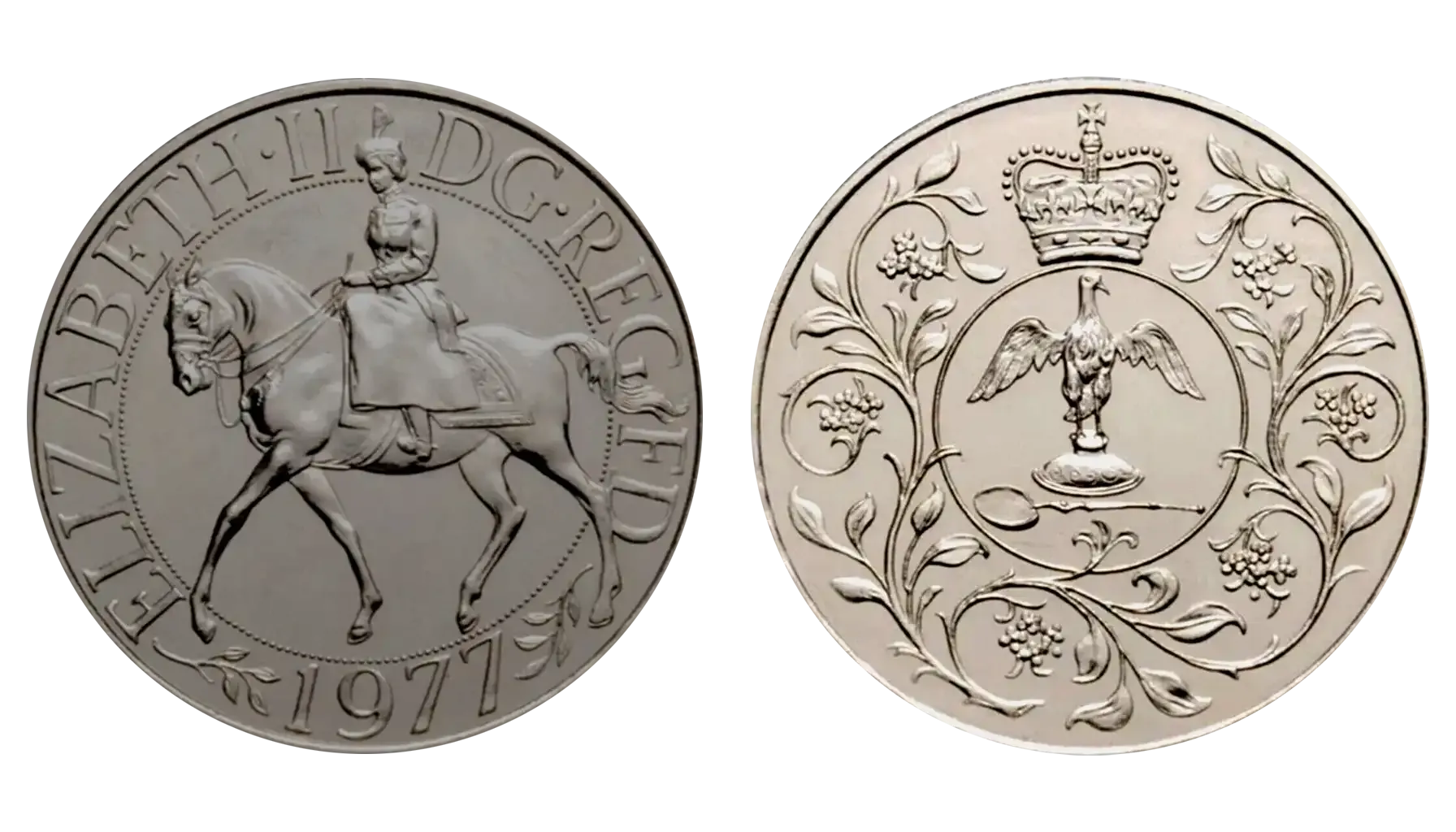
The silver jubilee coin 1977 was struck to celebrate Queen Elizabeth II’s 25th year on the throne. The Silver Jubilee was a huge national event, with street parties, souvenirs, and official commemoratives. The Royal Mint chose the crown denomination (traditionally used for big royal events) to honour the occasion.
The coin had a face value of 25 pence, though this wasn’t marked on the design. In theory, it could be spent in shops, but in practice, most people never saw it used. Many children were given one at school assemblies, and others were bought as keepsakes in presentation packs. This is why millions survive today, usually sitting in drawers, boxes, or passed down through families.
“Silver jubilee” in this case referred to the 25th anniversary, not the metal. That’s a common point of confusion; most coins were struck in cupronickel, not silver. Only the proof version had real silver content.
For collectors, the 1977 Queen Elizabeth II Silver Jubilee Crown coin value shows in condition and whether you’ve got the silver proof version.
Design Features of the 1977 Silver Jubilee Coin
The silver jubilee 1977 coin was created by sculptor Arnold Machin; it was in the style of earlier coronation issues.
Obverse (front): | Shows Queen Elizabeth II riding on horseback in Guards uniform. This design is linked back to the 1953 Coronation crown. Around the edge, the inscription reads “ELIZABETH II DG REG FD 1977.” |
Reverse (back): | Has the St Edward’s Crown, surrounded by the heraldic flowers of the United Kingdom (rose, thistle, leek, and shamrock). It was meant to show unity across the nations during the Jubilee year. Unlike standard coins, the reverse had no denomination printed, which often confuses casual holders today. |
Edge: | Unlike modern £2 coins, the crown had a plain edge with no inscription |
Diameter: | 38.61 mm |
Weight: | 28.28 g |
Thickness: | 3.2 mm (cupronickel), 2.89 mm (silver proof) |
This coin was officially a crown, which, after decimalisation (1971), carried a value of 25 pence. In practice, shopkeepers rarely accepted the 1977 Queen Elizabeth Silver Jubilee coin. Its real role was commemorative, something to keep, not spend.
If you’re interested in the broader story of modern British issues, check out From Mint to Majesty: Collecting Queen Elizabeth II Coins. That article tells you how commemoratives have created those designs throughout Elizabeth II’s reign, linking everyday change to key royal anniversaries and national events. It has useful context for understanding why series like Jubilee became such a cultural phenomenon, and how they fit within the wider tradition of UK commemoratives.
What is the 1977 Coin Made Of?
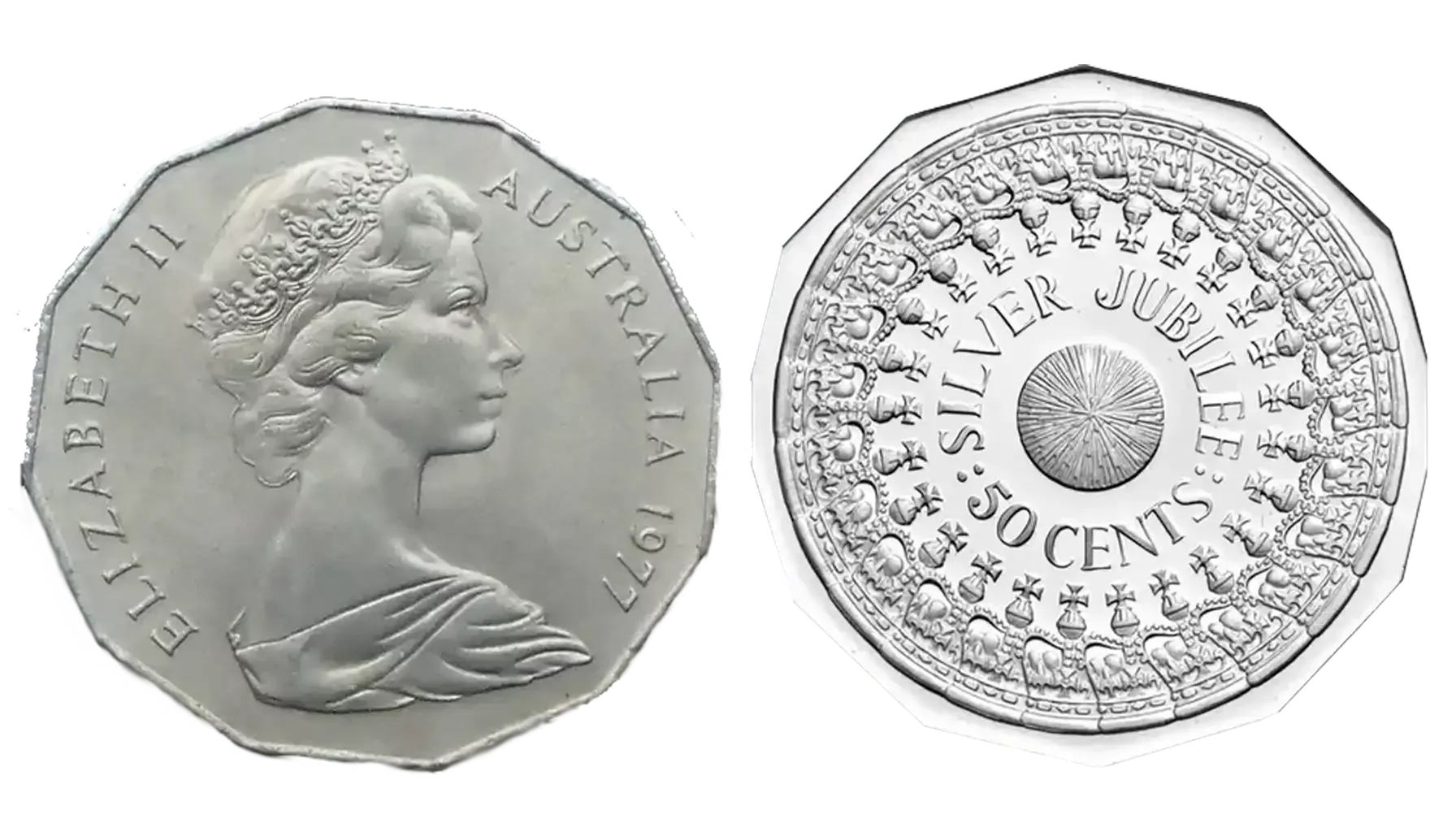
One of the most common questions people ask is: What is the 1977 Silver Jubilee coin made of? The answer depends on which version you own.
Standard Issue (Cupronickel)
Mintage: 37,061,160
Composition: 75% copper, 25% nickel
Thickness: 3.2 mm
These were the coins handed out in schools and sold cheaply as souvenirs. They’re heavy and attractive but have no precious metal content.
Proof Issue (Sterling Silver)
Mintage: 377,000
Composition: 92.5% sterling silver
Silver Content: 0.841 troy ounces
Thickness: 2.89 mm
These were sold in presentation boxes and targeted at collectors. Because of the silver content, they carry much higher value than the cupronickel pieces.
How Can You Tell if a 1977 Jubilee Coin is Silver?
Both versions look almost identical, so it’s easy to mistake a cupronickel piece for the silver proof. If you’re wondering how you can tell if a 1977 Jubilee coin is silver, here are the main checks:
Thickness Test
Cupronickel version: 3.2 mm thick
Silver proof version: 2.89 mm thick
That tiny difference is the quickest way to identify the real silver one
Packaging
The silver jubilee 1977 came in a presentation box with a certificate. If yours has the original case, that’s a strong sign you’ve got the proof version.
Sound
Silver ones have a ring when tapped gently with another coin, while cupronickel sounds duller. It’s not foolproof, but many collectors use this as a quick test.
Wear and Colour
Cupronickel tends to dull to a greyish tone with age
Proofs usually stay brighter if stored properly, though tarnish can occur
Weight Check
Both weigh 28.28 g, so weight won’t help. Thickness is the more reliable physical difference.
Tip: If in doubt, use calipers to measure thickness. The difference of about 0.3 mm is enough to separate the 1977 Queen Elizabeth II Silver Jubilee coin (proof) from the common cupronickel crown.
1977 Silver Jubilee Coin Value – Cupronickel vs Silver
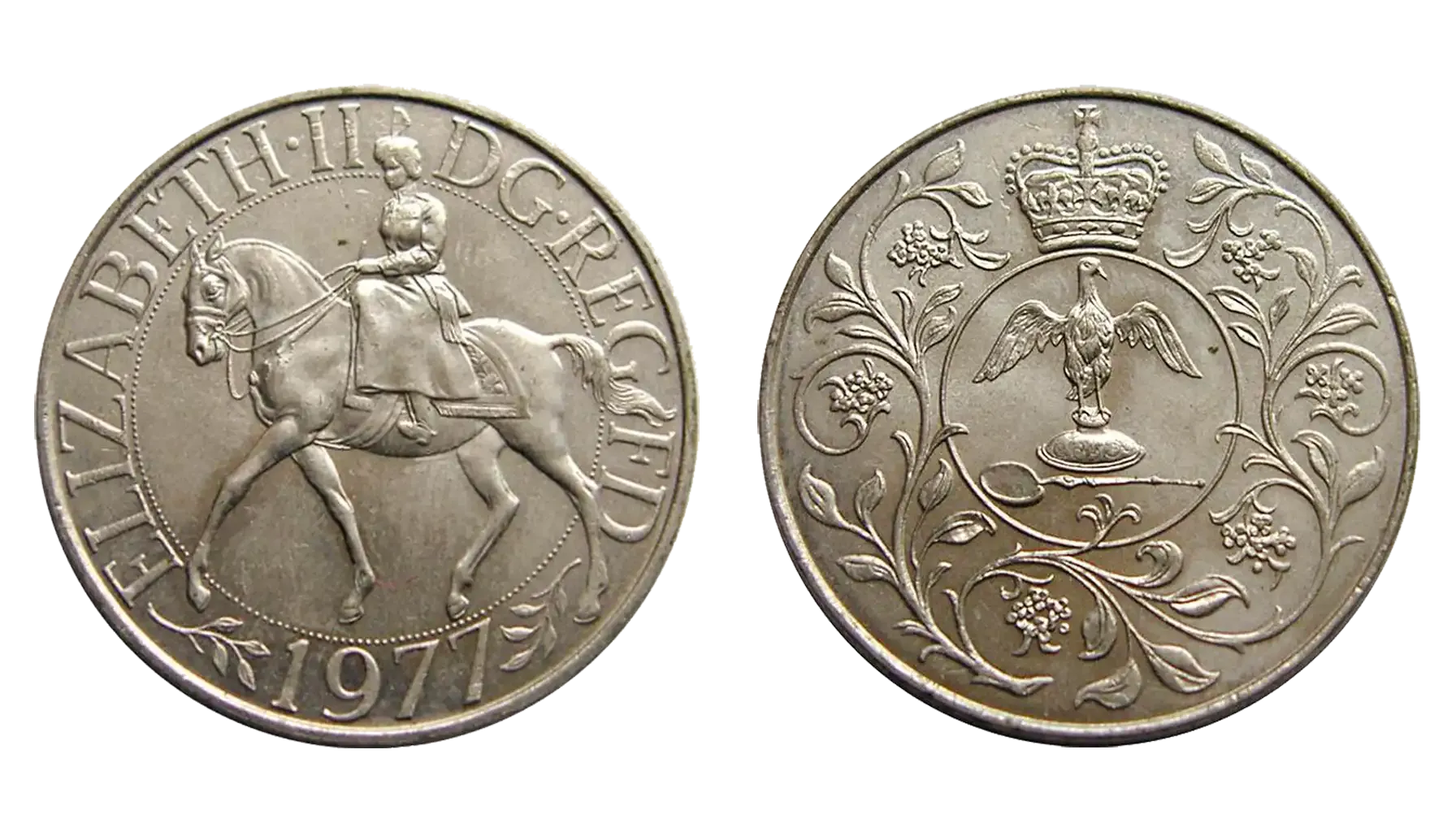
With tens of millions of cupronickels struck, most examples have little collector value. The sterling proofs, however, are pretty valuable.
Version | Mintage | Metal | Circulated Value | Uncirculated Value | Notes |
Standard Issue | 37,061,160 | Cupronickel | £1-£2 | £2-£3 | Extremely common, given out in schools and sold widely. |
Silver Proof | 377,000 | Sterling silver (.925) | £20-£25 (if loose) | £30-£40 (with box & certificate) | Contains 0.841 troy oz silver; collector demand for boxed examples is steady. |
The standard 1977 Queen Elizabeth piece has sentimental value but very little resale value. Millions survive in drawers and coin jars across the UK
The proof edition holds both metal value and collector appeal. Prices hover around £25-£40
Bullion dealers may only pay for the silver content (~£18-£20 at today’s silver prices), but collectors often pay more for pristine boxed coins
What is the Value of a 1977 Silver Jubilee Coin Today?
Standard Cupronickel
Value: About £1–£2 if loose, maybe £3 in excellent uncirculated condition
With over 37 million mints, the 1977 coin is still very common. Almost every family in the UK has one tucked away
Sterling Silver Proof
Value: £20–£25 if sold loose; £30–£40 if still in its original box with certificate
Limited mintage of 377,000 and 0.841 troy ounces of content. Collector demand is steady
Type | Average Value Today | Collectability |
Cupronickel 1977 Jubilee Crown | £1-£3 | Sentimental, not rare |
Silver Proof 1977 Jubilee Crown | £20-£40 | Collector interest + silver content |
So, check the thickness and packaging.
If you’re curious how other countries marked Elizabeth II’s milestones, check out Symbols of a Reign: Canada Elizabeth II Coins and Beyond. It looks at how Canada and other Commonwealth nations designed their own commemoratives, often with very different styles and imagery. Lining them up against the 1977 Jubilee crown gives you a neat comparison, same monarch, same anniversaries, but each country putting its own version to it.
Collecting the 1977 Queen Elizabeth II Coin
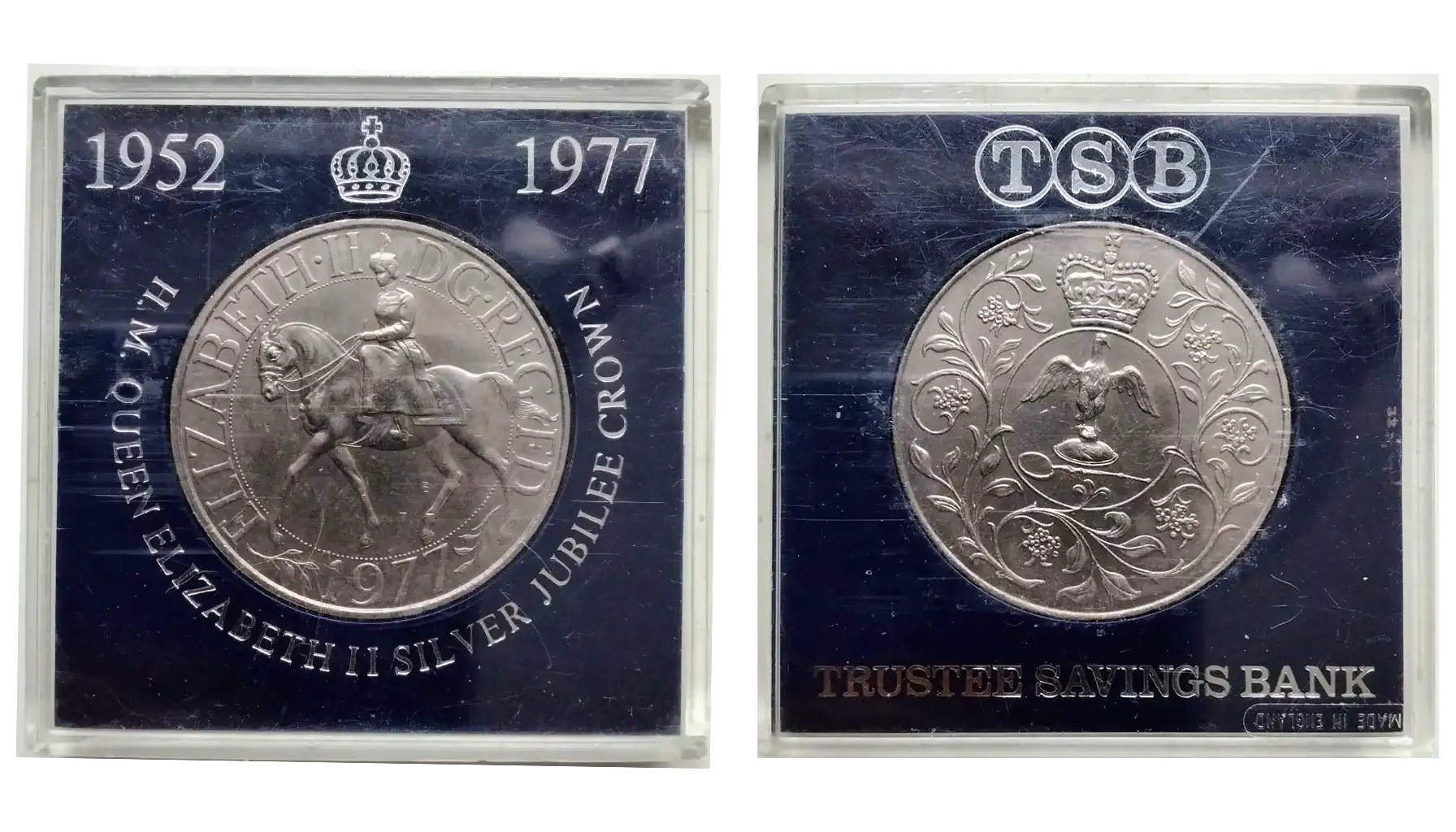
The 1977 piece isn’t rare, but it has become one of the most recognisable commemoratives of modern British history. Millions of people received one as children at school or bought them as souvenirs during the Jubilee celebrations.
Because of that, the coin holds more sentimental than financial value, yet collectors still actively seek out the best-preserved examples.
Why Collect It?
Cultural history: this piece marks the Queen’s 25th coronation anniversary, a date celebrated across the UK and Commonwealth with street parties, souvenirs, and ceremonies
Affordable starting point: most examples trade for just a few pounds; it is a budget-friendly way for new collectors to get started. Unlike rarities that cost hundreds, this one is easy to find and simple to add to any collection
Appeal of the proof edition: specially struck for presentation, these have numismatic interest and metal value. You can pair them with original packaging and certificates, so they will be the most desirable form of the issue
Popular Versions Among Collectors
Standard cupronickel: kept mainly for nostalgia. Millions of people still have one passed down from school days or family souvenirs
Proof edition: struck to a higher standard, these are far more sought after, especially if still in the original box with paperwork
Presentation sets: sometimes found as part of complete 1977 packs that include other denominations, so they are an attractive option for people who enjoy themed or historical sets
Other Jubilee Crowns
The 1977 coin was the first of several Jubilee crowns struck during Elizabeth II’s reign:
2002 Golden Jubilee Crown (face value £5, often issued in silver and gold versions)
2012 Diamond Jubilee Crown (again £5 denomination, various metals)
2022 Platinum Jubilee issues (marking her 70-year reign)
If you are exploring British commemoratives, look at The Queen’s Beasts Collection. Inspired by the heraldic statues that stood guard at Elizabeth II’s coronation, the designs have iconic creatures such as the Lion of England, the Griffin of Edward III, and the Red Dragon of Cadwaladr.
FAQ
Is the 1977 coin silver?
Usually no. Most of the 37 million coins minted are cupronickel. Only the limited proof version (377,000 coins) was struck in sterling silver.
What is the 1977 coin made of?
The standard one is cupronickel (75% copper, 25% nickel). The proof edition is 92.5% sterling silver, with a content of 0.841 troy ounces.
How much is a 1977 coin worth?
The standard one is worth about £1-£3 depending on condition. The proof coin sells for around £20-£40, especially if boxed with its certificate.
How can you tell if a 1977 Jubilee coin is silver?
Measure its thickness: cupronickel is 3.2 mm, proof is 2.89 mm. Silver proofs were also sold in presentation boxes, which is another clue.
Why does the coin say 1952–1977?
Those dates mark Queen Elizabeth II’s Jubilee, 25 years after her coronation in 1952.
What is the 1977 Queen Elizabeth II crown piece value today?
Cupronickel is about £2. Silver proof is £30+ if in mint packaging. Collectors generally pay more than bullion value for pristine silver proofs.
Is the Silver Jubilee crown legal tender?
Yes, technically. It has a face value of 25p, though most shops won’t accept it. Today, it’s treated as a commemorative piece.
Should I keep or sell my 1977 Jubilee coin?
If you have the cupronickel version, it’s mainly a keepsake. If you’ve got the proof, it’s worth selling or holding as part of a collection, especially if boxed.

 Facebook
  X (Twitter)
  Pinterest
  LinkedIn