Contents:
This became one of the most important acts in economic history. It completely changed the composition and, in principle, the minting of American coins, which, in turn, affected the coin iIdentifying.
Why the Coinage Act of 1965 Was Passed
By the early 1960s, the market price of silver was rapidly rising, but the quantity of the metal itself, of course, was not increasing. A silver deficit began; the mint's government warehouses experienced shortages.
The Mint was forced to buy expensive metal at market prices, leading to inflation.
Inflation
Due to economic growth and inflation, the cost of minting silver dimes, quarters, and half dollars began to approach their face value.
Production costs could eventually exceed the value of the coins, making their minting truly unprofitable.
“Approximately 230 million pieces of the new quarter will be distributed during the week beginning November 1. Initial distribution will be backed by production that will rise from 28 million to 60 million pieces a week during November, and will be still higher thereafter.”
– Lyndon B. Johnson, remarks at the Signing of the Coinage Act Online by Gerhard
The American Presidency Project website
Cost Reduction
The bill proposed completely removing expensive gold from the regular strikes, replacing it with cheaper alloys. This law generally affected the gold and silver coins. This would allow for savings of tens of millions of dollars per year on metal purchases and production.
Removal of Silver From Circulating Coins
Type | Nominal | Metal Content |
Dimes | 10 cents | 90% silver, 10% copper |
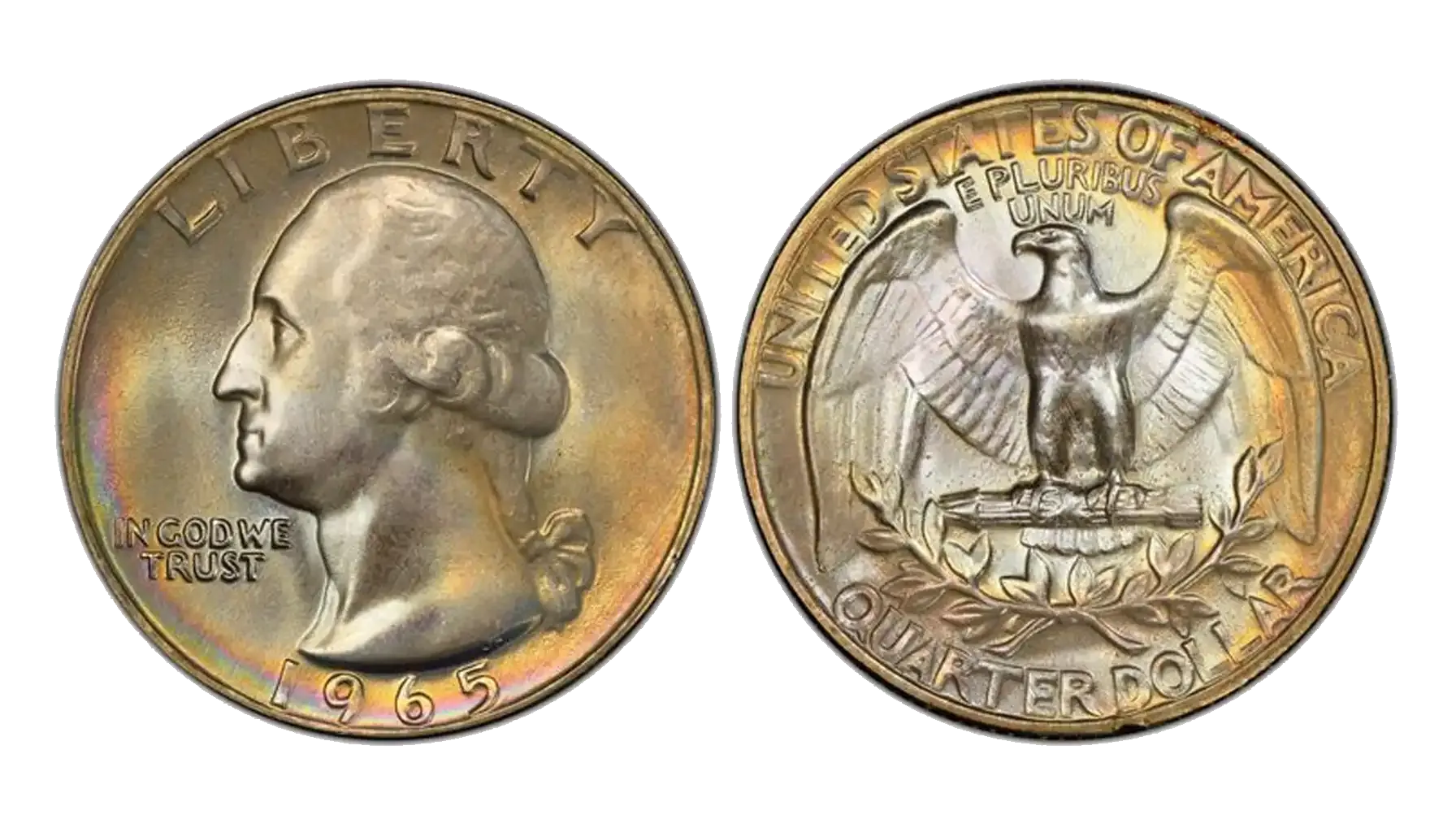
Quarters | 25 cents | |
Half dollars | 50 cents, Kennedy Half Dollar from 1964 |
This is regarding the situation before 1965, and after it, two stages followed.
1. The discontinuation of 90% silver Dimes and Quarters starting from April 1965.
2. A transitional period for half dollars. Coins from 1965-1966 contained only 40% silver. This was a simple silver cladding over a copper core.
And starting from 1968, valuable Kennedy Half Dollars were minted entirely without silver. As a result, after 1968, no regular strike coins with actual silver content remained in circulation, except for special commemorative and investment coins such as Proof and Bullion.
Introduction of Clad Coinage
The new law officially legalized a new type of composition, clad, or simply a sandwich structure.
The inner core, that is, the heart, consisted of pure copper, and the outer layers, that is, the exterior layers, were made of a copper-nickel composition, 75% copper and 25% nickel, or "kortzall."
Main Сharacteristics
Cost is significantly lower than silver. Appearance, meaning color and luster, was almost indistinguishable from the previous silver coins. The alloy proved resistant to wear and corrosion. It maintained the familiar magnetic response, which simplified the operation of banking machinery.
Appearance, meaning color and luster, was almost indistinguishable from the previous silver coins. The only difference was that their naturally toned coins after a few years were different from those of silver coins.
Type | Before | After |
Roosevelt Dime | 90% Ag / 10% Cu | copper (core) + Cu-Ni layers |
Washington Quarter | 90% Ag / 10% Cu | transitioned to clad composition |
Kennedy Half Dollar | 90% Ag | 40% Ag; from 1968: without silver (copper + Cu-Ni) |
Lincoln Cent | It had already been bronze since 1959 (95% Cu + 5% Zn/Sn) | |
Nickel | The coin was already Cu-Ni (75% Cu / 25% Ni) and remained in the same composition. | |
Conclusion
The mass transition to clad alloys allowed for savings of hundreds of millions of dollars on silver purchases. It also stabilized the circulating supply of coins by eliminating the silver shortage and reducing the risk of melting coins for scrap metal.
Furthermore, silver coins and quarters from 1964 and earlier became more attractive to collectors, and a new landmark appeared in numismatics: the pre- and post-silver era. Thus, this law eliminated the shortage and high constraints on silver; the clad alloy was introduced and is still used today.

 Facebook
  X (Twitter)
  Pinterest
  LinkedIn