Contents:
The dime is one of the lowest-denomination coins in the US monetary system that, despite its barely pronounced face value, can be significantly more valuable from the collector's perspective, thanks to its silver content, mint marks, condition (especially when confirmed by major grading services like NGC or PCGS), and possible mint errors to look for.
Now and then, the dime has long been considered a standard that, however, evolved: there were two major variations of the same design, i.e., the silver Type 1 and the clad Type 2 (the source of the change is the Coinage Act of 1965). So, let us focus on one undistinguished numismatic creation, i.e., the 1959 Roosevelt dime: what does it look like? How to check coin value? Is it really worth keeping or not?
Where the 1959 Roosevelt Dimes Started…
The first 10-cent piece in the series was the 1946 Roosevelt dime, released as a prompt response to the untimely passing of the beloved president, Franklin D. Roosevelt. It was a logical initiative to commemorate his legacy through the dime design that, by 1946, had already turned into the informal symbols of the American coinage – the Mercury dime was an eloquent, ravishing coin after all.
Why dimes, by the way? The name of the president and this unit of currency were closely associated with one another: in fact, Roosevelt had been closely tied to the March of Dimes campaign, which supported the nationwide fight against polio and the deep research in this field. The dime was a symbol – the United States Mint leveraged the power of this connection for its own good.
All along the numismatic history of this piece, there were introduced 2 major variations of the same basic design: the earlier 10 cents were struck in 90% silver; since 1965, all regular issues switched to a copper-nickel clad.
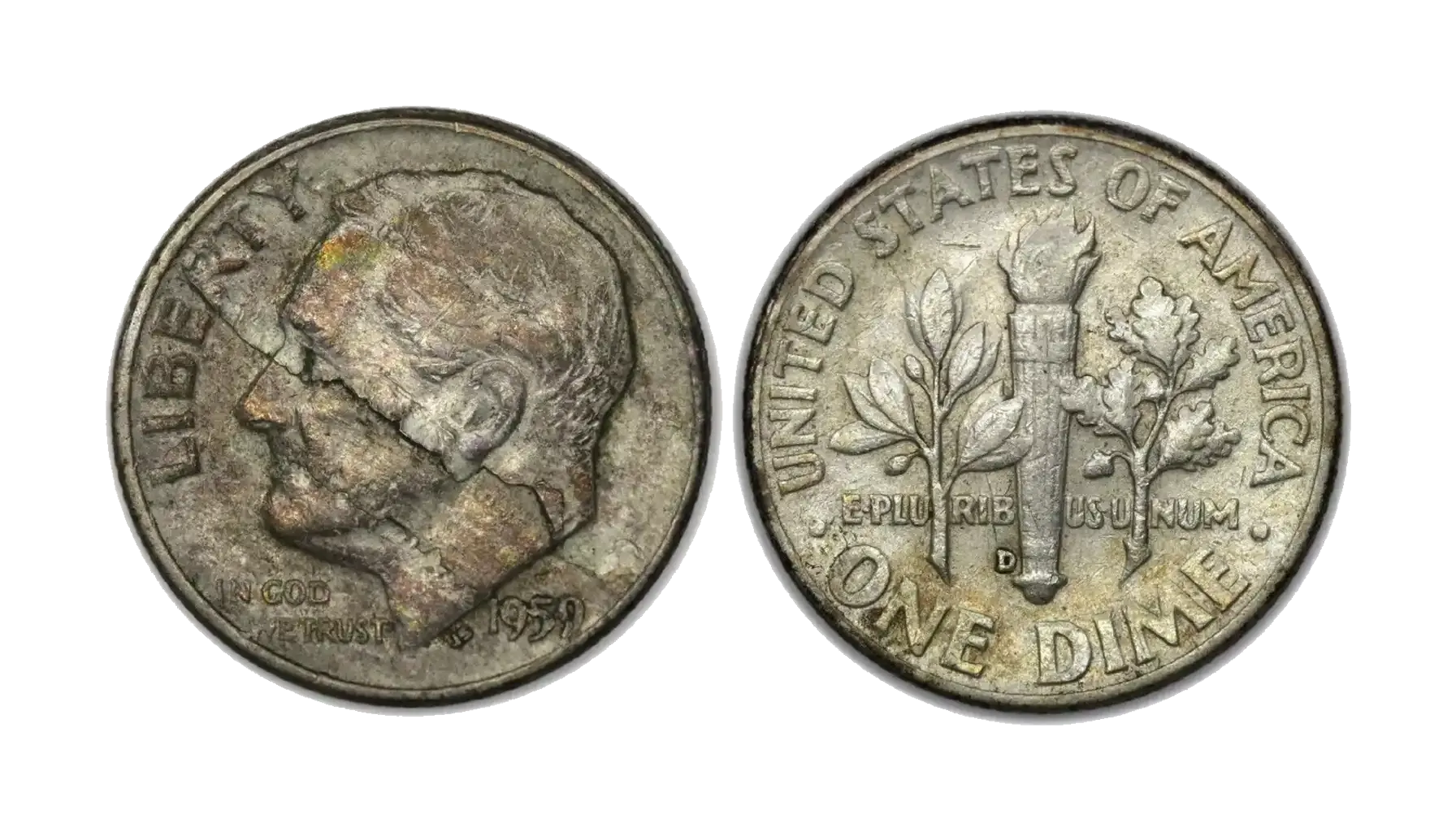
1959 Dime Silver Content, Design, and Composition
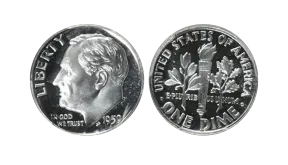
Obverse: Shows a bust of President Franklin D. Roosevelt, the inscription “LIBERTY” positioned to the left of the profile, the motto “IN GOD WE TRUST” to the lower-left area, as well as the designer's initials "JS" near the cutoff of the portrait, and the date closer to the "5 o'clock" position.
Reverse: Demonstrates a trio of an older branch, a Torch of Liberty, and a branch of oak, as well as the inscription “UNITED STATES OF AMERICA” around the upper rim, the iconic phrase “E PLURIBUS UNUM” running across the field (behind the trio arrangement), a mint mark (if present) at the base of the torch, and the denomination “ONE DIME” along the bottom.
The Main Features | |
Denomination | 10 cents |
Composition | 90% silver, 10% copper |
Silver fineness | 0.900 |
Weight | 2.50 g |
Actual silver weight | 2.25 g pure silver (≈ 0.07234 troy oz) |
Diameter | 17.90 mm |
Thickness | 1.35 mm |
Edge | Reeded |
Number of reeds | 118 |
1959 Dime Types by Mint Mark Explained
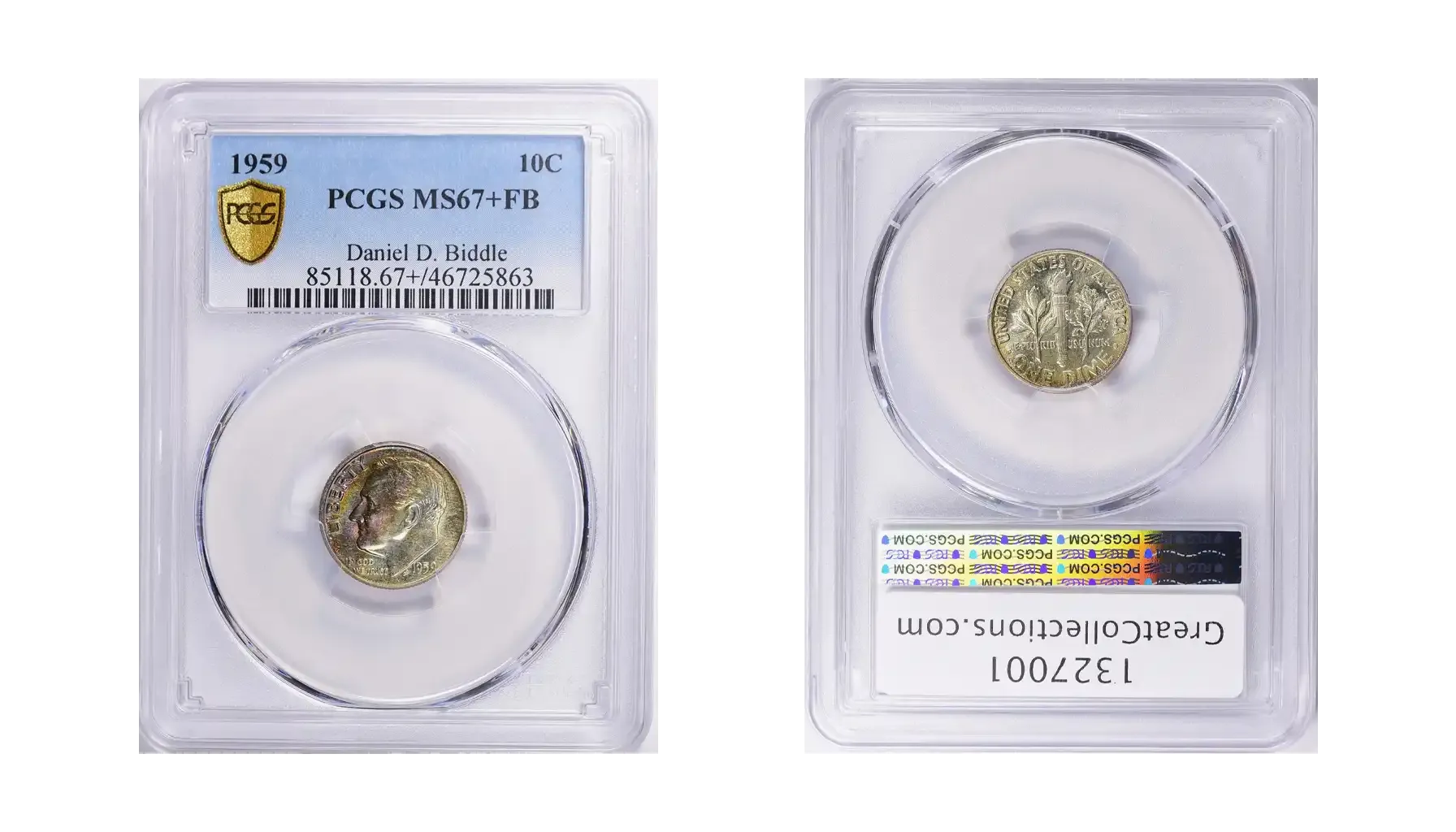
1959 10C
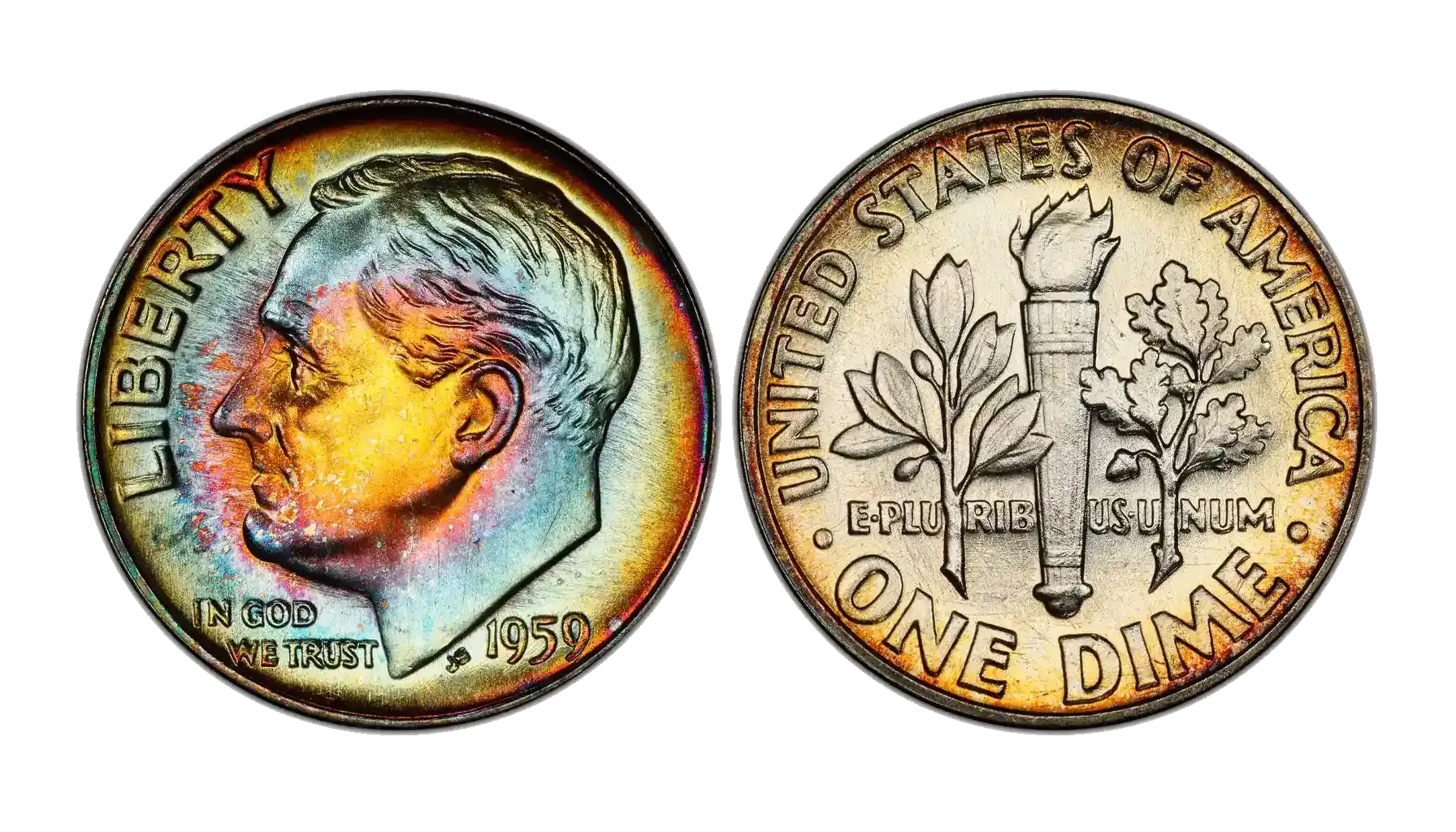
Produced by: Philadelphia Mint
Mintage: 85,780,000
Auction Record: $2,880 for MS67+FB
The 1959 dime no mint mark is one of the most common dates of the series, with the main part being present in circulated and Mint State grades up to MS64. In MS65, they become scarcer, but examples in this grade can still be purchased for a minimal price. According to Jaime Hernandez, there are fewer than a dozen examples graded in MS67FB+ by PCGS – the chances of finding these are low but never zero.
1959-D 10C
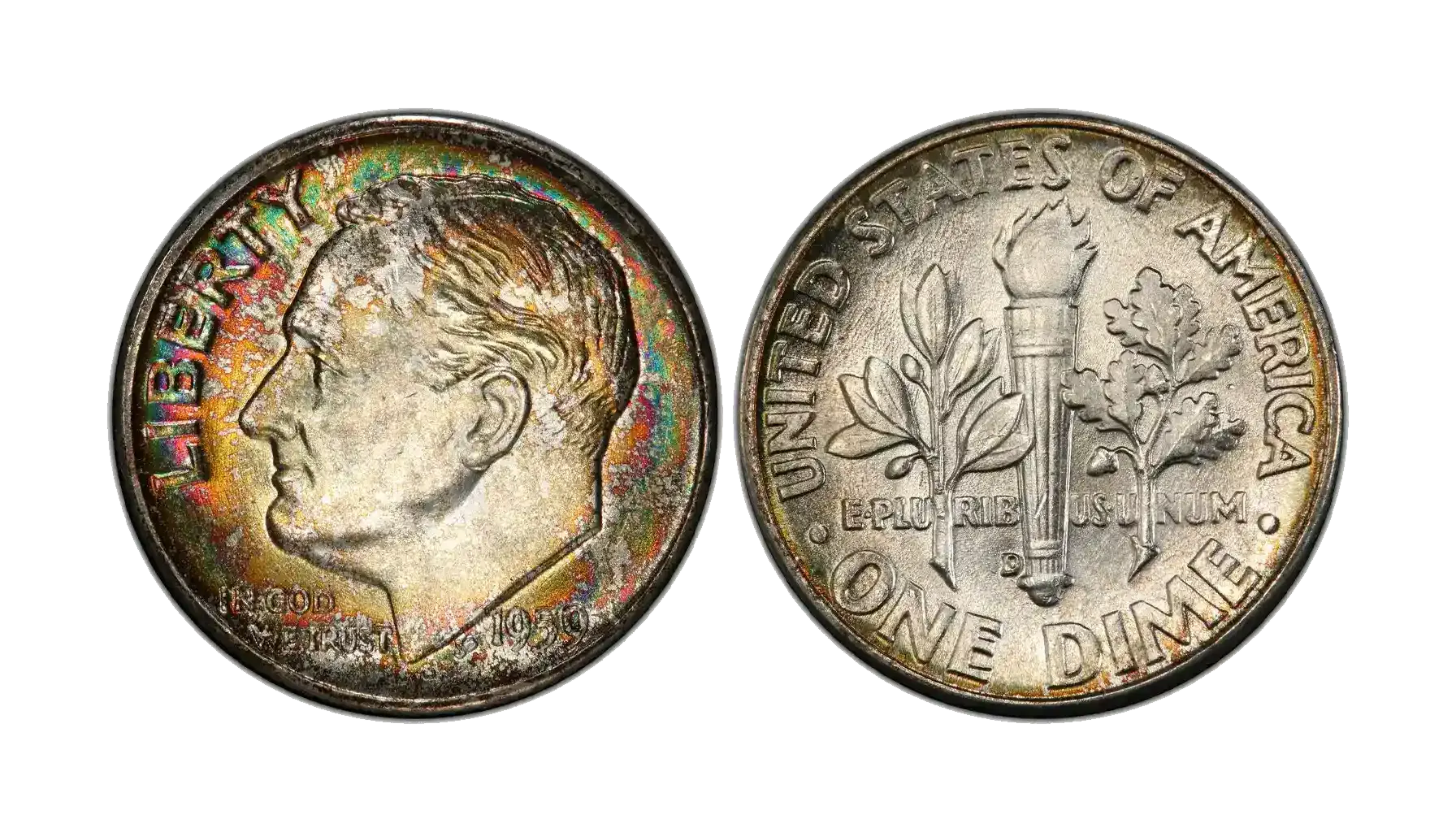
Produced by: Denver Mint
Mintage: 164,919,790
Auction Record: $5,288 for MS68FB
The variety from the Denver Mint also belongs to a group of the most common dates. High-grade, fully struck examples might be difficult to catch, and there is at least one known example graded by PCGS in MS68FB.
“The 1959-D Roosevelt Dime is one of the more common dates in the series. Over 164 million were struck, therefore, it has the highest mintage for any dime from 1947 to 1960. <...> Only in MS67 or MS67 Full Bands does it become scarce…”
— Jaime Hernandez, renowned numismatist, PCGS price guide editor
PCGS CoinFacts
1959 10C Proof
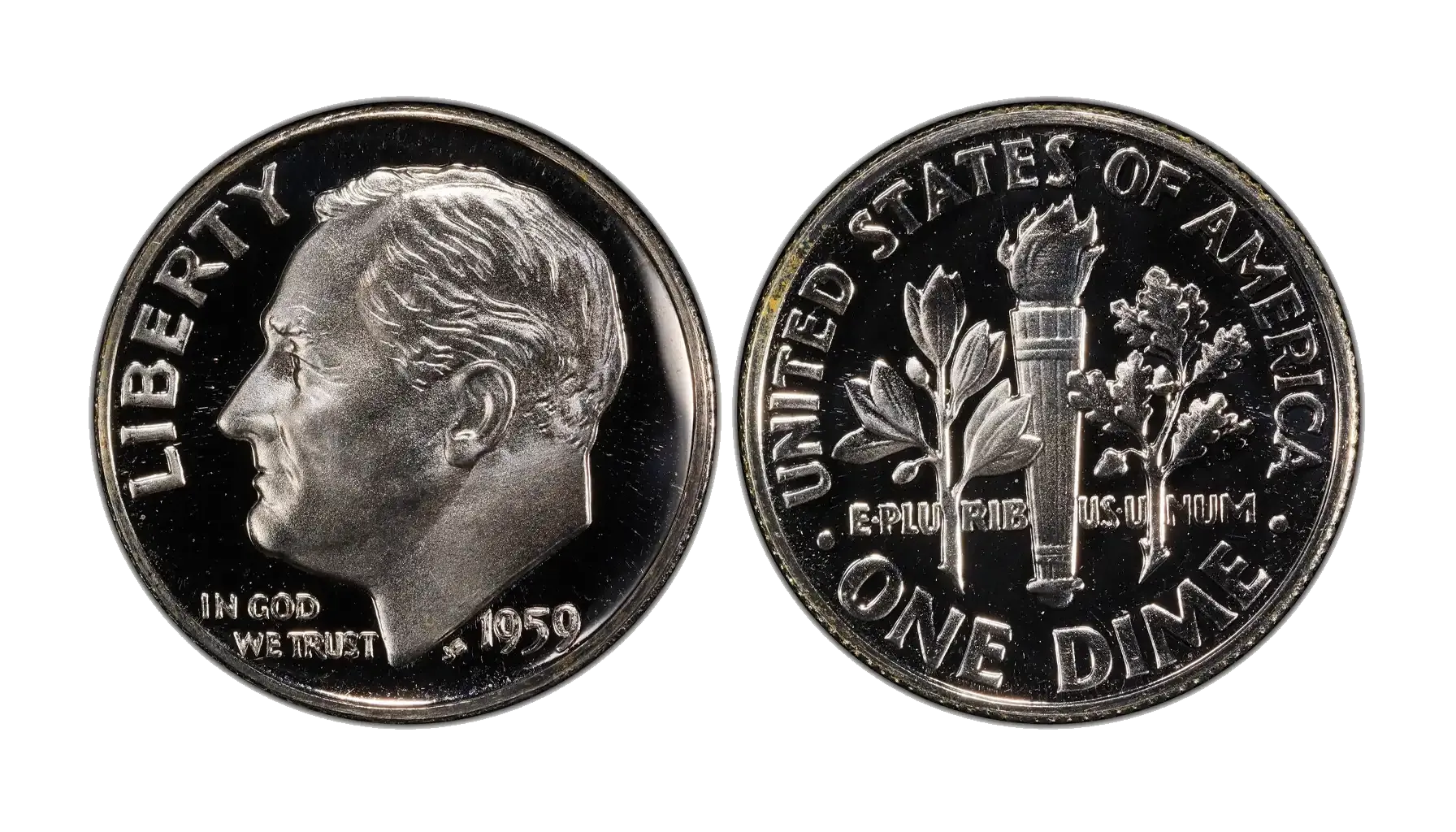
Produced by: Philadelphia Mint
Mintage: 1,149,291
Auction Record: $5,980 for PR69
Finally, here comes the proof edition, which is also fairly common when compared to other Proof Roosevelt dimes. In grades of PR69+, these might be considered scarce, though the samples with Deep Cameo designation can also be valuable in PR68 and beyond.
Market Demand & 1959 Silver Dime Value
Demand for the pre-clad era coins is usually steady, since there are two overlapping buyer groups looking for these dimes: i.e., silver-stackers and collectors who are looking for high grades. All in all, most circulated pieces trade close to their silver floor, until the condition, designations, and overall appeal push them into the “collector premium” zone. So, how much is a 1959 dime worth?
1959 Roosevelt Dime Value by Mint Mark
Grade | 1959 10C | 1959-D 10C | 1959 10C Proof |
Circulated | $5–$8 | $5–$9 | $6–$10 |
VF (20–35) | $9–$13 | $9–$13 | – |
AU (50–58) | $10–$15 | $9–$13 | – |
MS63 | $14–$15 | $14–$15 | $50–$55 (PR63) |
MS65 | $20–$25 | $29–$22 | $110–$120 (PR65) |
MS66 | $28–$65 | $26–$50 | $135–$165 (PR66) |
MS67 | $225–$1,100 | $120–$1,000 | $215–$325 (PR67) |
Top grade | $1,200+ | $6,250+ | $700–$5,000 (PR70) |
1959 Dime Errors and Varieties to Know: Top 3
Clipped Planchet Error
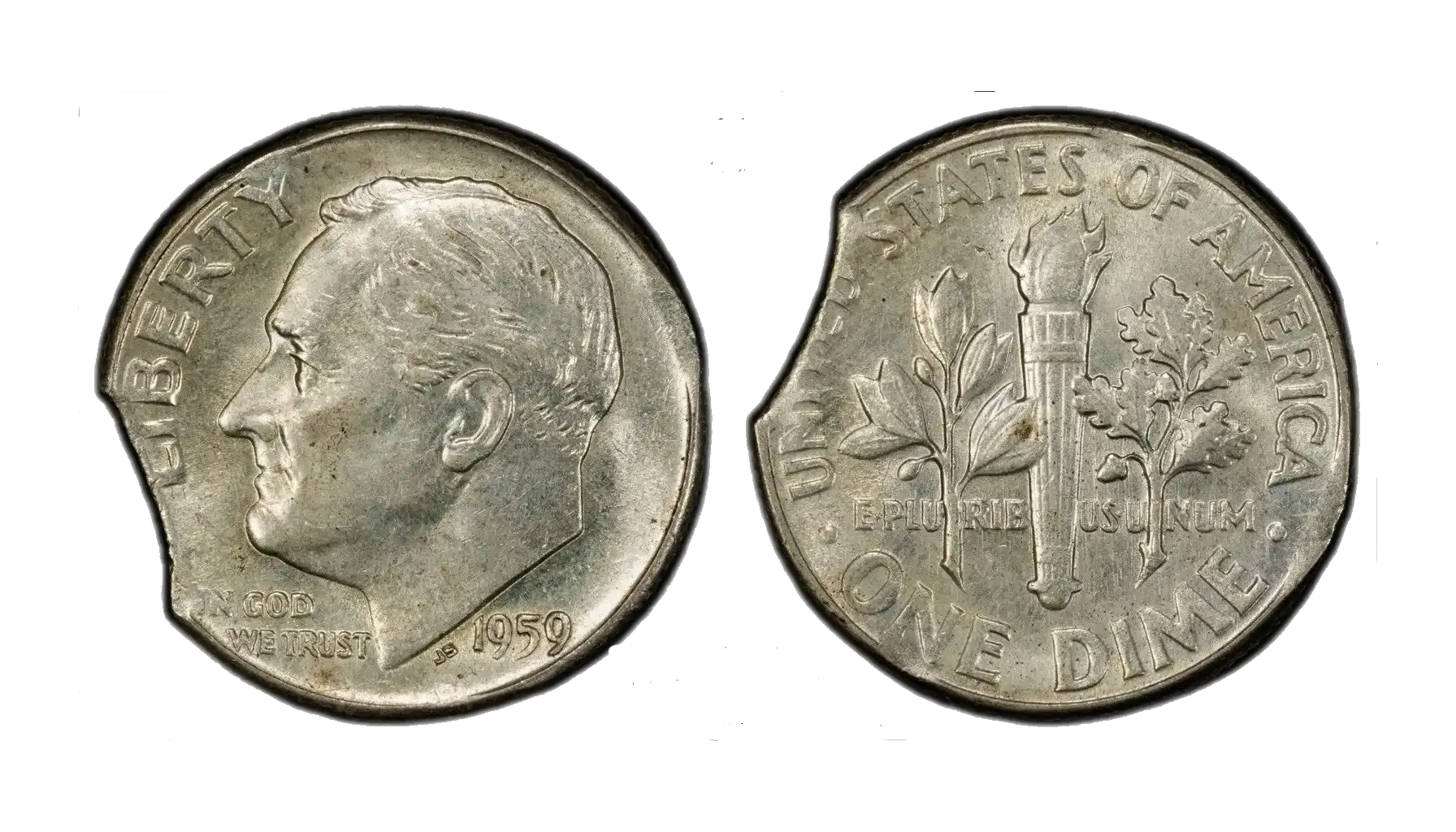
Estimated value: $250+
This is by far the most widespread and, at the same time, expensive minting deviations associated with the boosted 1959 D dime value. The origin is rather obvious: a clipped planchet happens when the blank coin strip is misfed into the cutting press, so the punch overlaps a previously cut area and produces a “missing chunk” along the rim. These can be small or dramatic, with the latter being always more valuable.
To confirm authenticity, do not hesitate to appeal to reputable grading services and use apps like Coin ID Scanner to identify and analyze coins on the spot.
Doubled Die Obverse or Reverse
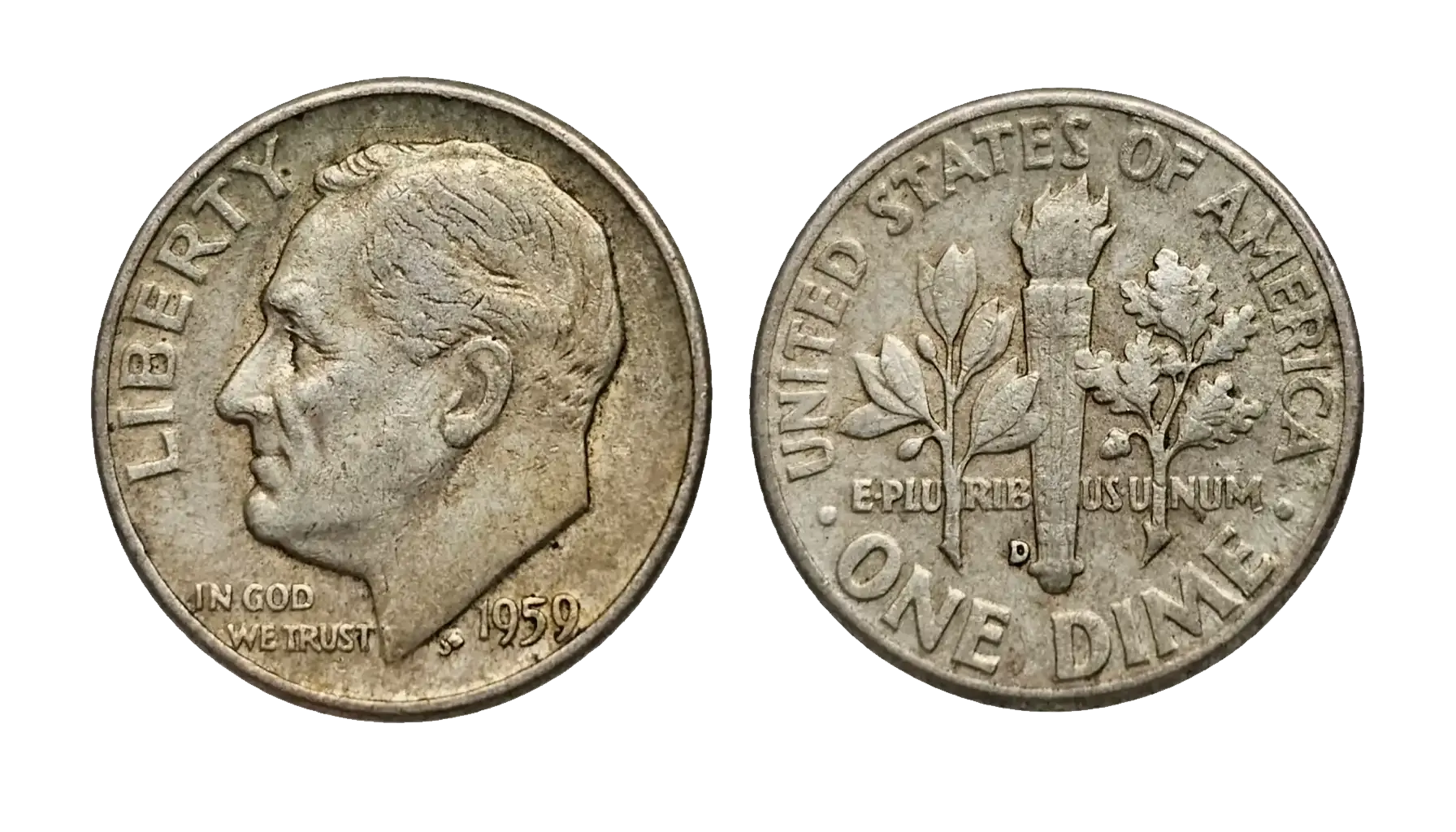
Estimated value: $100+
A doubled die is also extremely popular and widespread, though its connection with the 1959 dime might be a bit weaker. As for its source, a doubled die may be produced when the die receives a misaligned impression during hubbing. That said, the appearance looks doubled with clear separation in letters and numbers rather than a smeared “shadow” – this is vital.
How much is a 1959 silver dime worth? This depends on the strength and location of the doubling and grade. The more exquisite the error, the higher prices collectors are ready to pay.
Repunched Mint Mark (RPM)
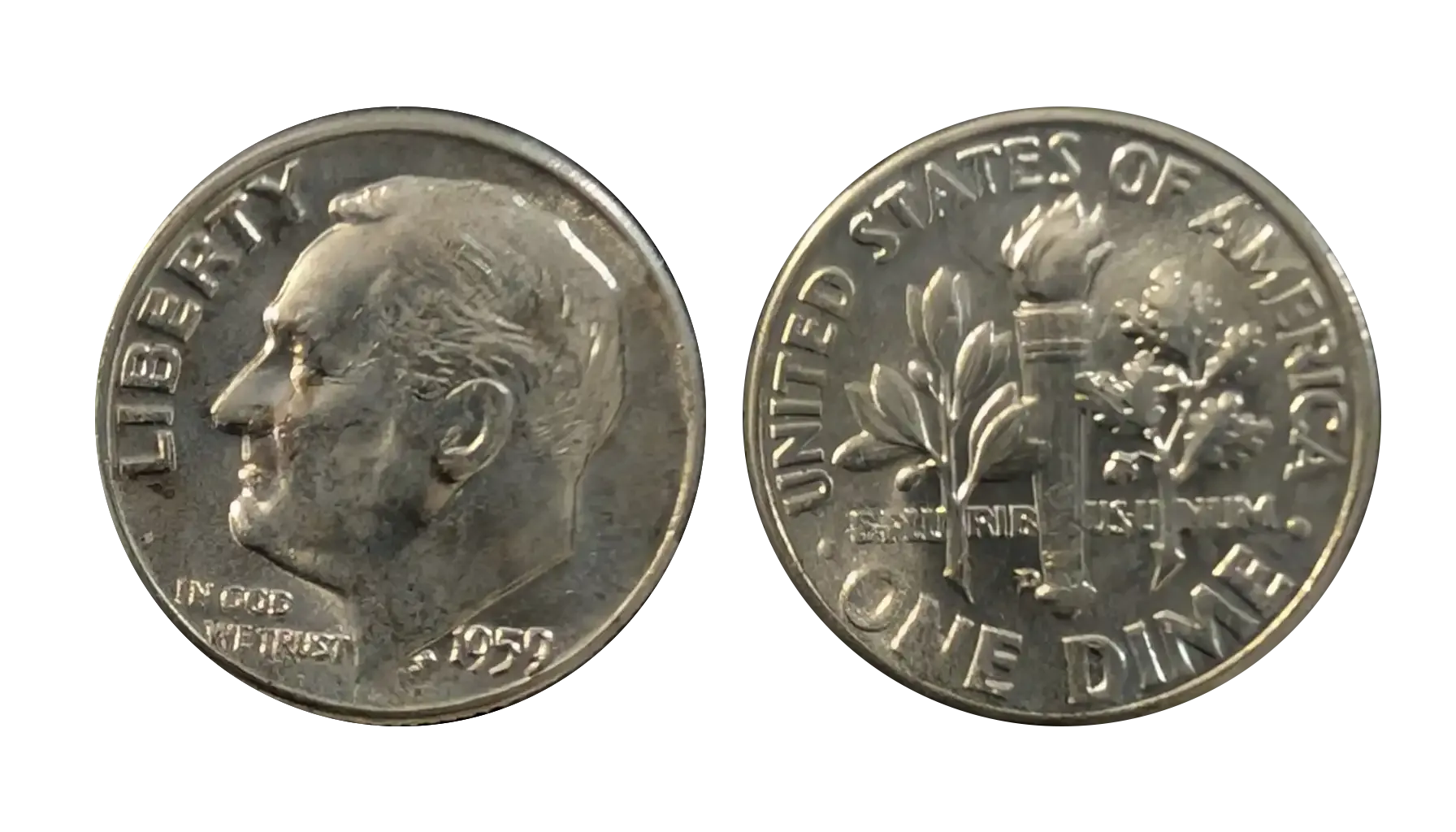
Estimated value: $15–$80+
It is a logical continuation of the previous error, yet this only affects the mint mark (and nothing more). In this case, the mint mark was punched into the working die more than once in slightly different positions. The result is the secondary “D” hidden behind the main mint mark (manifested as a small extra curve, split serif, or shadow-like outline, depending on the direction).
Ordinary pieces of low denominations are not so simple. Build your collection, incorporating various coins – even ten cents can be worth a lot.

 Facebook
  X (Twitter)
  Pinterest
  LinkedIn