Contents:
Constantine the Great is a valuable part of Roman Empire history that opened the door to a new era of Christianity, capitals, and reforms.
Truly significant are Constantine the Great Coins, which are constantly being sought in a Coin Identifier App. Find them too, but in our guide.
Who Was Constantine the Great
Flavius Valerius Aurelius Constantinus, or Constantine the Great. He was a Roman emperor who became one of the most important figures for medieval Europe and Christianity, as the most widespread religion.
He was born around 272 AD in the city of Naissus in modern-day Serbia. His father was one of the co-rulers of the Tetrarchy. This system divided the empire into four parts.
After his father's death, Constantine was proclaimed emperor by the troops in Britain, and this marked the beginning of his great path.

Adoption of Christianity
One of the most important moments was the Battle of the Milvian Bridge. It took place against Constantine's rival, Maxentius. On the eve of this event, Constantine had a vision involving the Christian Christ and words promising victory. His army fought under this symbol and eventually indeed won. Although he himself did not treat Christianity with such high regard, for everyone else, this became a great symbol.
The Edict of Milan
In 313 AD, Constantine, along with his eastern co-ruler, issued the Edict of Milan. It proclaimed religious tolerance throughout the empire.
This allowed the persecution of Christians to stop and legalized their faith. This is precisely what became one of the most important events for Christianity. It allowed it to spread freely throughout the world, including the empire.
Founding of Constantinople
In 330 AD, Constantine founded a new capital of the empire on the site of the ancient Greek city of Byzantium. He named it New Rome, but later it was proclaimed as Constantinople.
This city quickly became the capital of the Christian empire and gained popularity as one of the largest and wealthiest cities in the world. Subsequently, it played a major role in the entire empire and continued its existence for over a thousand years.
After
Constantine died just a few years after the founding of Constantinople. He was baptized shortly before his death and left behind a Great Empire that became centralized, stable, and Christian.
His reign is rightly considered the beginning of the Middle Ages and the end of antiquity. That is why the Emperor Constantine coin is so valuable.
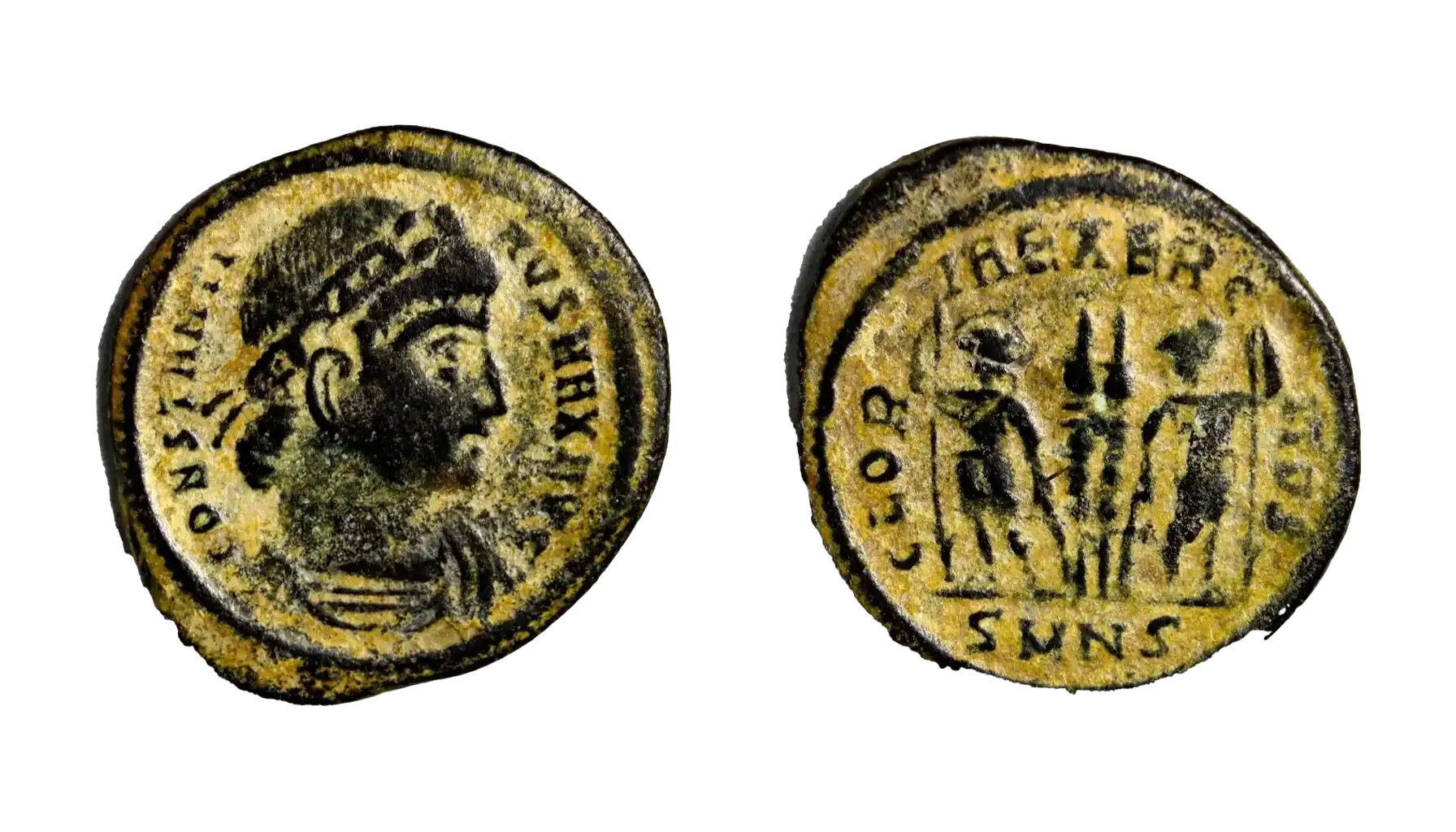
Constantine Roman Coin Types
Before Constantine's reign, there were already attempts to implement new monetary system reforms. For example, large bronze coins with a small admixture of silver, which were called follis.
These became the prototype for the Constantine bronze coin. However, all these attempts were unsuccessful, and therefore it was up to Constantine to deal with them.
Reverse Designs
Sol Invictus – The Unconquered Sun
Victoria – Victory
Military Scenes
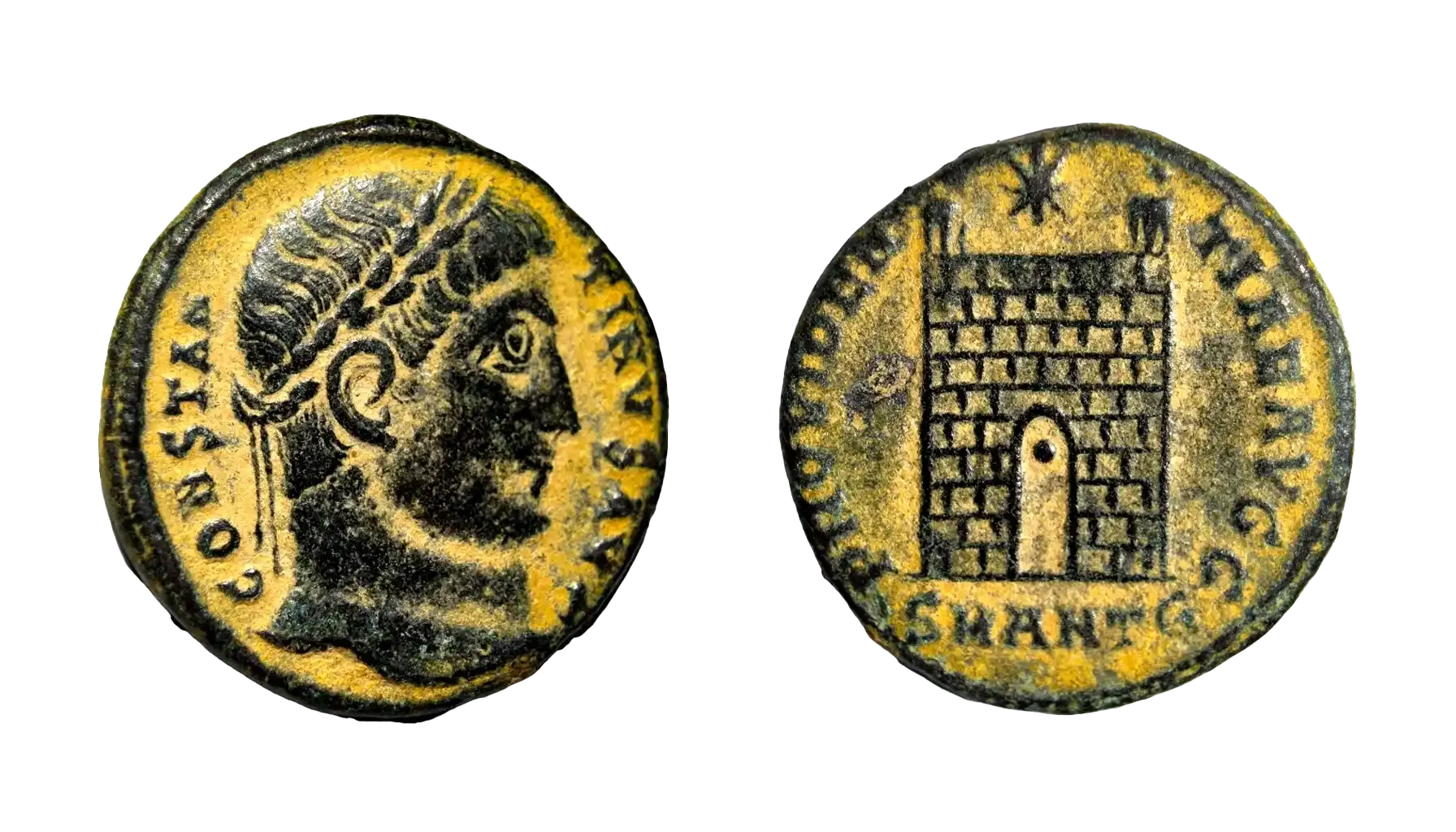
Camp Gates
Legionary Standards
Christogram
Inscriptions: IMP C FL VAL CONSTANTINUS P F AVG
Mint Mark: ROMA (Roman Empire house of Constantine coin), TRES (Trier), SIS (Siscia), CONST (Constantinople)
Constantine's Reform
One of his main achievements in this area is the adherence to the gold standard, i.e., the creation of the Constantine gold coin. He introduced a new specimen, the solidus, which replaced the earlier aureus coins.
The solidus coins were introduced around 312 AD and were a gold coin that became stable and standard for the entire Byzantine Empire for the next 700 years. These specimens depicted a portrait of Constantine on the obverse and various deities or military scenes on the reverse.
The miliariense version was a Roman coin Constantine made of silver. There were several types of it, and it was used for large calculations and was more valuable than bronze. Overall, which is characteristic of Roman coins, the solidus was the most valuable and best-known denomination among the others.
Constantine Coin Value Guide
Gold solidi and silver miliarenses are considerably rare, and because of this, they are more expensive than bronze examples.
Condition
Fine | The main design is visible, but the details are heavily worn. Inscriptions are not fully legible. |
Very Fine | Clearly legible inscriptions, main design details are visible, but there are heavy signs of wear. |
Extremely Fine | Clear details, most of the inscriptions are legible, minimal wear. |
About Uncirculated | Very clear details, almost no wear, minor signs of circulation. |
Uncirculated | The specimen looks as if it just came out of the mint, with perfect design and luster. Extremely rare for ancient coins, especially bronze ones. |
Also, some reverse designs, for example, those with unusual Christian symbols, can be much more valuable than others because fewer of them were struck.
In addition, some mints may have produced particularly low mintages, so their specimens will also be more valuable than others. Depending on the condition, design, and mintage, the Constantine II coin value can range from $30 to $10,000.
House of Constantine Coinage
It is not a specific attribution to Constantine the Great, but also to his entire dynasty, his descendants who ruled the Roman Empire after his death.
Members
Constantine I the Great (306–337)
Crispus, Caesar (317–326)
Constantinus II (337–340)
Constantius II (337–361)
Constans (337–350)
Helena
Fausta
Characteristics
They continued the reforms of their ancestor. They continued the reforms of their ancestor. The system of solidi and bronze nummi created by Constantine I was developed.
The system continued to function, despite the fact that bronze specimens gradually lost their value. Emperors continued to be depicted on the specimens, but they became less and less realistic.
The coins of the House of Constantine are not just a series, issue, or specific type; but for the history of the Roman Empire, they are an important point that shows the path from the pagan Roman Empire to the Christian Byzantine Empire.

 Facebook
  X (Twitter)
  Pinterest
  LinkedIn