Contents:
The United States quarter is one of the most common, high-volume coins that has been present in the monetary system for more than 200 years (since 1796, to be more precise). Over the years, it went through numerous design modifications, but the essence of this denomination stayed the same – a quarter has always been a practical, widely circulated coin with a face value of 25 cents.
The Washington quarters represent the later iteration, which was introduced in 1932 as a commemorative coin, but so enthusiastic was the public response that the design was adopted for regular production and became the standard quarter for decades. In this material, let us take a look at a seemingly average sample, i.e., the 1950 25C, check the features that may identify a coin, and explore the 1950 quarter silver content and worth.
1950 Washington Quarter Overview
The long-running series of the Washington 25C coins started in 1932, when the United States Mint released a commemorative design, celebrating George Washington’s 200th anniversary. At first, it was a coin, meant for one-year regular circulation, but upon its inception, it proved to be popular and reliable in terms of production.
The U.S. Department of the Treasury (through the United States Mint) held a competition to choose the appropriate appearance for the new 25C coin. In an advisory role, the U.S. Commission of Fine Arts favored entries by Laura Gardin Fraser (which would be later used on a 1999 commemorative half eagle), yet Treasury Secretary Andrew W. Mellon ultimately selected the design by John Flanagan.
In fact, the previous Standing Liberty design, which was initially seen as a breakthrough in modern (at that time) numismatics, had been found unsatisfactory, and the main complaints were targeted at poor strike consistency and fast-wearing details that made coins look “flat” after circulation. The Washington quarter, on its part, solved many of those practical problems, let alone its symbolic appearance and global recognition.
“...It would have been the second Quarter Dollar commemorative (the first was the Isabella Quarter Dollar of 1893). The coin proved so popular that the design was continued as a regular-issue for circulation beginning in 1934…”
— Ron Guth, renowned numismatist, licensed Certified Public Accountant
PCGS CoinFacts, Washington Quarters, Type 1, Silver
Identifying the 1950 Silver Quarter: Design & Specs
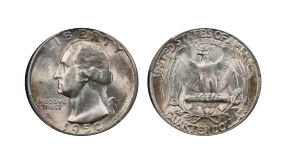
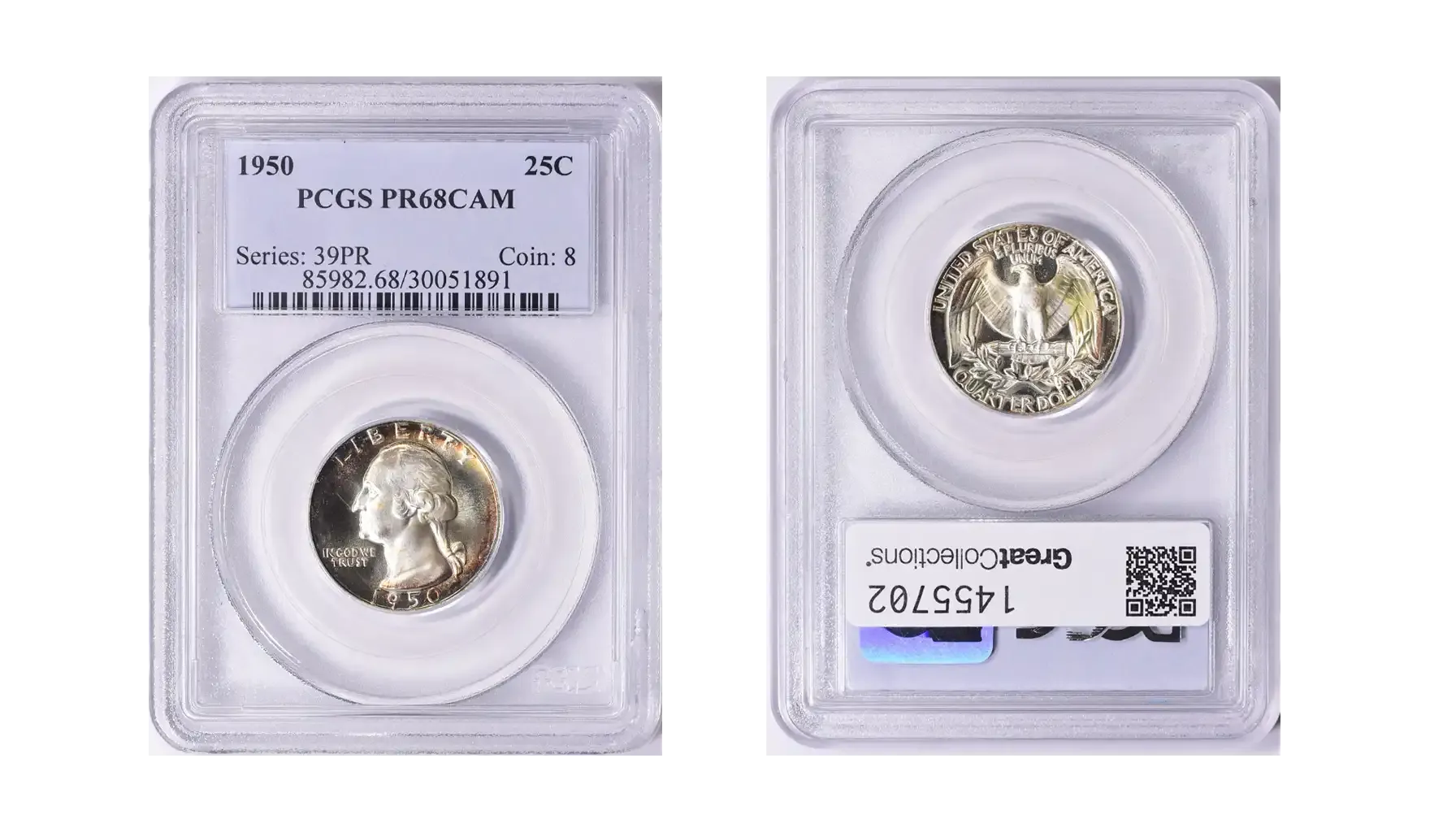
Obverse: Features the bust of George Washington, designed by John Flanagan, as well as inscriptions “LIBERTY” at the top of the coin, “IN GOD WE TRUST” to the left of Washington’s neck, and the date “1950” centered beneath.
Reverse: Demonstrates a bold eagle with its wings opened wide (with arrows in its talons and two olive branches beneath), along with the inscriptions “UNITED STATES OF AMERICA” across the top, “E PLURIBUS UNUM” between the eagle's wings (right above its head), the denomination “QUARTER DOLLAR” along the bottom rim, and a small mint mark above.
The Main Features | |
Denomination | 25 cents |
Composition | 90% silver, 10% copper |
Silver fineness | .900 |
Weight | 6.30 g |
Actual Silver Weight | 0.1808 troy oz pure silver |
Diameter | 24.30 mm |
Thickness | ~1.75 mm |
Edge | Reeded |
Mint Marks | None for Philadelphia “D” for Denver “S” for San Francisco |
Strike Type | Business + proof |
Mint Marks and Varieties of the 1950 Quarter
1950 25C
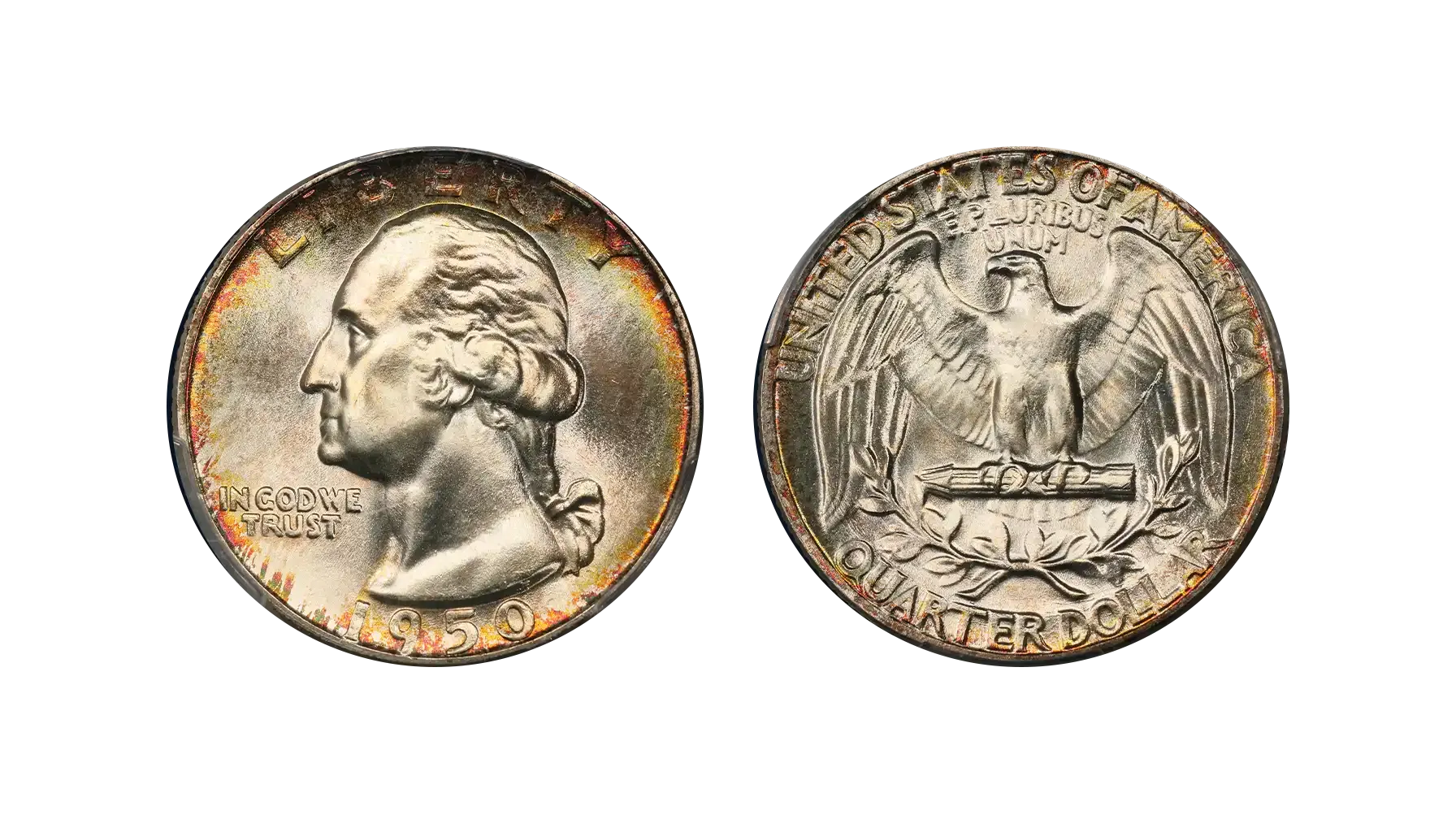
Produced by: Philadelphia Mint
Mintage: 24,920,126
Auction Record: $11,400 for MS68
The 1950 Philadelphia quarter is widely available, as it is the second most common issue in the series (after 1941) in MS65 and above, according to PCGS population data and David Hall in particular. This means that many coins were initially well-preserved, which is why they may show a notably attractive quality for a Philadelphia strike.
1950-D 25C
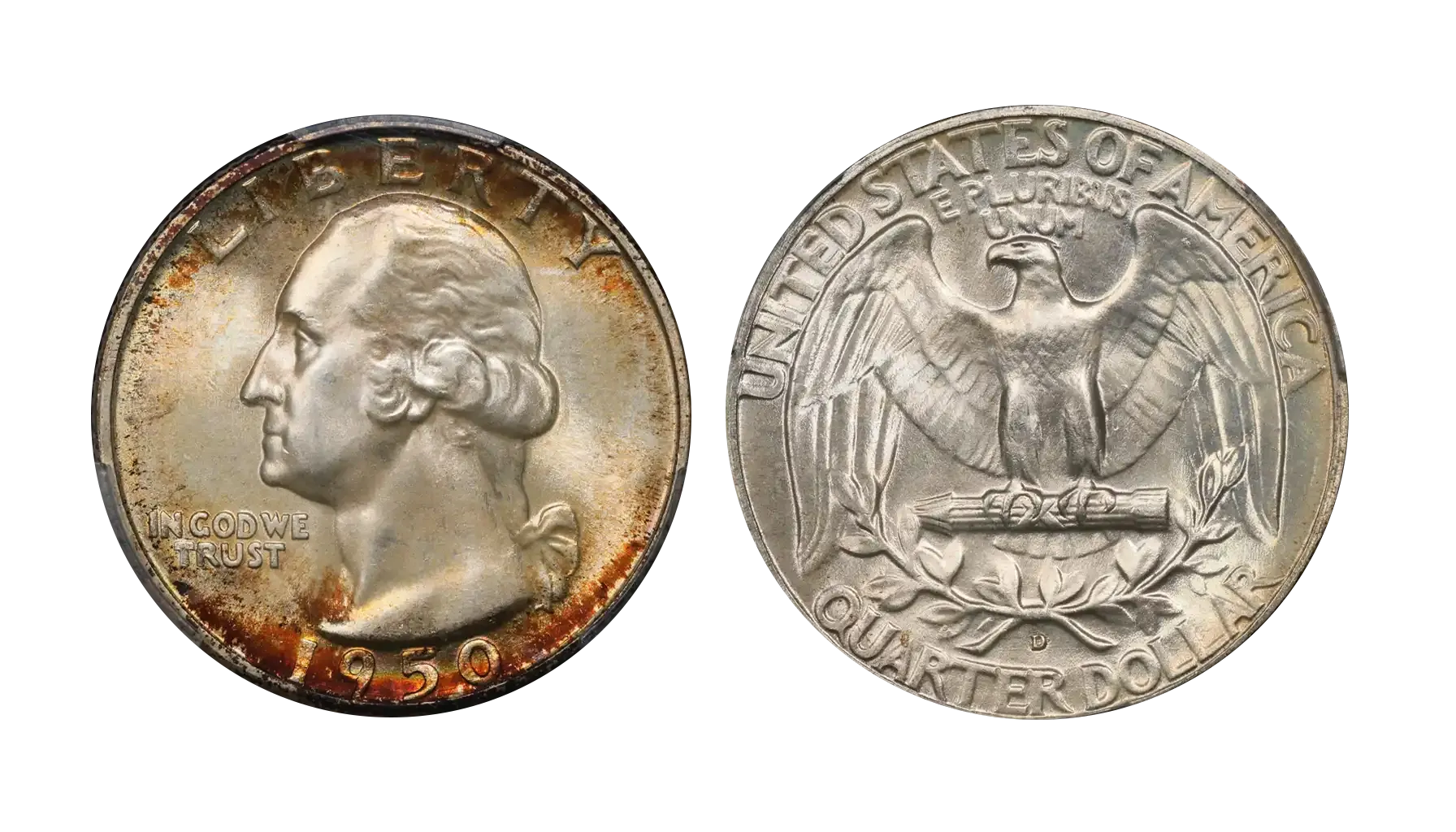
Produced by: Denver Mint
Mintage: 21,075,600
Auction Record: $7,638 for MS68 CAC
The 1950 D quarter value cannot be considered exceptional, since it refers to the type of numismatic creations that are not especially scarce, but still desirable in top-end condition. One may easily find Gem examples from white, frosty pieces to coins with attractive natural toning (both are beautiful in their own ways).
1950-S 25C
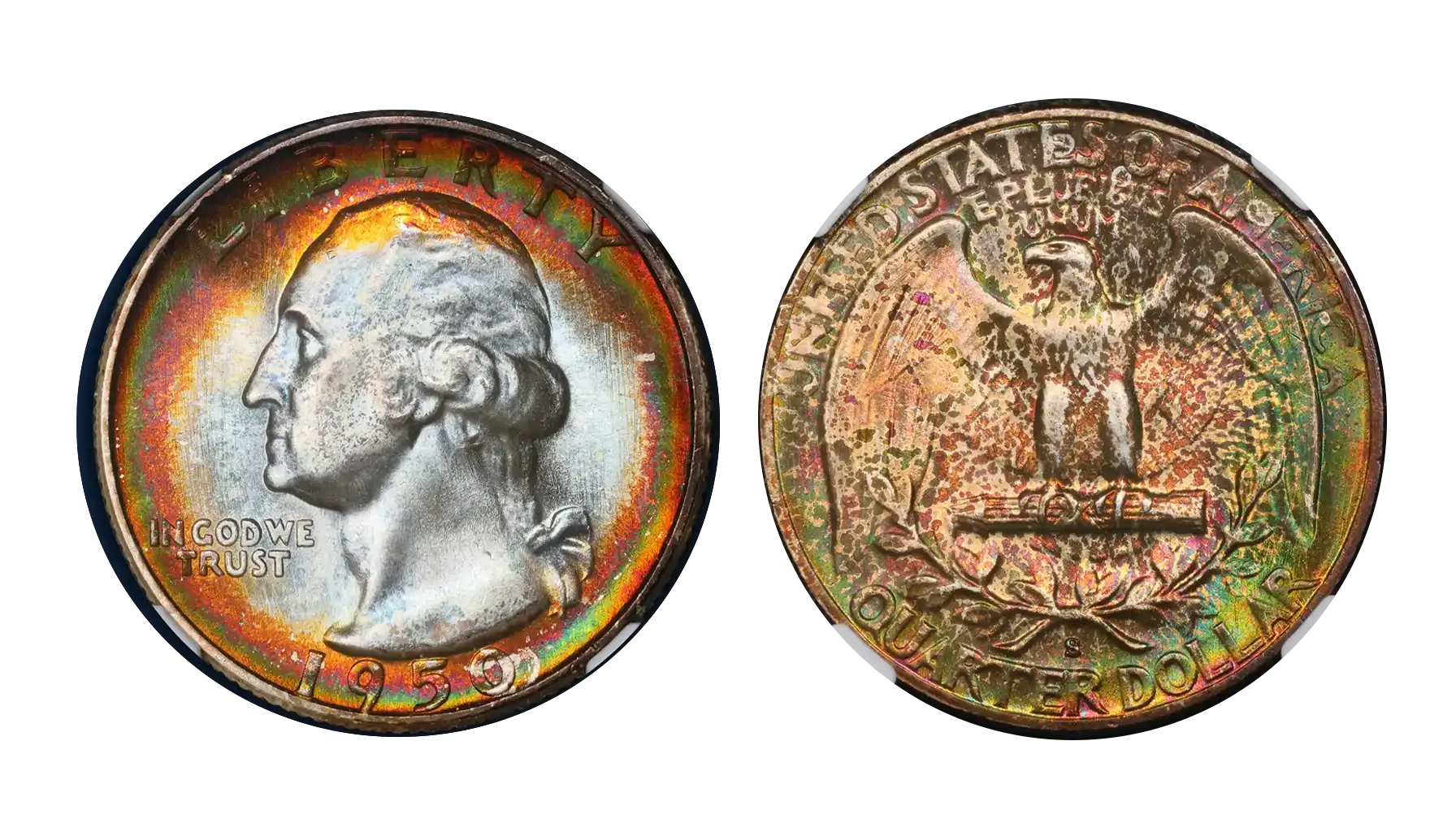
Produced by: San Francisco Mint
Mintage: 10,284,004
Auction Record: $19,800 for MS68
The third minting facility was established in San Francisco, and its products could boast the highest 1950 S quarter value in its regular group. Many surviving coins showed excessive softness, so pieces with sharp definition and full strike tend to be more desirable to obtain (these are considered scarce).
1950 25C Proof
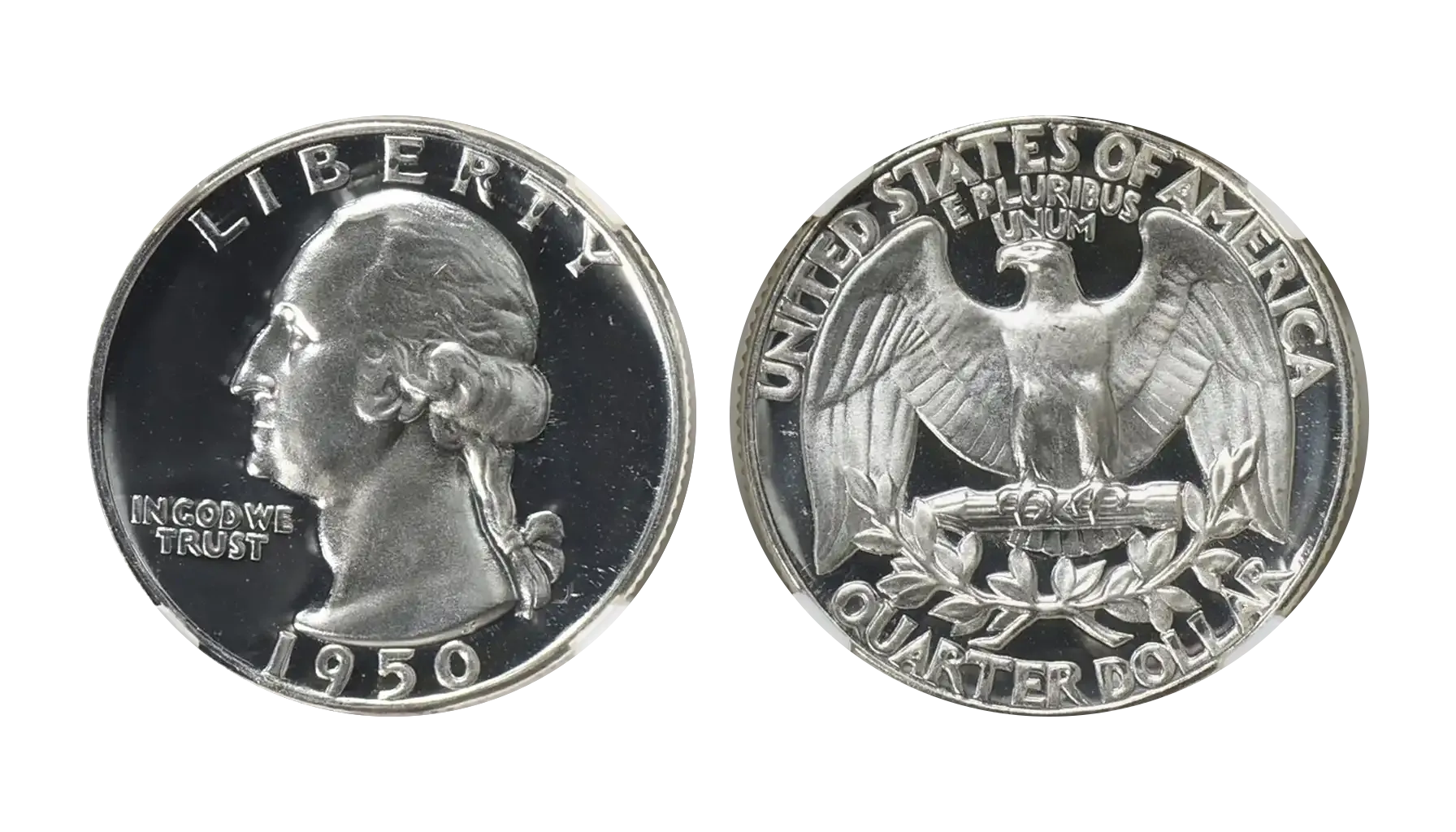
Produced by: Philadelphia Mint
Mintage: 51,386
Auction Record: $31,200 for PR68DCAM
The 1950 proof quarter was the first proof coin released after an eight-year pause in proof production, and the overall quality is often regarded as stronger than many proofs from 1936–1942. Jaime Hernandez from PCGS also noted that only a few hundred instances with the Cameo designation and less than a dozen Deep Cameo samples survived.
1950 Quarter Value Today (by Condition and Mint)
How much is a 1950 quarter worth? Although the presence of these coins is stable, their prices are not. Nonetheless, each has an embedded “melt value” baseline, upon which collectors layer premiums, but why?
Factors Affecting the 1950 Silver Quarter Value
Silver Spot Price: Since all 1950 strikes are made of gold (90%), the intrinsic worth should be approximately $15.6 (check silver rates accordingly).
Grade: Numerical references are attributed by authorized grading agencies like PCGS or NGC, and they indicate how well the surface and quality of the coin are preserved.
Mint Mark: Marks, associated with mintages, always drive the demand and, consequently, the price.
Overall Appearance: It includes luster, toning, designations, and the quality of mining in general.
How Much Is a 1950 Silver Quarter Worth?
Grade | 1950 25C | 1950-D 25C | 1950-S 25C | 1950 25C Proof |
G4–VF20 | $19 | $19 | $19 | – |
EF40 | $20 | $20 | $20 | – |
AU50 | $21 | $21 | $21 | – |
MS63/PR63 | $25 | $25 | $25 | $50–$52 |
MS64/PR64 | $26 | $26 | $26–$28 | $55–$65 |
MS65/PR65 | $30–$42 | $38–$46 | $35–$42 | $80–$85 |
MS66/PR66 | $65–$115 | $75–$140 | $50–$115 | $90–$110 |
MS67/PR67 | $450–$2,000+ | $400–$2,150+ | $375–$1,600 | $135–$425+ |
Collector Tips and Where to Buy
Here is one tip we would like to provide: trust reputable coin auctions and established dealers, because they are far more likely to offer accurately described coins, relevant certificates, clear photos, documented provenance, and transparent return policies.
And to make it even more enjoyable and insightful, do not forget to employ Coin ID Scanner, an advanced application to identify coins from photos, organize your collection, and get more professional day by day. Bring your phone and turn it into your personal collecting assistant.

 Facebook
  X (Twitter)
  Pinterest
  LinkedIn