Contents:
A 1968 quarter is a Washington quarter minted as part of the standard U.S. coinage series. It was the fourth year after the U.S. Mint eliminated silver from circulating quarters. So, all regular 1968 quarters are copper-nickel clad — not silver.
But how can you identify the coin? And how much is a 1968 quarter worth?
Feature | Details |
Denomination | 25 cents |
Year | 1968 |
Obverse Design | George Washington (by John Flanagan) |
Reverse Design | Heraldic eagle with arrows and olive branches |
Composition | 75% Copper, 25% Nickel (clad over pure copper core) |
Weight | 5.67 grams |
Diameter | 24.3 mm |
Thickness | 1.75 mm |
Edge | Reeded (119 reeds) |
Mint Mark Location | Obverse, below Washington’s hair ribbon |
1968 Quarter Silver Content | None (clad only) |
History Behind
Just four years prior, in 1965, the U.S. Mint had removed silver from quarters and dimes in response to rising bullion prices and silver shortages. As a result, the 1968 quarter was part of the new generation of coins struck with a copper-nickel clad composition over a pure copper core.
In 1968, the Mint also finalized a design change that would impact all subsequent Washington quarters: it moved the mint mark from the reverse side of the coin to the obverse, just to the right of Washington’s ponytail. This change was part of broader efforts to standardize production and prepare for the increased role of mechanical coin sorting and vending technology.
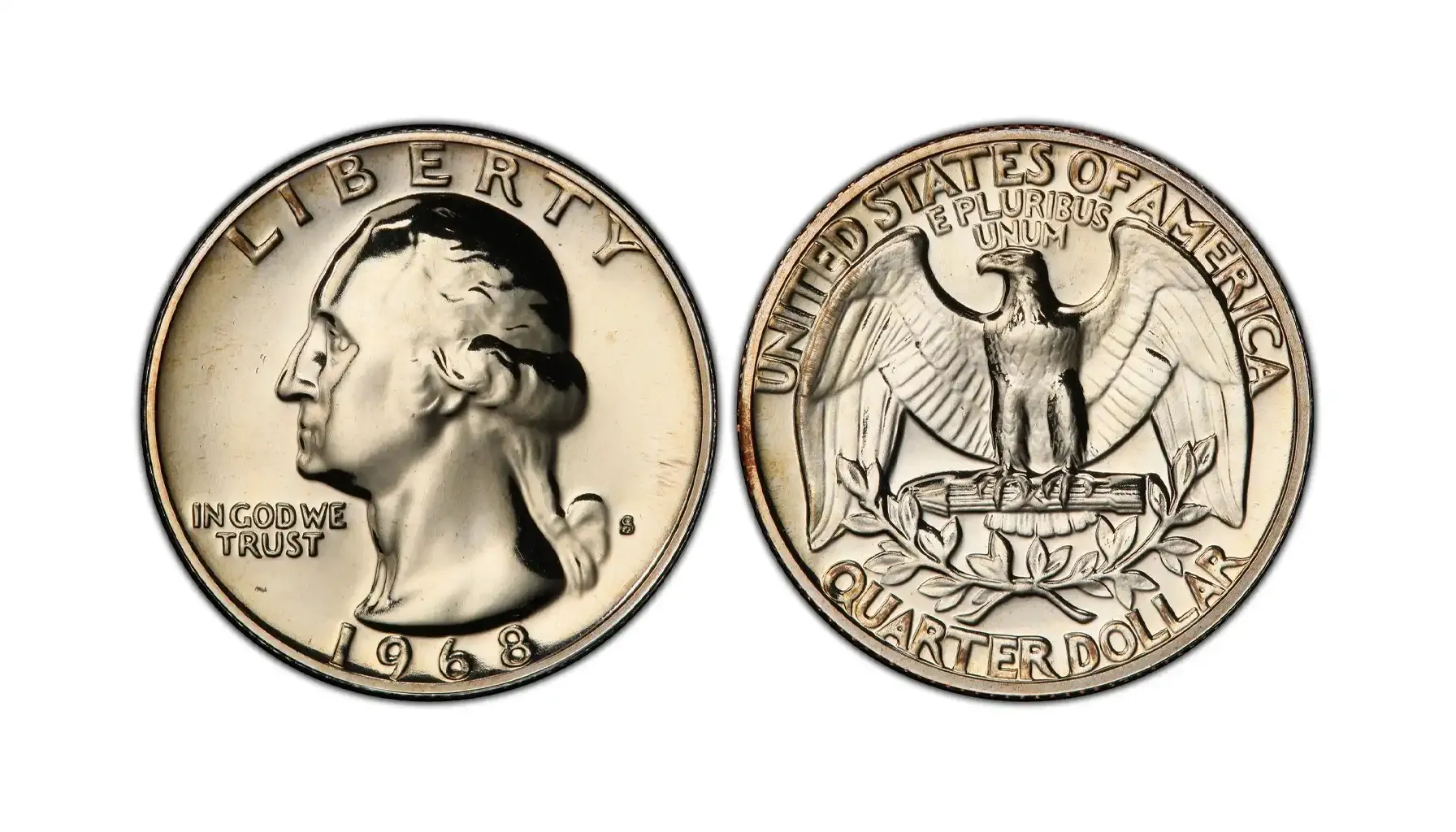
Additionally, 1968 was the return of proof coinage after a two-year pause during the transition to clad coinage. These proof coins were now produced exclusively at the San Francisco Mint and clearly marked with an “S”—another step in modernizing U.S. Mint practices.
Mint Marks
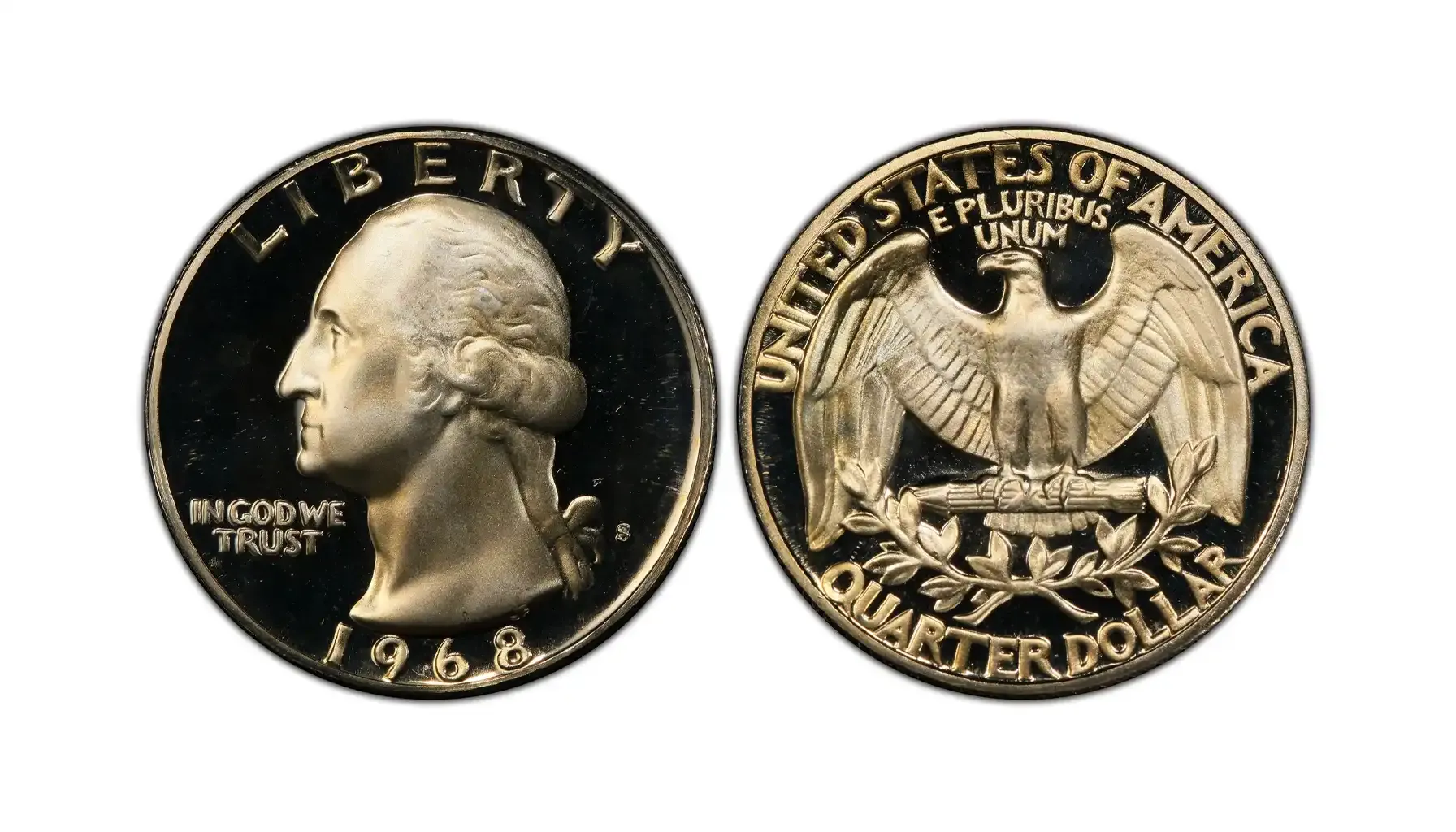
The 1968 Washington quarter featured mint marks that were newly placed on the obverse side of the coin, just to the right of Washington’s ponytail and beneath the ribbon in his hair.
This was the first year the mint mark location was moved from the reverse to the obverse on quarters—a change that continues to this day.
In 1968, only three mints produced quarters:
The 1968 quarter with no mint mark was struck in Philadelphia.
Denver struck a “D” mint mark.
San Francisco (S) produced proof quarters only, intended for collectors. These coins were not released into circulation and can be identified by their “S” mint mark in the same location on the obverse.
1968 Quarter Value No Mint Mark Explained
The 1968 quarter without a mint mark was struck at the Philadelphia Mint, which—unlike Denver (D) and San Francisco (S)—did not use a mint mark at that time.
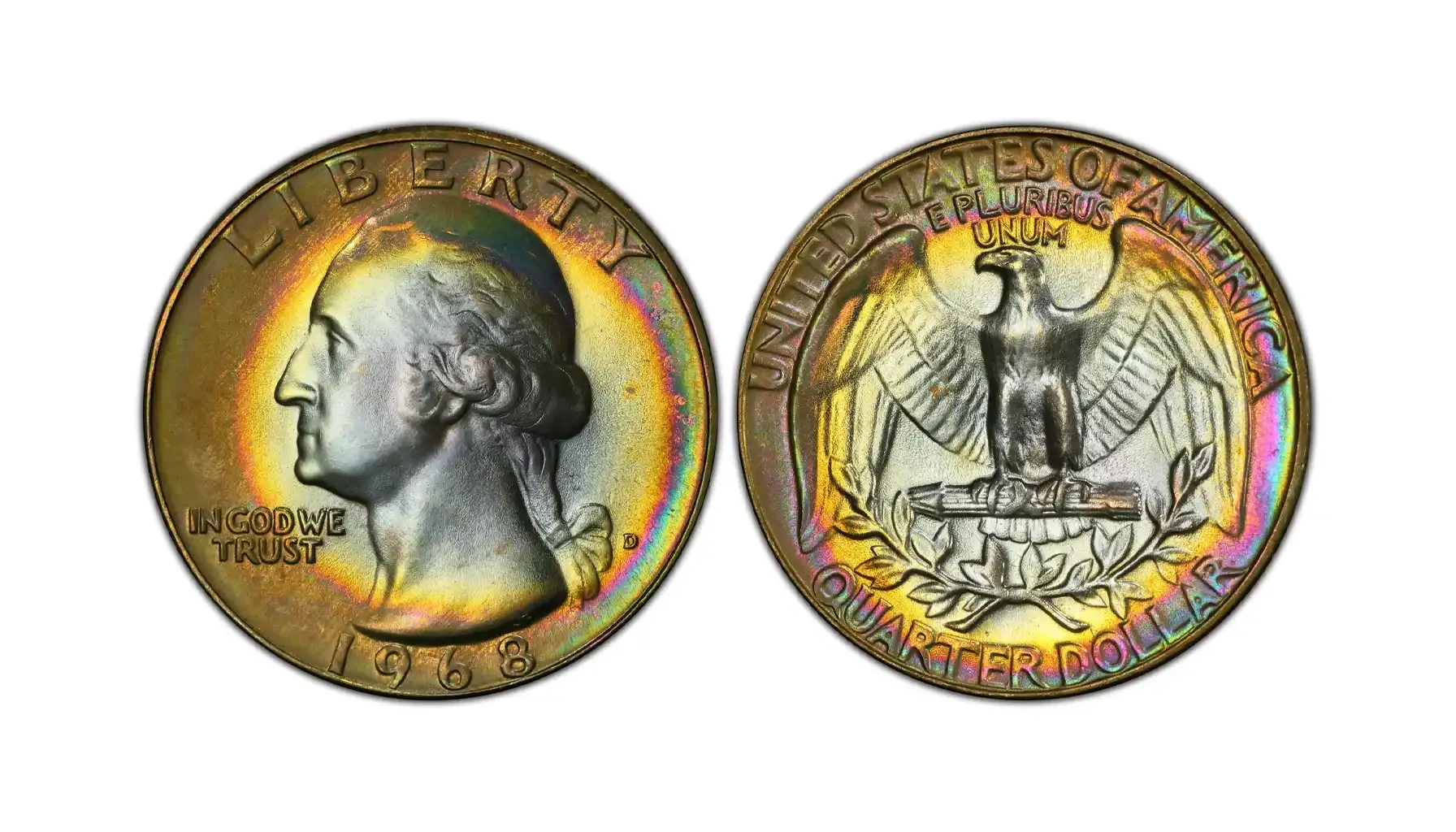
There are three other possible explanations of a 1968 quarter no mint mark:
1. It’s a 1968-S Proof Coin
1968 proof quarters were struck at the San Francisco Mint. They do not circulate and carry an “S” mint mark, but if it’s missing due to wear or weak strike, it might be mistaken for having none. These coins have mirror-like surfaces and sharp details.
→ Examine the coin’s finish. If it’s highly reflective and not worn, it might be a proof with a faded or very faint “S”. If so, you need to check the 1968 S quarter value.
2. The Mint Mark Was Worn Off or Obscured
The mint mark on the 1968-D quarter is small and can wear off over time, especially in circulated coins. Dirt, scratches, or corrosion can also obscure it completely.
→ Use a 10x magnifier and examine the area just right of Washington’s ponytail. If the surface is smooth or damaged there, it’s likely the mint mark was simply erased by wear.
3. It’s a Counterfeit or Altered Coin
Rarely, people attempt to remove mint marks to create the illusion of a rare variety. A true 1968 no mint mark quarter was never struck for circulation, so if you find one in perfect condition with no trace of a mint mark, it could be tampered with—or a fake.
→ Compare with known Denver-struck coins. If you're unsure, consider authentication from PCGS or NGC.
Is a 1968 Quarter Worth Anything?
Type | Grade | Estimated Value (USD) |
1968 No Mint Mark Quarter Value | Circulated (G–XF) | $0.25 – $1.00 |
About Uncirculated (AU) | $1.00 – $2.50 | |
Mint State (MS60–MS63) | $3.00 – $10.00 | |
MS64 | $10.00 – $15.00 | |
MS65 | $18.00 – $30.00 | |
MS66 | $40.00 – $70.00 | |
MS67 | $150.00 – $300.00+ | |
MS68 (rare) | $2,500.00 – $4,000.00+ | |
1968 D Quarter Value | Circulated (G–XF) | $0.25 – $1.00 |
About Uncirculated (AU) | $1.00 – $2.50 | |
Mint State (MS60–MS63) | $3.00 – $10.00 | |
MS64 | $10.00 – $15.00 | |
MS65 | $18.00 – $30.00 | |
MS66 | $40.00 – $70.00 | |
MS67 | $125.00 – $250.00+ | |
MS68 (rare) | $600.00 – $1,200.00+ | |
1968 S Proof Quarter Value | PR60–PR64 | $1.50 – $5.00 |
PR65 | $6.00 – $10.00 | |
PR66–PR67 | $12.00 – $18.00 | |
PR68 | $20.00 – $30.00 | |
PR69 | $35.00 – $50.00+ | |
PR67 CAM / DCAM | $50.00 – $120.00+ |
Disclaimer: These values reflect retail estimates and may vary depending on market trends and certification.
1968-D quarters are common, but prices rise sharply at MS66 and above, especially for well-struck examples with full luster and no contact marks.
1968-S proof coins are collectible in high grades, especially with Cameo (CAM) or Deep Cameo (DCAM) contrast.
1968 Quarter Error List with Pictures
1. Doubled Die Obverse (DDO)
It's a rather valuable 1968 quarter error. It occurs when the coin die is struck more than once out of alignment. This creates a doubling effect on the obverse elements.
You may notice doubling on letters in “LIBERTY”, “IN GOD WE TRUST”, or on the date “1968”. It may also appear as extra thickness or shadow-like images on the lettering.
Value of 1968 quarter with DDO in 2025:
XF: $50–$100
MS63: $150–$300
MS65+: $500–$1,000+ (if certified)
2. Off-Center Strike
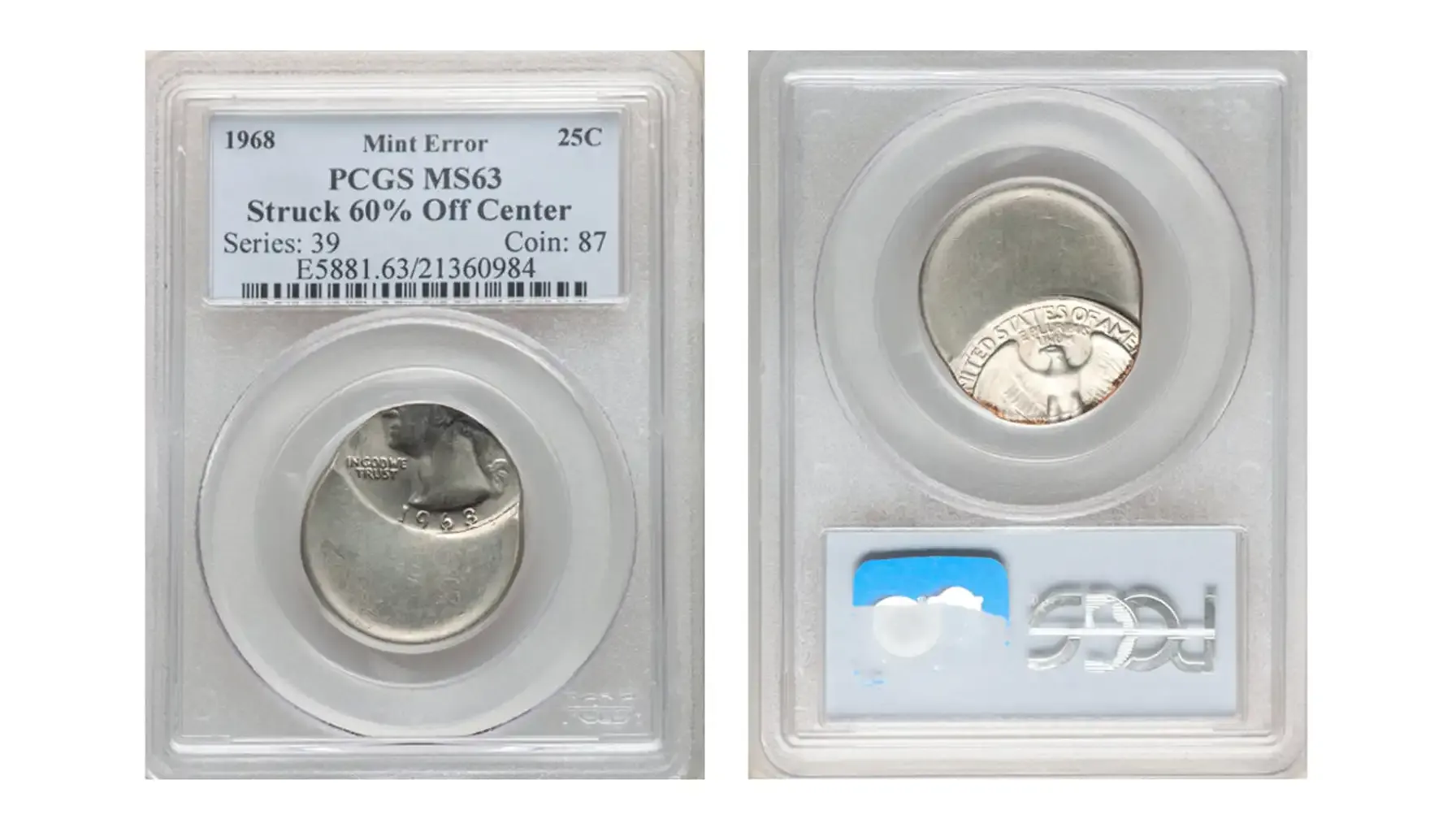
The coin is not properly aligned during striking, resulting in part of the design being off the coin’s surface.
What to look for:
Visible blank crescent where part of the design is missing.
Must include a visible date to be valuable.
Value of a 1968 quarter in 2025:
5–10% off: $25–$50
20–50% off: $75–$250+
More than 50% off-center: $300+ if well-struck
3. Missing Clad Layer
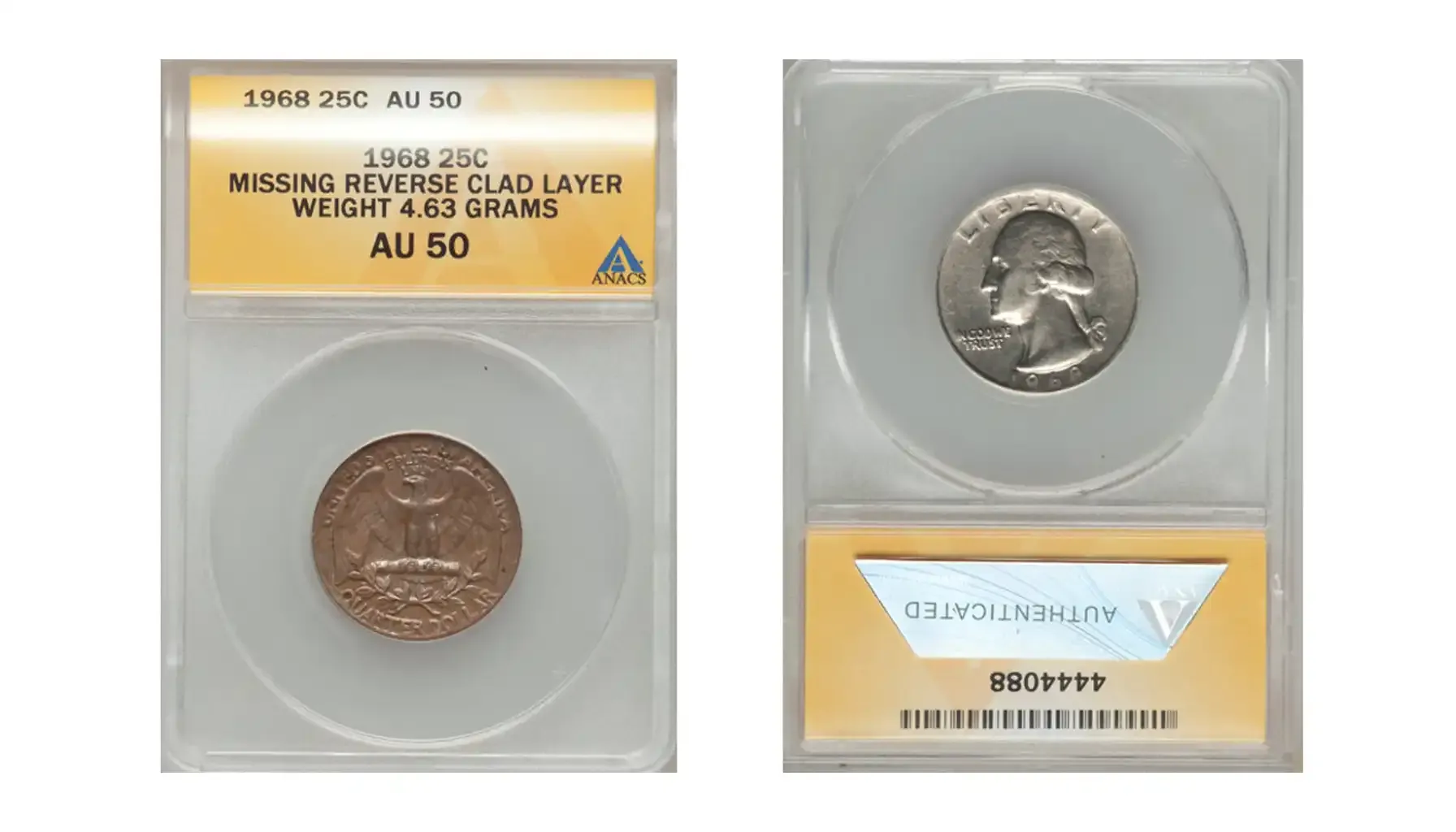
This error happens when the nickel outer layer is missing, exposing the copper core beneath. Can occur on one side or both.
One side appears dull reddish-brown like a penny. The coin may be slightly lighter in weight (~5.1g vs. 5.67g normal).
What is a 1968 quarter worth in 2025 with such an error?
One side missing clad: $150–$300
Both sides: $400–$750+
4. Clipped Planchet
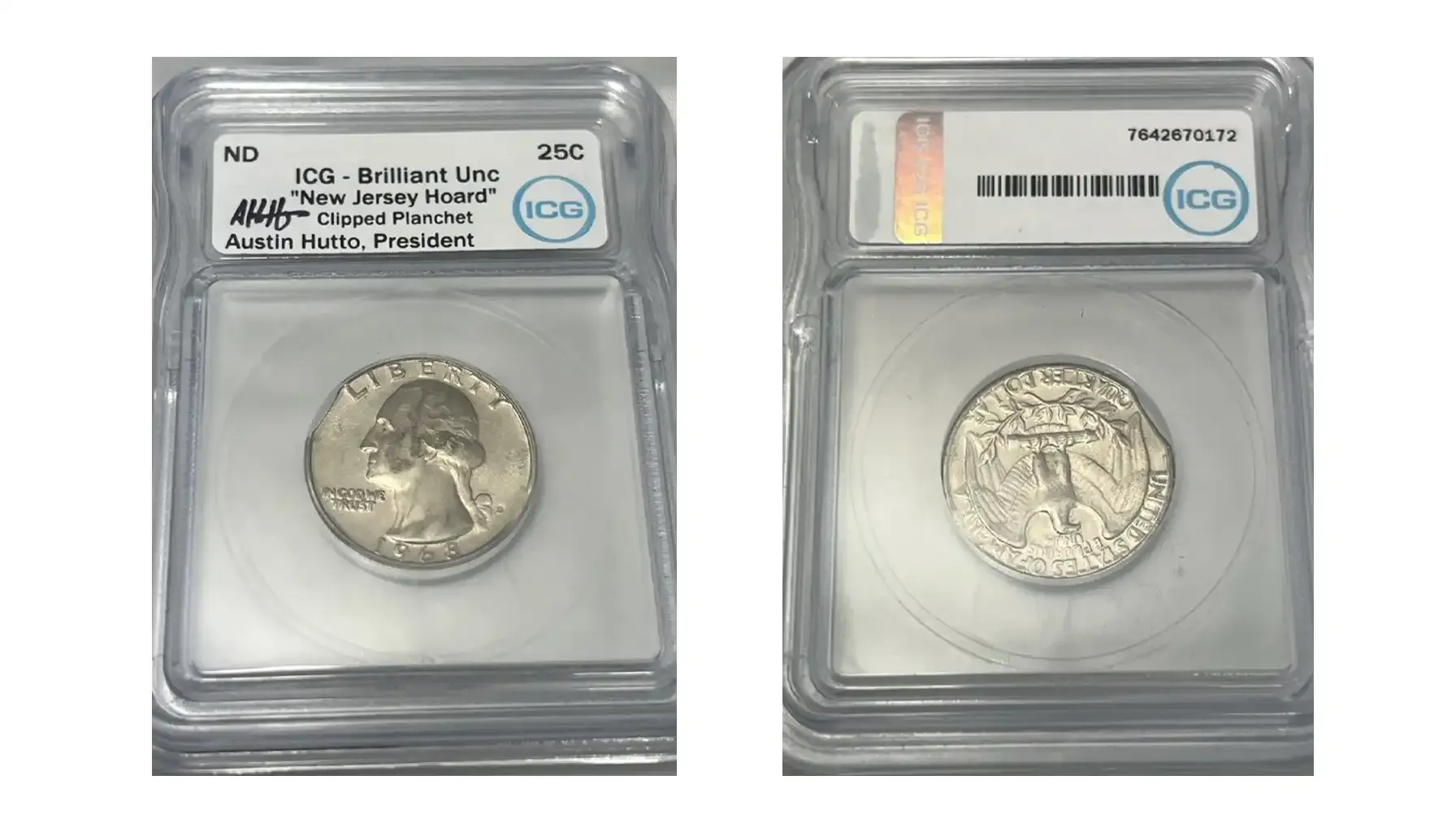
Part of the coin is missing due to an error in cutting the metal blanks. Can be curved or straight.
What to look for:
Clean “bite” out of the edge of the coin, not a jagged or damaged edge.
Look for “blades” or metal flow distortion near the clip.
Value in 2025: $25–$200+
5. Struck Through Grease or Debris
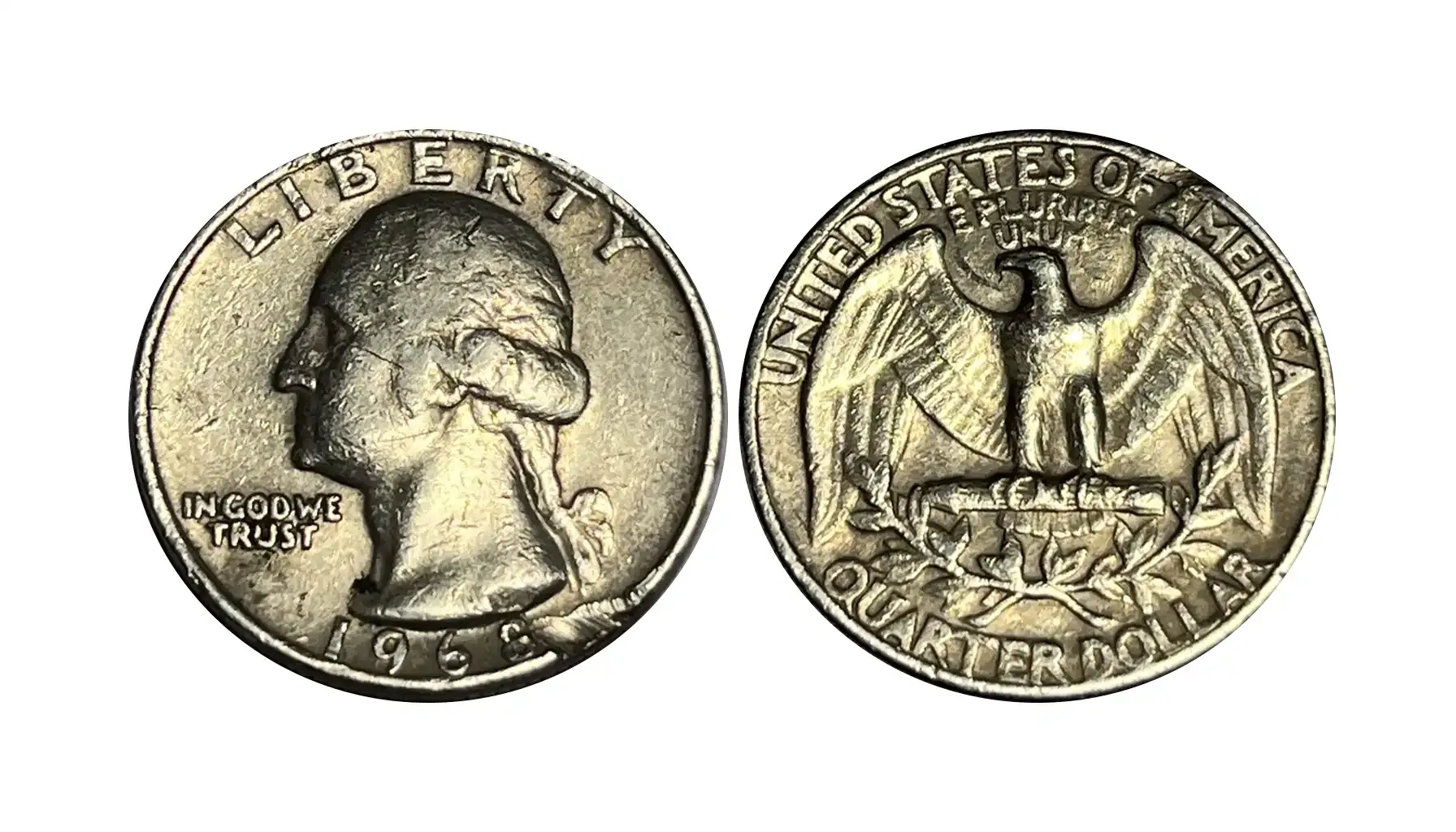
Foreign material (like grease or wire) interferes with the striking process, flattening or distorting parts of the design.
You may see weak or missing design areas (especially date, mint mark, or eagle details). Must appear natural and not scratched or post-mint damaged.
1968 quarter coin value in 2025:
Minor: $10–$30
Major: $50–$150+
Tip for Your Collection
If you suspect you have valuable 1968 quarter errors:
Use a 10x–20x loupe
Weigh the coin on a precise digital scale (normal: 5.67g)
Compare it with verified examples on PCGS or NGC
Consider submitting rare errors for certification
You can also use Coin ID Scanner to photograph and identify your coins and their values in seconds.
1968 Quarter vs. Other Notable Quarters
Feature | 1968 Quarter | 1999 Delaware Quarter | ||
Type | Regular Washington quarter (clad) | Final silver Washington quarter | First Statehood quarter (Delaware) | Part of American Women Quarters Program |
Composition | 75% copper, 25% nickel (clad) | 90% silver, 10% copper | Copper-nickel clad | Copper-nickel clad |
Mint Mark Location | Obverse, under ponytail | Reverse, below wreath | Obverse, under "IN GOD WE TRUST" | Obverse, under "IN GOD WE TRUST" |
Design - Obverse | George Washington | George Washington | George Washington | George Washington |
Design - Reverse | Heraldic eagle | Heraldic eagle | Caesar Rodney on horseback | Bessie Coleman and an airplane in flight |
Silver Content | None = NOT a 1968 silver quarter | 0.1808 troy oz | None | None |
Typical Value (2025) | $0.25–$2 (circulated); up to $50+ (MS) | $5+ melt; $25–$300+ (MS) | $0.25–$1 (circulated); $5–$10 (MS) | $0.25–$2 (MS or sets only) |
5-Year Collectibility Forecast
In its circulated form, the quarter is still common and unlikely to gain substantial value above face unless silver prices dramatically shift or economic instability pushes demand for pre-2000 coinage.
However, examples in high Mint State (MS66–MS68) and all certified error varieties like those from the 1968 D quarter error list have already shown rising demand. Proofs, especially deep cameo 1968-S coins, are also experiencing upward movement, especially among modern type collectors and set builders.
Looking ahead to 2030, here’s what’s likely:
MS66–MS68 graded coins will remain the key targets for registry collectors. 1968 quarter price sums are projected to increase by 15–25%, especially for well-struck 1968-D coins with clean fields.
Rare errors (e.g., missing clad layers, DDOs) will likely see a 35–50% gain, due to shrinking supply and growing interest in major clad-era mistakes.
Deep Cameo proof coins graded PR68 or higher may double in value, particularly if PCGS or NGC populations stay low.
Check the silver price predictions for 2030 if you’re a silver coin collector.
In summary, for collectors and investors who want to build a future-proof clad-era portfolio, this coin deserves a place.

 Facebook
  X (Twitter)
  Pinterest
  LinkedIn