Contents:
The age of quarters has been long: it went through numerous modifications, some of which, though, are notoriously known for short-lived details, blandness, or the lack of popularity among numismatic professionals. Others, however, managed to become lasting favorites, and the Standing Liberty design, launched as a substitute for Barber quarters, is exactly what one may think of.
The Standing Liberty quarter 1929 issue belongs to the final modification of the coin, i.e., the most refined and no less well-recognized form of the design. But why is it so special? How much is a 1929 quarter worth, and where to check coin value so as to rest assured it is up-to-date?
1929 Standing Liberty Quarter Overview
When Barber coinage could no longer satisfy the public's expectations for modern designs and, hence, avoid criticism for its dated appearance, the United States Mint began searching for a more daring replacement. This was made possible only because of the act, passed in 1890, which permitted the Treasury Department to approve new coin designs once the existing option had been in use for at least 25 years.
At first, the Mint's engravers were required to submit the renewed iteration of the quarter, yet when they failed to do so (these were not well received), the Commission of Fine Arts, responsible for counseling the federal government on artistic and design matters, invited a few notable US coin designers to submit their own version of the coin.
These were Albin Polasek, Adolph Weinman (who later became the creator of the new dime and half dollar series), and Hermon MacNeil, i.e., a person standing behind a new Liberty design, released in 1916. The series is commonly divided into three main varieties. The differences mainly consisted in Liberty's figure (chainmail covering), date adjustments, and the presence of stars. The rest remained the same.
“...The Director of the Mint shall have power, with the approval of the Secretary of the Treasury, to cause new designs or models of authorized emblems or devices to be prepared and adopted in the same manner as when new coins or devices are authorized. But no change in the design or die of any coin shall be made oftener than once in twenty-five years…”
— U.S. Congress, “Legislation to Allow for New Coin Designs”
United States Mint
Identifying the 1929 Silver Quarter: Design & Specs
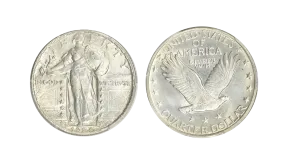
Obverse: The full-length depiction of Liberty in a chainmail apparel, holding a shield and a branch of olive, standing in a gateway, along with the inscriptions “LIBERTY” across the top rim, the national motto “IN GOD WE TRVST” split across the left and right sides of the gateway, a tiny mint mark located to the left of Liberty's feet, and the date “1929” at the bottom.
Reverse: A more peaceful image of an eagle in flight, surrounded by stars, the inscriptions "UNITED STATES OF AMERICA" at the top of the coin, "E PLVRIBVS VNVM" right below the name of the country (between eagle's wings), and the denomination "QUARTER DOLLAR" along the bottom rim.
The Main Features | |
Denomination | 25 cents |
Design Type | Type 2b (1925–1930) |
Composition | 90% silver, 10% copper |
Actual Silver Weight | 0.18084 troy oz silver |
Weight | 6.30 g |
Diameter | 24.30 mm |
Thickness | ~1.75 mm |
Edge | Reeded |
Mint Marks | None for Philadelphia “D” for Denver “S” for San Francisco |
Mint Marks and Varieties of the 1929 Quarter
1929 25C
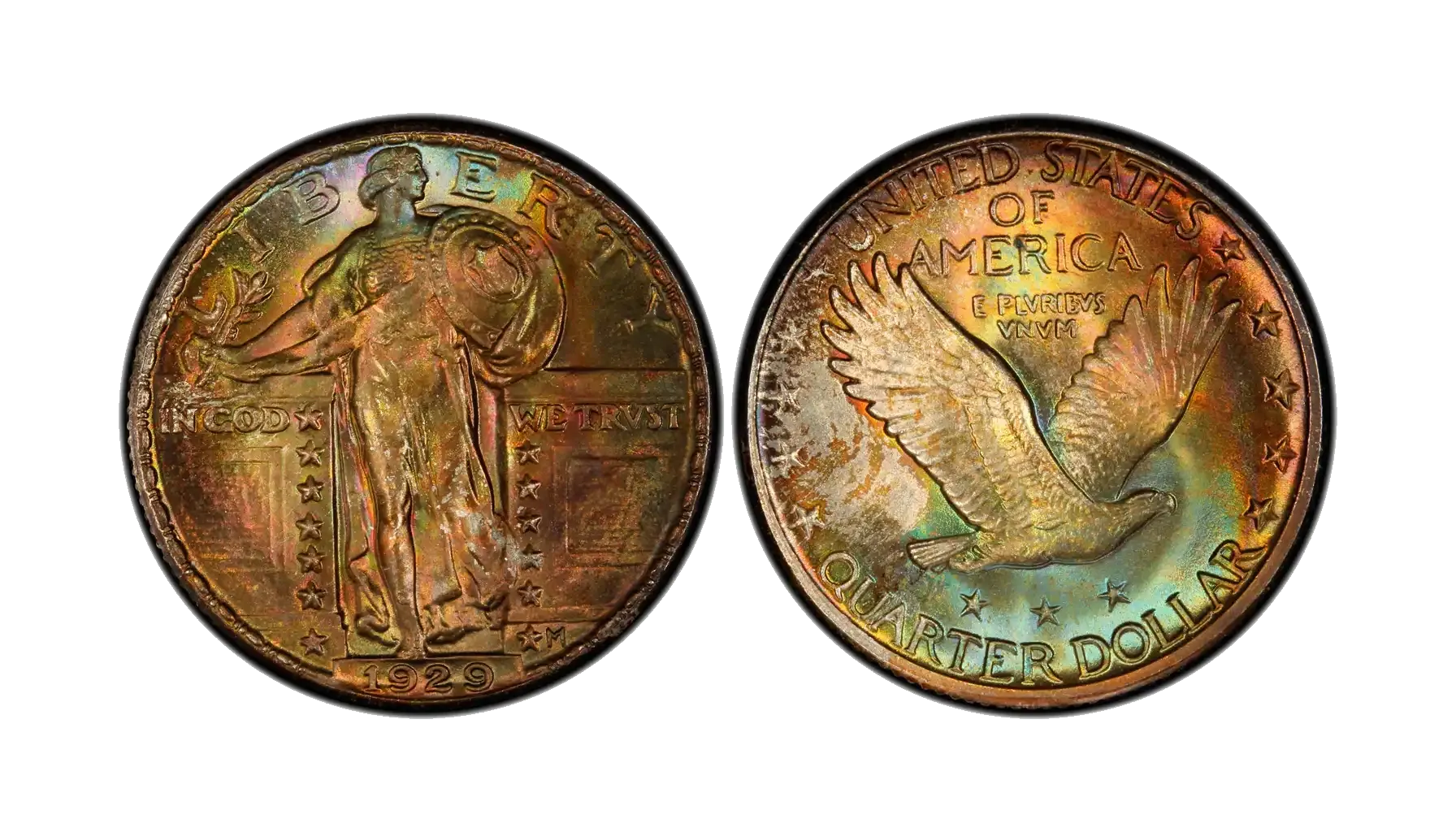
Produced by: Philadelphia Mint
Mintage: 11,140,000
Auction Record: $72,000 for MS67+FH
The 1929 quarter eagle from the Philadelphia Mint, as usual, does not bear any mint mark and belongs to the most plentiful variety of the year. It, however, does not mean that the 1929 Standing Liberty quarter value should be low: in turn, the more coins that were struck, the lower the chances of finding an immaculate piece. This is why the auction record of the year refers to the product of Philadelphia.
1929-D 25C
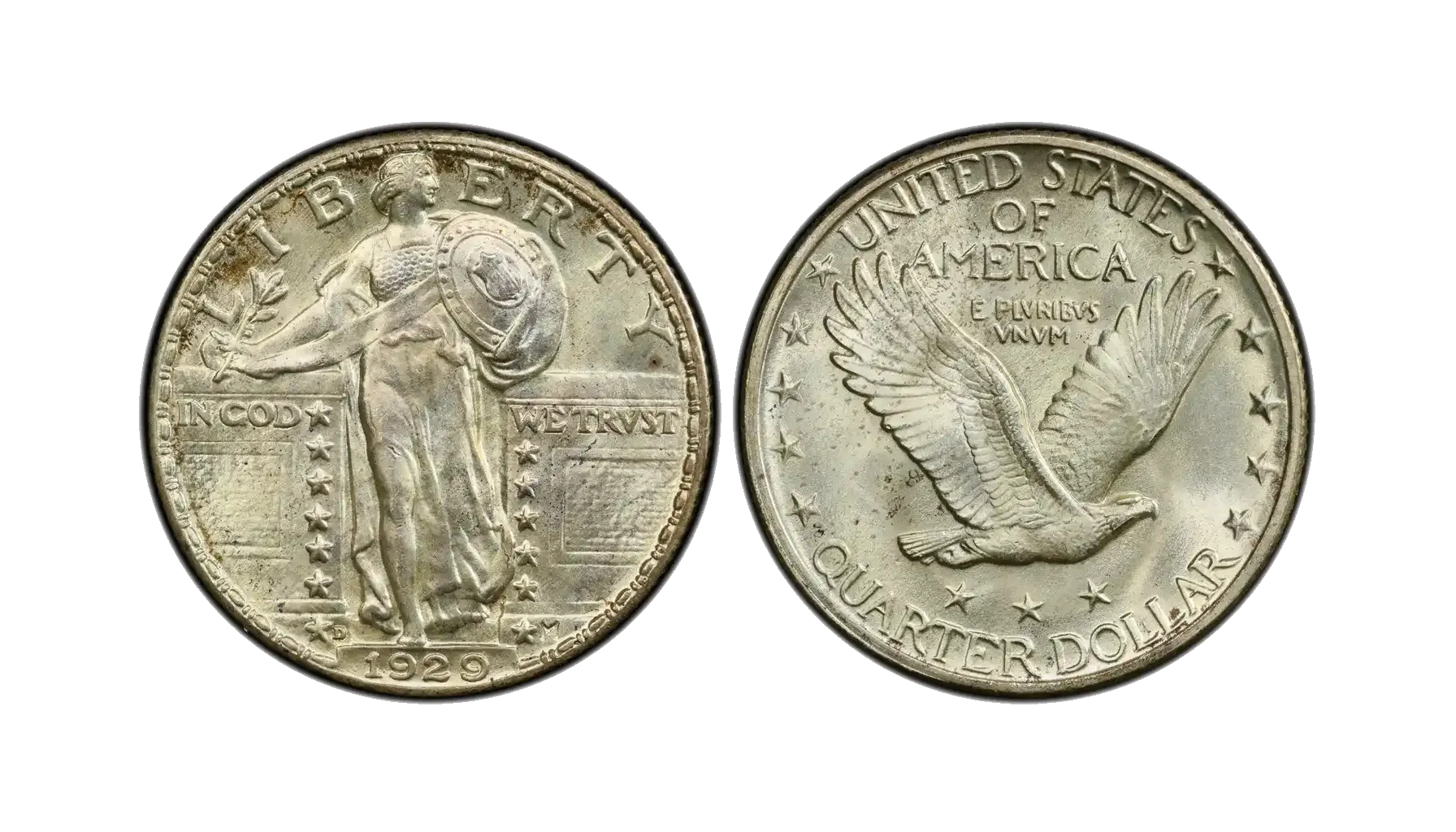
Produced by: Denver Mint
Mintage: 1,358,000
Auction Record: $58,800 for MS66+FH
The 1929 D Standing Liberty quarter comes from the Denver Mint, and it is the lowest-mintage coin in the 1929 series. Finding one in high grades is difficult, yet not impossible (however, the issues with the Full Head designations are still cherished from the numismatic perspective).
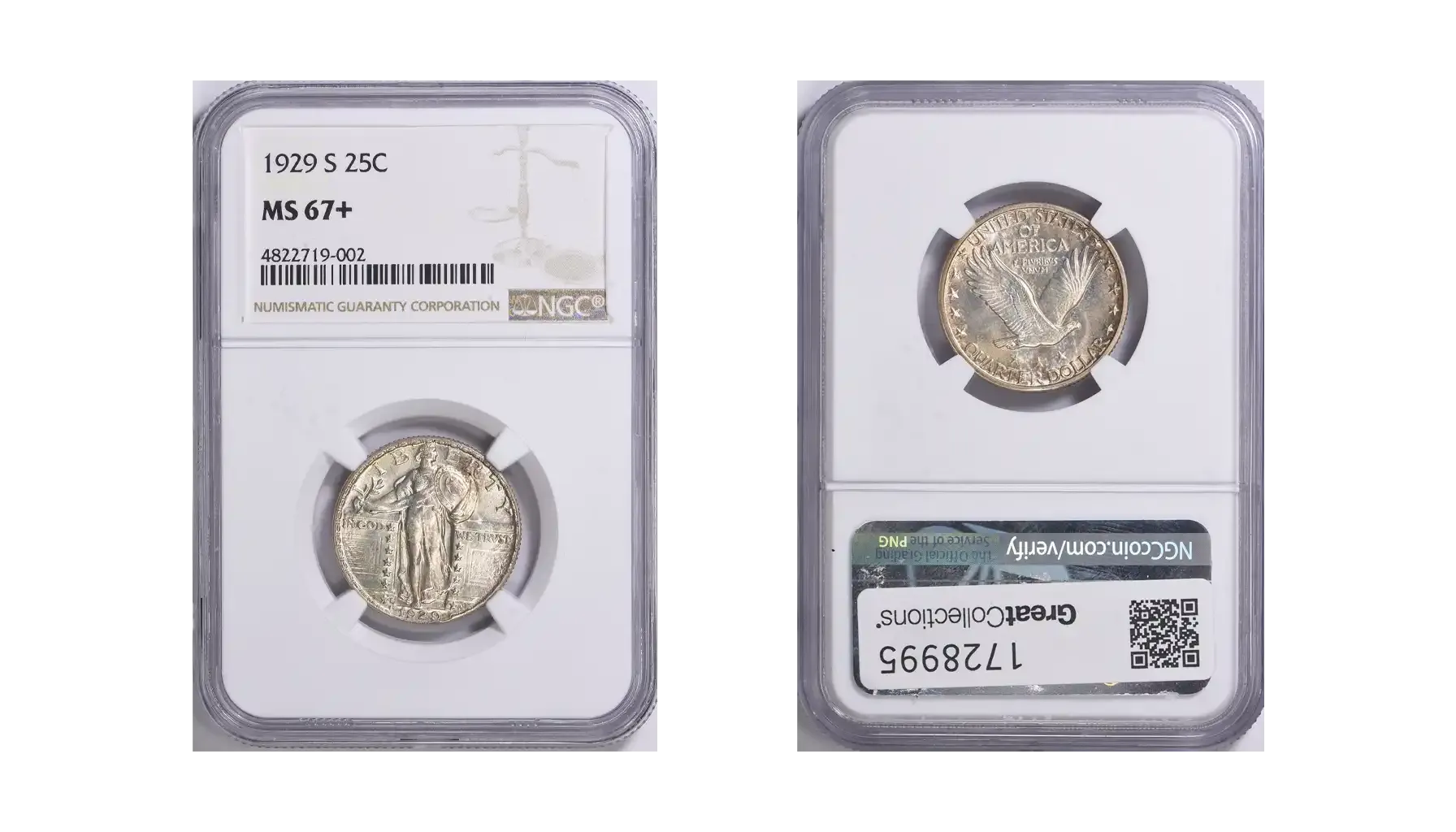
1929-S 25C
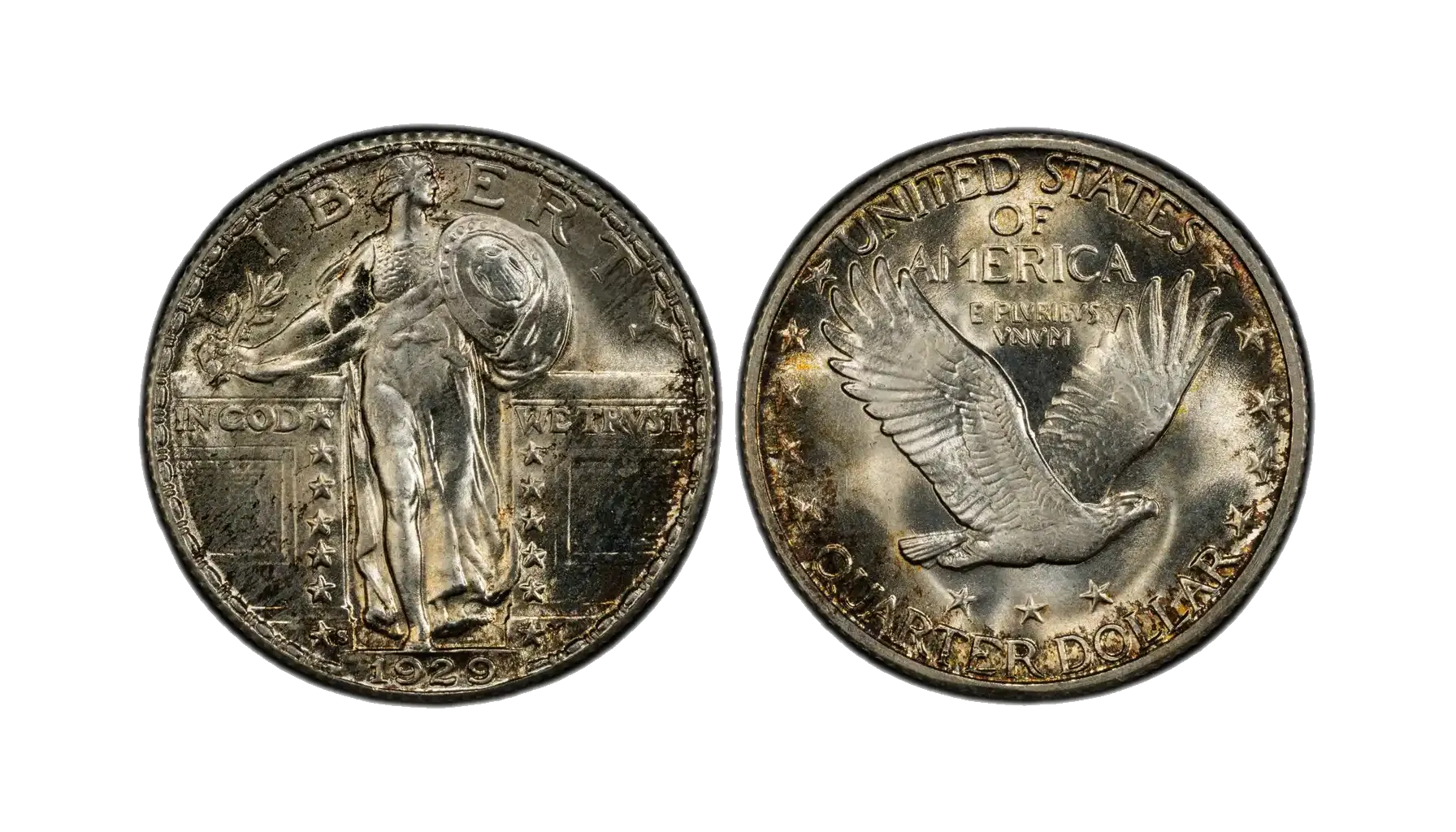
Produced by: San Francisco Mint
Mintage: 1,764,000
Auction Record: $14,375 for MS67
Finally, here is the issue from the San Francisco Mint with a modest mintage and rather fine strike. The 1929 S quarter value is not at its highest, yet top-end examples may potentially break records over time.
1929 Quarter Value by Condition and Mint
The same can bring different values, and it is a common practice that pricing is based on comparable auction results rather than a single fixed number. Nonetheless, there are several factors that may define the reference 1929 silver quarter value rates.
Factors Affecting the 1929 Liberty Quarter Value
Mint Mark: Prices differ, according to mintage figures and availability relevant to each mint (check on official websites like PCGS).
Grade: Value depends on how well the coin is preserved, especially if there is no proof variety in the series.
Special Designations: The only designation that may boost the value of 1929 quarter is FH (Full Head), which means that Liberty’s head details are fully brought up.
General Value Ranges by Grade
Grade | 1929 25C | 1929-D 25C | 1929-S 25C |
G4 | $17–$18 | $17–$18 | $17–$18 |
F12 | $27–$35 | $27–$35 | $27–$35 |
VF20 | $40–$45 | $40–$45 | $40–$45 |
XF40 | $75–$80 | $75–$80 | $75–$80 |
AU58 | $175–$185 | $200–$225 | $200–$225 |
MS63 | $325–$350 | $350–$400 | $360–$400 |
MS65 | $575–$675 | $600–$700 | $650–$700 |
MS66 | $900–$2,250+ | $950–$2,250+ | $1,250–$2,000 |
The 1929 S Standing Liberty quarter value with FH designation may be significantly higher, so use the above-mentioned figures as a reference only.
Collector Tips and Where to Buy 1929 Quarters
To identify the type you own, do not hesitate to use digital support. Coin ID Scanner may help you confirm the design, spot the mint mark, and narrow down an approximate grade before you compare value ranges.
To find reliable offers, always appeal to major online coin auctions, reputable dealers, authorized coin shops, renowned shows, and numismatic marketplaces (examples include Heritage Auctions, Stack's Bowers, and the like).
If you are ready to pay huge sums, pay attention to pieces with sharper head details (FH).
Remember that coins may differ even within the same grade. Explore them carefully. Coins need your attention first.

 Facebook
  X (Twitter)
  Pinterest
  LinkedIn