Contents:
The Standing Liberty quarter was a long-awaited numismatic creation: its path started before its inception, when artists, the US Mint's officials, and collectors expressed the idea of "reimagining" American coinage. From that perspective, coins were no longer seen as mere products/means of trade. In turn, they had gradually turned into the symbols of national identity with a more artful, innovative flair.
One of the most prominent representatives of the series is indeed the 1920 US quarter. Its value may differ, though the top-end examples tend to reach the prices of a few thousand dollars. Anyway, these variations make the 1920 quarter dollar unique, but what exactly do these units of currency mean? How much is a 1920 quarter worth, and are there rare coins within the issue that collectors might be currently willing to preserve?
1920 Standing Liberty Quarter Overview
At a certain period, it was rather obvious that the Barber quarters were destined to be eventually replaced. The United States needed something fresh to employ as money, and the call was met with a new wave of coinage that treated everyday pieces as public art.
In 1915, the Mint Director Robert W. Woolley and the Superintendent Adam M. Joyce asked the Mint's engraving department to prepare sketches for the new design. The results, however, did not satisfy the broader artistic goals. The Mint, hence, invited third-party prominent sculptors, and Hermon A. MacNeil managed to provide an appropriate concept that would later become the 1916 Standing Liberty quarter (the first in the line).
“In 1917, the design of the Standing Liberty Quarter Dollar was modified. Liberty's bare breast was covered with a coat of chain mail and the reverse design was modified by moving the eagle more to the center of the coin and by placing three of the thirteen stars beneath the majestic bird.”
— Ron Guth, renowned numismatist, licensed Certified Public Accountant
PCGS CoinFacts, 25C Type 2a, Stars Below Eagle (Pedestal Date)
Identifying the 1920 Liberty Quarter: Design & Specs
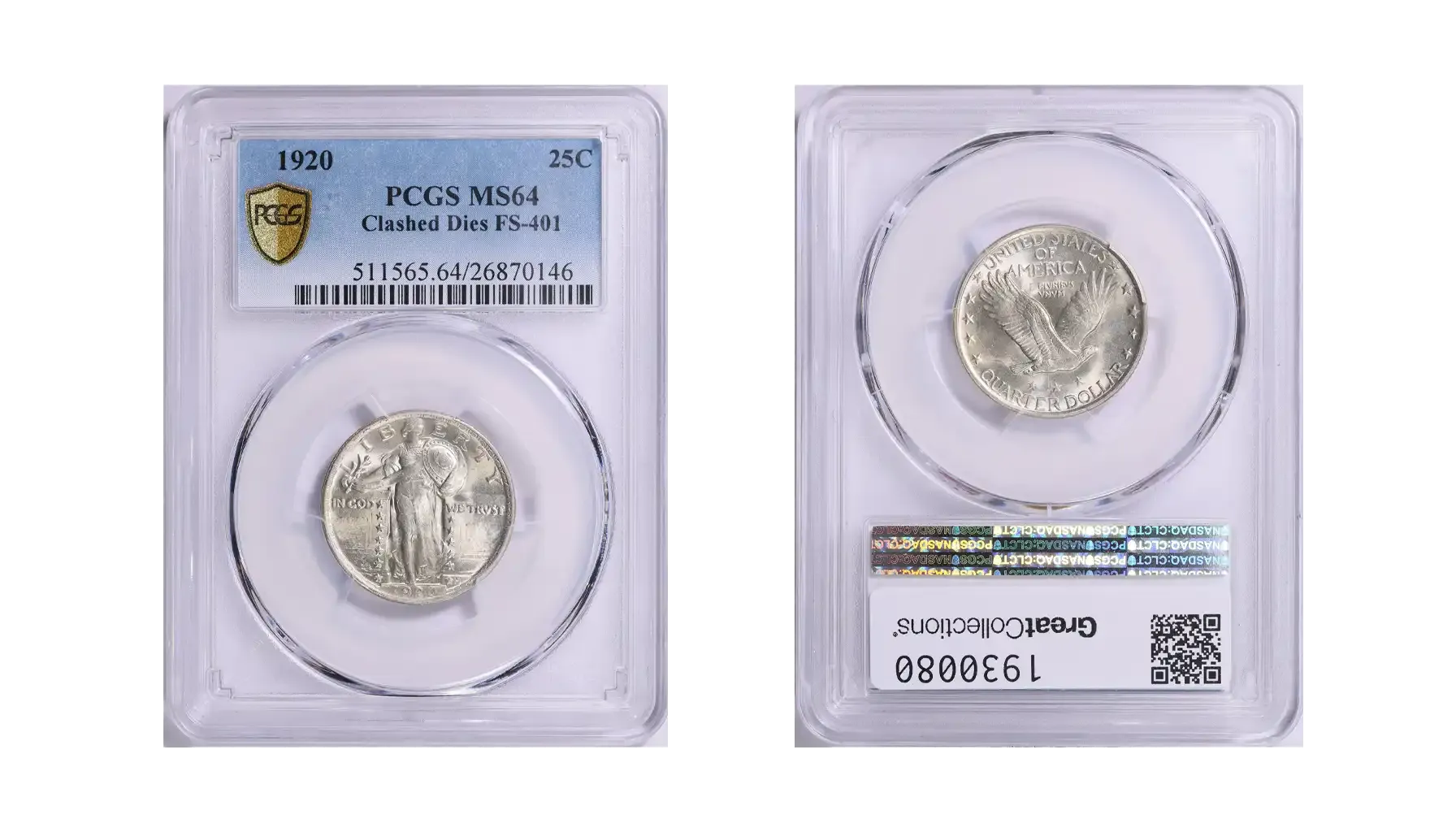
Obverse: The front side of the quarter 1920 demonstrates the full-length figure of Liberty standing in a gateway, wearing chain mail, with a shield in her left hand and an olive branch in her right (the traditional symbols of defense and peace, respectively). As for the inscriptions, these include “LIBERTY” along the upper edge, “IN GOD WE TRVST” separated on either side of the gateway, a mint mark located to the left of Liberty's feet, and a date “1920” on the pedestal beneath.
Reverse: The back features a naturalistic depiction of an eagle in flight, surrounded by stars along the rim, as well as the inscriptions "UNITED STATES OF AMERICA" positioned around the top, "E PLVRIBVS VNVM" located above the eagle, and the denomination "QUARTER DOLLAR" at the bottom.
The Main Features | |
Denomination | 25 cents |
Designer | Hermon A. MacNeil |
Composition | 90% silver, 10% copper |
Weight | 6.30 g |
Diameter | 24.30 mm |
Thickness | ~1.75 mm |
Edge | Reeded |
Silver content (ASW) | ~0.18084 troy oz |
Mint Marks | None for Philadelphia “D” for Denver “S” for San Francisco |
Mint Marks and Varieties of the 1920 Quarter
1920 25C
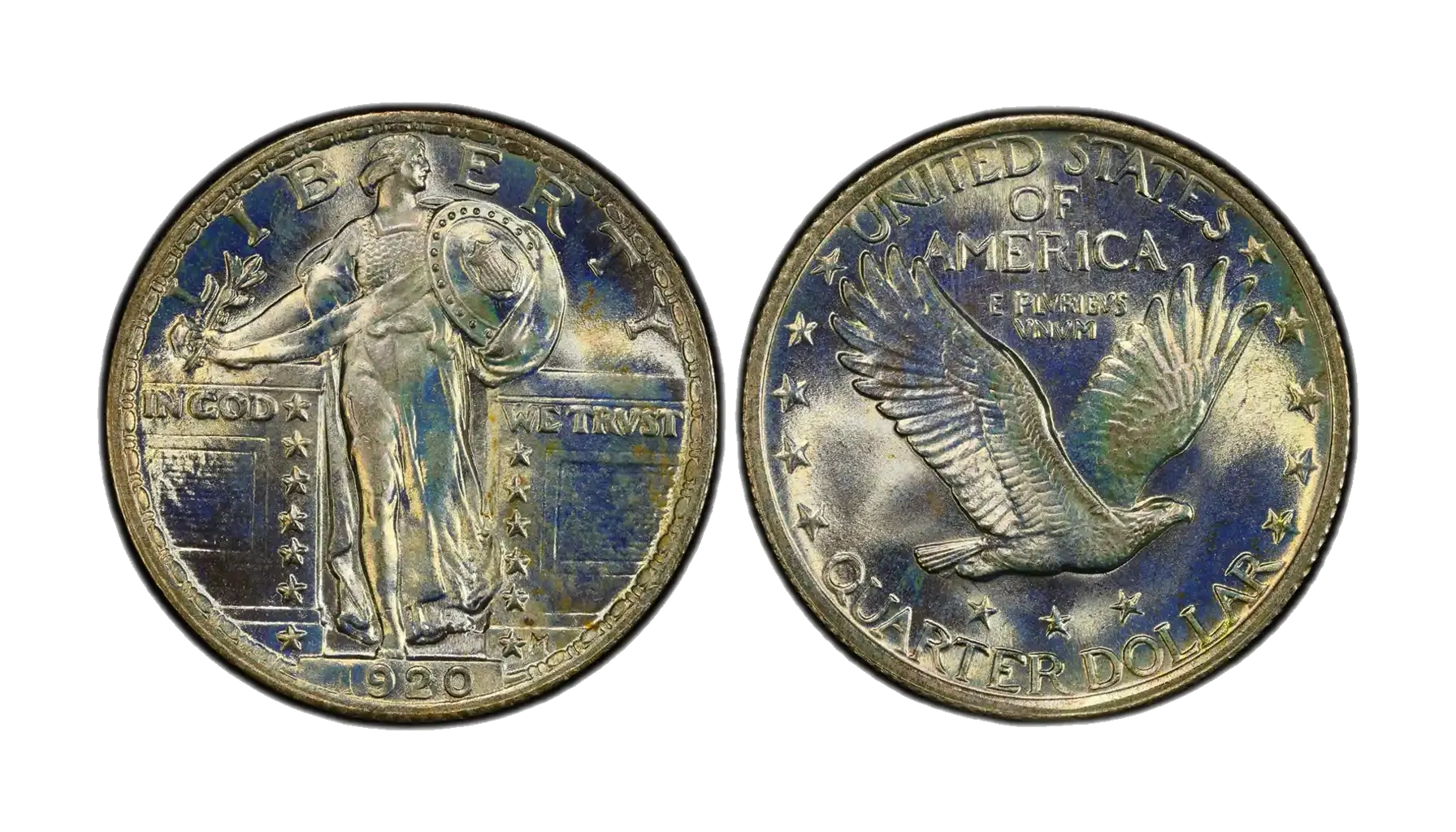
Produced by: Philadelphia Mint
Mintage: 27,860,000
Auction Record: $93,000 for MS67+FH
The most available 1910 issue, with the lowest auction record in the line (though the 1920 Standing Liberty quarter value is exorbitant anyway). High-grade pieces with FH designation (=Full Head) are much scarcer than typical Mint States works.
1920-D 25C
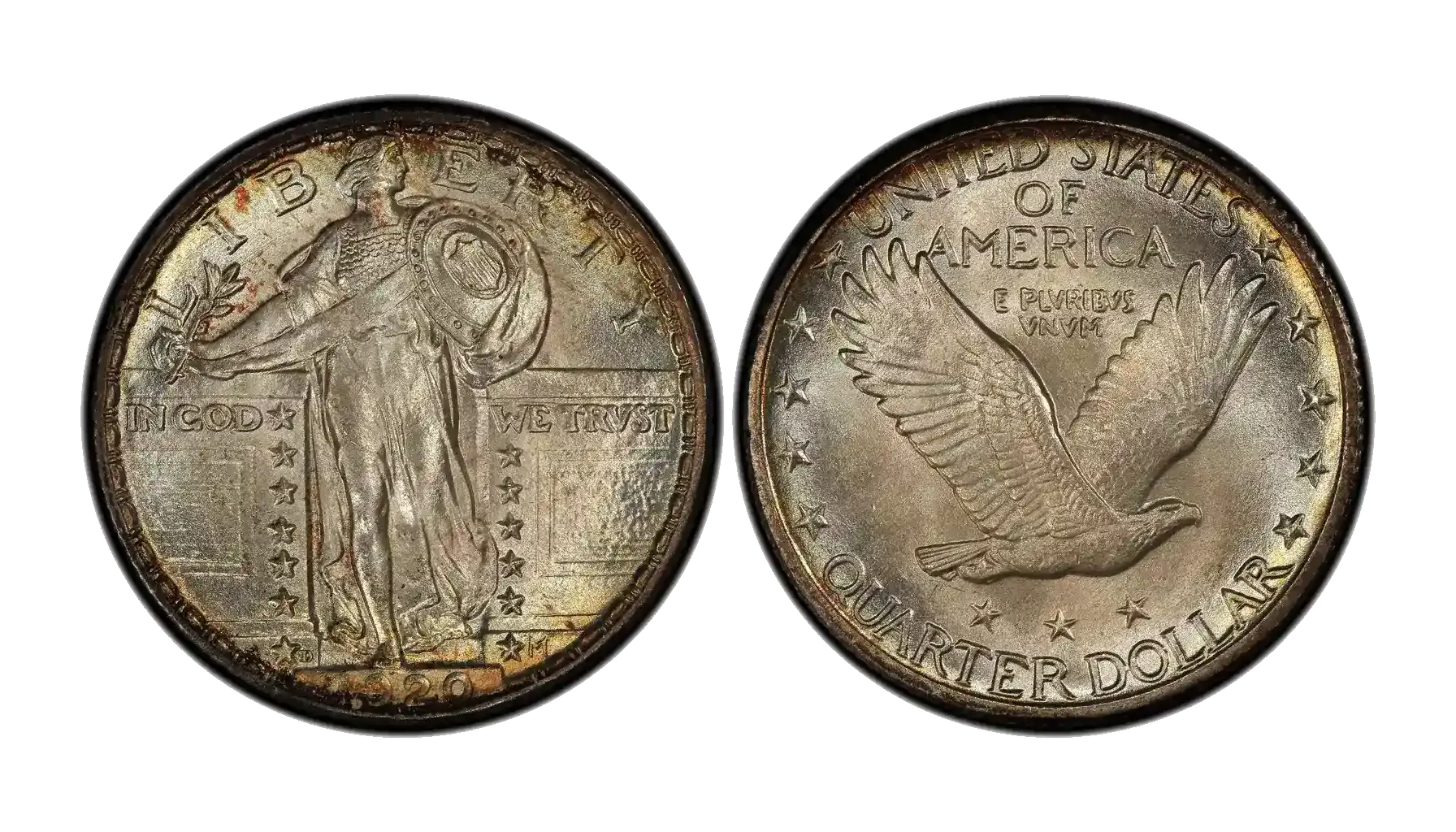
Produced by: Denver Mint
Mintage: 3,586,400
Auction Record: $372,000 for MS68+FH
The core variety of the year: low mintage, tough strike quality, and collector demand altogether contribute to the numismatic appeal of the coin. The combination of the superb preservation, Full Head, and well-documented provenance represents the elite end of the quarter market in general.
1920-S 25C
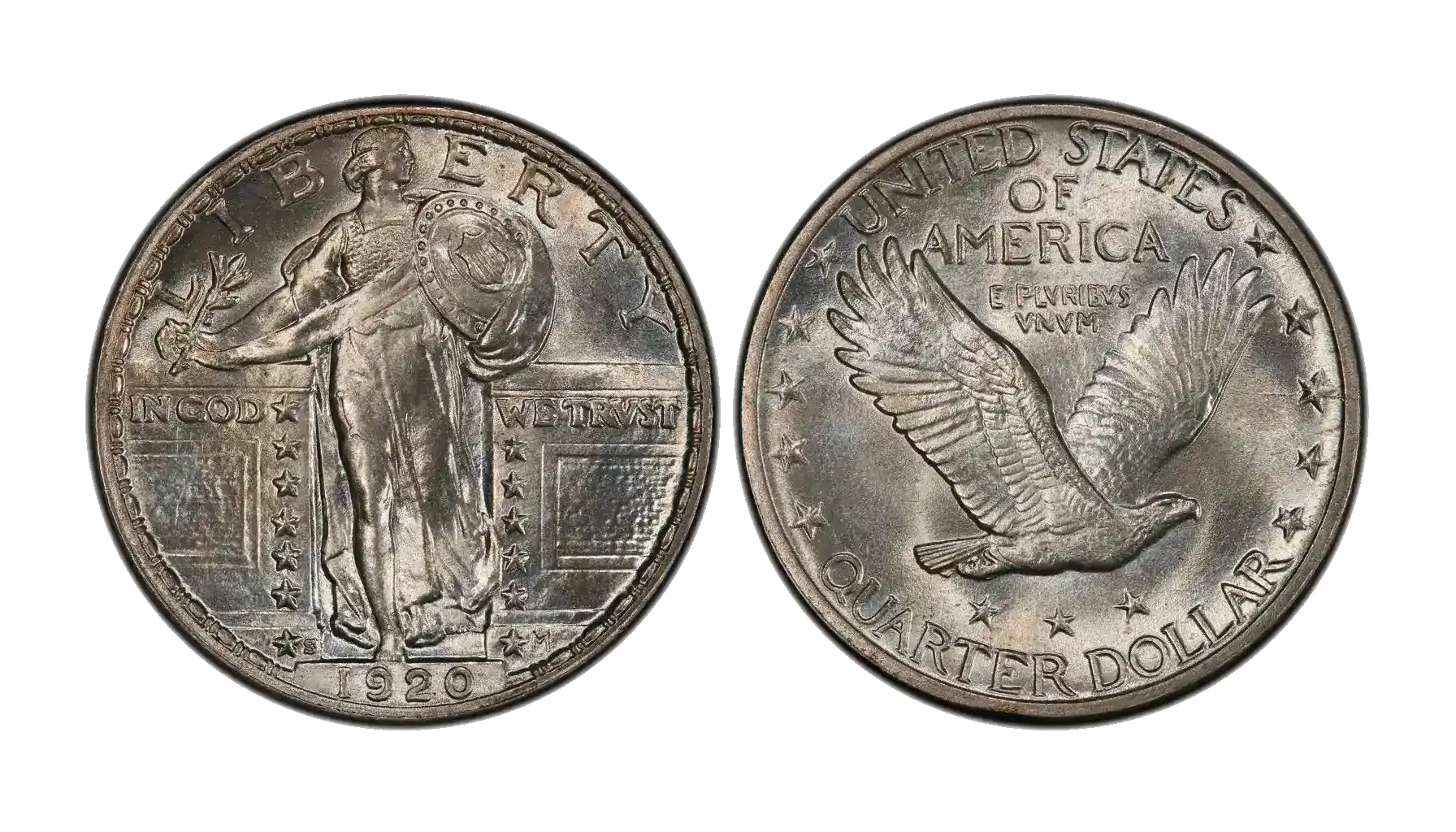
Produced by: San Francisco Mint
Mintage: 6,380,000
Auction Record: $105,000 for MS66FH
The 1920 S Standing Liberty quarter variety that usually comes with softer details and lower strike sharpness, which is why truly crisp examples are quite expensive. Mint State is rather widespread, but when combined with the FH designation, it becomes notably elusive.
1920 Quarter Value Today (by Condition and Mint)
The 1920 silver quarter value is a variable that changes from one piece to another, even within the same subtype group. Let us take a quick look at the prices set by PCGS for average examples by grade.
Grade | 1920 25C | 1920-D 25C | 1920-S 25C |
G4 | $24–$26 | $135–$150 | $30–$35 |
F12 | $40–$45 | $185–$200 | $50–$60 |
VF20 | $50–$55 | $225–$250 | $70–$85 |
XF40 | $75–$80 | $325–$350 | $130–$180 |
AU50 | $100–$110 | $400–$425 | $250–$275 |
AU58 | $210–$235 | $800–$875 | $450–$500 |
MS63 | $375–$400 | $1,450–$1,625 | $1,250–$1,425 |
MS64 | $450–$550 | $1,750–$2,400 | $1,850–$2,350 |
MS65 | $650–$800 | $3,000–$3,750 | $3,750–$4,500 |
MS66 | $1,075–$1,300+ | $4,750–$6,000 | $7,000–$9,500 |
Factors Affecting the Value of a 1920 Standing Liberty Quarter
Mint Mark: 1920-D and 1920-S are typically more valuable than pieces from Philadelphia.
Grade: The most definitive factor. Coins in Mint States are undeniably the most desirable to acquire.
Strike (Full Head): Strong detail can boost the prices, too.
Problems & Eye Appeal: Cleaning/damage lowers value; original luster/toning can raise it, in turn.
Collector Tips and Where to Buy 1920 Quarters
Coin hunts should be pleasant, not stressful. Prepare in advance and meet the following guidelines to avoid overpaying or counterfeits:
To acquire coins, refer to reputable dealers, coin auction platforms (e.g., Heritage Auctions), or established coin shows. Their purchases should be guaranteed by both parties on the same level.
Buy the coin, not its grade: check the date, mint mark, and overall quality of the strike.
Avoid cleaned or damaged coins. Erroneous pieces are worth your attention, though.
Use additional tools like Coin ID Scanner to know the objects of your purchase from deep down.
Do not look for the coins that you do not feel. Own only those that speak to your heart.

 Facebook
  X (Twitter)
  Pinterest
  LinkedIn