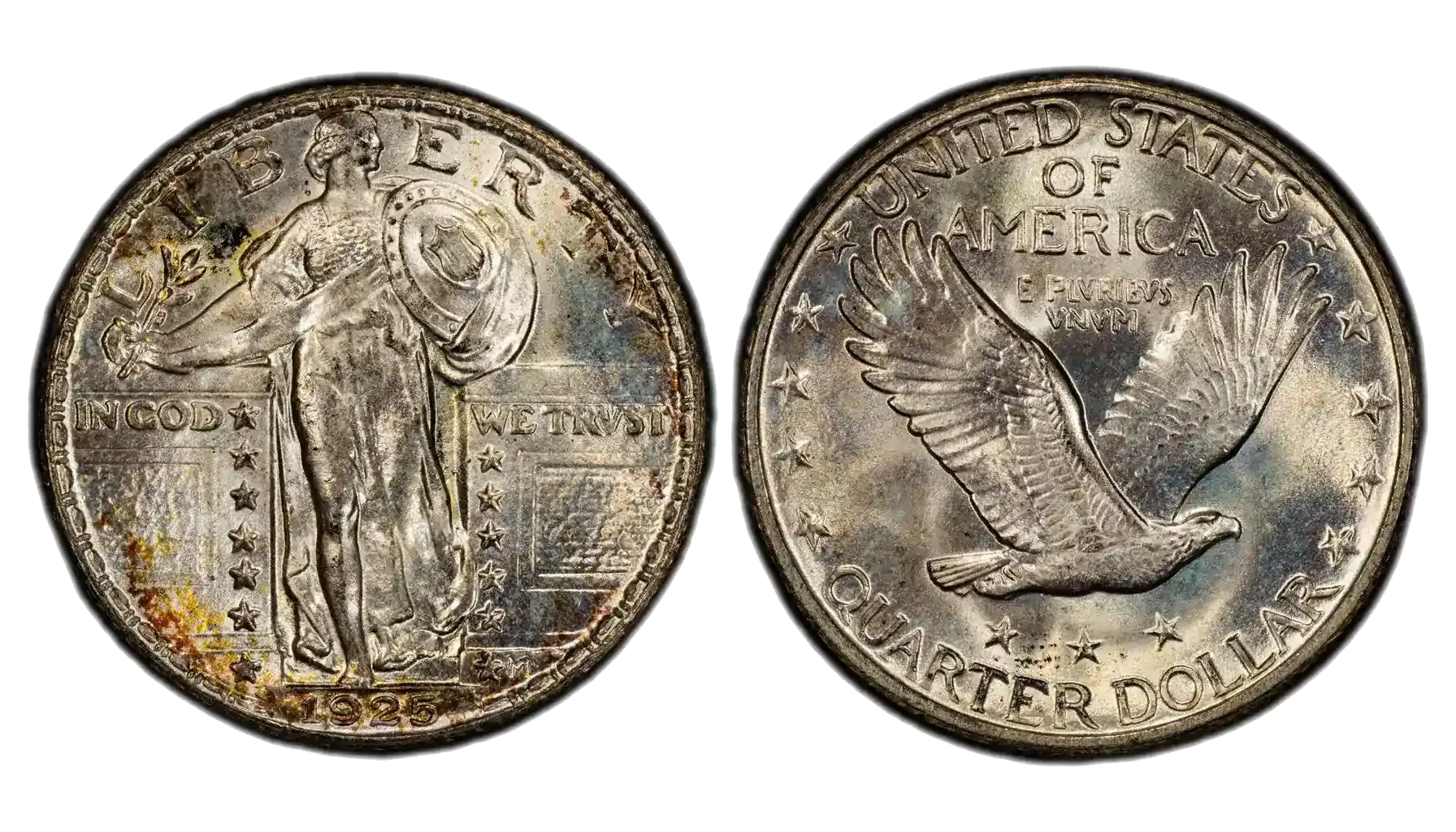
By 1925, the U.S. Mint was producing quarters in the middle of the Standing Liberty series, which had started in 1916 to replace the Barber Quarter. The design showed Lady Liberty standing in a gateway with a shield and an olive branch in her hands. The reverse depicted an eagle in flight.
The 1925 issue is interesting because:
It was struck at three mints: Philadelphia (no mint mark), Denver (D), and San Francisco (S).
The design had already been modified in 1925: Liberty’s figure was slightly changed, and her date was recessed into the coin’s surface to reduce wear (earlier dates wore away quickly).
So, how much is a 1925 quarter worth today? And what is the process of identifying coins and their values?
Specification | Detail |
Denomination | 25 cents |
Series | Standing Liberty Quarter (NOT a 1925 Walking Liberty quarter) |
Year | 1925 |
Hermon A. MacNeil | |
Composition | 90% silver, 10% copper |
Weight | 6.25 grams |
Silver Content | 0.18084 troy oz (≈ 5.62 grams) |
Diameter | 24.3 mm |
Thickness | 1.75 mm |
Edge | Reeded |
Mintage | 12,280,000 (Philadelphia), 4,720,000 (Denver), 5,840,000 (San Francisco) |
1925 US Quarter Mint Marks
For the Standing Liberty Quarter 1925, three different mints produced coins, and each is identified by its mint mark:
Philadelphia (no mint mark): Coins struck at the Philadelphia Mint carry no mint mark. If your 1925 quarter does not show a mark, it’s from Philadelphia.
Denver (“D”): Coins struck at the Denver Mint show a small “D” mint mark.
San Francisco (“S”): Coins struck at the San Francisco Mint show a small “S” mint mark.
On all Standing Liberty Quarters, including the 1925 issue, the mint mark is placed on the obverse (front) of the coin, just to the left of Liberty’s lower gown hem, above and slightly to the right of the date. It is small but visible under magnification.
Philadelphia coins are the most common. Denver and San Francisco issues tend to be scarcer in high grades, especially with the sought-after Full Head detail on Liberty.
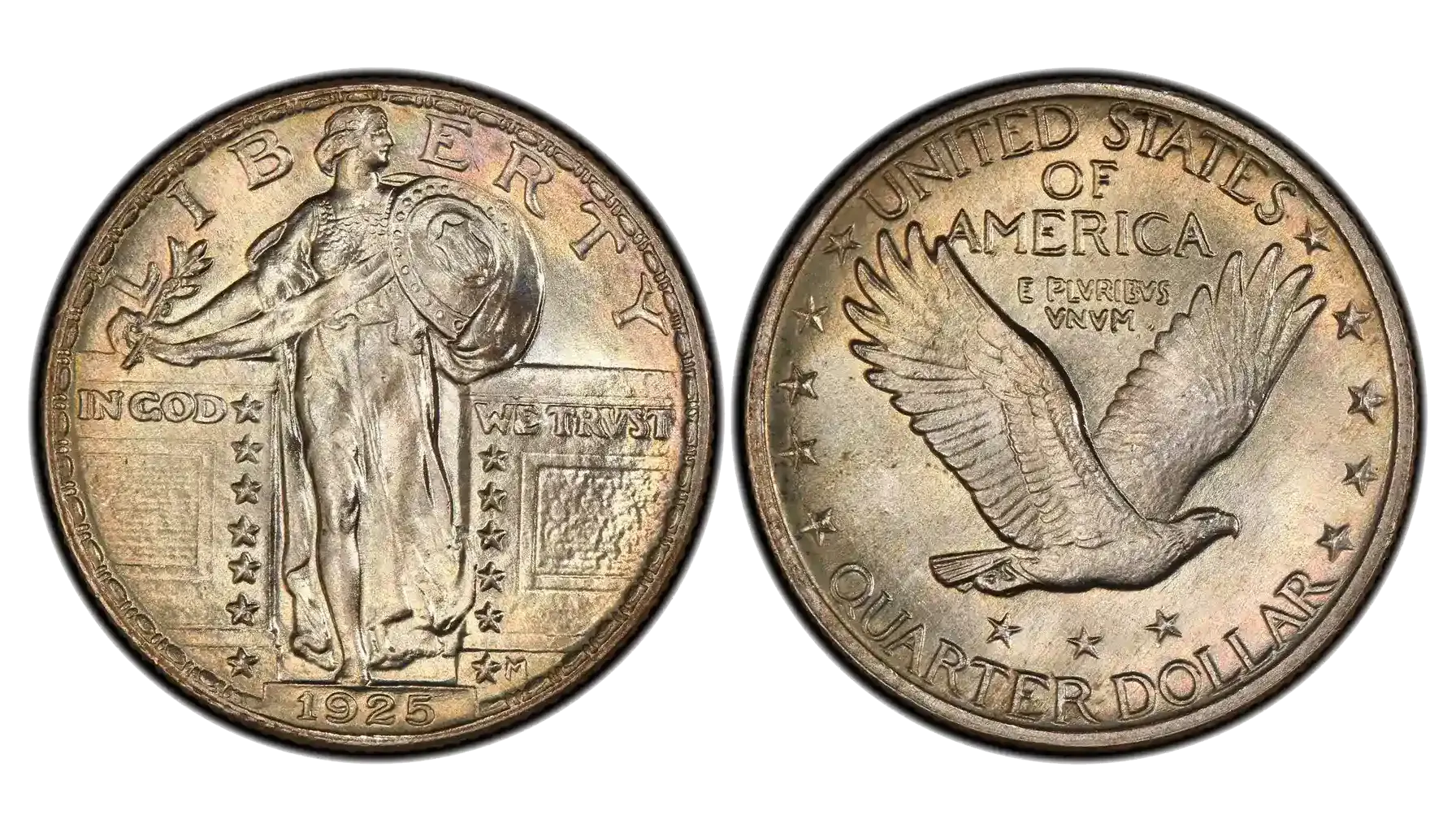
1925 Standing Liberty Quarter Mint Mark M
It’s not a mint mark! Possible explanations for “M”:
Misread mark – Sometimes the “S” can look unusual or weakly struck and be mistaken for a 1925 quarter mint mark M.
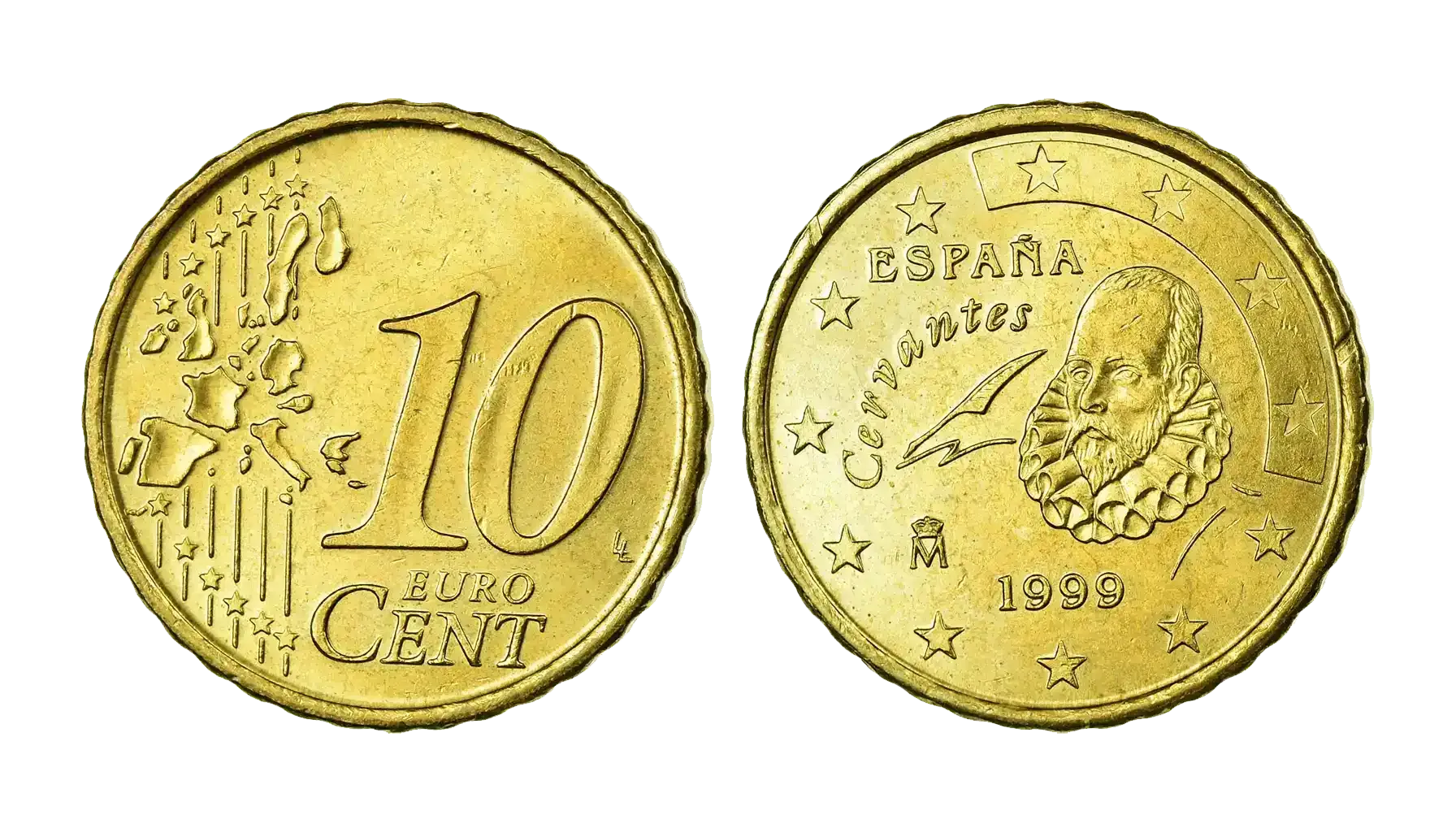
Foreign coin confusion – Some world coins of the same era had an “M” mint mark (for example, Italy used “M” for Milan).
Countermark or damage – If you truly see an “M,” it could be post-mint damage, engraving, or a counterstamp added later.
1925 Quarter Value Today
1925 (Philadelphia) | 1925-D (Denver) | 1925-S (San Francisco) | |
Good (G-4) | $10 – $15 | $12 – $18 | $12 – $20 |
Very Good (VG-8) | $15 – $25 | $18 – $30 | $20 – $35 |
Fine (F-12) | $25 – $40 | $30 – $50 | $35 – $60 |
Very Fine (VF-20) | $45 – $70 | $55 – $90 | $60 – $100 |
Extremely Fine (EF-40) | $80 – $120 | $100 – $160 | $110 – $175 |
About Uncirculated (AU-50) | $150 – $250 | $200 – $325 | $225 – $350 |
Mint State (MS-60) | $300 – $500 | $400 – $650 | $450 – $700 |
Mint State (MS-65) | $850 – $1,200 | $1,200 – $1,800 | $1,300 – $1,900 |
Full Head MS-65 | $2,000 – $3,000+ | $3,500 – $6,000+ | $4,000 – $7,500+ |
Disclaimer: The 1925 Standing Liberty Quarter value sums above are estimates based on retail ranges in the numismatic market. Actual prices may differ depending on grading service certification, eye appeal, auction premiums, and market fluctuations.
Full Head Designation
On Standing Liberty Quarters, collectors look for the “Full Head” designation, where Liberty’s helmet shows all three raised hair lines clearly, with the ear hole and forehead fully separated.
Many coins struck in 1925 were weakly struck, so finding a true Full Head example is rare.
This detail can multiply the 1925 Liberty Quarter value several times compared to the same grade without Full Head.
Silver Content and Melt Value
Each coin contains 90% silver (about 0.18 troy ounces, acc. APMEX). This influences the 1925 silver quarter value.
While the silver melt value provides a baseline (often between $4–5 in modern bullion terms), collector premiums are far more significant.
Errors
Off-Center Strikes

This occurs when the blank planchet was not properly seated in the press and the dies struck only part of its surface. The result is a coin where a portion of Liberty and the date may appear shifted or missing, with blank crescent-shaped space on the opposite side.
Collectors value these quarter dollar 1925 examples depending on how far the strike is shifted. Small shifts of 5–10% usually bring modest premiums, while bigger misalignments of 20–40% with a fully visible date can reach several hundred dollars. If the date is missing, the value often drops because authentication and attribution become more difficult.
Doubled Die Obverse (DDO)
Some 1925 quarters show doubling on the obverse design. This doubling can affect the numerals of the date, Liberty’s head, or details in the shield. Most examples are light and subtle, but even modest doubling increases desirability because the Standing Liberty series does not have as many dramatic doubled dies as other U.S. coin types.
Stronger doubled dies, though rare, can elevate a circulated coin worth only a few dozen dollars into a piece worth hundreds. Collectors especially prize coins where the doubling is sharp and easy to see without magnification.
Doubled Die Reverse (DDR)
On the reverse of the coin, certain dies also produced doubling, particularly on the eagle’s wings and the surrounding inscriptions such as “UNITED STATES OF AMERICA” or “E PLURIBUS UNUM.” As with obverse doubling, the strength of the doubling determines the 1925 quarter dollar value.
A faint doubling might only bring a small premium, while bold separation in the wing feathers or lettering could make a 1925-S or 1925-D quarter particularly sought after. Given that reverse doubling is less common, collectors specializing in varieties pay close attention to these.
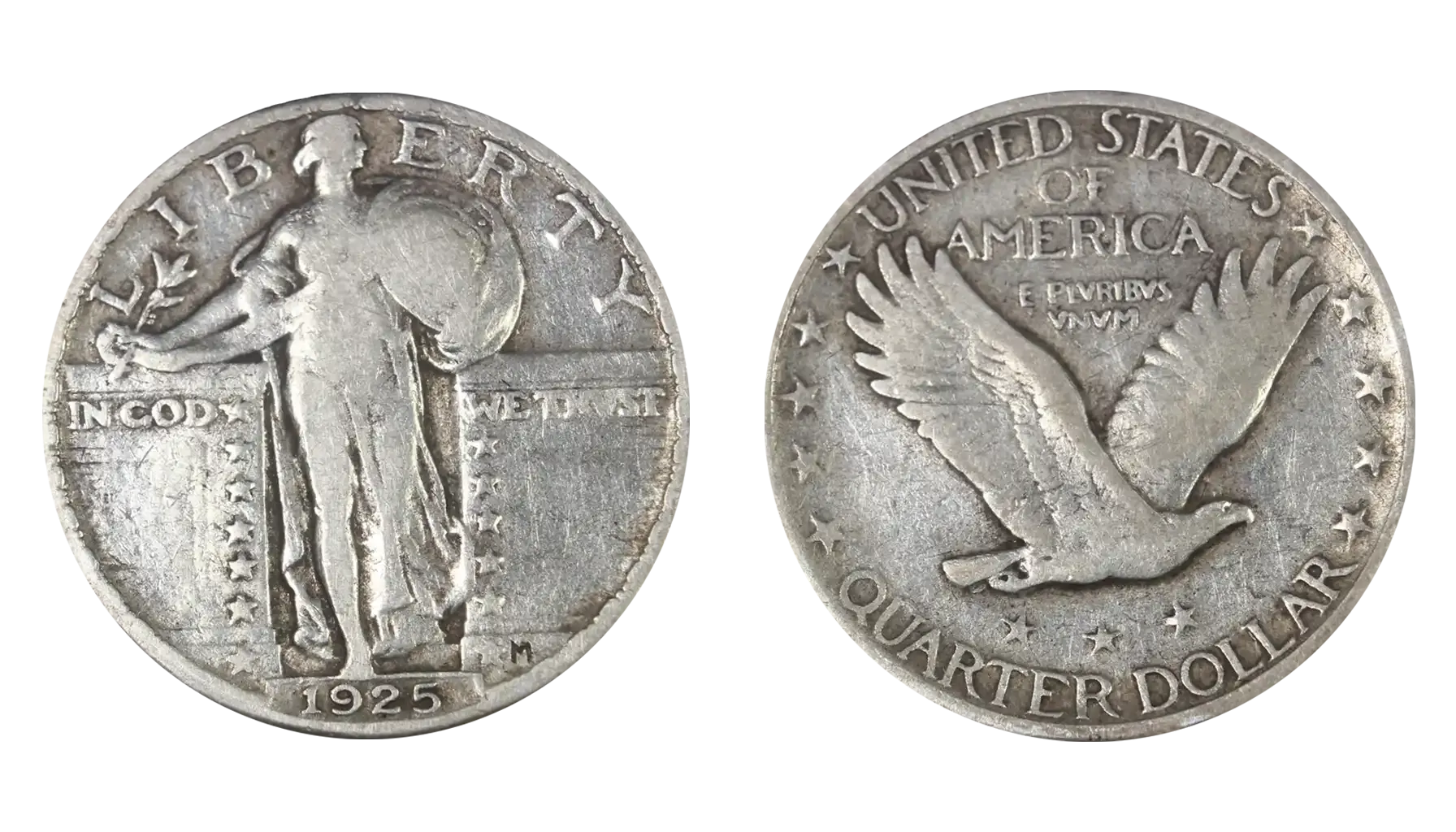
Broadstrikes and Partial Collar Errors
These occur when the collar die—the component responsible for shaping the reeded edge—fails to contain the coin fully during the strike. The result is a quarter with a wider diameter and missing or incomplete reeding around the rim.
Such pieces look unusual compared to standard quarters, and the value of 1925 quarter may vary depending on how dramatic the error appears. A full broadstrike with sharp details and a clean rim can be highly collectible, especially in higher grades.
Clipped Planchets
A clipped planchet error happens before the coin is even struck. If the metal strip from which blanks are cut overlaps or misfeeds in the press, part of the blank is missing, leaving a curved “clip.” On 1925 Standing Liberty Quarters, this can appear along the edge, often removing part of the design.
What is a 1925 quarter worth? While smaller clips add modest value, larger or well-placed clips—particularly those that leave the date intact—are far more desirable. Collectors look for strong “Blakesley effect,” a flattening opposite the clip that helps confirm authenticity.
Wrong Planchet Strikes
Although exceedingly rare, there are reports of Standing Liberty Quarters from the 1920s struck on the wrong planchet. If a dime or nickel blank entered the press instead of a quarter blank, the resulting coin would be undersized and lighter than normal, often missing parts of the design at the edge.
Auction prices may climb into the thousands of dollars. Any suspected wrong planchet example should be certified by a major grading service.

Coin ID Scanner can help by quickly identifying a 1925 Standing Liberty Quarter from a photo, showing its specs and potential value ranges. It also allows collectors to spot varieties, compare error details, and track the coin in a digital collection.

 Facebook
  X (Twitter)
  Pinterest
  LinkedIn