Contents:
This is a standard circulation issue from the late Cu+Ni era, struck when production volume took priority over strike refinement. Both Philadelphia and Denver produced large quantities intended strictly for commerce, while San Francisco limited its output to proof coinage for collectors.
So, how much is a 1978 nickel worth? Are they coins that are worth money?
1978 Jefferson Nickel Overview
From a numismatic standpoint, 1978 is best understood as a condition-sensitive issue rather than a rarity-driven one. Weak strikes are frequent, particularly on the reverse steps of Monticello, and fully detailed examples are disproportionately scarce compared to overall mintage.
The year holds no special historical or transitional significance within the series, and the nickel 1978 in particular. There were no composition changes, design modifications, or minting anomalies.
Identifying the 1978 Jefferson Nickel
The coin has a standard design format used throughout the mid-to-late Jefferson series. So identification is simple, but condition assessment is more nuanced.
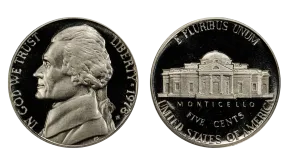
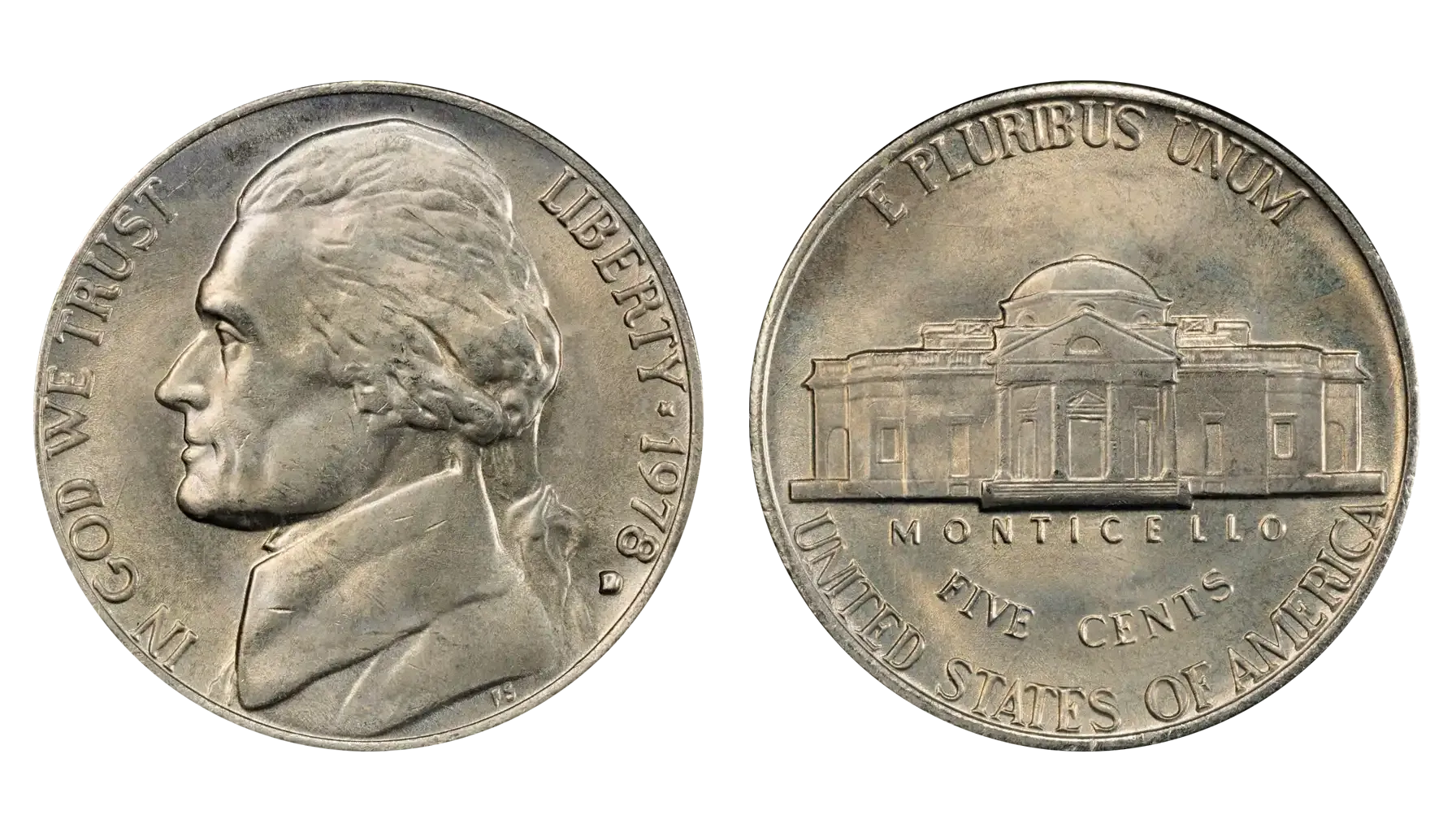
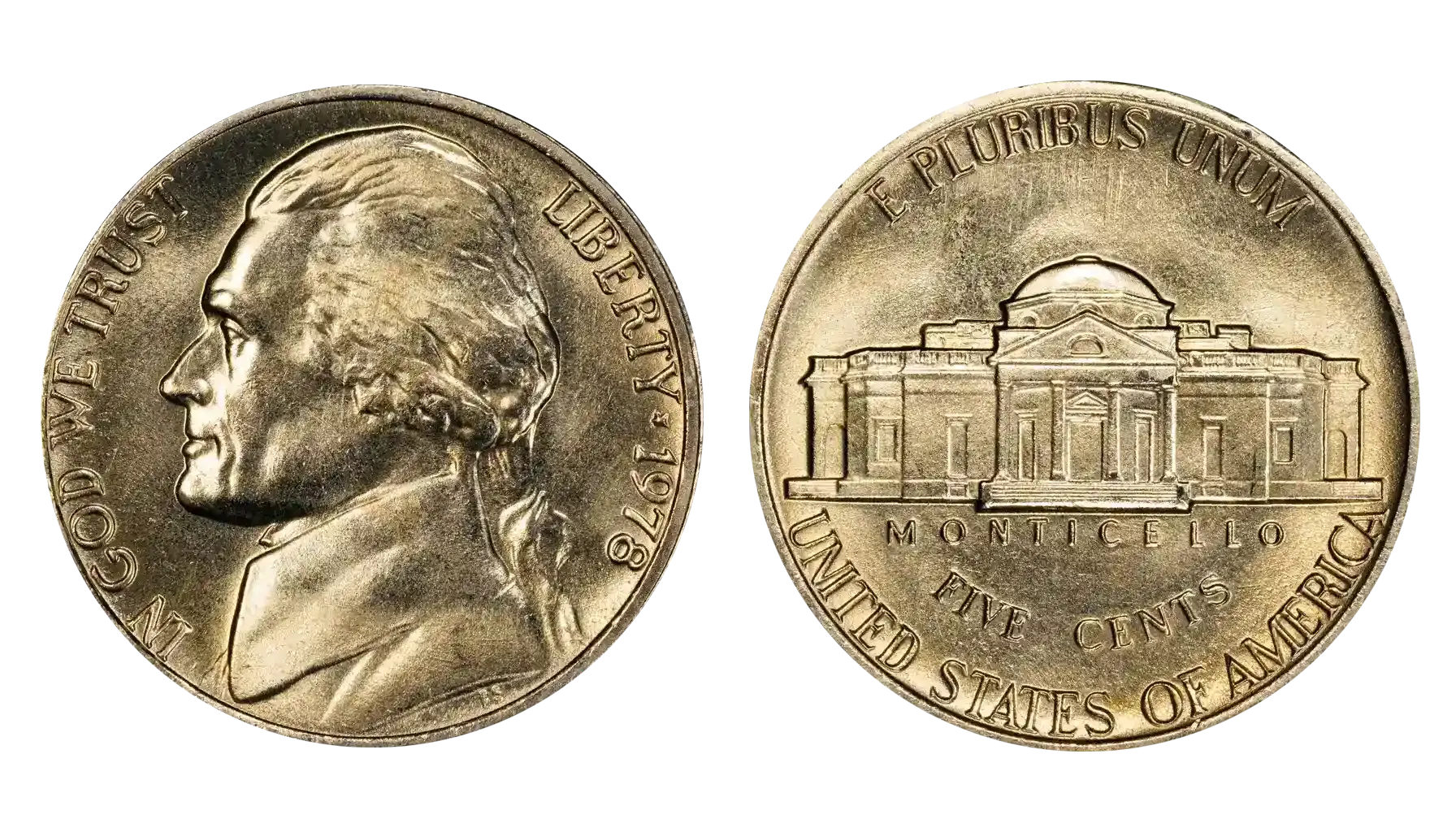
The obverse features a left-facing portrait of Thomas Jefferson with the date “1978” positioned to the right. The motto “IN GOD WE TRUST” appears along the left rim. Where is the mint mark on a 1978 nickel? Any mint mark, when present, is placed just to the right of the date.
The reverse depicts Monticello in a frontal view. “E PLURIBUS UNUM” is centered above the building, while “FIVE CENTS” and “UNITED STATES OF AMERICA” appear below.
On circulated examples, wear develops first on Jefferson’s cheek, jawline, and hair above the ear. On the reverse, flattening of the steps and loss of separation between architectural lines appear early.
Mint Marks and Varieties of the 1978 Nickel
Three issues were struck:
Philadelphia: No mint mark (modest 1978 nickel no mint mark value)
Denver: “D” mint mark
San Francisco: “S” mint mark, proof only
No major varieties are listed for this year. Minor die cracks, strike weakness, or mechanical doubling may appear but are common and usually carry no premium.
Design Features and Metal Composition
Designer: Felix Schlag
Composition: 75% Cu, 25% Ni
Weight: 5.0 grams
Diameter: 21.2 mm
Edge: Plain
Proof coins show polished fields and frosted devices. Many surviving proofs display haze due to original packaging or storage conditions.
1978 Jefferson Nickel Value by Condition and Mint
Grade | 1978 Nickel Value No Mint Mark | 1978 D Nickel Value | 1978 S Nickel Value |
G–XF | Face value | Face value | — |
AU | $0.05–$0.10 | $0.05–$0.10 | — |
MS63 | $0.30–$0.60 | $0.30–$0.60 | — |
MS65 | $1.00–$2.00 | $1.00–$2.00 | — |
MS66 | $8–$15 | $8–$15 | — |
MS67 | $25–$60 | $25–$60 | — |
Proof PR65 | — | — | $1.00–$2.00 |
Proof PR69 Deep Cameo | — | — | $5–$15 |
The proof value of 1978 nickel depends on cameo contrast and freedom from haze or spotting.
Common Errors and Collector Tips for 1978 Nickels
The specimen is not known for major, cataloged varieties, but a consistent group of mint errors appears on the market. Here is the 1978 nickel error list with pictures:
Strike Errors
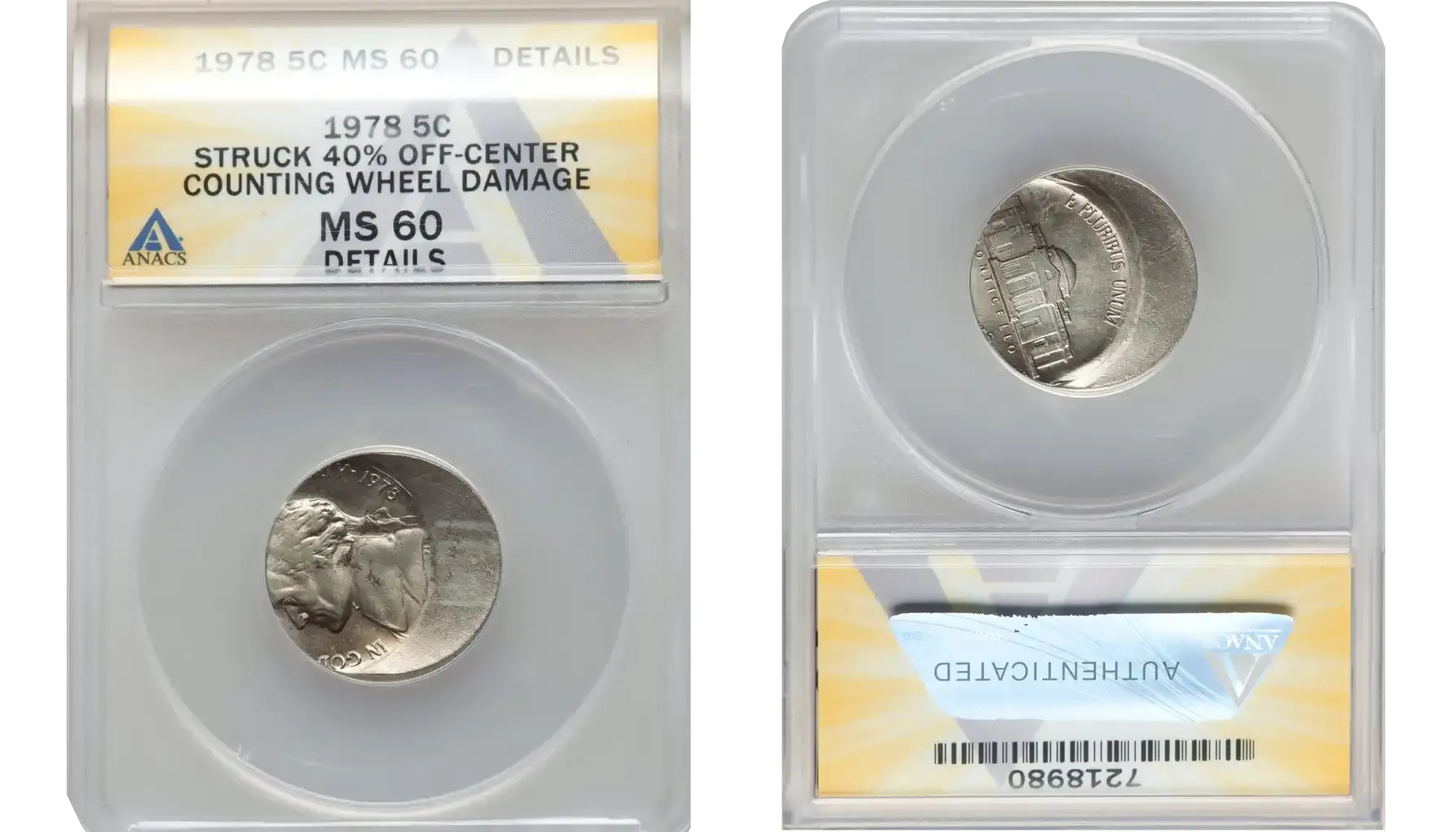
Off-center strikes
Partial design missing due to misaligned planchet. Value increases if the date is visible.
Broadstrikes
Coin struck without a retaining collar. Expanded diameter, flat rim.
Partial collar (railroad rim)
Uneven rim caused by incomplete collar engagement.
Planchet Errors
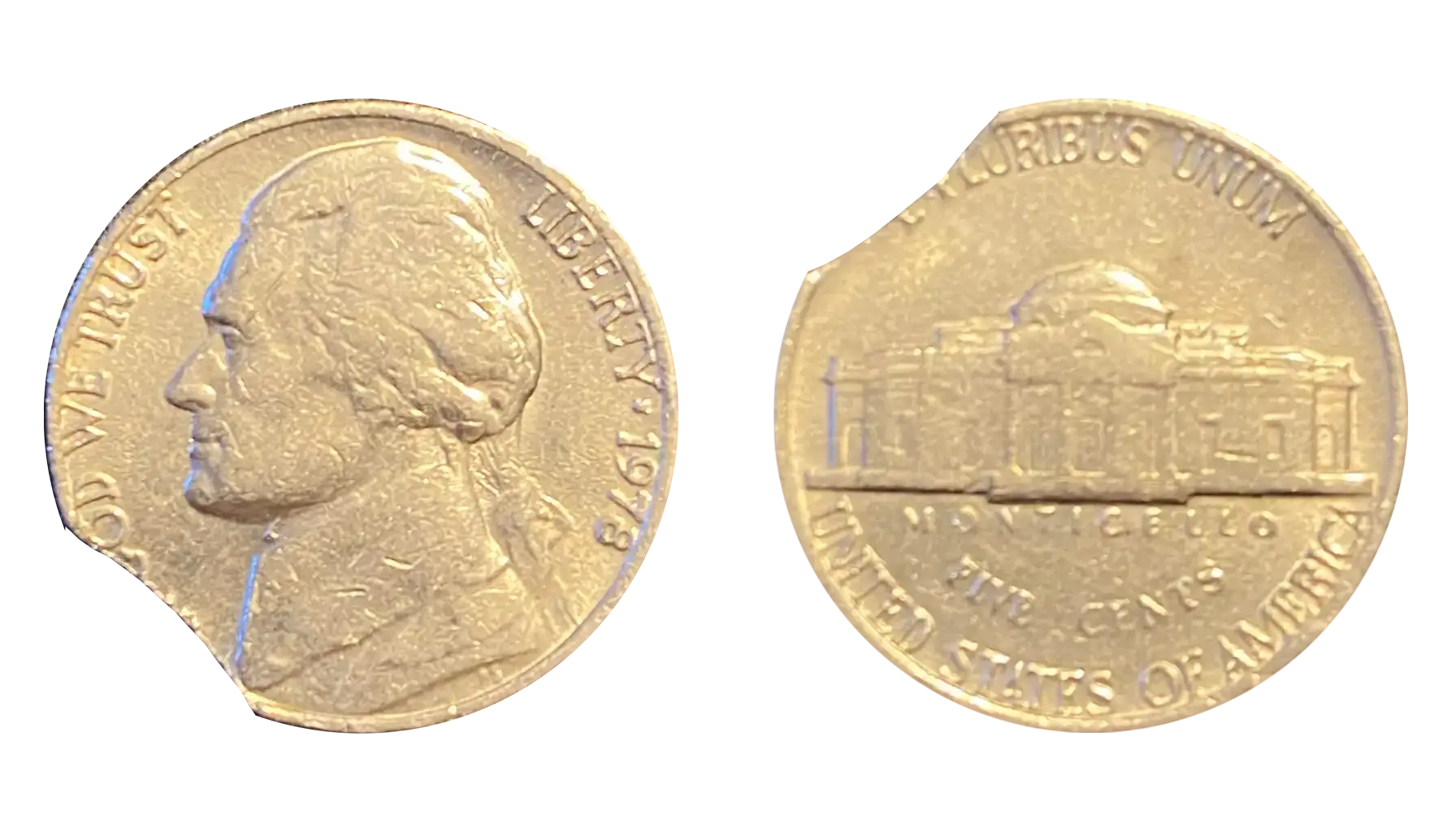
Clipped planchet (curved or straight)
Missing metal from the edge. Curved clips are more common.
Wrong planchet strikes
Rare but documented cases of designs struck on thinner or lighter planchets.
Underweight planchets
Often subtle. Such 1978 nickel errors require precise coin scales to confirm.
Die Errors
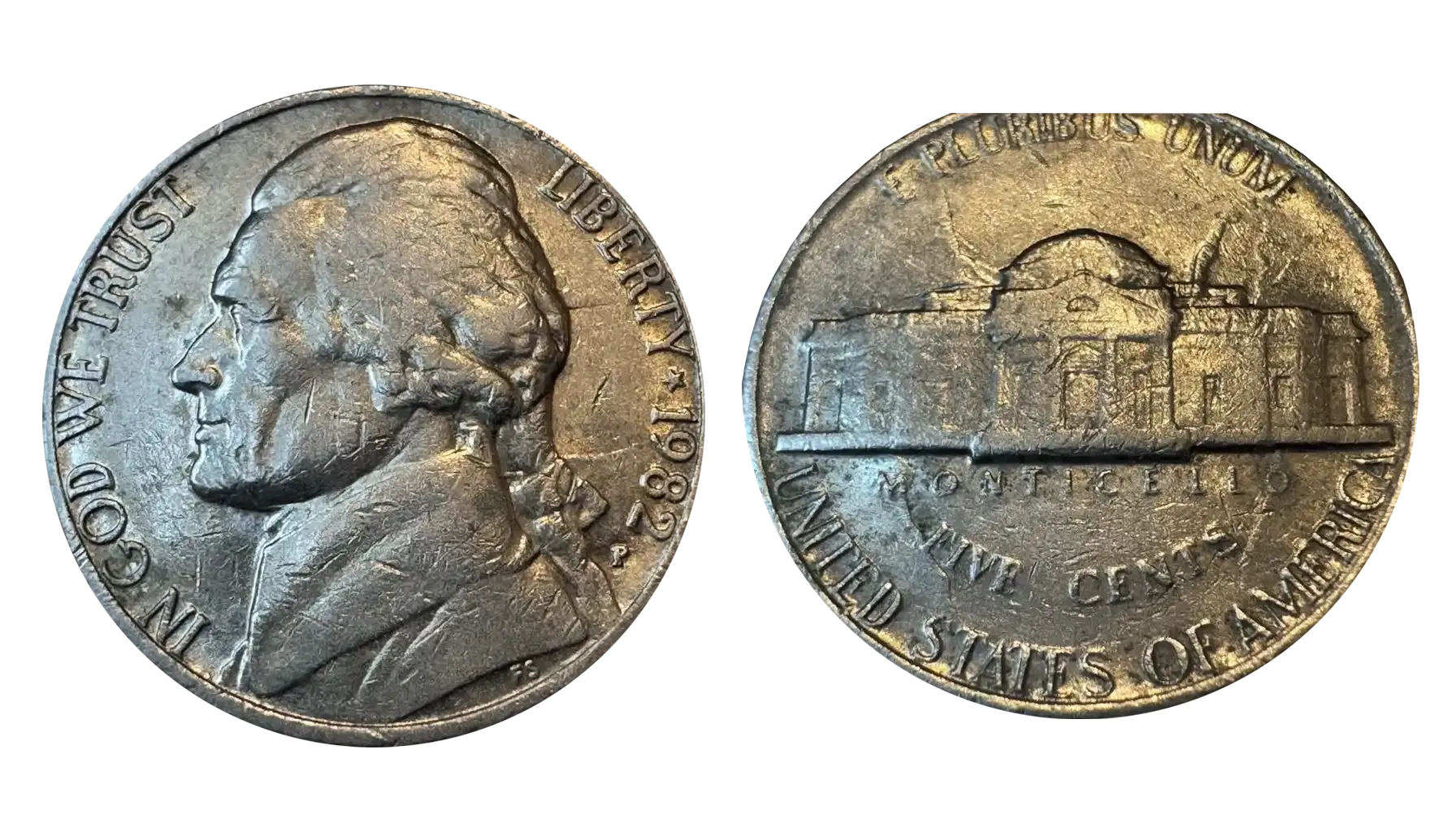
Die cracks
Raised lines, most often near lettering or Monticello.
Retained cuds
Broken die sections still partially attached; premium depends on size and location.
Full cuds
Missing die sections at the rim. Scarcer and more collectible.
Die chips
Small raised blobs, common and usually minor, which rarely influence the 1978 nickel error value.
Doubling and Misalignment
Mechanical (strike) doubling
Flat, shelf-like doubling on letters or date. Common and not a true variety.
Misaligned die strikes
Design shifted off center without planchet misalignment.
Proof-Specific Errors (1978-S)
Cameo inconsistency
Frost loss on devices.
Strike-through debris
Foreign material between die and planchet.
Missing or weak details
Caused by late-stage die wear.
Is a 1978 nickel worth anything if it contains mistakes? Most errors are modest in value unless visually dramatic or professionally certified.
Off-center strikes, retained cuds, and major planchet errors draw the strongest interest. Mechanical doubling is common and should not be confused with true doubled dies like the 1978 D nickel error DDO/DDR.
For collectors, the coin is best approached with a quality-first mindset. Seek sharply struck coins, minimal surface disturbance, and—most importantly—clear Monticello steps.

 Facebook
  X (Twitter)
  Pinterest
  LinkedIn