Contents:
Even within the most stable coin series, one may witness small "revolutions" and tiny design shifts that redefine the collecting experience for good. The Roosevelt dime program went through one major change: so as to comply with the Coinage Act of 1965, the US Mint removed silver from circulating dimes – only certain proof editions preserved the privilege of being precious.
The 1961 Roosevelt dime was one of the last genuinely silver coins that once circulated as ordinary workforce of commerce. That everyday status was not meant to last long. Now, certain issues may be considered overly valuable – the only definitive factors are the mint mark and the grade. So, what are the rare coins of 1961, which varieties to pay attention to, and how much do they cost in general?
The Origin of the 1961 Silver Dime
The Roosevelt dime first appeared on the numismatic scene in 1946, when President Franklin D. Roosevelt passed away, and, by well-established tradition, the US Mint paid tribute to the legacy and contributions of the leader who took the country through its darkest times: the Great Depression and the global crisis of World War II.
In fact, the association of Roosevelt's figure with 10-cent coins was quite obvious: he was a founder and a devoted proponent of the March of Dimes, i.e., the campaign that supported and still supports polio research and treatment programs. This is why the choice of the denomination was quite obvious from the very beginning. The public positively responded to the design change, though the previous iteration, i.e., the Mercury dimes, was widely admired in its own right.
By 1961, the series had already matured, struck in massive numbers, and was well-recognized as a piece of numismatic art. But what about the 1961 silver dime value?
Is a 1961 Dime Silver? Design and Metal Content
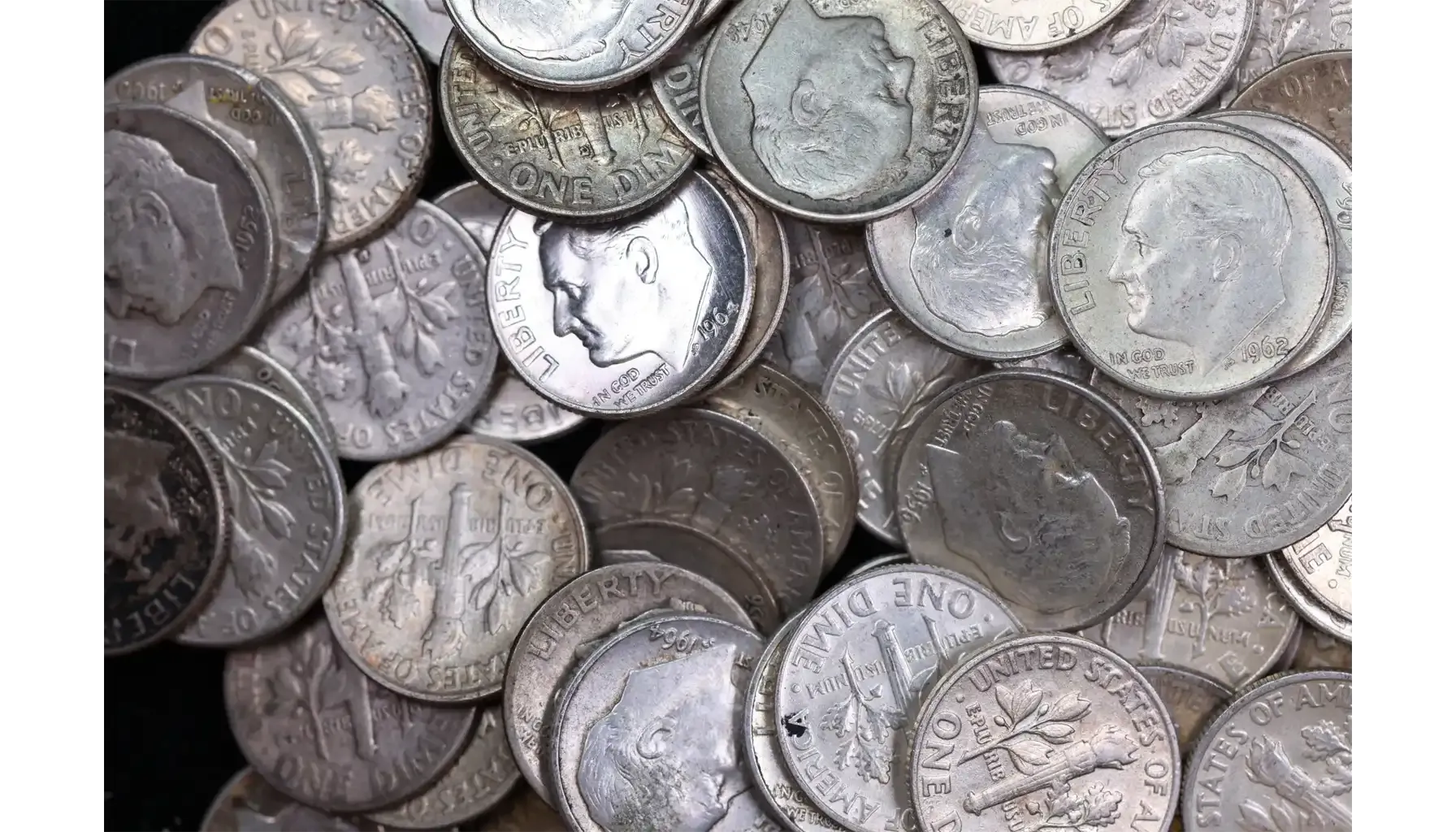
A quick answer: yes, a 1961 10-cent coin was still minted in silver, since the Coinage Act of 1965 would only be passed a few years later: all regular issues, according to the pre-1965 standard, were struck in 90% silver and 10% copper. This was a rule.
Specifications and Design Features
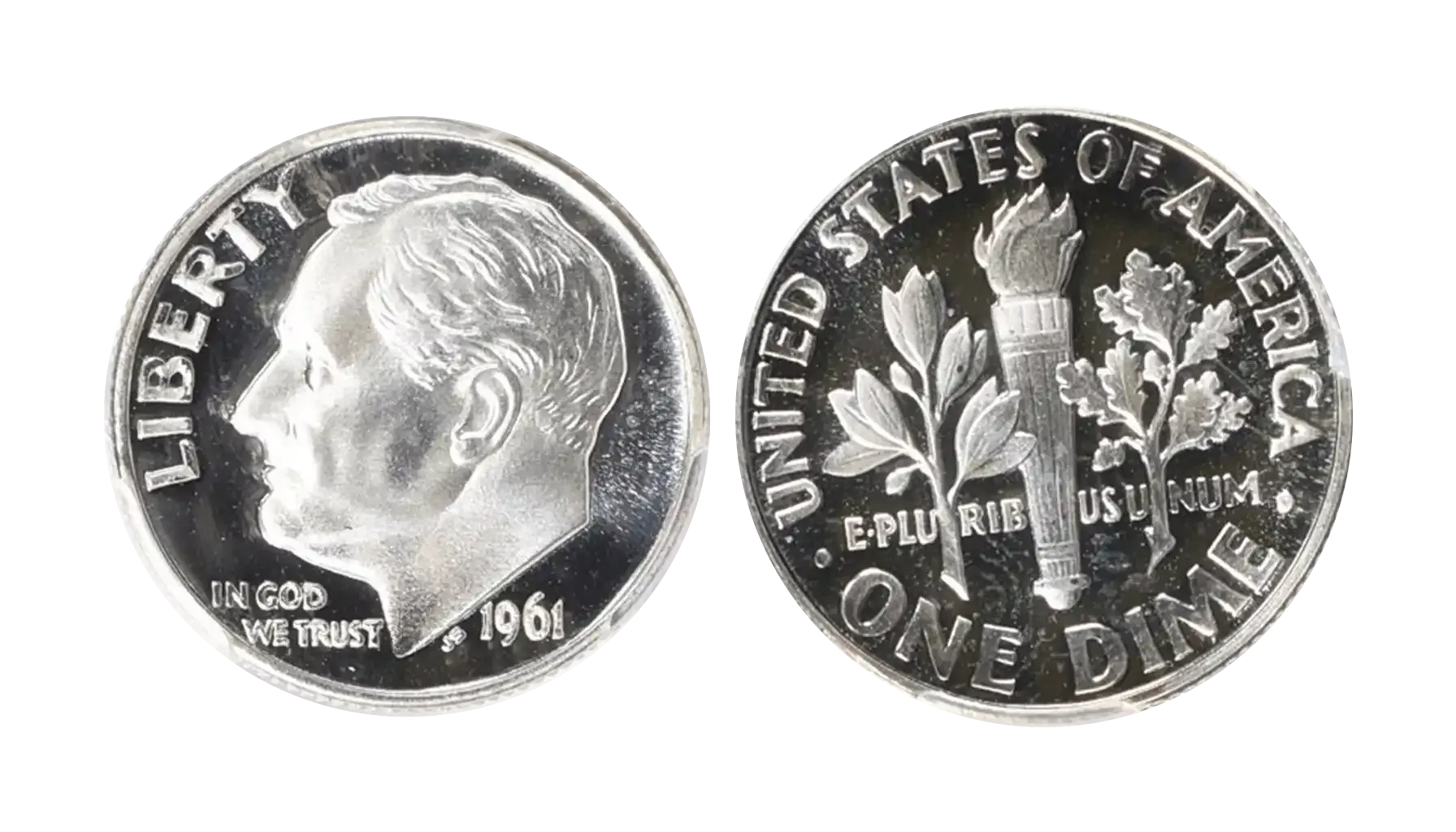
Obverse: The front demonstrates a classic portrait of Franklin D. Roosevelt, the inscription “LIBERTY” to the left along the rim, the national motto “IN GOD WE TRUST” to the lower-left of Roosevelt’s chin, the initials “JS” referring to John R. Sinnock (which caused controversies associated with the Cold War-era rumor that these were a hidden reference to Joseph Stalin), and the year “1961” approximately at the “5 o'clock” position.
Reverse: The back side showed a trio of an olive branch, a torch, and a branch of oak (left to right), as well as the inscriptions “UNITED STATES OF AMERICA” around the top, “E PLURIBUS UNUM” behind the trio arrangement (closer to its base), a mint mark to the left of the torch, below the previously mentioned inscription, and the denomination “ONE DIME” at the bottom.
The Main Features | |
Denomination | 10¢ (10 cents) |
Composition | 90% silver, 10% copper |
Silver content | 2.25 g (0.07234 troy oz) |
Weight | 2.50 g |
Diameter | 17.90 mm |
Thickness | 1.35 mm |
Edge | Reeded |
Mint Marks | None for Philadelphia “D” for Denver |
Types by Mint Mark and Origin
1961 10C
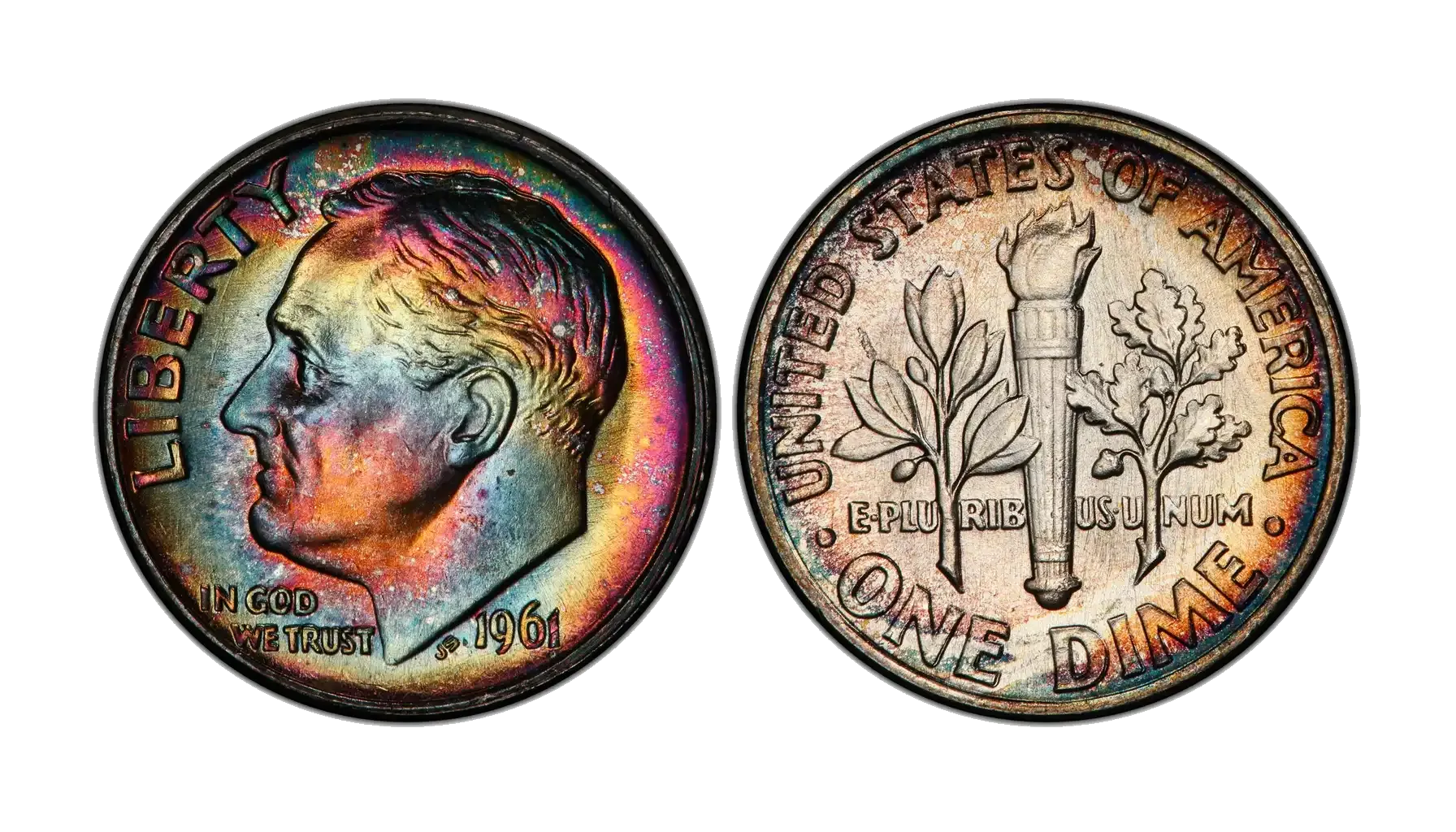
Produced by: Philadelphia Mint
Mintage: 93,730,000
Auction Record: $3,400 for MS67+FB
A regular-issue 1961 Roosevelt dime struck in 90% silver at Philadelphia (the coin bears no mint mark at all). They are pretty common in lower grades, but those with Full Bands designations or of higher grades can be worth a lot (up to a few thousand dollars).
1961-D 10C
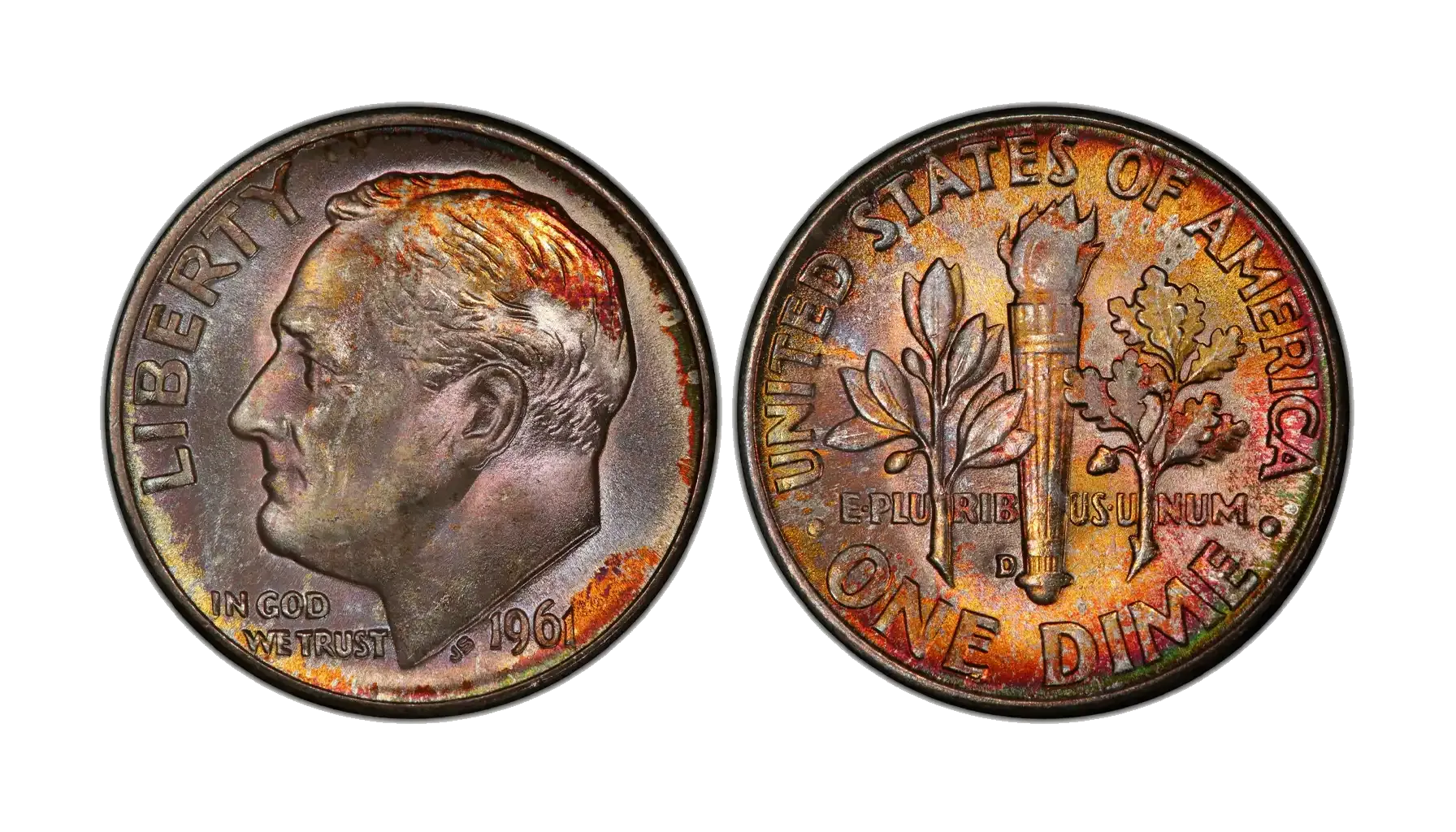
Produced by: Denver Mint
Mintage: 209,146,550
Auction Record: $5,288 for MS67+FB
As for the creations of the Denver Mint, it was the most plentiful variety, which is widely available in circulated and lower mint-state grades. This, however, makes high-grade pieces even more valuable, especially when this is accompanied by the FB designation, certificates, and provenance track.
1961 10C Proof
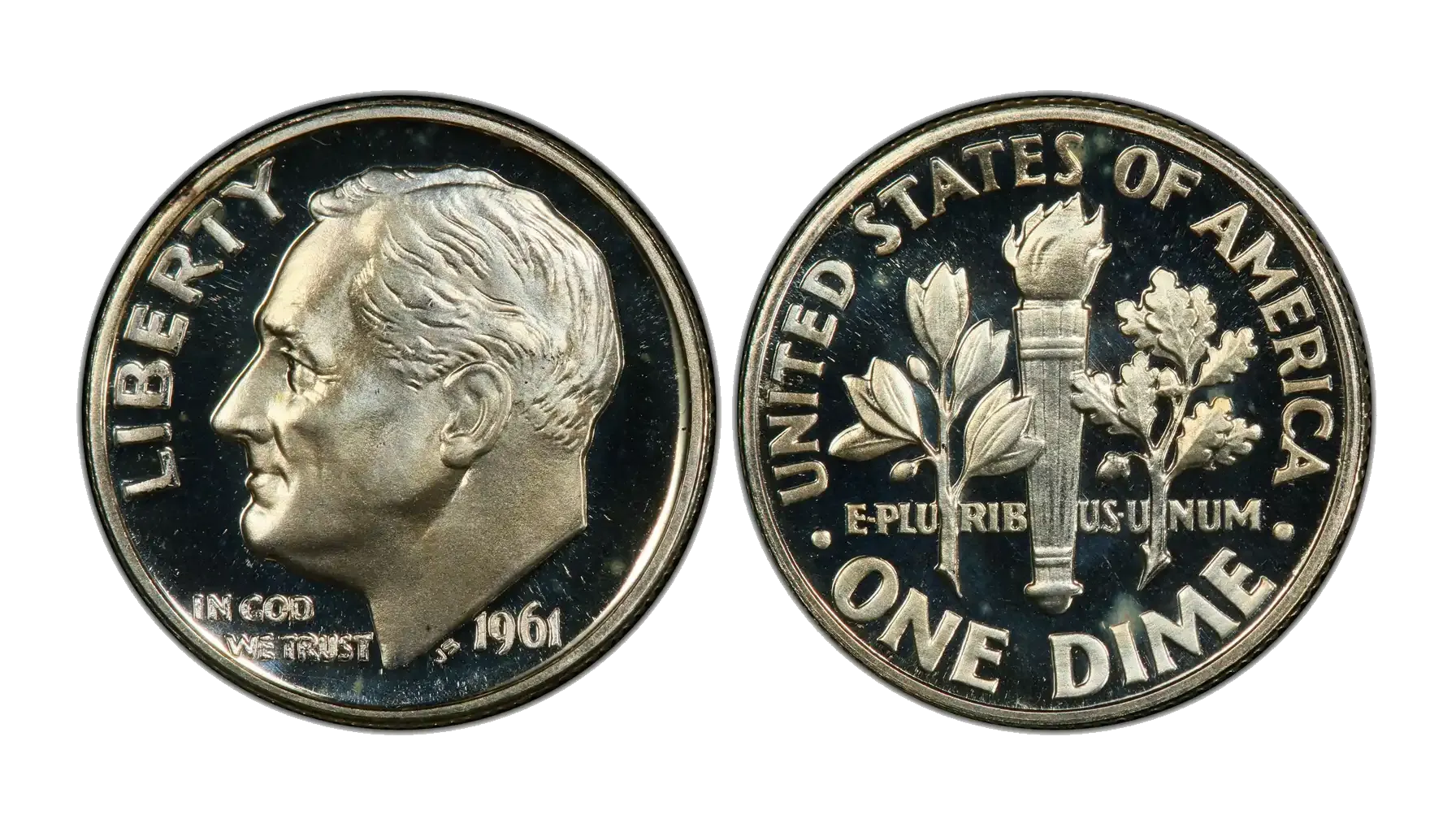
Produced by: Philadelphia Mint
Mintage: 3,028,244
Auction Record: $5,581 for PR70
The 1961 proof dime is often the most valuable entry in this trio, even though the silver content is practically the same. Proof strikes are usually made more delicately, with sharper details, mirrored fields, and three main destinations, i.e., PR, CAM, or DCAM. Besides, it is one of the higher mintage coins of the series, which is why the main part is affordable (compare to, for example, the U.S. Mint prestige proof sets).
“The 1961 Proof Roosevelt Dime had a relatively high mintage <...>. As an example, the highest mintage Proof Roosevelt Dimes from 1950-1960 was the 1960 with a mintage of approximately 1,691,600. However, the 1961 mintage was almost double the amount as the Mint struck about 3,028,200 examples for 1961.”
— Jaime Hernandez, renowned numismatist, PCGS price guide editor
PCGS CoinFacts
1961 Dime Value Today: What Collectors Pay
The silver-era coins in circulated grades usually cost a few dollars, but those in Mint State grades can be worth a lot more. So, how much is a 1961 dime worth?
1961 Roosevelt Dime Value by Mint Mark (P & D)
Grade level | 1961 10C | 1961-D 10C | 1961 10C Proof |
G-VF | $3–$6 | $3–$6 | – |
XF-AU | $5–$6 | $4–$5 | – |
MS60-MS64/PR | $7–$15 | $5–$15 | $7–$15 |
MS65-MS66/PR | $20–$325 | $18–$38 | $18–$32 |
MS67+/PR67+ | $4,000+ | $225+ | $65+ |
The value of 1961 dime may fluctuate over time. Please, find relevant information on PCGS CoinFacts, online coin auctions, and apps like Coin ID Scanner – there is only reliable data, management tools, and educational resources on the spot.
1961 Dime Error List and Notable Varieties
Doubled Die Obverse (DDO)
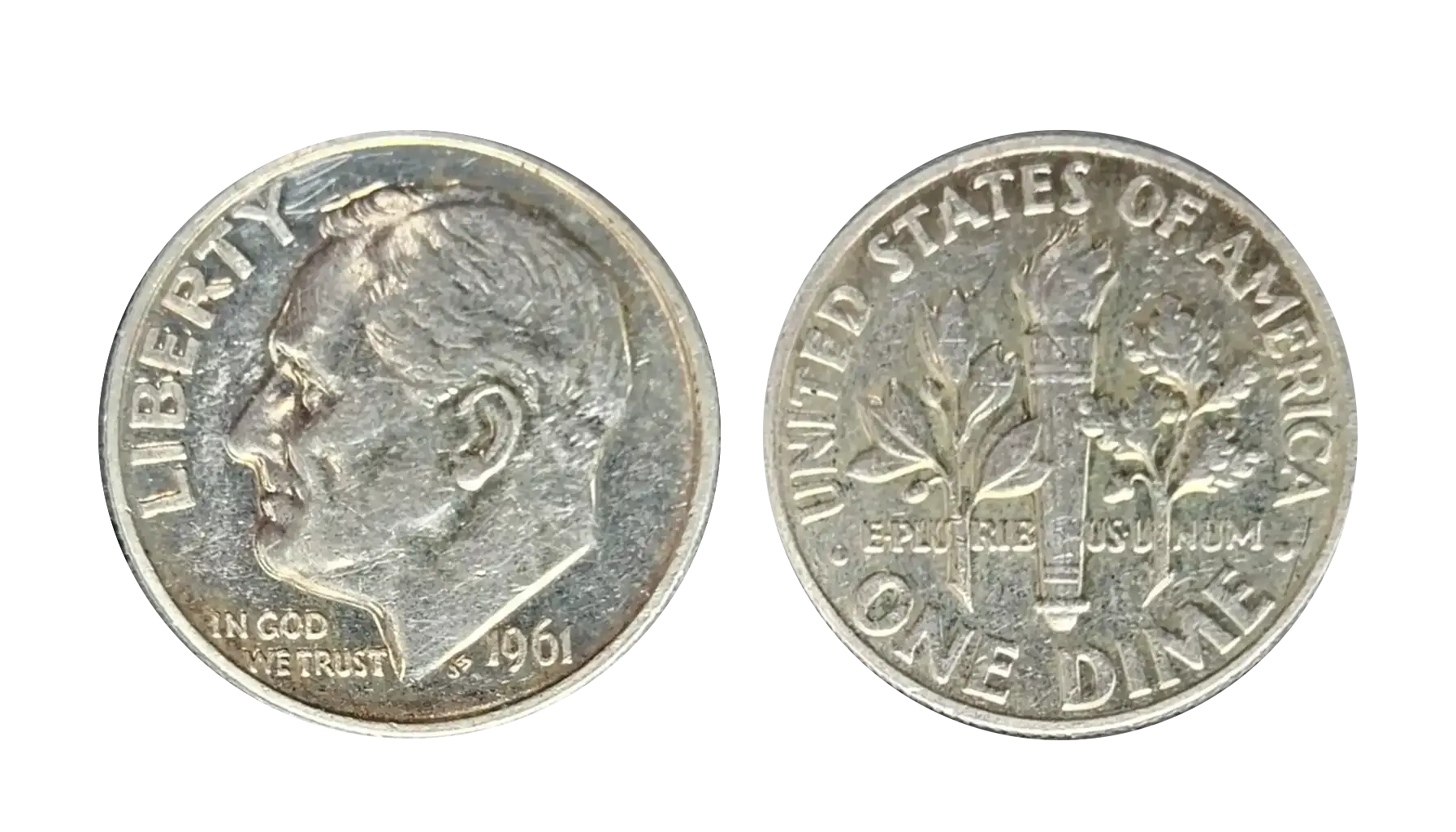
Estimated value: ~$700
One of the most widespread numismatic errors in general is a doubled die obverse, i.e., the doubled impression of the design on the front side. This usually comes from the improper die-making process, when the hub presses the design onto the working die more than once. The strongest examples are the most valuable ones.
Missing Letters Error
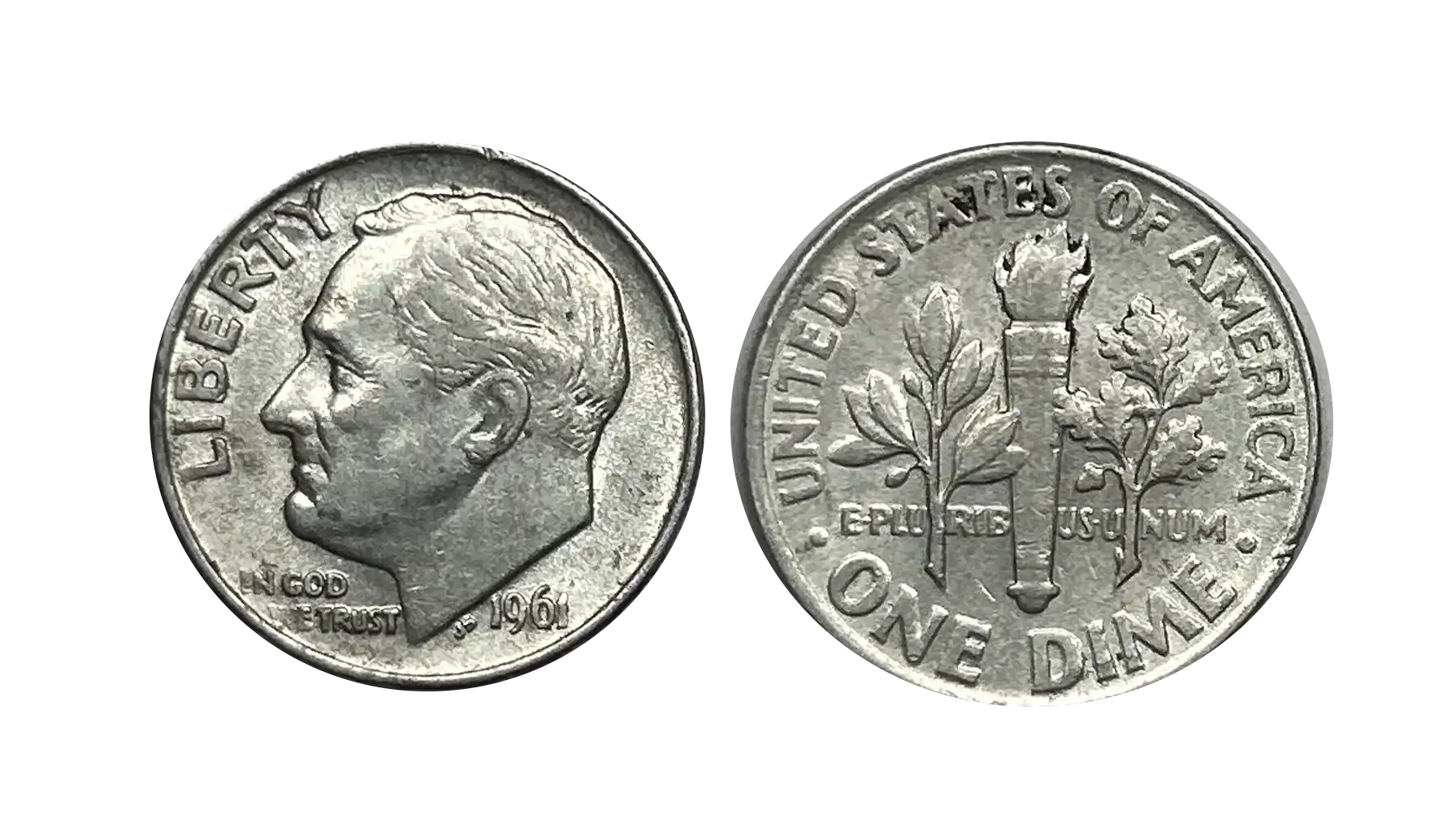
Estimated value: ~$300
Some coins might lack certain letters (or digits) that, in the end, create peculiar puns. As for the 1961 dimes, one may observe a missing “I” in the motto “IN GOD WE TRUST”, which was probably caused by a filled die (grease, debris, or polishing compounds). Anyway, it is vital to check if it is a genuine error or a made-up alteration that is not valuable at all.
Railroad Rim Error
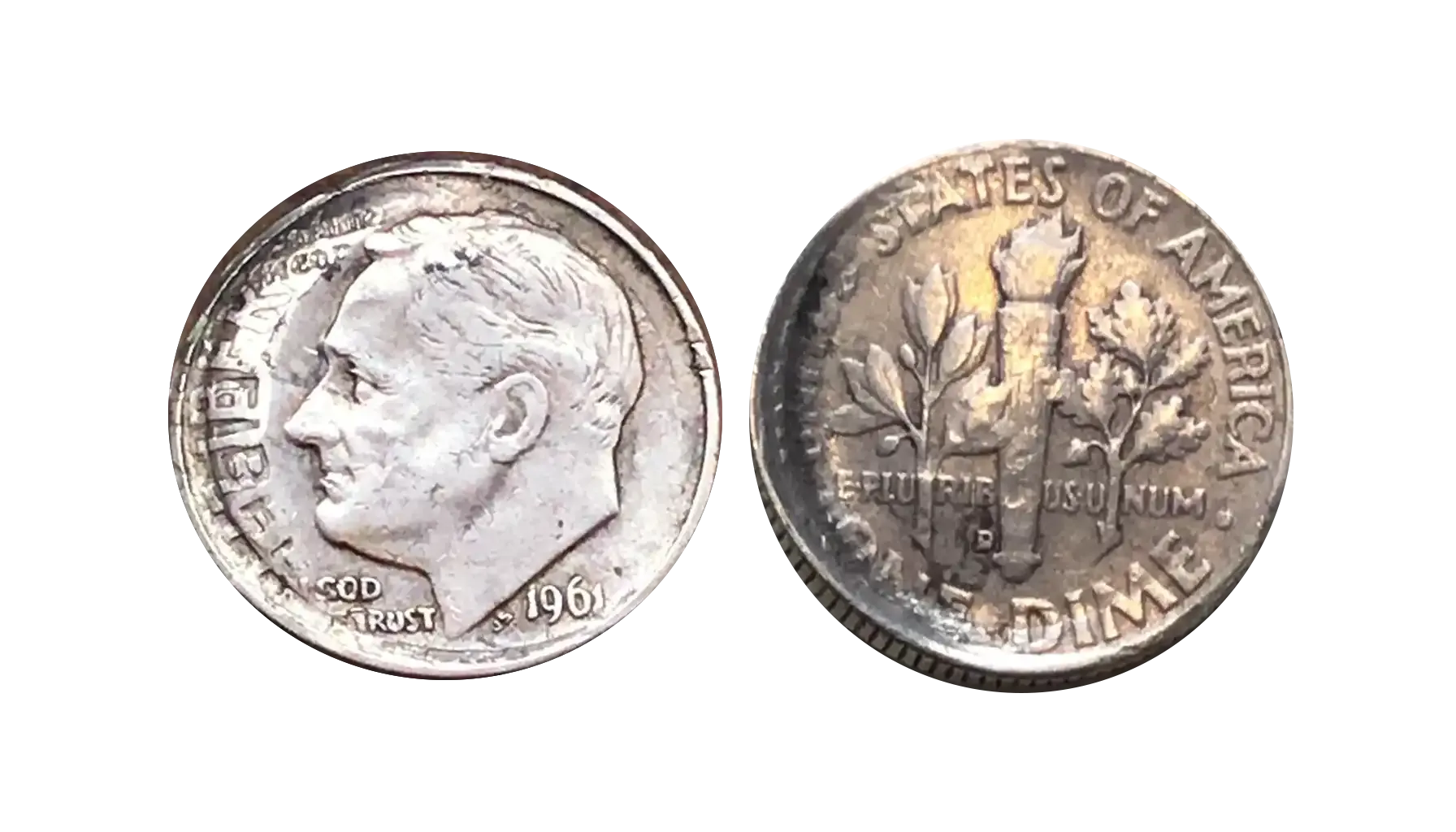
Estimated value: ~$250
One of the most exquisite errors that may significantly boost the 1961 D dime value is the railroad rim. In fact, it is easy to distinguish from other forms of rim alterations, as it resembles two parallel tracks around the coin’s edge. Nonetheless, such pieces should be authenticated to be considered genuine.
The last years of regular silver coinage were soon to end. Explore those pieces and keep them as reminders of a bygone era of precious-metal money in daily life.

 Facebook
  X (Twitter)
  Pinterest
  LinkedIn