Contents:
The extent to which the Washington quarters are present in the monetary system of the United States is evident, and it is highly unlikely that they will disappear from circulation anytime soon. The series was positively accepted right from the start, in 1932, and once a commemorative issue was introduced into regular circulation right away.
The long production run remains a reliable source of exclusive coins with minor yet significant differences, and their prices may be impressive enough to be considered exceptional. Follow the material to learn more about the quarter value and its basics, analyze specifications and design features, and explore rare coins of the year.
1953 Washington Quarter Overview
It is not too surprising that the history of the Washington quarters started with the Standing Liberty design. In the early 1930s, the quarter was due for a redesign, yet, at first, it was only a temporary decision to develop a commemorative design to celebrate 200 years since George Washington's birth. Nonetheless, the Standing Liberty quarter design had come to be viewed as impractical for circulation (although its beauty could not be denied).
In order to find the most suitable design, the Treasury launched the competition, during which artists were invited to submit proposed obverse and reverse designs for the new quarter, and the best entries were received from Laura Gardin Fraser (whose works were favored by the United States Commission of Fine Arts but were set aside) and John Flanagan (whose design was ultimately selected by Treasury officials).
The public response was strong, however, and the United States Mint kept it in production beyond the anniversary year. By 1953, the Washington 25C coin had already been a well-established, standard unit of currency and part of the classic silver coinage era from the pre-1965 time.
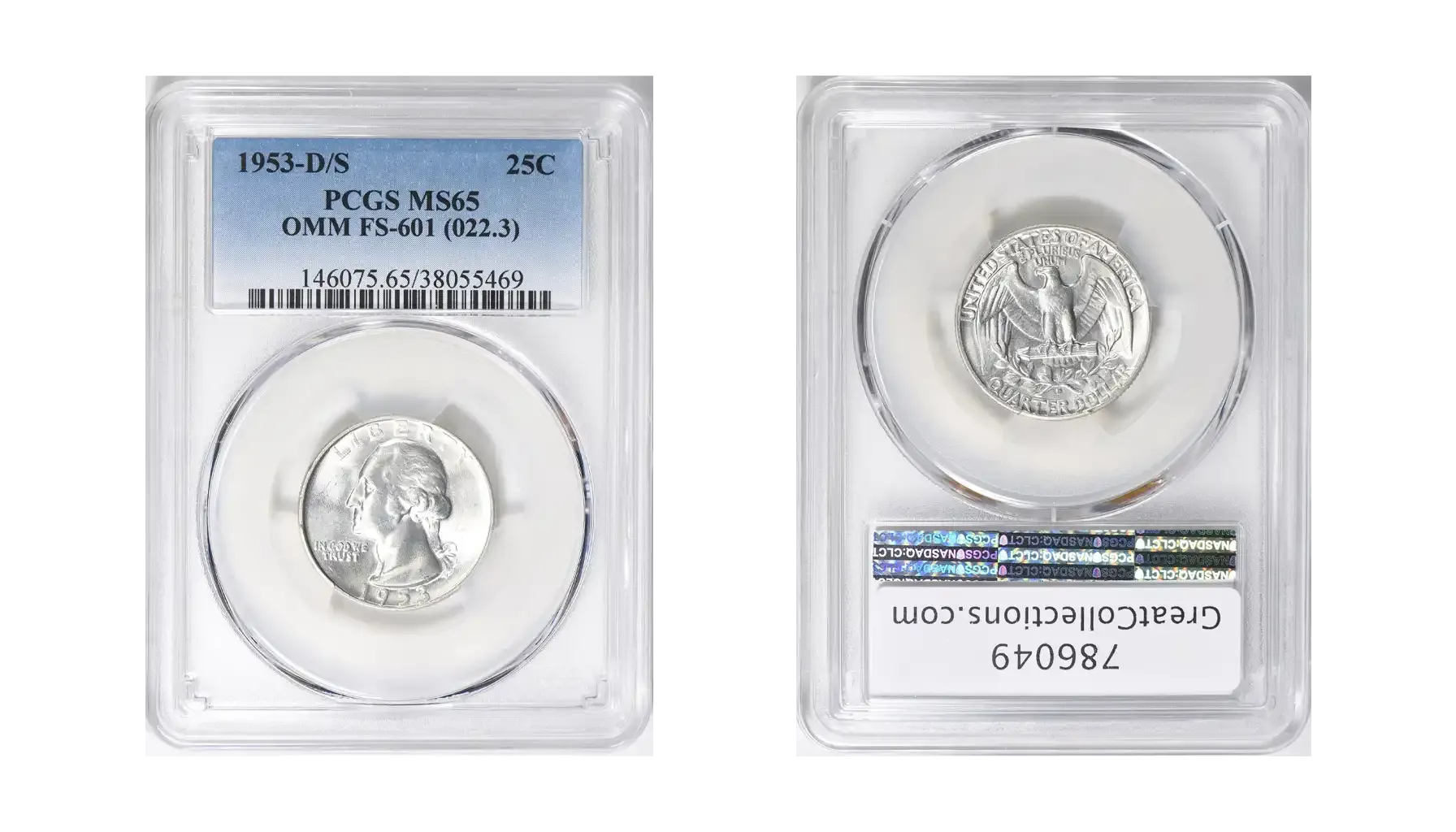
Identifying the 1953 Silver Quarter: Design & Specs
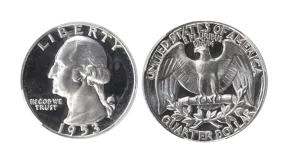
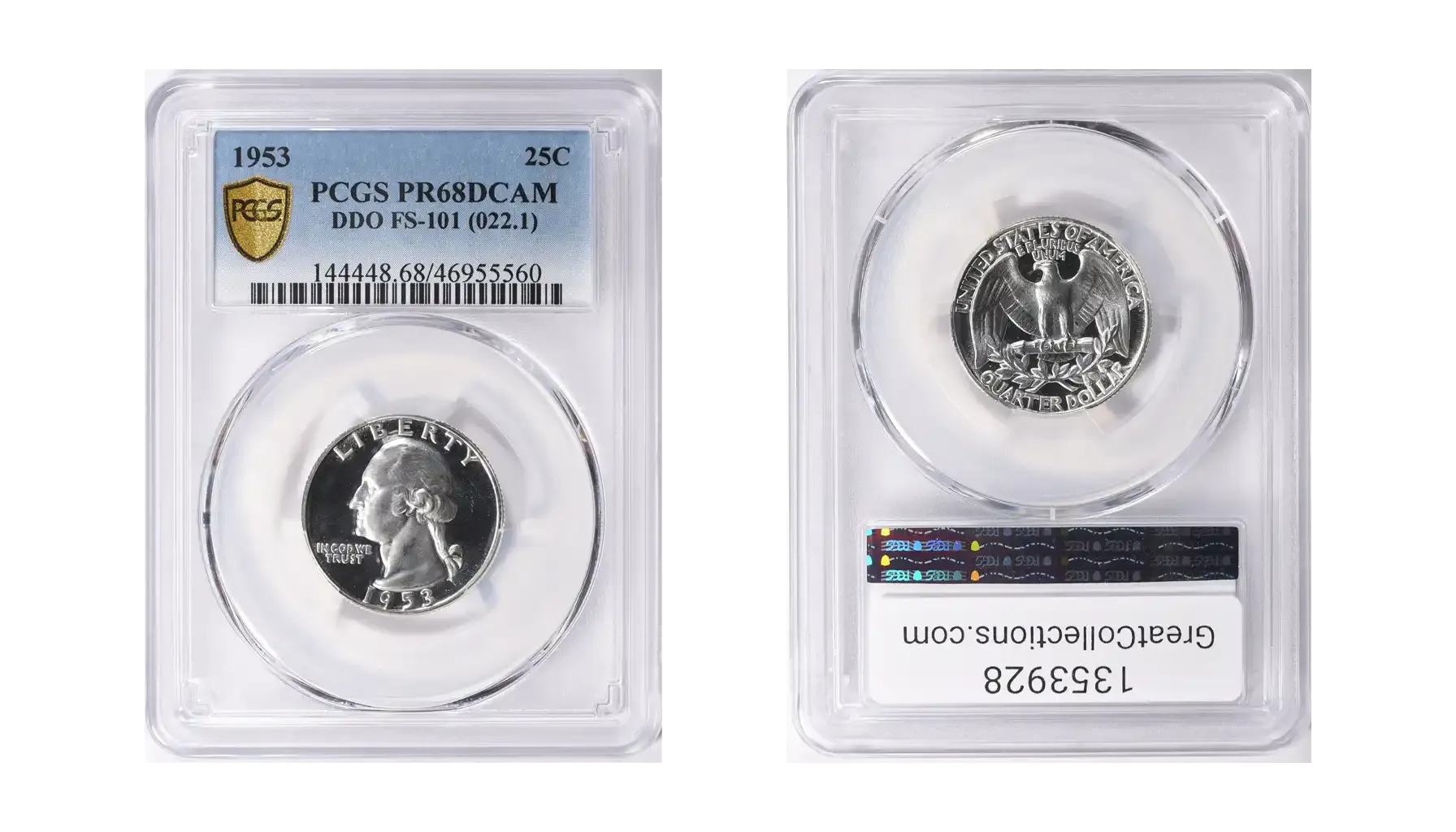
Obverse: The front side showcases the profile of George Washington, the inscription “LIBERTY” located across the upper rim, the national motto “IN GOD WE TRUST” placed to the left of the bust, and the year of mintage “1953” beneath.
Reverse: The back side, on its part, shows an eagle opened-up, holding arrows in its talons, as well as two branches of olive beneath the bird, the inscription “UNITED STATES OF AMERICA” along the upper rim, the symbolic phrase “E PLURIBUS UNUM” above the eagle, a small mint mark below the olive branches, and the denomination “QUARTER DOLLAR” at the bottom.
The Main Features | |
Type | Washington Quarter (silver era) |
Designer | John Flanagan |
Composition | 90% silver, 10% copper |
Weight | 6.30 g |
Diameter | 24.30 mm |
Thickness | ~1.75 mm |
Edge | Reeded |
Silver Weight | ~0.1808 troy oz of silver |
Mint Marks | None for Philadelphia “D” for Denver “S” for San Francisco |
Mint Marks and Varieties of the 1953 Quarter
1953 25C
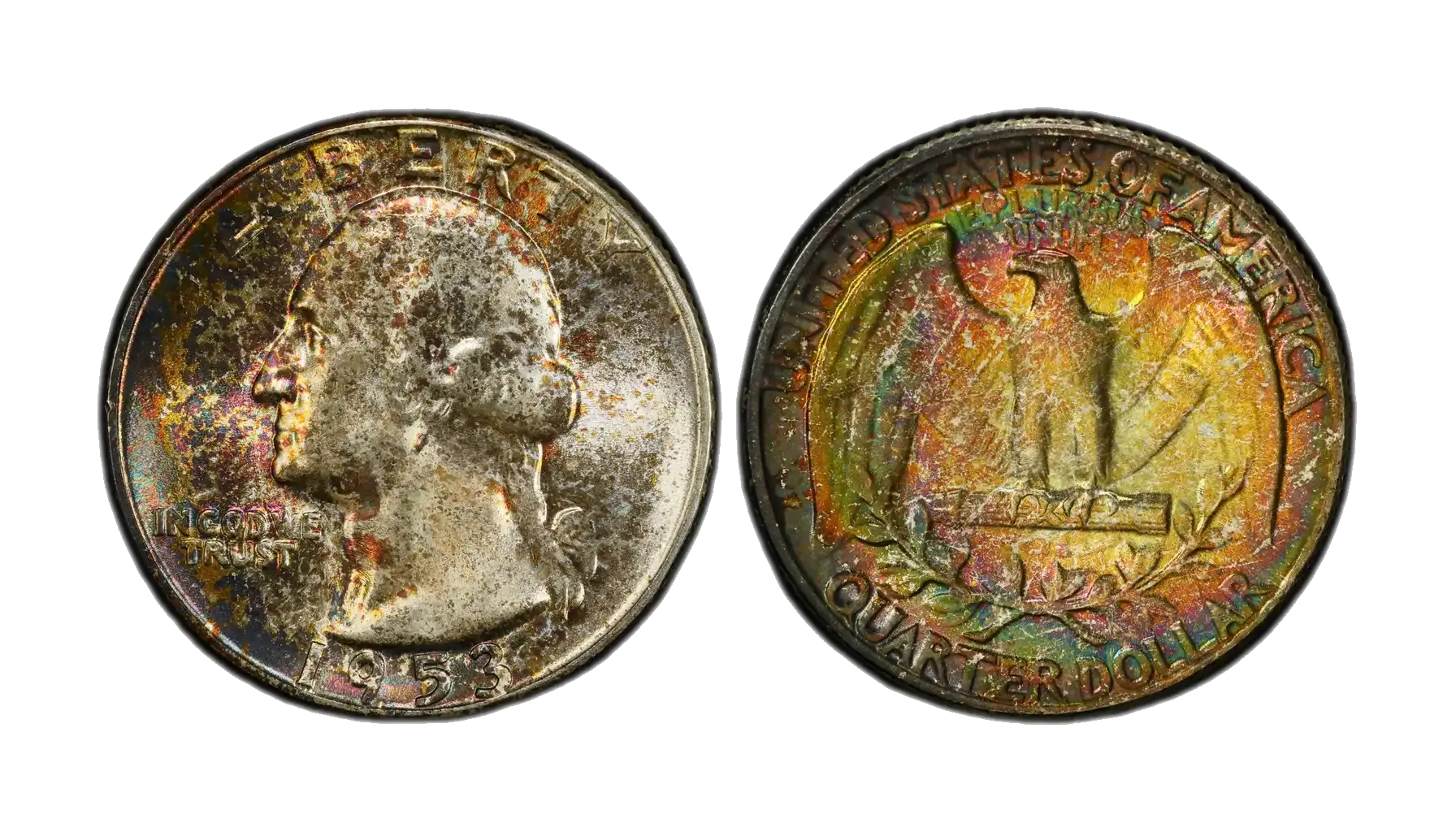
Produced by: Philadelphia Mint
Mintage: 18,536,120
Auction Record: $4,500 for MS68
The 1953 quarter no mint mark issue is a sleeper in the series: although the mintage was high, numismatists call it one of the rarest Washington quarters, minted in silver. This might come from the lower amounts of coin rolls saved, which initially boosted the 1953 quarter value no mint mark, when compared with other dates.
1953-D 25C
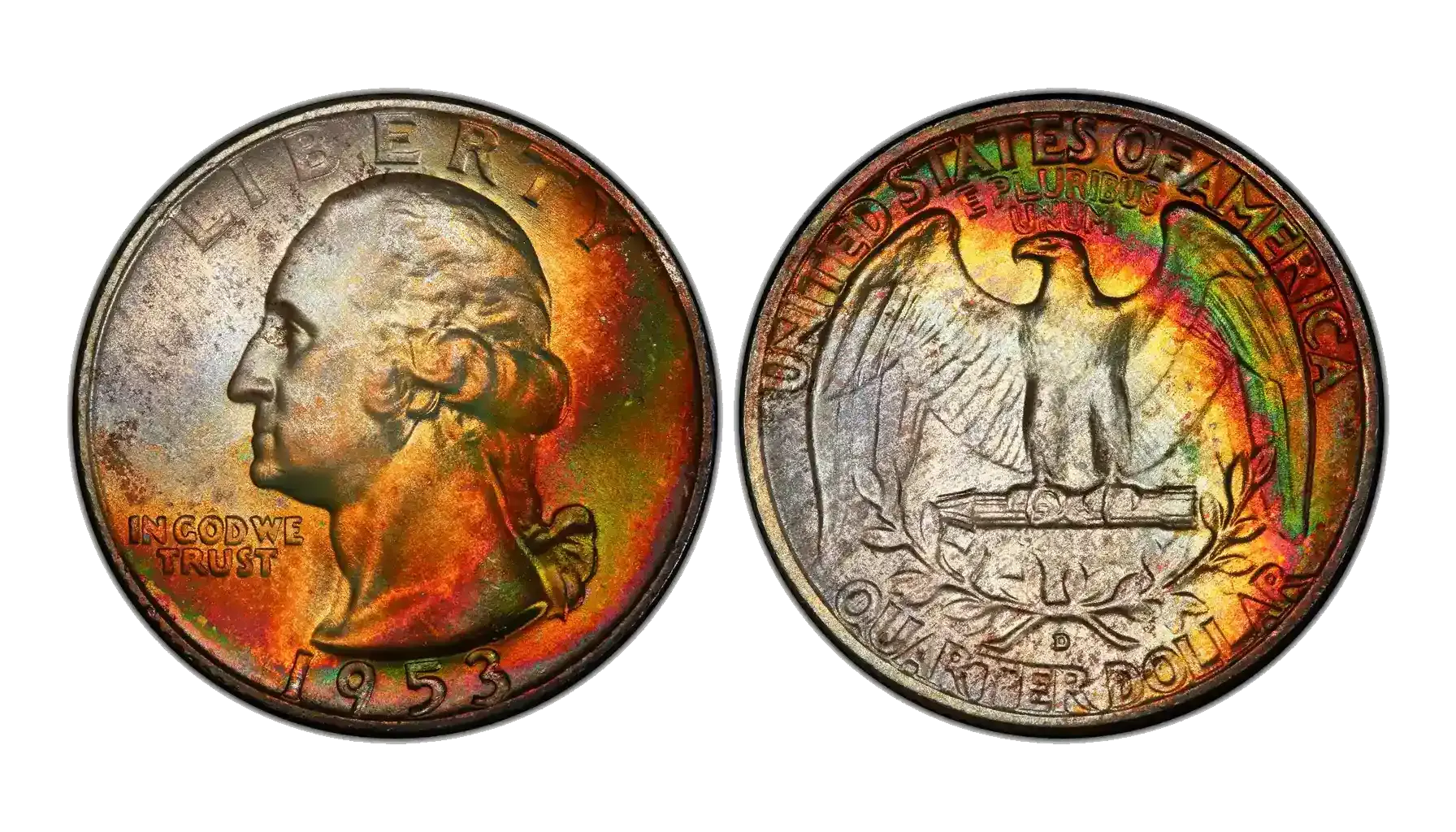
Produced by: Denver Mint
Mintage: 56,112,400
Auction Record: $4,744 for MS67
The 1953 D quarter value is not always impressive, but numismatists treat this coin as a real treasure in its field. According to David Hall, these belong to the rarest 1941-1964 Washington quarters, and the scarcity becomes even more pronounced in MS66 and above.
1953-S 25C
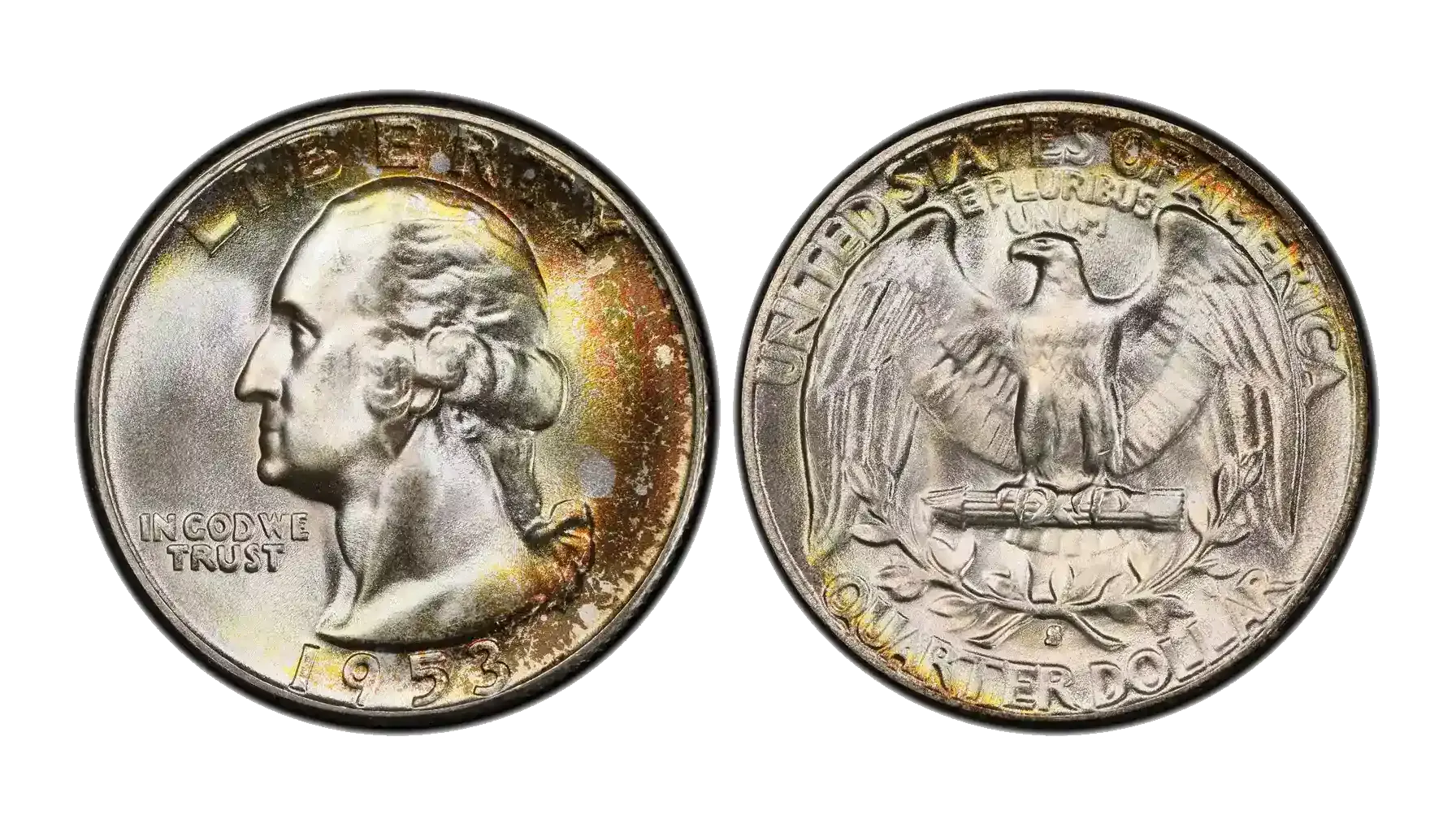
Produced by: San Francisco Mint
Mintage: 14,016,000
Auction Record: $5,040 for MS68
Although it has the lowest mintage of the three circulation strikes, the 1953-S is typically the most approachable to locate in higher grades. The main reason is that quarters from that period were often saved, since collectors and dealers assumed they would be valuable soon. Nonetheless, the 1953 S quarter value proves that they were neither right nor wrong.
1953 25C Proof
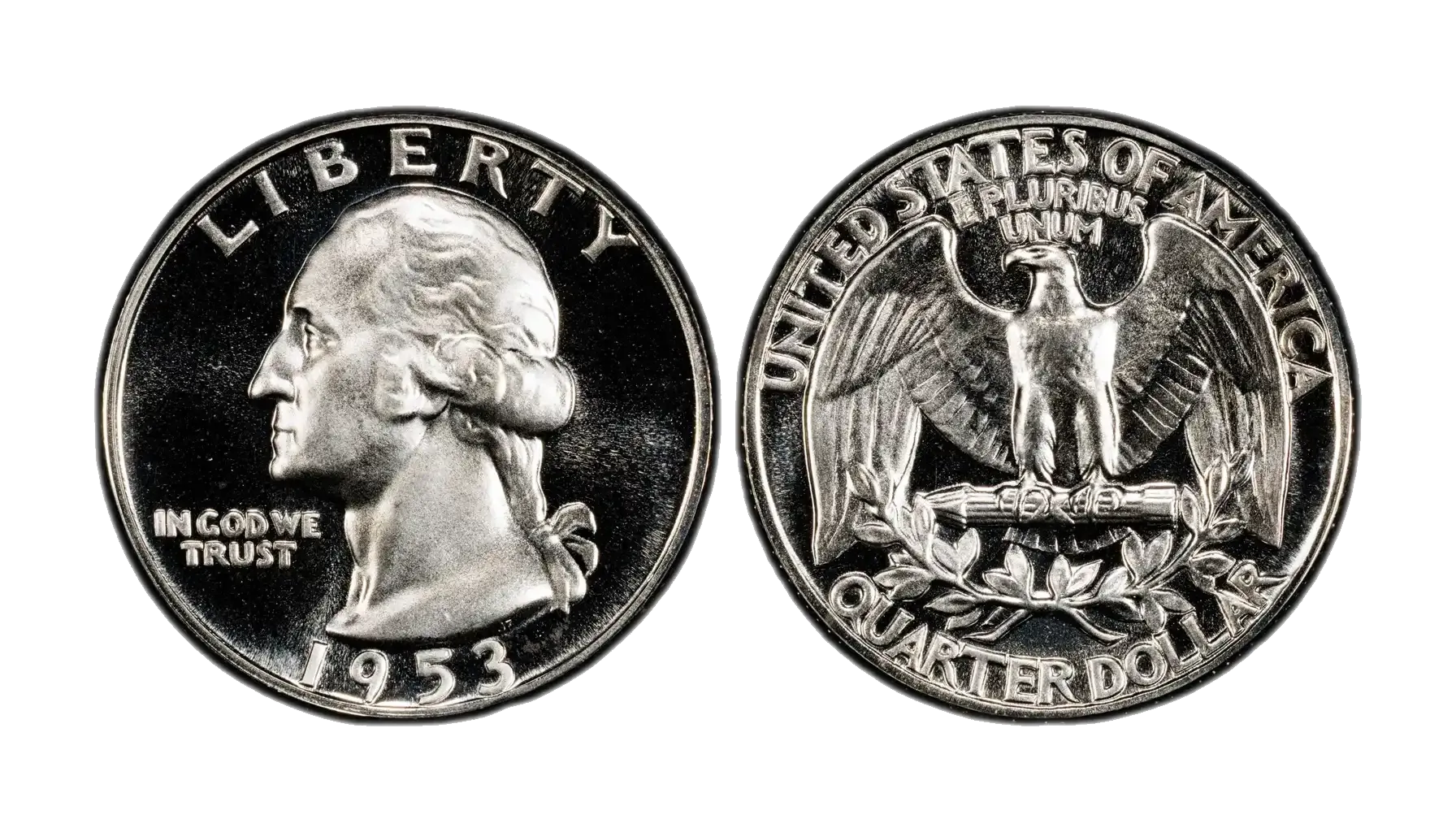
Produced by: Philadelphia Mint
Mintage: 128,800
Auction Record: $15,600 for PR69DCAM
This is the last coin of the set, which was produced as a proof edition. And despite this fact, this issue is not genuinely difficult to obtain in typical proof grades, though it is still a reliable and quite popular option for collectors, especially when accompanied by CAM or DCAM designations.
“The 1953 Proof Washington Quarter has one of the lower mintages from the 1950's to 1960's proof silver quarters. <...> In PR68, it is much more difficult. With cameo surfaces, it is scarce in most grades. In deep cameo condition, it is very tough to locate…”
— Jaime Hernandez, renowned numismatist, PCGS price guide editor
PCGS CoinFacts
1953 Quarter Value by Condition and Mint
How much is a 1953 quarter worth? When it comes to silver coinage, there is one significant aspect that makes these coins exceptionally valuable – the melt value. It forms the basis for the coin’s minimum worth, which is $15.6 today.
Factors Affecting the 1953 Silver Quarter Value
Mint Marks: Same design, minor alterations, yet different scarcity patterns.
Grade: The degree of wear, luster, and surface preservation, supported by documents from the grading services.
Strike Quality: Sharper details (hair, eagle feathers) are more important from the numismatic perspective.
Proof vs Business Strike: Proofs follow a different market, let alone special designations like CAM and DCAM.
How Much Is a 1953 Silver Quarter Worth?
Grade | 1953 25C | 1953-D 25C | 1953-S 25C | 1953 25C DCAM |
G4–VF20 | $19 | $19 | $19 | – |
EF40 | $20 | $20 | $20 | – |
AU50 | $21 | $21 | $21 | – |
MS63/PR63 | $25 | $25 | $25 | $26–$28 |
MS65/PR65 | $30–$34 | $32–$42 | $30–$36 | $500–$550 |
MS66/PR66 | $45–$75 | $70–$150 | $50–$100 | $650–$700 |
MS67/PR67 | $300–$1,600+ | $575–$3,750+ | $160–$575+ | $850–$1,450+ |
Collector Tips and Where to Buy 1953 Quarters
Keep this in mind: buy from established, reputable sources. This could be a trusted local coin shop or well-known numismatic marketplaces where coins are graded/authenticated (ideally by PCGS or NGC). Otherwise, the chances of stumbling upon counterfeited coins are high.
The numismatic path is entangled. Try Coin ID Scanner to make your experience easier and more pleasant.

 Facebook
  X (Twitter)
  Pinterest
  LinkedIn