Contents:
The 1982 twenty-pence coin was the first decimal issue of its type. Even though it cannot be considered the most valuable unit of the sterling system in the UK, the auction records repeatedly showed figures over £1,000 (the price of £13,000 is also possible, as per the eBay results). This, however, is mainly dependent on the type: the 1982 silver proof Piedfort 20p or the regular one.
Nonetheless, the true market 20p 1982 value is hidden somewhere in between: the average worth is the face value, and this is common among all coin types. So, are 1982 20p coins rare? What are the main characteristics of the earliest new 20p issue in the UK, and how to find value of coins for free?
1982 20p Coin: First Year of Issue
The path toward decimalization in the United Kingdom was long and entangled. In fact, the country made a few more or less successful attempts to turn to a decimalized currency, and the first ones (which, for instance, involved the introduction of the florin coins in 1849) did not yet result in a full transition to a decimal monetary system.
The final step was made in 1971: the renowned Decimal Day of February 15 launched the modern structure that replaced the traditional pounds, shillings, and pence system. The 20p coin, however, was not part of the original decimal set in 1971. In turn, it entered circulation only in 1982, as a practical replacement of the 10p coins, the measure to make the currency less heavy, and the intermediate between the 10p and the rare 50p coin types.
20p Coin Types
1982–1984: First portrait of Queen Elizabeth II, crowned Tudor rose reverse
1985–1997: Second portrait of Queen Elizabeth II, crowned Tudor rose reverse
1998–2008: Third portrait of Queen Elizabeth II, crowned Tudor rose reverse
2008–2015: Third portrait of Queen Elizabeth II, Royal Arms reverse
2015–2022: Fourth portrait of Queen Elizabeth II, Royal Arms reverse
2023–...: King Charles III obverse, puffin reverse
“Both the 20p and 50p coins are seven-sided to aid identification. The sides are not straight, but curved, with the centre of curvature being the opposite apex. This means that when used in slot machines, they always appear to have exactly the same diameter regardless of the orientation of the coin when it is put in…”
— Tony Clayton, coin collector
Coins of the UK – Decimal Twenty Pence
Design and Specifications of the 20p Coin 1982
The shape of the 20p denomination was similar to that of the 50p coin worth money (which was released a bit earlier, in 1969) – the equilateral curve heptagon.
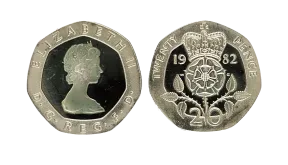
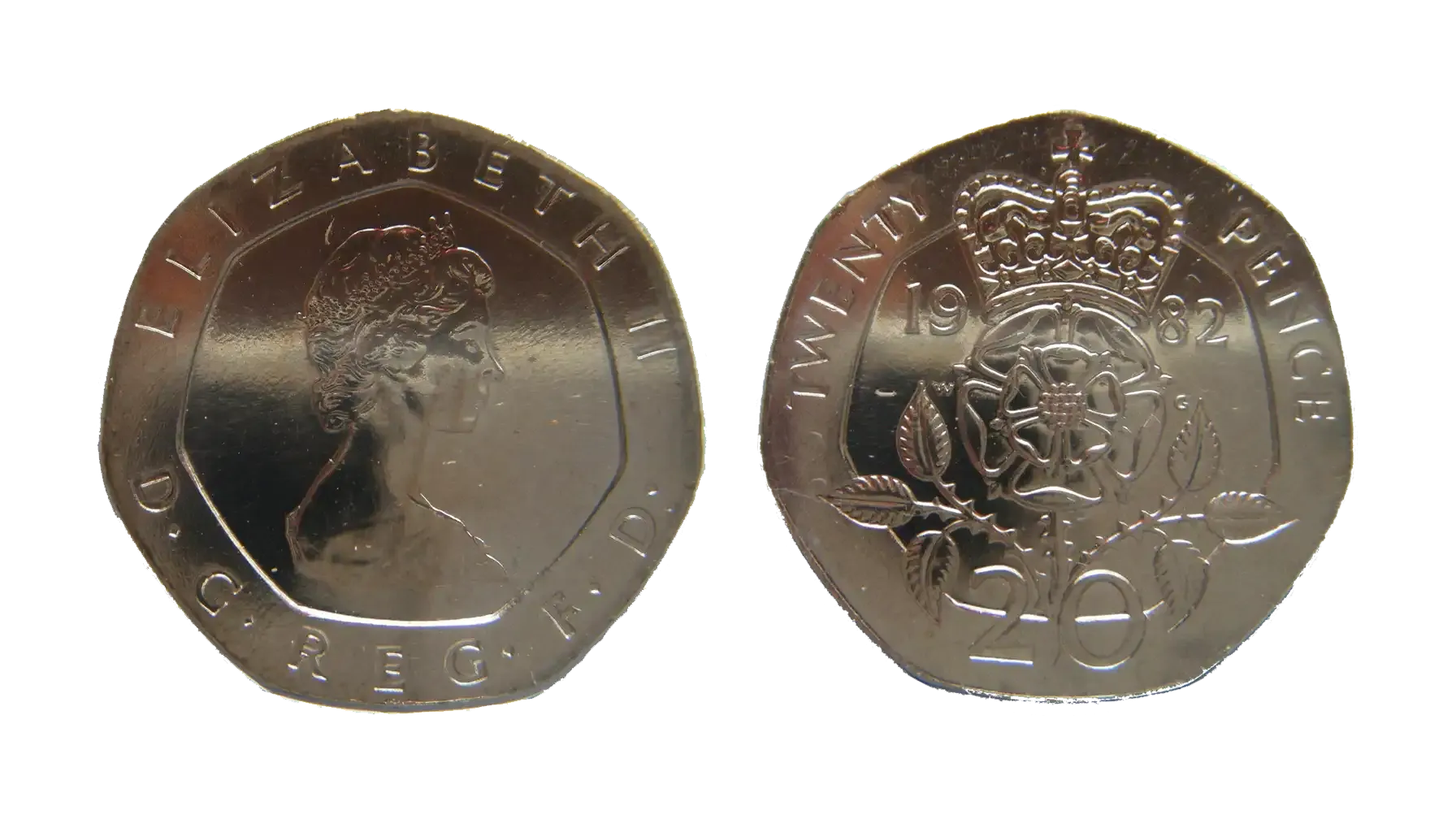
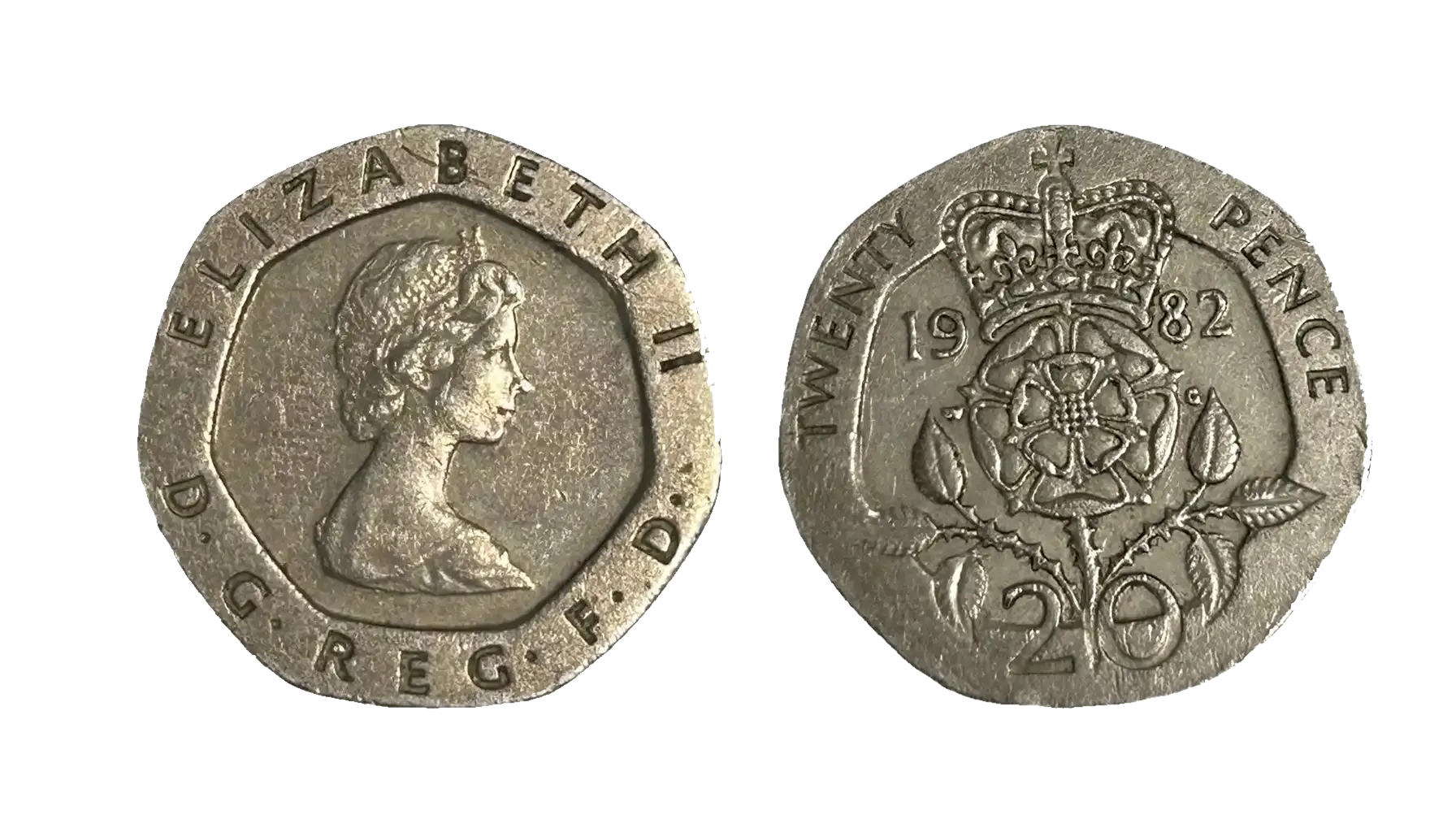
Obverse: The obverse of the earliest twenty-pence unit by Arnold Machin features the second crowned portrait of Queen Elizabeth II in the Girls of Great Britain and Ireland tiara and the inscription “ELIZABETH II D·G·REG·F·D·” (=“Elizabeth II, by the Grace of God, Queen, Defender of the Faith”) along the rim.
Reverse: The reverse design by William Maving Gardner is also formal, for it depicts a crowned Tudor rose, as well as the date split by this rose, the inscription “TWENTY PENCE” across the edge (the upper half), and “20” below.
Main Characteristics | |
Denomination | 20 pence |
First issued | 9 June 1982 |
Shape | Equilateral curve heptagon (7-sided) |
Composition | Copper-nickel (84% copper, 16% nickel) Silver (for a proof edition) |
Weight | 5.0 g |
Diameter | 21.4 mm |
Thickness | 1.7 mm |
Edge | Plain |
Mint | Royal Mint, Llantrisant |
Why Is 1982 20p Coin Rare?
Mintage for the regular unit: 740,815,000
Mintage for the proof type: 106,800 (according to NGC)
The rarity of the 1982 20p piece depends on the type discussed, since the regular circulation coin is not genuinely scarce, as the Royal Mint recorded an immense mintage of more than 740 million units. Therefore, ordinary worn examples are rather common, though the status of the first year of issue is still viable.
The treasure of the year is the silver proof version, which was limitedly produced for collectors only (106,800 units during that year). The Piedfort 20p from 1982 is even more exclusive, for it had a mintage limit of 10,000 pieces a year.
1982 20p Coin Error Variations
Warning: Do not confuse genuine errors with post-mint damage (e.g., discoloration), polished coins, or unrelated varieties.
Errors are usually the most profitable coin varieties, for they represent exclusive anomalies that may range in numismatic appeal and the level of expression. As a rule, these include misalignments, off-centre strikes, or clipped planchets, though most claims of “rare errors” online are overstated. For users' convenience, here are average market prices for authentic errors, according to the online coin auctions and other numismatic resources:
Rotated die, i.e., the obverse and reverse are misaligned; £50–£150 (eBay example)
Off-centre strike, i.e., the design is partially missing; £35–£80
Clipped planchet, i.e., part of the blank is missing; £30–£70
Strike-through/weak strike, i.e., there is the faint or incomplete design; £20–£60
The prices may be higher on the coin-trading platforms, but this does not usually mean that the coins actually sell for those amounts. In general, these are often asking prices rather than confirmed sales.
1982 Silver Piedfort 20p Value
There were two major varieties of the proof 20p coin in 1982, i.e., the standard cupro-nickel proof version and the sterling silver one. Rare 20p coins 1982 worth money, hence, tend to refer to the latter type. The silver Piedfort edition was struck thicker and heavier than standard pieces, and its intrinsic worth was initially higher (relevant to the current rates of silver per ounce).
Condition | Typical Value Range (GBP) |
With case & COA (uncertified) | £25–£35 |
Loose, no case | £20–£30 |
Toned/minor wear | £20–£28 |
With a certificate & presentable case | £30–£40+ |
Certified/graded (higher condition) | £40–£80 (varies) |
Is a 1982 20p Coin Worth Anything Today?
Many listings online suggest that the coin might be worth a lot (up to a few thousand pounds per piece). However, in most cases, these are asking prices but not the confirmed sales. A regular 1982 20p unit is the representative of one of the most common dates in the series, and the circulated pieces should be worth the face value only (unless the exceptional condition is applied).
The price of each coin is based on several factors, taken into consideration simultaneously. They include:
Condition/attributed grade, i.e., how worn or well-preserved the coin is
Strike quality, i.e., sharpness of the design and lettering
Mintage, i.e., how many were originally produced
Errors or varieties, i.e., mint anomalies that make a coin unusual
Certification/packaging, i.e., the presence of proof packaging and official grading
Market demand, i.e., collector interest and recent sales trends
How Much Is a 1982 20p Coin Worth?
Grade | Value (£) |
Very Good/VG | £0.19 |
Fine/F | £0.19 |
Very Fine/VF | £0.19 |
Extremely Fine/EF | £0.26 |
About Uncirculated/AU | £0.34 |
Uncirculated/UNC | £0.75 |
Brilliant Uncirculated/BU | £1.03 |
In Numismatic Tools We Trust...
Should you wish to identify or analyze valuable rare 20p coins 1982, it might be reasonable to appeal to reputable tools so as not to miss the least noticeable details that define the worth. Variations in coins are common, and even the most experienced collector may overlook them unintentionally.
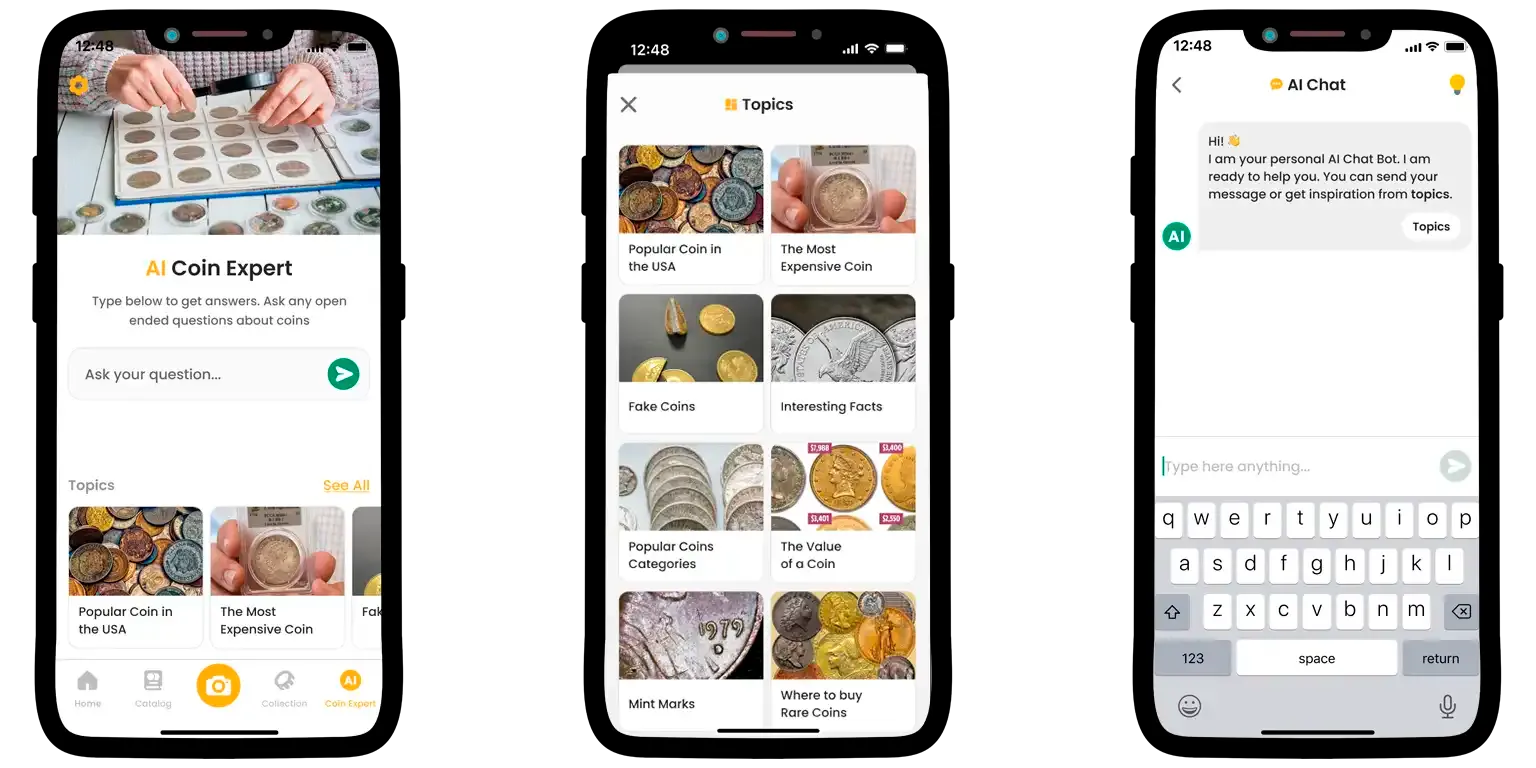
Coin ID Scanner is an advanced, all-in-one application that may help one identify, catalog, and analyze coins from the UK and all over the world. Scan a coin with your smartphone camera and:
Detect the year, denomination, background info, and variants
See Special designations, errors, and proofs (if present)
View a large database of different currencies and their possible market values
Record your collection to track whenever you need
Coins of key years may not be overly valuable at first. Yet, time passes, and prices tend to grow – watch your wealth appreciate.

 Facebook
  X (Twitter)
  Pinterest
  LinkedIn