Contents:
Since 1834, the Bailiwick of Jersey, one of three British Crown Dependencies, has used the pound sterling as its official currency, and each reform in Great Britain, including decimalization, has inevitably affected the monetary framework of the island economy. Within that system, there is the 20p coin, which may resemble its British counterpart, yet with a distinct local flair.
The rarity and the worth of the coin depend on the year of production: although the estimated price of many circulated 20p units equals their face value, the lowest mintage of 10,000 makes the 2003 “Lighthouse at La Corbière” variety the scarcest and the most expensive, let alone non-circulating silver issues from 1982 and 1983.
But what do the 20p Bailiwick of Jersey coins mean? What is their background? And how to identify these coins on the numismatic market?
Overview of the Bailiwick of Jersey 20p Coin
The twenty-pence coin first appeared in Britain as a measure meant to implement and validate a new decimalized currency system in the Isles. The country, whose monetary frameworks also depend on sterling, followed the same pattern, too. The renowned "Decimal Day" took place in 1971 in the UK, and this was the moment when Jersey decimalized, too (the introduction of the local 20p denomination in 1982 was carried out following the example of a more powerful neighbor and supporter).
The series could be divided into three groups by stage:
First came the 1982 coin, i.e., the primary one-year issue, which could be distinguished by the date placed on the reverse.
Then, the system welcomed the regular 1983–1997 circulation type with Arnold Machin’s portrait of Queen Elizabeth II on the obverse.
From 1998 to 2016, the coin kept the same lighthouse reverse but adopted Ian Rank-Broadley’s later portrait of the Queen.
The new design with Charles III is not publicly documented as part of Jersey’s regular 20p currency, but the UK has already introduced a 20p bearing the new monarch’s portrait (as well as King Charles 50p coins, which are close in terms of size, function, and place within the modern sterling system).
Design and Specifications
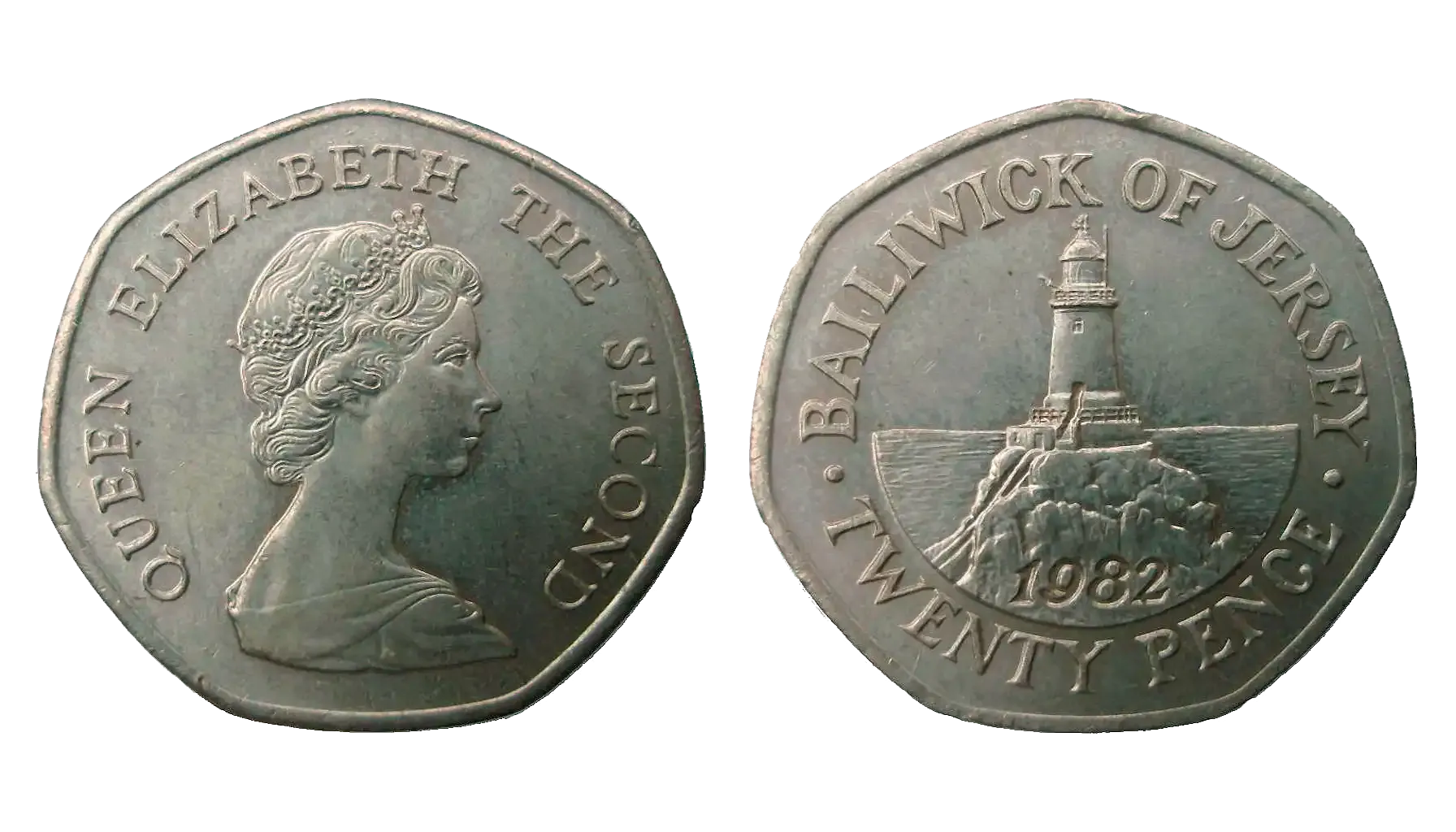
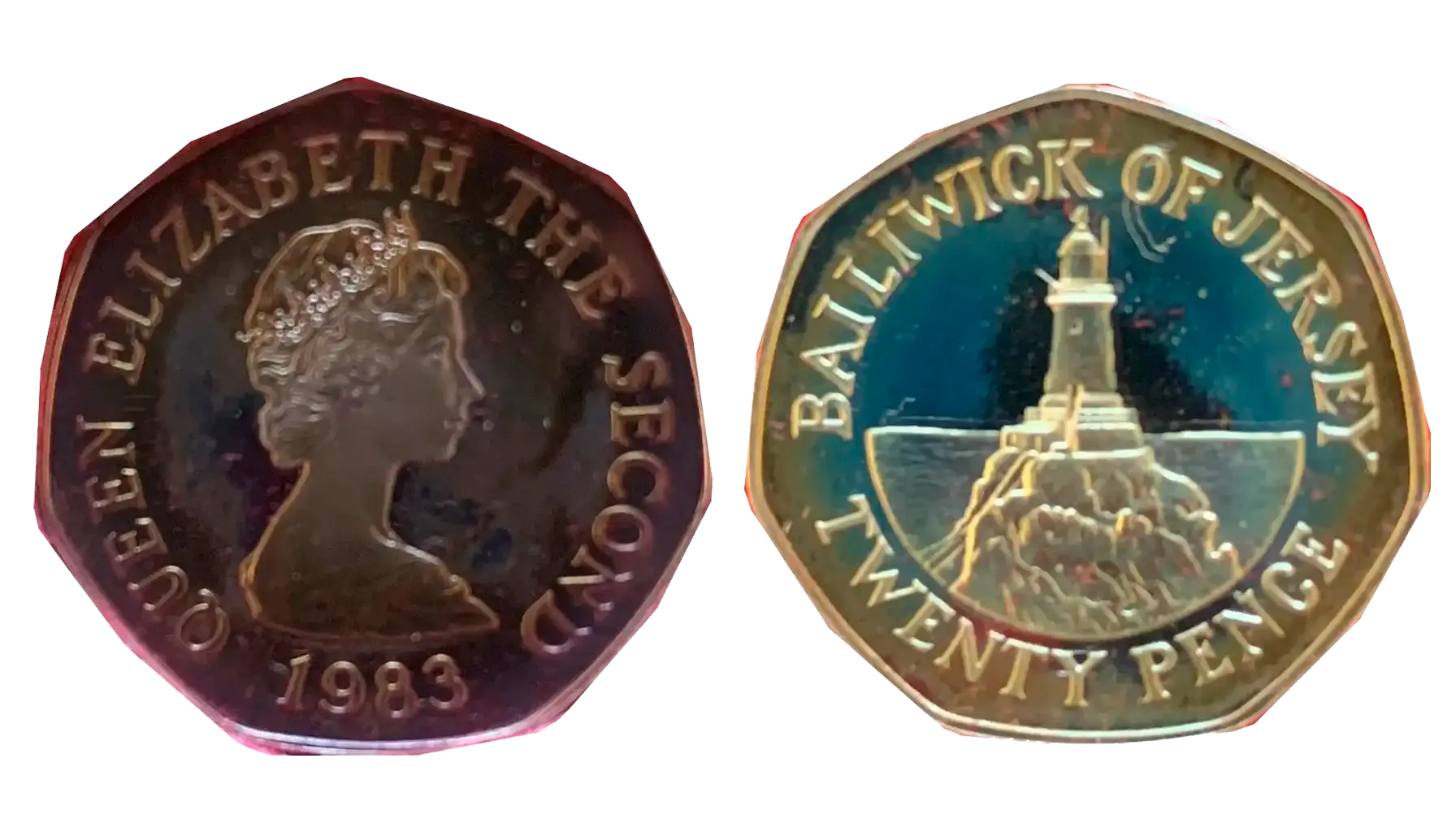
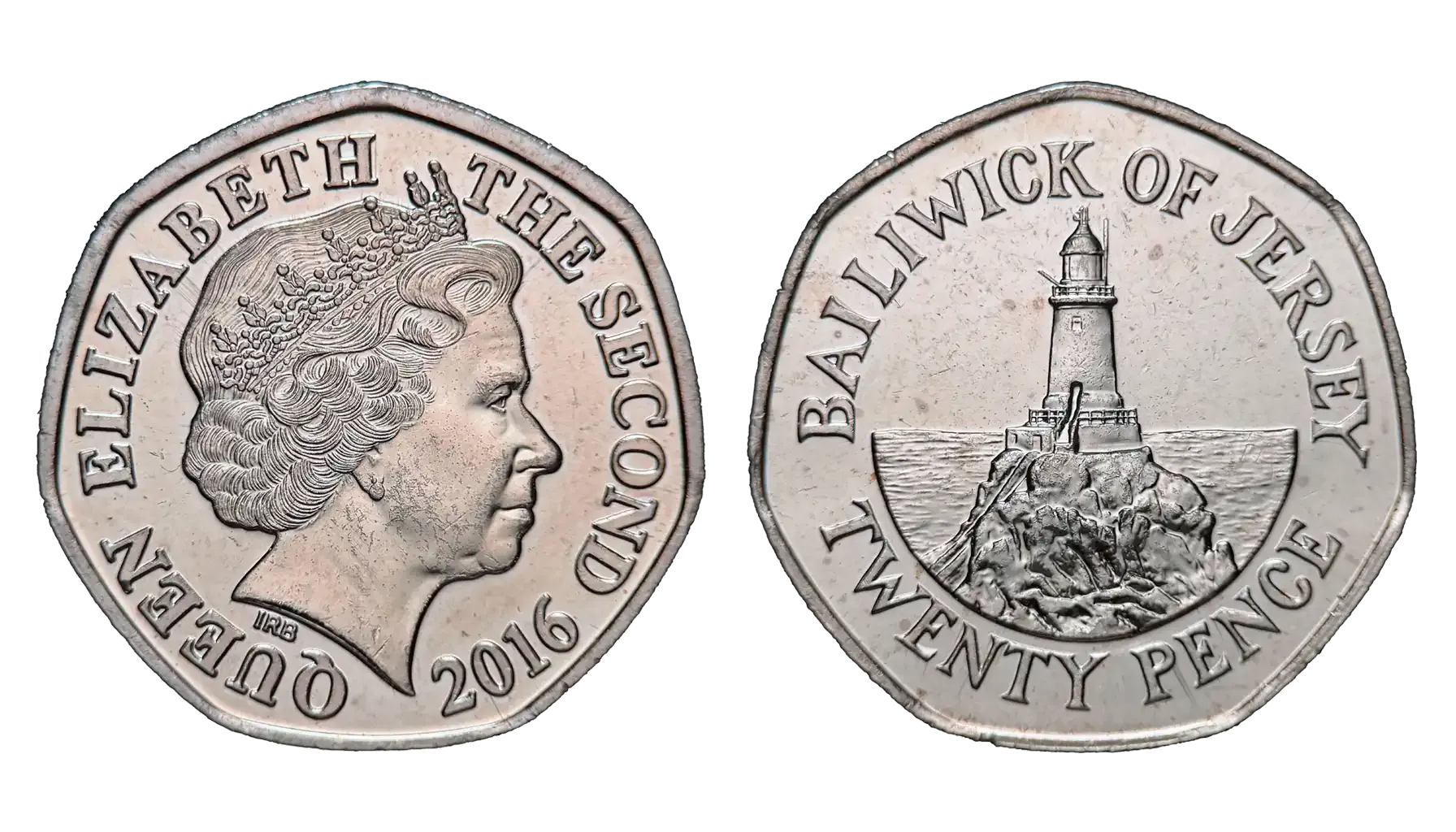
Obverse: Although the design has repeatedly changed, the obverse side always bore the profile of Queen Elizabeth II in the Tiara of the Girls of Great Britain and Ireland, the inscription “QUEEN ELIZABETH THE SECOND”, and the date below the portrait. The 1982 issue was different, as the date was not present on this side.
Reverse: The reverse, on its part, shows La Corbière Lighthouse on the marine background, the name of the country “BAILIWICK OF JERSEY” above the lighthouse, and the denomination below. The date of the 1982 issue was also included here, though.
The Main Features of the Jersey 20p | |
Denomination | 20 pence |
Currency system | Jersey pound |
Years issued | 1982; 1983–1997; 1998–2016; |
Composition | Copper-nickel; Silver (.925) for non-circulating pieces; |
Weight | 5.0 g |
Diameter | 21.4 mm |
Thickness | 1.7 mm (1983–1997); 1.8 mm (1982); 1.9 mm (1998–2016); |
Shape | Equilateral curve heptagon (7-sided) |
Edge | Plain |
Is the Jersey 20p Rare?
Although the 20p of Jersey cannot be considered extremely rare (for many dates could boast great volumes of production), some issues are significantly scarcer than the rest. Hence, the rarity within the series depends on the year, and these iterations are more valuable by nature.
Lowest Mintages by Year: Top 7
Year | Mintage | Why It Is Special |
2003 | 10,000 | Lowest reported mintage |
1992 | Mint sets only | Not issued for normal circulation |
1986 | 100,000 | Scarce circulation issue |
1987 | 100,000 | Scarce circulation issue |
1989 | 100,000 | Scarce circulation issue |
1990 | 150,000 | Low mintage |
1982 | 200,000 | First issue of the denomination |
Which Jersey 20p Coins Are the Rarest?
The title of the rarest coin within the series is definitely attributed to the 2003 variety, as it shows the lowest reported mintage of 10,000 pieces. Nonetheless, there are a few more iterations when there were little to no circulation units produced: e.g., the 1992 issue, struck only for sets, or the 1982 and 1983 pieces, made of precious metals as a collector's edition.
The 1982 type should not be missed, too, as it is the first coin in the series and, hence, quite attractive in terms of its historical worth.
“There can at times be a significant lag between the order of a coin and the date coins are struck. Furthermore, if a small number of coins are ordered, it might not be cost-effective to commission a new die with an updated year. So, what can happen is a coin with one date can actually be 'minted' over several years…”
— Harold K. Fears, Jr., compiler of the Jersey Coins website
Jersey Coins and Banknotes, Part 9: Circulating Decimal Coinage
Does “Rare” Mean Valuable?
It is a complex question, as not all rare coins can be equally valuable. Low mintage is only one factor that may affect the attractiveness of the issue, but here are a few more to go: the condition, demand, and appearance as a whole. So, that said, the lowest mintage is not usually connected with the highest price; the demand is.
How Much Is a Bailiwick of Jersey 20p Worth?
In most cases, the worth of one twenty-pence coin is worth twenty pence, which is obvious. However, at times, circulated pieces of higher grades may sell for several pounds. This, in turn, depends on the year, rarity, and overall condition of the item. All in all, price tables, provided by major online coin auctions, prove that the main 20p types usually remain modestly priced (the 1987, 1982, and 2003 issues are exceptional).
Bailiwick of Jersey 20p Coin Value Factors
Year of mintage: Low-mintage dates are generally more attractive, though this factor is not definitive.
Condition: An uncirculated coin is, by law, worth much more than a worn example. This is logical.
Type: This typically comes down to the distinction between regular, commemorative, and proof versions.
Set-Only Status: Coins such as the 1992 issue, listed as struck in sets only, can be harder to find than standard circulation pieces.
Average Value Ranges for the 20p Types
Type | Approximate value |
Common circulated dates | ~£0.50–£2.00 |
Better common dates in nice condition | ~£2.00–£4.00 |
1982 first issue | ~£0.90–£2.60+ |
1987 | ~£1.40+, often higher in stronger grades |
2003 | ~£1.30+ in lower grade; ~£6+ in UNC range; |
1982 silver proof | ~£8–£20+ |
1983 silver proof | ~£10–£25+ |
How to Define If Your Coin Is Worth Anything?
One of the most confusing aspects of numismatics is understanding if the coin you hold is a true relic or not. Although one may try to guess, the most accurate way is to employ additional tools to analyze several variables at once, namely the year of mintage, rarity, condition, metal, background, and overall demand.
Here is the app to try – Coin ID Scanner, an innovative tool that makes coin identification easier, faster, and more fun.
This Is What Coin ID Scanner Can Do
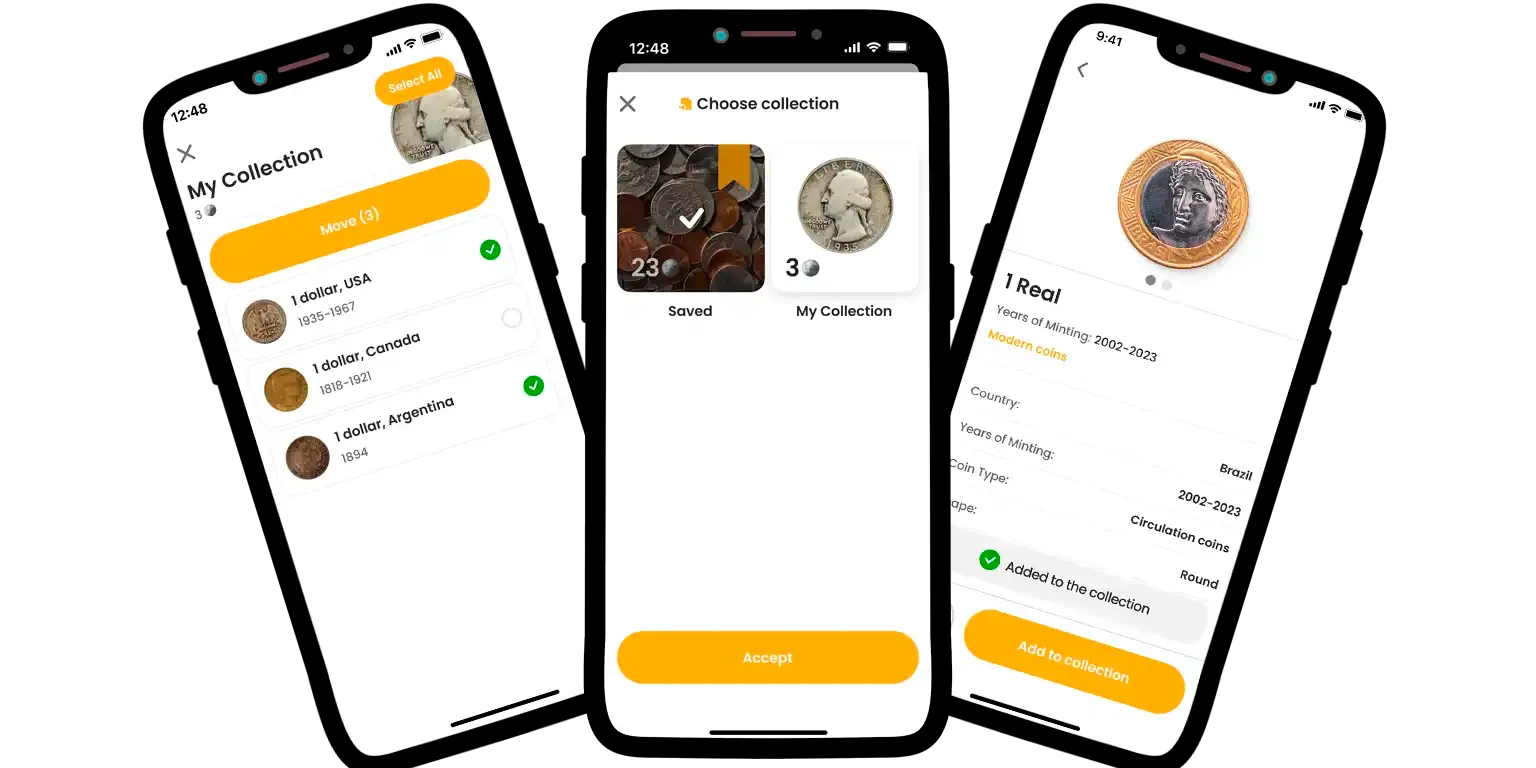
Identify coins by photo: Users are free to upload photos from the gallery or take a picture directly in the app to access coin cards and review essential information about years of minting, country, coin type, edge, composition, diameter, weight, price, and more.
Manage collections: Besides, one may add coins to a digital collection to organize finds, keep track of pieces, and build a personal inventory under the same digital roof.
Access an extensive database: Explore a large database of more than 187,000 coins from all over the world. The range is exhaustive in the end.
Communicate with the AI Coin Helper: Last but not least, the app also supported its users with additional guidelines to get closer to the value the coin may hold.
The 20p coins of Jersey are a good example of the local, but still globally affected numismatic creations that may be truly interesting, despite the fact that the prices are initially low. These tend to grow – take care of the coins to make it happen.

 Facebook
  X (Twitter)
  Pinterest
  LinkedIn