Contents:
The 1922 Peace Dollar, often nicknamed the Liberty Dollar for its striking depiction of Lady Liberty, reflects a major step in US coinage: as a new representative of its time, it was meant to replace the long-running Morgan dollar and celebrate the end of World War I.
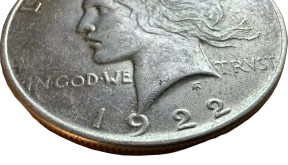
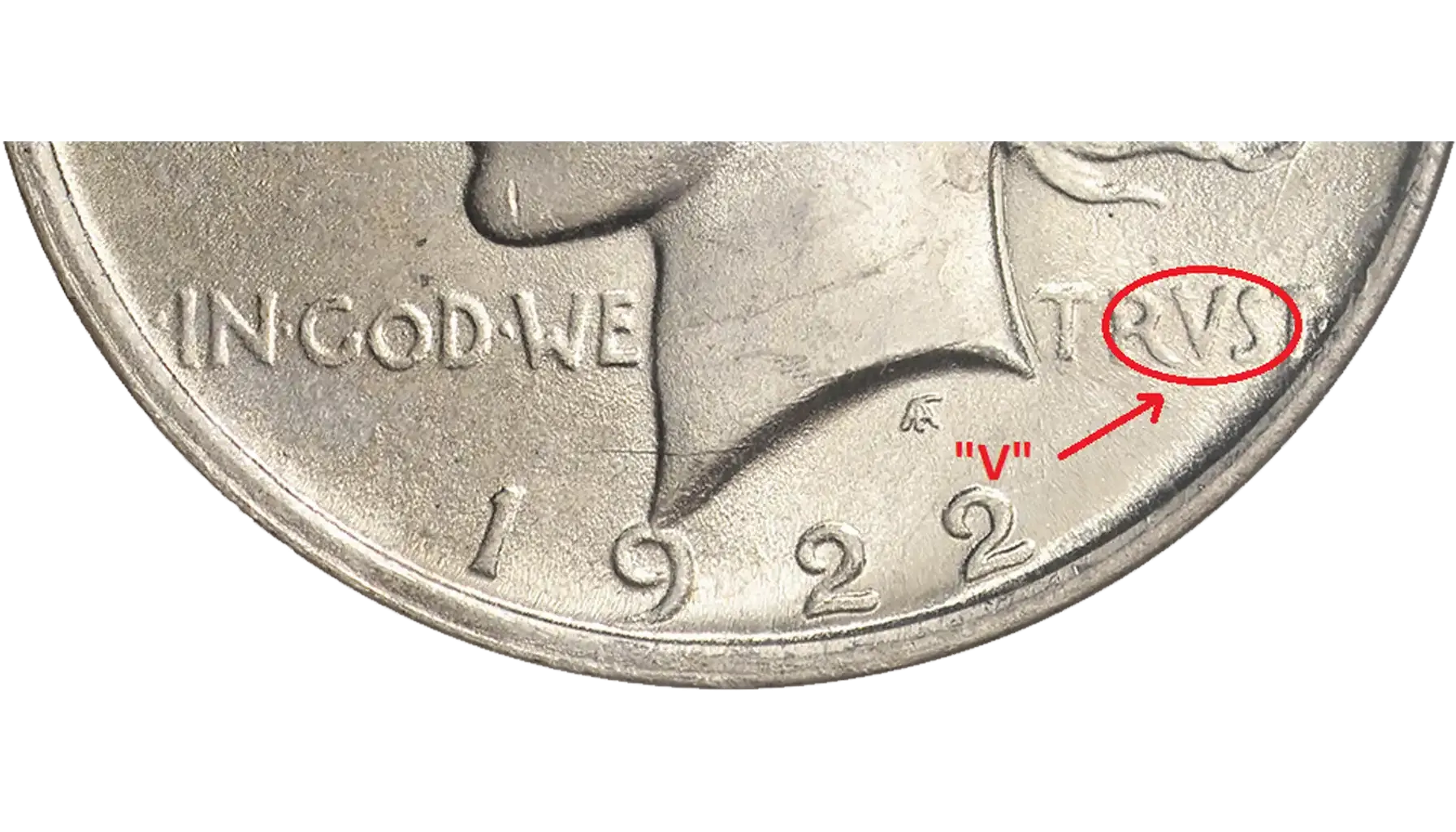
Nevertheless, one feature always draws a second look: the motto on the reverse reads “IN GOD WE TRVST,” spelling TRUST with a V instead of a U. This choice reflects a nod to ancient Roman inscriptions, not a die error. True minting mistakes, like coins missing the “D” mintmark, can still command hefty premiums well above face value. You can verify these quirks and appraise your piece with a reliable coin value identifier like Coin ID Scanner.
So, why does the Peace Dollar say TRVST? And why do numismatists pay so much attention to these creations? Let us see.
The 1922 Liberty Dollar: Unpacking the "Misspelling"
In classical Latin, the letter U did not exist. The letter V was used for both the “U” and “V” sounds, and this convention appeared on Roman coins, monuments, and inscriptions.
By the early 20th century, American sculptors often borrowed this style when designing coins meant to look permanent and dignified. When Anthony de Francisci created the Peace Dollar design in 1921, the classical lettering fit the coin’s purpose.
The wording was officially approved by the United States Mint and used consistently throughout the series. A Liberty dollar issued in 1922 reflects a period when artistic symbolism mattered more than strict modern spelling conventions.
Because:
it appears on every Peace Dollar (1921–1935)
it was part of the original approved design
it is consistent across all mints and years
it cannot be classified as a mint error, variety, or misprint.
It has no effect on the total 1922 Liberty Silver Dollar TRUST misspelled value. Any piece of this series with this lettering is normal and correct. For example, for Liberty silver dollars struck in 1923, the presence of TRVST is expected and has no direct impact on pricing or rarity.
Public Reaction in the 1920s
To many Americans, the use of a “V” instead of a “U” looked like a spelling mistake on an official coin. This reaction was common, especially among people unfamiliar with classical lettering traditions.
Newspapers of the early 1920s occasionally mentioned the issue, and letters were sent to editors and government offices asking why the word TRUST appeared to be misspelled.
The response from the United States Mint was effectively silent. The Mint did not revise the design, issue corrections, or acknowledge the lettering as a problem. Internally, the inscription was already understood as intentional and artistically justified. By choosing not to react, the Mint reinforced that it was not a 1922 Silver Dollar error TRVST to be fixed, but a design decision to be accepted. Over time, public confusion faded as the coin became familiar.
Key Figures in the Design
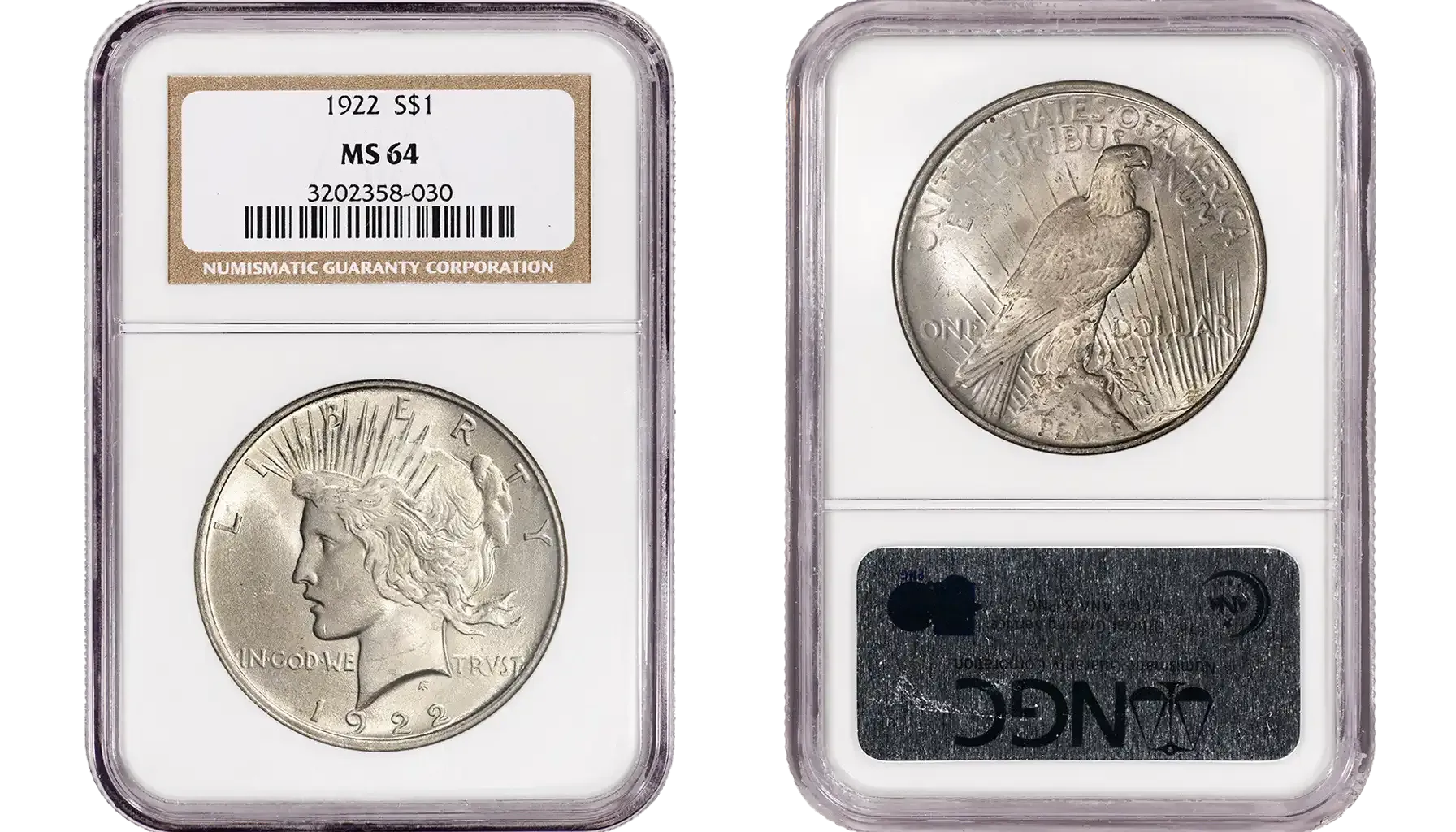
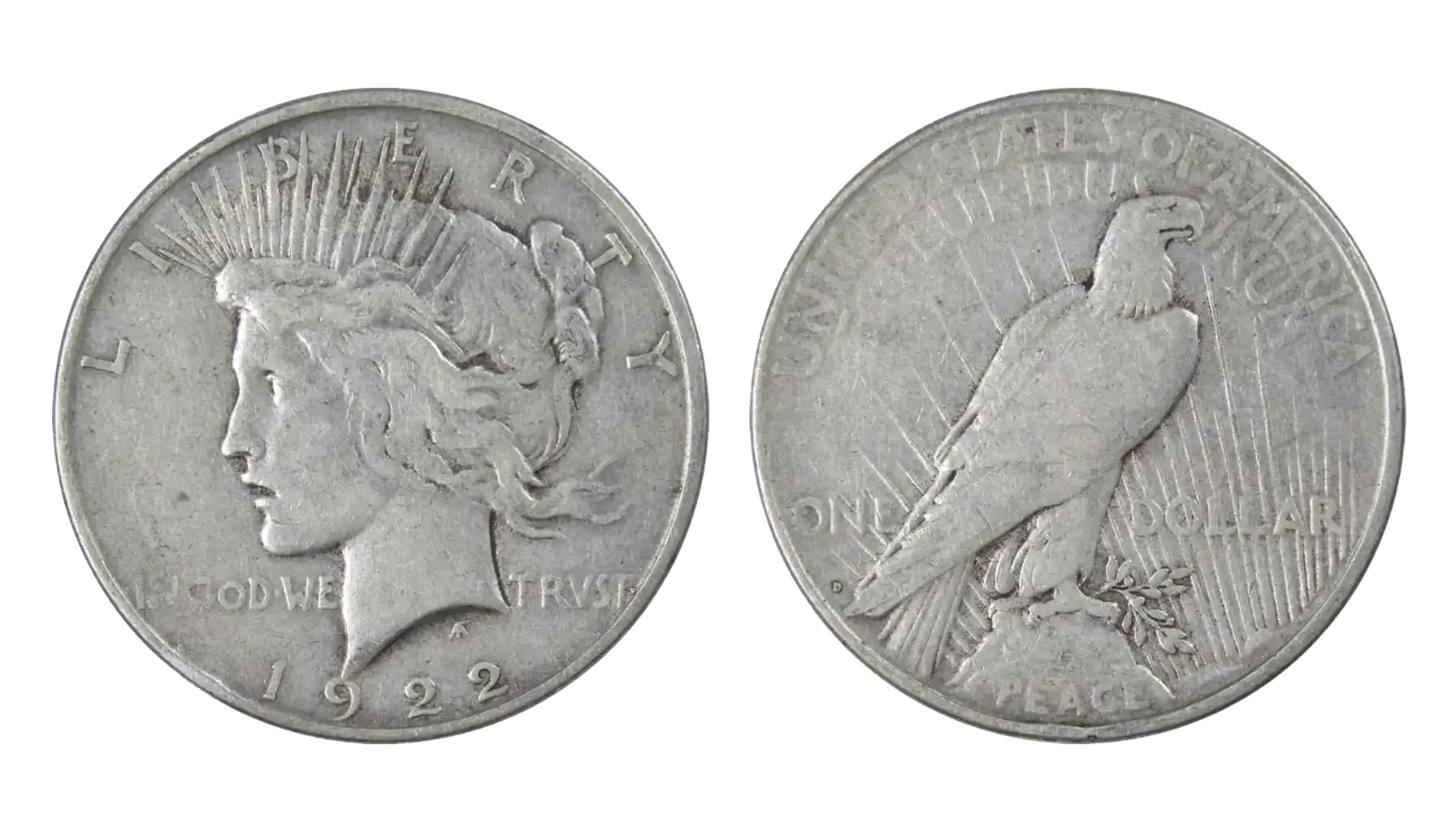
Obverse: A profile of Liberty wearing a radiant crown, along with the inscriptions “LIBERTY” along the top edge, the motto “IN GOD WE TRVST” flanking Liberty’s neck, and the date “1922” at the bottom.
Reverse: A powerful bald eagle perched on a rock, clutching an olive branch, surrounded by the inscriptions “UNITED STATES OF AMERICA”, “E PLURIBUS UNUM”, “ONE DOLLAR”, and the word “PEACE” at the bottom.
“To create Liberty’s portrait, de Francisci asked his wife, Mary Teresa, to pose. As an Italian immigrant, she had been enchanted by the Statue of Liberty as a child. Decades later, her face became the inspiration for Liberty herself on the new Peace Dollar.”
– Unknown Author
APMEX website
The Main Features | |
Relief | High relief and low relief |
Composition | 90% silver, 10% copper |
Weight | 26.73 grams (0.859 troy oz) |
Diameter | 38.1 mm (1.5 inches) |
Thickness | Approximately 2.4 mm |
Edge | Reeded |
3 Quick Facts About the Peace Dollar Design and Latin Influences
The “TRVST” inscription uses a V to mimic ancient Roman stone carvings; it’s not a 1922 Silver Dollar Lady Liberty misprint error.
Liberty’s spiked crown echoes classical depictions of deities and heroes.
The word “PEACE” appears prominently below the memorial, signaling the dollar’s celebratory purpose.
The "TRVST" Mystery: Not a Misspelling
Collectors often mistake the “V” in the Liberty silver dollar 1922 for mint errors. In truth, the Mint chose a classical Latin style to reflect ancient inscriptions. This detail echoes the coin’s theme of peace rooted in classical tradition.
Some sellers inflate prices by citing the 1922-1923 Liberty Silver Dollar TRUST misspelled value as proof of rarity. Standard issues with the “TRVST” legend sell at common Peace Dollar rates. Genuine mint errors like missing mintmarks or doubled dies truly command premiums.
3 Common Misconceptions About ‘TRVST’:
It reflects a modern typo rather than intentional Roman styling.
It signals a flawed die that boosts the 1922 Liberty Silver Dollar value.
It indicates a limited-run experimental issue.
How Rare is the 1922 Peace Dollar?
Error | Liberty Dollar 1922 Value | Description |
Struck-Through Error | $70 | A foreign object, such as cloth or debris, caught between the die and the planchet. |
Obverse Planchet Crack | $110 | A crack on the obverse caused by a defect in the blank before striking. |
Grease-Filled Die Error | $150 | Missing or faint details due to grease buildup clogging the die. |
Rotated Die Alignment | $225 | Misalignment between obverse and reverse designs due to die rotation. |
Curved Clip 8:00 Position | $400 | A crescent-shaped section missing from the edge, typically near 8 o'clock. |
Only true errors make these coins rare and expensive.
How Much Is a 1922 Silver Dollar TRVST Worth Today?
As it is not an error, the price does not change and follows standards. The market value of Liberty silver dollars dated 1922 is shaped mainly by condition, mint origin, and eye appeal rather than design details.
Circulated coins in average condition often sell for $25–$35 at auction. Dealers price worn but collectible examples around $30 in grades like VG8 to EF40. This 1922 Silver Dollar value range reflects steady demand for the classic piece.
For higher-grade pieces, people check the 1922-1924 Liberty Silver Dollar TRUST misspelled value in mint state. Uncirculated coins graded MS60 bring $40–$50. Sharp strikes at MS63 command $60–$75. Top-end MS65 specimens often reach $100–$150, and rare MS67 pieces trade for several hundred dollars.
Collectors examining Liberty-era silver dollars from 1922 often overlook how much strike quality influences long-term desirability.
Grade | Description | Approx. 1922 Lady Liberty Silver Dollar Value |
VG8 | Good, heavy wear | $25 |
EF40 | Light wear, all details | $30 |
AU55 | Trace wear, high luster | $40 |
MS60 | Uncirculated, basic strike | $45 |
MS63 | Choice uncirculated | $65 |
MS65 | Gem uncirculated | $120 |
MS67 | Ultra gem, top quality | $350+ |
Coins from 1922 that feature the unusual TRVST inscription tend to attract attention, but the lettering itself does not create additional value.
Why It Remains Popular
The use of the 1922 Silver Dollar In God We Trvst continues to attract attention because it looks unusual to modern eyes, even though it was intentional. Collectors encountering the coin for the first time often think the lettering is a mistake. That reaction has helped keep the design memorable for more than a century.
Moreover, the Peace Dollar was created to mark the end of World War I and a return to stability. By using classical Roman-style lettering, the design connected modern America with older ideas of permanence, order, and civic trust. The inscription stands out as a conscious artistic decision rather than a routine slogan.
Finally, the consistency of TRVST across all Peace Dollars helps recognize them. Because it appears on every issue, including the In God We Trvst Silver Dollar 1923 coins struck by the United States Mint, it has become a defining feature of the series.
Comparison With Other U.S. Coins Using “V”
While TRVST stands out today, it was not without precedent in American numismatic design. Earlier U.S. medals, commemorative pieces, and inscriptions occasionally borrowed classical Roman lettering, especially in formal or symbolic contexts. The use of “V” in place of “U” was a known artistic convention, though rarely applied to circulating coinage.
What made the Peace Dollar different was visibility. Unlike medals or limited issues, it was produced in large numbers and handled daily by the public. That exposure made the lettering choice far more noticeable—and more controversial—than on earlier pieces.
In later decades, U.S. coin designs moved away from this idea. Typography became more literal and modern. As a result, TRVST remains one of the last prominent examples of Roman-style lettering on a circulated U.S. coin.

 Facebook
  X (Twitter)
  Pinterest
  LinkedIn