Contents:
AU notes might not be the oldest in the world, but no less valuable, by any means. The Australian $100 note is one of the more valuable denominations in the country.
Introduction
You can find all kinds of dollars in Australia: 1 dollar note, 50 dollar note, and the biggest of them all, the 100 dollar note.
How did this banknote appear, and how does it look? About that and more, we will learn today.
The Origin of the Australian 100 Dollar Note
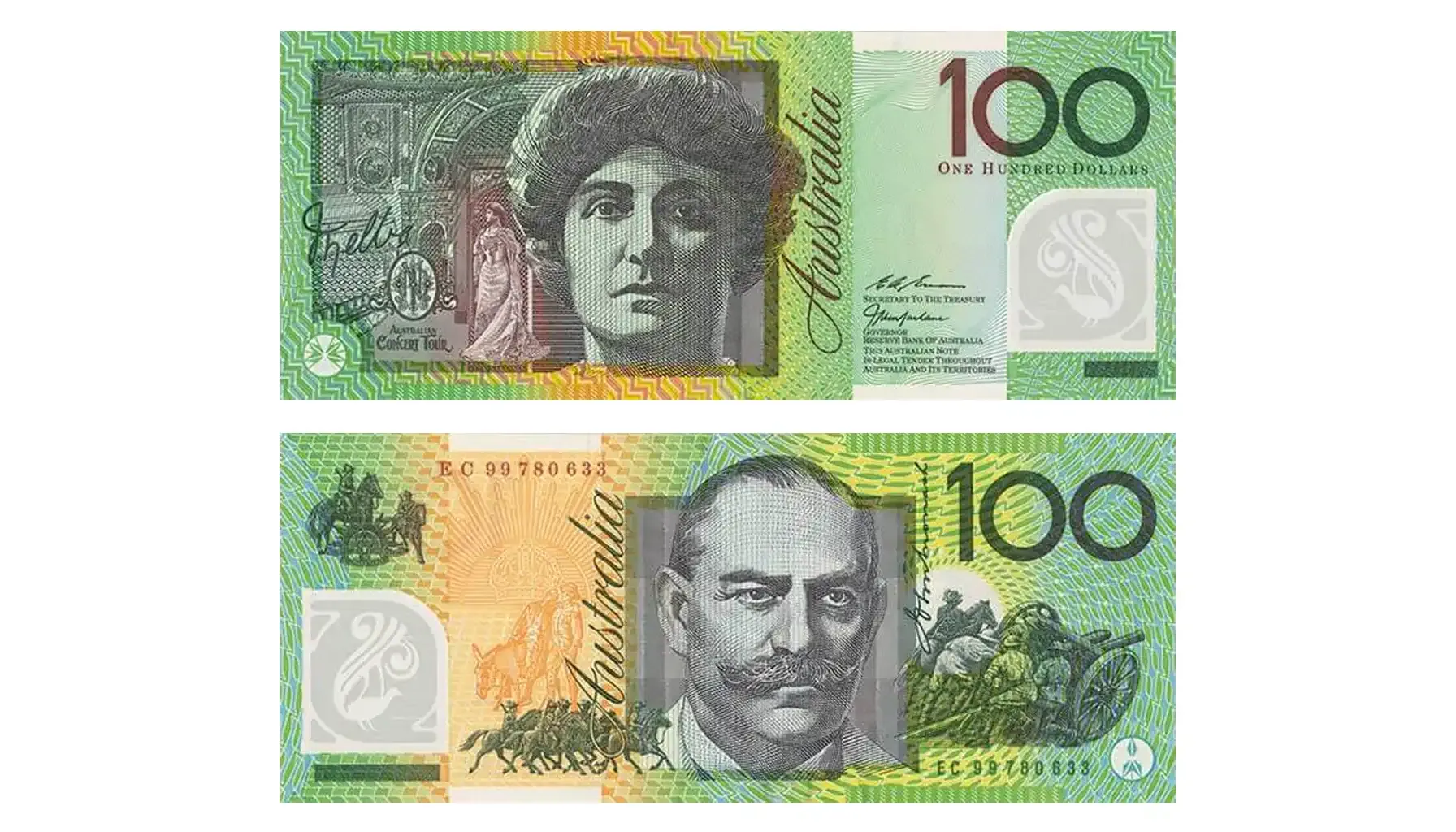
$100 note Australia was first introduced in 1984. It was the year when the country's paper currency series was officially “completed” by the Reserve Bank of Australia (RBA).
You see, dollars came in one by one, in different years, and the 100 banknote was the last:
1966: The $1, $2, $10, and $20 notes were issued.
1967: The $5 note was issued.
1973: The $50 was issued.
1984: The $100 was issued.
By 1984, a new dollar set completely overtook the old imperial pound system in Australia.
Today, the bill features two important Australian figures as part of its design. Both purposefully feature different worlds: art and military.
Dame Nellie Melba, the world-renowned opera singer, is on the front.
Sir John Monash, an engineer, soldier, and civil leader, is on the back.
Security Features of the New 100 Dollar Note

Security features have always been evolving on coinage.
The new-generation $100 note was released in 2019. This new version was a part of the Next Generation Banknote (NGB) program. The program aims to improve security while keeping the banknotes recognizable.
The new edition had many security features:
Top-to-bottom window: A transparent strip is running vertically through the note, containing multiple dynamic elements. You should see a flying bird and reversing numbers that change direction when tilted.
3D holographic elements: The note features rolling colour effects and shifting patterns visible when the note is moved under light.
Tactile feature: Raised bumps near the long edges help visually impaired Australians identify the denomination by touch.
Microprint and fine line patterns: Excerpts from Melba's autobiography, Melodies and Memories, are in microprint form (front). These intricate details are difficult to see and reproduce accurately, even with modern printing technology.
Fluorescent ink and UV features: These hidden elements glow under ultraviolet light.
Together, these features make the $100 note one of the most secure and technologically advanced banknotes in the world. Other Australian notes, the 10 dollar note, got similar security.
The Role of the $100 Note in Australian Currency
The one-hundred-dollar note plays a unique role in Australia’s coinage system. Being the biggest denomination there, the banknote is not for daily transactions. It is a job for smaller denominations. No, this banknote is a store of value. Investors and enthusiasts prefer it for savings, gifts, and large cash payments.
According to the Reserve Bank of Australia, the number of $100 notes in circulation has steadily increased over time. Perhaps it is a sign of their popularity. During periods of economic uncertainty or financial stress (the global financial crisis or the COVID-19 pandemic), such banknotes are in high demand.
The one hundred dollar note is popular with numismatists and is the most widely circulated Australian denomination. Its high face value and distinctive look give it a unique appeal. Particularly if they have an interesting serial number.
Collecting and Valuing the $100 Australian Note
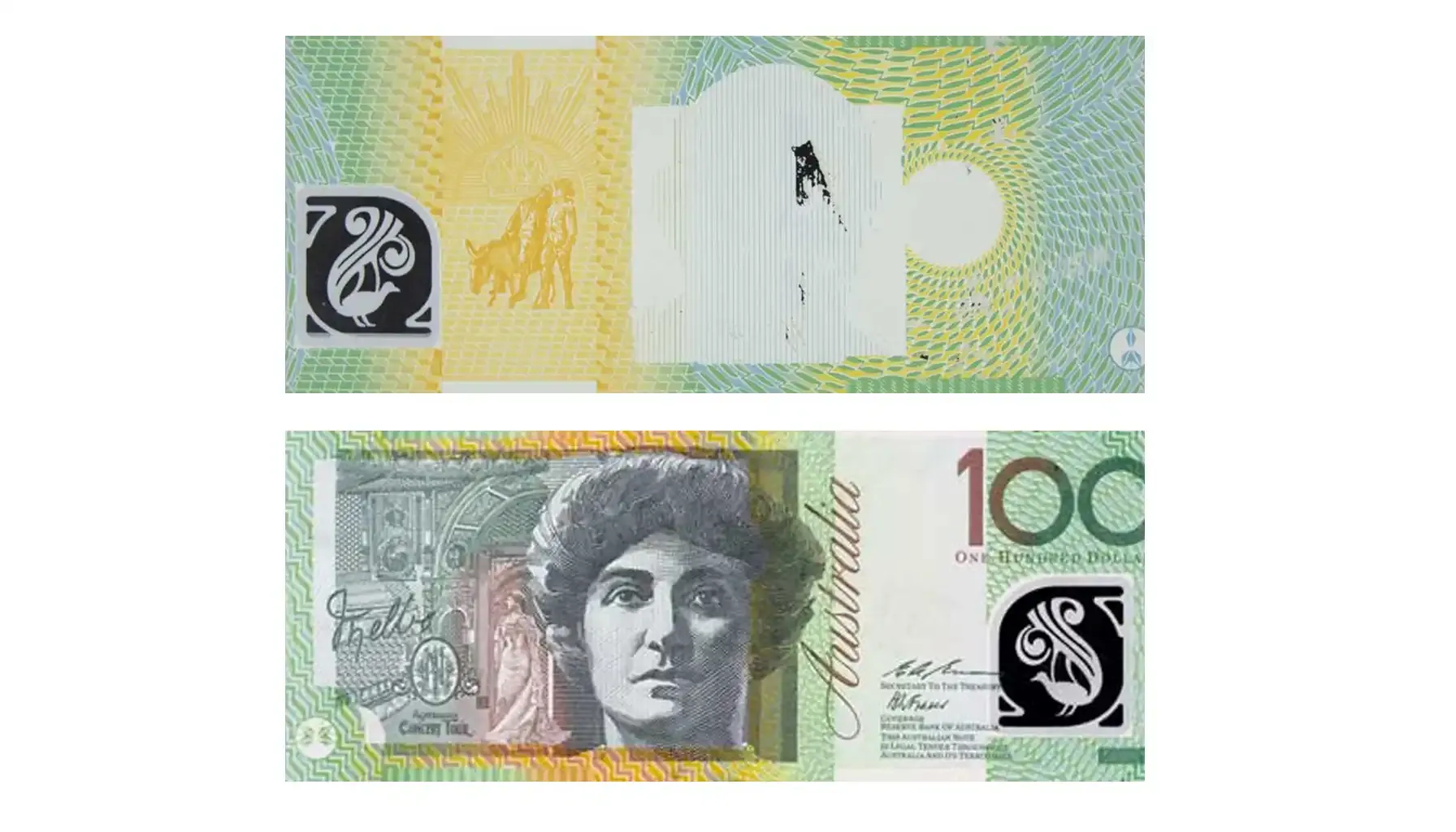
For numismatists and casual collectors, the Australian one-hundred-dollar note is a point of interest. Its high denomination and unique design make it highly collectible. Especially if they have an interesting serial number.
Collectors often look for:
First and last prefixes in a print.
Uncirculated condition (crisp, mint-quality dollars).
Commemorative or misprinted editions.
Older paper notes (1984–1996 series) have become increasingly rare.
The value of a collectible $100 can range from a slight premium over face value for common uncirculated examples to hundreds or even thousands of dollars for rare serial numbers or historical issues.
Here are the best sellers:
№ | Date (Auction) | Item (full name) | Price (AUD) | Value Factors |
1 | March 2014, Noble | ONE HUNDRED DOLLARS (Macfarlane/Evans 1998) missing simultaneous printing phase (unc.) | $2,100 | This specimen was missing the printing phase on the back. A valuable error. |
2 | July 2016, Noble | Polymer simultaneous colour trial of ONE HUNDRED DOLLARS (c.1996) — uncirculated trial | $1,800 | Some banknotes were used for colour-trial, to see how the ink would fit with the design. These “test subjects” are very scarce. |
3 | November 2010, Noble | Mixed album including one hundred dollar polymer issues — album lot | $1,400 | A multi-note collection lot including $100. Sold for a high value due to quantity and a nice package. |
4 | April 2016, Noble | ONE HUNDRED DOLLARS (Fraser/Higgins 1990) — uncirculated | $440–760 (appeared on various lots) | A class of most banknotes in excellent condition. |
5 | November 2015, Noble | Uncut pair of $100 (Fraser/Cole 1995) — collector folder | $320 | Newer dollars are polymers, and they need to be cut. Someone “forgot” to cut fused dollars, making them a point of interest. |

 Facebook
  X (Twitter)
  Pinterest
  LinkedIn