Contents:
James Buchanan was the 15th president of the United States, in office from 1857 to 1861. Before the presidency, he served in Congress, worked as Secretary of State, and held diplomatic posts in Russia and Great Britain.
During his term, tensions over slavery and state secession escalated. Buchanan supported the Dred Scott decision and took no effective action as Southern states began to leave the Union. He left office just before the Civil War, with the country divided and unstable.
However, he is a part of our history. That is why he is on a dollar coin. Let us know more about it in this coin identifying guide.
James Buchanan Dollar Coin (1857 to 1861) on U.S. Coins
Buchanan never appeared on U.S. coins during his lifetime. In the 19th century, American coinage used Liberty designs, not portraits of real people. His dollar was created much later, under modern rules that allow only deceased presidents to be included in the series.
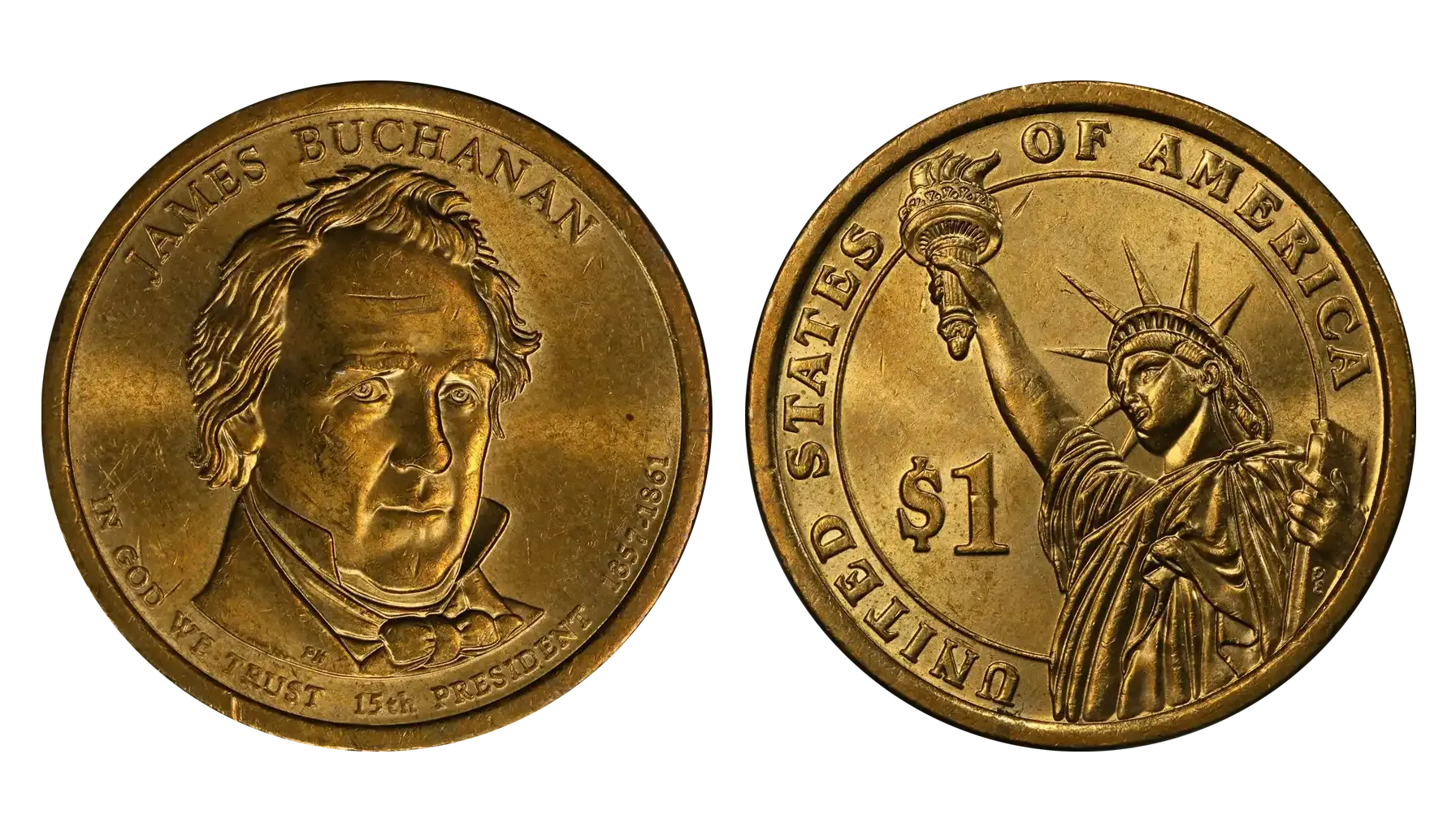
The dollar coin James Buchanan was issued in 2010 as part of the Presidential $1 Program, which honors former U.S. presidents in the order they served.
The obverse shows a straightforward portrait of Buchanan, along with his name, presidential number, and term dates. The reverse follows the standard design used across the program: the Statue of Liberty and the $1 denomination. Inscriptions, including the year 2010, the mint mark (P, D, or S), and E Pluribus Unum, appear on the edge.
Coins were struck at:
Philadelphia (P) and Denver (D) for circulation-quality collector issues
San Francisco (S) for proofs
The James Buchanan dollar coin 1857-1861 is rather common. Most examples sell near face value. Interest usually comes from collectors completing a full Presidential dollar set or from specialists looking for high-grade pieces or edge-lettering errors.
Specifications
President | James Buchanan |
Presidential term | 1857–1861 |
Program | Presidential $1 Coin Program |
Year issued | 2010 |
Denomination | $1 (One Dollar) |
Composition | Manganese-brass clad (copper core) |
Weight | 8.1 g |
Diameter | 26.5 mm |
Edge | Plain with incused lettering |
Edge inscriptions | 2010, mint mark, E Pluribus Unum |
Mint marks | P (Philadelphia), D (Denver), S (San Francisco – proof) |
Finish types | Business strike (P, D), Proof (S) |
Coin Current Market Value
Most Philadelphia (P) and Denver (D) business strikes trade close to face James Buchanan 1 dollar coin value. Circulated examples typically sell for $1.10–$1.50, mainly as set fillers. Clean uncirculated pieces are more common on the market and usually change hands for $2–$4.
Certified specimens show clearer price separation. According to PCGS and NGC market records, examples graded MS65 regularly sell in the $8–$15 range. Higher grades become harder to find. MS66 pieces often bring $20–$40, while MS67 coins have recorded sales between $60 and $120, depending on eye appeal and timing. Top-population grades such as MS68 or MS69 appear infrequently and have reached $150+ in individual transactions, usually through online auctions.
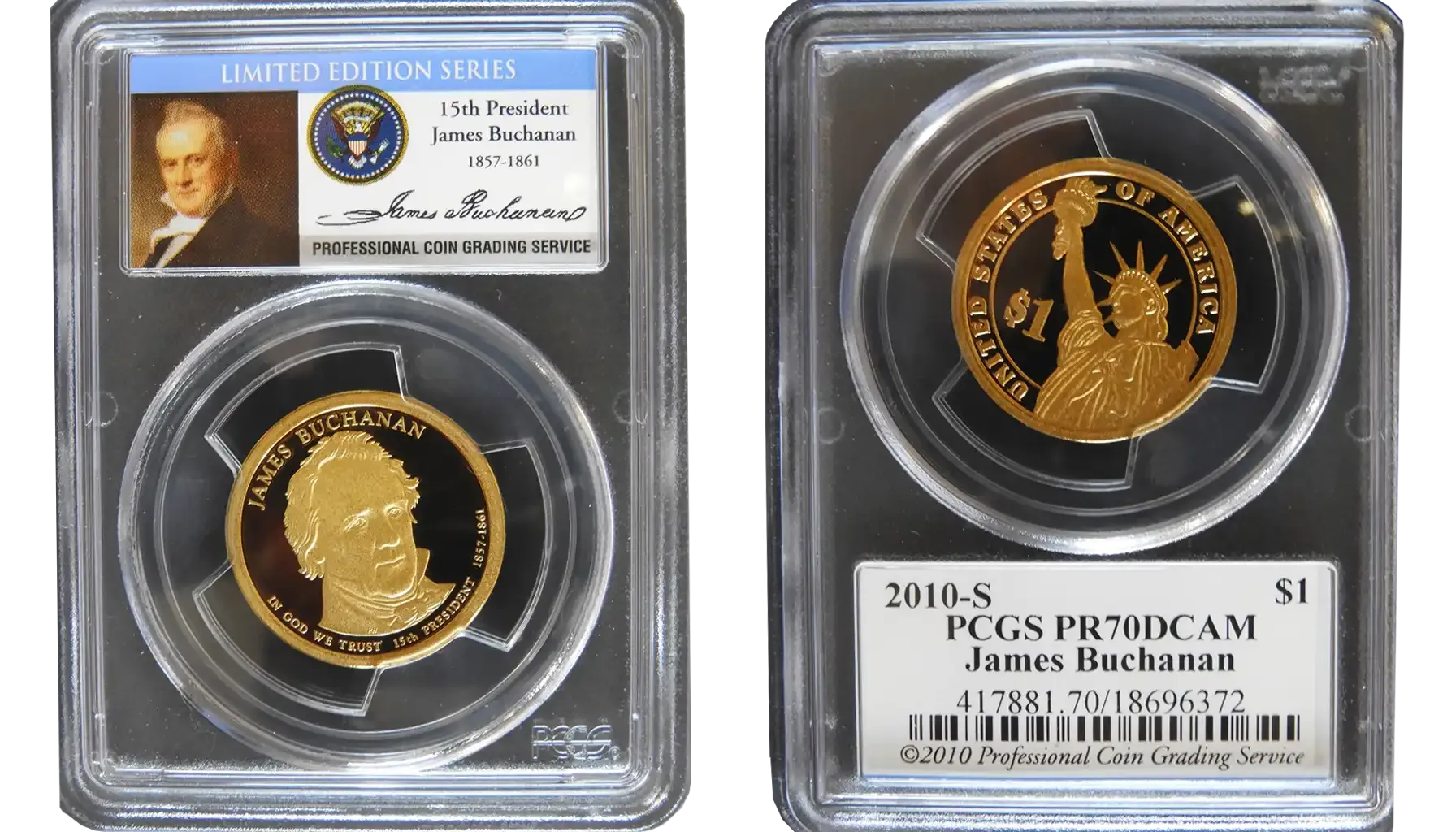
The 2010-S proof version of the James Buchanan dollar coin 1857 to 1861 from the San Francisco Mint is common. Standard proofs typically sell for $5–$8. Certified PR69 examples trade around $10–$15, while PR70 DCAM proofs have sold for $18–$25, mostly between 2022 and 2024.
Collectors also watch for edge-lettering errors, especially missing or weak inscriptions. Verified errors have sold anywhere from $40 to over $150, depending on clarity and third-party attribution.
How Much Is a James Buchanan Dollar Coin Worth?
Type | Value |
Circulated (P/D) | $1.10 – $1.50 |
Uncirculated (BU) | $2 – $4 |
Graded MS65 | $8 – $15 |
Graded MS66 | $20 – $40 |
Graded MS67 | $60 – $120 |
Graded MS68–MS69 | $150+ |
2010-S Proof | $5 – $8 |
Proof PR69 | $10 – $15 |
Proof PR70 DCAM | $18 – $25 |
Edge error | $40 – $150+ |
James Buchanan Dollar Coin Errors and Varieties
Edge-Lettering Errors
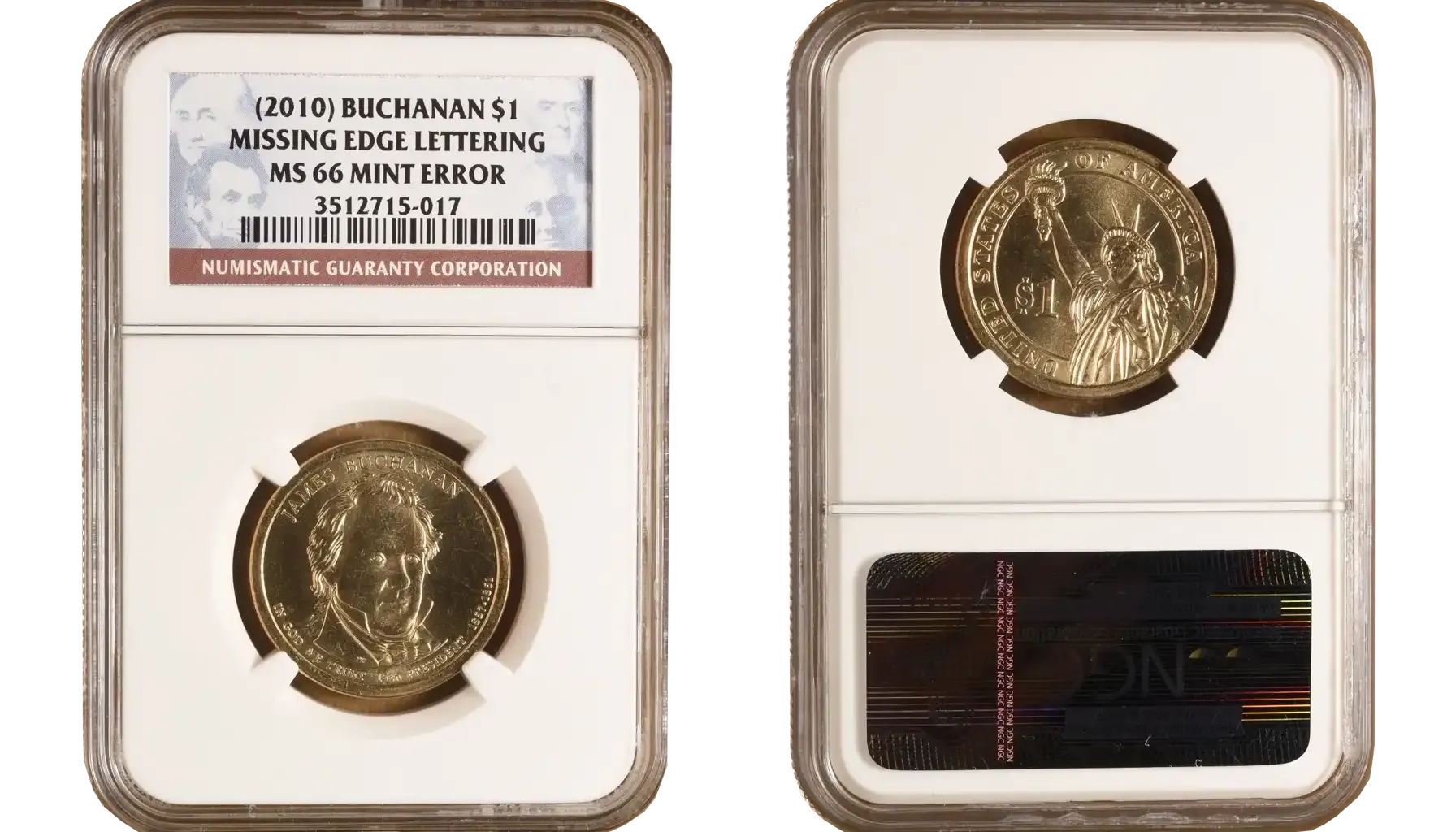
Presidential dollars feature incused edge lettering that includes the year (2010), mint mark (P, D, or S), and E Pluribus Unum. On some pieces, parts of this edge lettering may be weak, partially punched, doubled, or entirely missing. These errors are the most commonly reported for Buchanan dollars and are usually identified by careful inspection of the edge under magnification.
Note: The James Buchanan dollar coin no date or no mint on the edge is a real mint error, but it is not a missing obverse date. If all of that edge lettering is absent, the result is a mint error variety.
Specimens with missing edge lettering often sell at a noticeable premium over standard strikes because they are genuine production errors and relatively uncommon.
“Missing edge lettering became possible with the introduction of the Presidential dollar series in 2007 and the beginning of the Native American reverse series on the Sacagawea dollar in 2009.”
— Ken Potter, author
Numismatic News
Off-Center Strikes
Occasionally, a piece will be struck slightly off center, shifting the design toward one side. The James Buchanan dollar coin value of an off-center error depends on how far off center the strike is; minor off-centers may be worth only slightly more than face value. More dramatic examples can be more expensive.
Broadstrikes and Die Defects
Broadstrikes — where the collar fails and the coin spreads outward — are less common but sought by error collectors. Minor die cracks, die chips, or cud marks can also occur. These small defects often carry modest premiums to the James Buchanan dollar coin error value, depending on their prominence and impact on the appearance.
Mint-Specific Varieties
Collectors sometimes distinguish between Position A and Position B edge lettering varieties in Presidential dollars, based on the sequence of lettering relative to the portrait. While not always impacting value, well-documented position differences can attract specialist interest.
Proof Variations
Proofs from the San Francisco Mint (2010-S) occasionally show deep cameo (DCAM) contrast, where frosted devices contrast strongly with mirror-like fields. These finish variations are not errors but are collectible sub-types that can command higher prices than standard proofs.
Gold Dollar Versions of a Coin
There is no official gold version of the James Buchanan one dollar coin issued by the U.S. Mint.
The Buchanan dollar belongs to the Presidential $1 Program, where all money pieces share the same manganese-brass–clad composition. The program never included gold strikes for any president. As a result, no circulating, proof, or commemorative gold coin featuring James Buchanan exists in official U.S. coinage.
What Do Claims Offer?
What does exist are private or aftermarket pieces:
Gold-plated James Buchanan dollars
Gold-colored novelty strikes
Medals or tokens sold outside the U.S. Mint
These items have no numismatic James Buchanan gold dollar coin value. Any premium is based on appearance or marketing, not metal content. Most are plated with a microscopic layer of gold and contain no measurable bullion weight.
If a piece is described as a gold James Buchanan dollar, it is not an official Mint issue and should be evaluated as a novelty or altered coin, not as a precious-metal collectible.

 Facebook
  X (Twitter)
  Pinterest
  LinkedIn