Contents:
Enthusiasts of various levels have already discussed the future design of the half dollar 2026. The US Mint always plans new launches for upcoming years. This issue is a mix of growing public expectation and American tradition.
This guide will look at the issue from different angles and help the professional community figure it out and come to a consensus. Do not forget, any numismatist should know special tips and apps for rational collecting.
Overview of the 2026 US Half Dollar
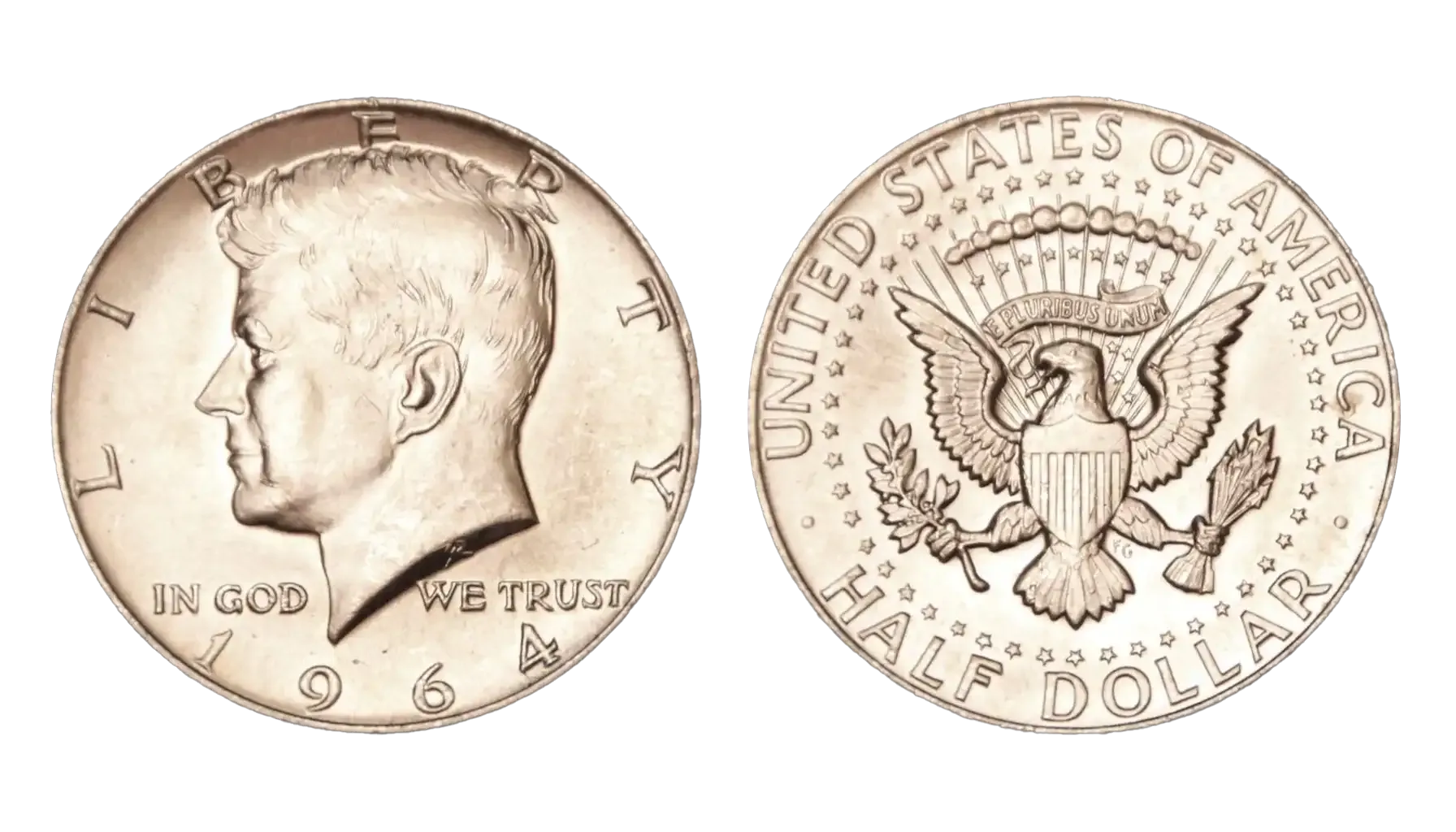
It is mostly possible that the 2026 gem will continue the more than 60-year Kennedy series. Today, the Mint has not released the final design and specifications, but there are expectations.
Federal law still supports the Kennedy portrait on the obverse and reverse – the presidential seal of the United States. The denomination continues to hold legal tender status, maintaining its face value of fifty cents.
Industry observers anticipate that future production will likely mirror the limited circulation approach adopted after 2002. Market data suggests that mint sets and rolls will remain the primary sources for acquiring these specimens.
Major Possible Characteristics
Look at these characteristics, you can see a clear evolution of the gems. From diameter to weight, from thickness to silver content or lack thereof.
Period | 1964–present |
Designer | Gilroy Roberts / Frank Gasparro |
Diameter | 30.6 mm |
Thickness | 2.15 mm |
Weight | 11.34 g |
Edge | Reeded |
Composition | Copper / Nickel |
Note: The composition of the 2002 quarters reminds one of early versions of Kennedy half items, for example, the 1967 silver era half dollar.
The Evolution of Item Features
1964: weight – 12.5 g, composition – silver / copper (90 % / 10 %)
1965–1970: weight – 11.50 g, composition – copper / silver (the second one always in the smallest proportion)
1971–present: weight – 11.34 g, composition – copper / nickel (75 % / 25 %)
2026 Kennedy Half Dollar Design
Since the first launch, the design can be divided into three eras: the original Kennedy, the bicentennial, and the return to classic. A comprehensive exposition of each stage follows below.
The Original Kennedy
In 1964, the design should match the memorial theme; therefore, obverse with Kennedy portrait, reverse – the presidential seal of the U.S. Notably, Mrs. Jacqueline Kennedy asked to simplify the hair, and the first proofs called the Accented Hair.
Note: The Accented Hair coin establishes the record of $46,800 on the Heritage Auctions in 2024.
The Bicentennial
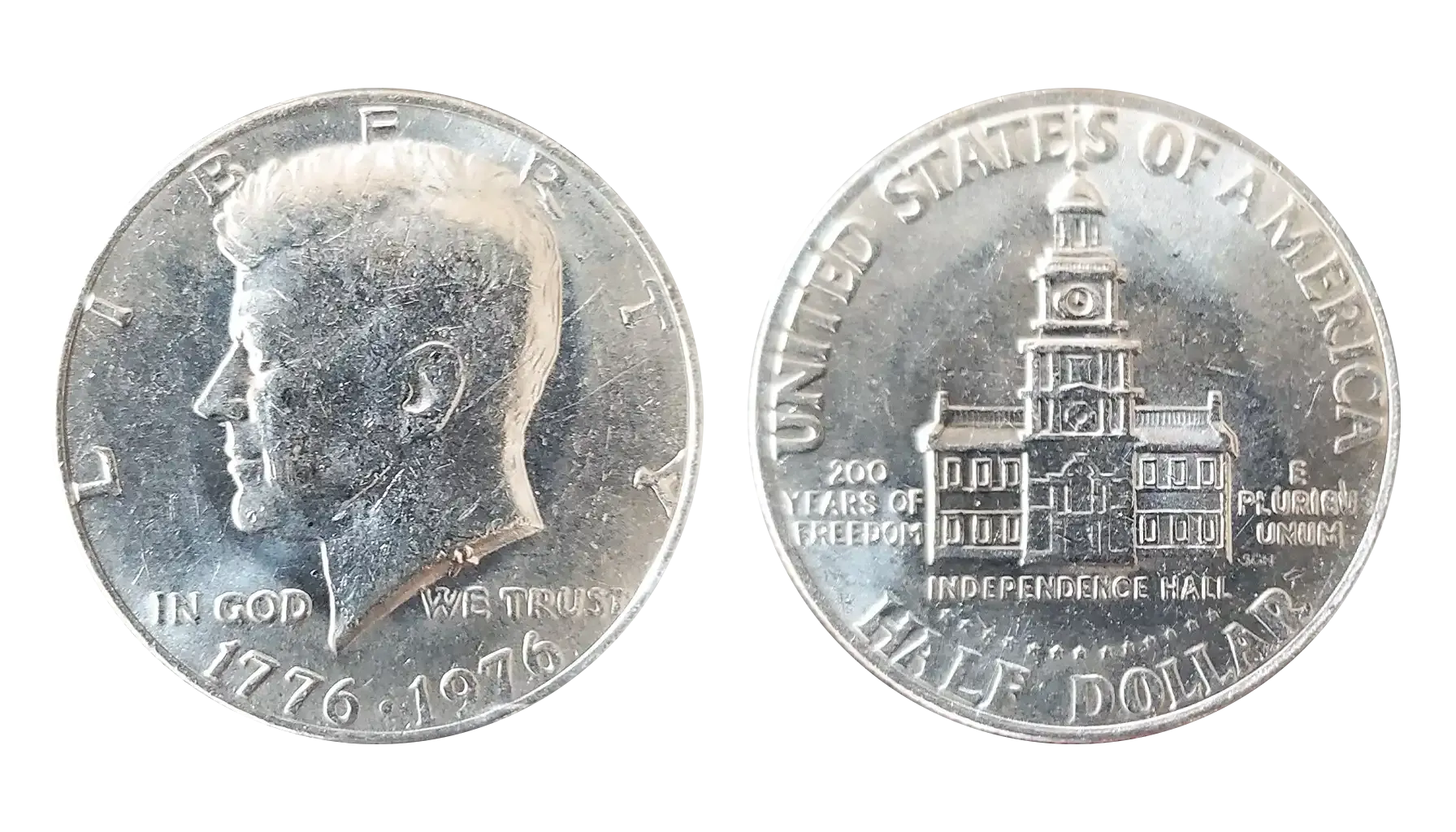
In 1975–1976, to celebrate 200 years of American Independence, the Mint held a national competition for a new reverse design. The reverse shows Independence Hall in Philadelphia, designed by Seth G. Huntington.
These coins featured the dual date 1776–1976. No half items were dated 1975; all produced in those two years bore the dual date.
The Return to Classic
After the Bicentennial, the coin reverted to the original Gilroy Roberts obverse and Frank Gasparro reverse.
In 2002, the United States Mint discontinued general circulation production of half‑dollar coins owing to persistently low demand, restricting their distribution to collector bags and rolls. However, the Mint reinstated general circulation striking of the denomination in 2021.
Possible 2026 Half Dollar Design Changes
The Kennedy half dollar 2026 design, in the beginning, has two possible theories. The first one contains the idea to continue the 2025 item. The second one is a redesign for a strong American symbol – the Liberty.
Through a recently released formal statement, the United States Mint established clear parameters regarding the matter. For the 250th anniversary celebration, the U.S. Mint will launch dimes, half dollars, nickels, and quarters.
"The designs on these historic coins depict the story of America’s journey toward a ‘more perfect union,’ and celebrate America’s defining ideals of liberty.”
– Kristie McNally, U.S. Mint Deputy Director
United States Mint
What Will the 2026 Half Dollar Look Like
The U.S. Mint Deputy Director Kristie McNally says that the United States Mint hopes to offer each American the opportunity to hold our nation’s storied 250 years of history in the palms of their hands as we Connect America through Coins.
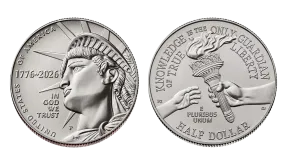
The 2026 half dollar coin will change the obverse and reverse this year. The principal possible features are in the table below.
Obverse | Liberty |
Reverse | Liberty and the Younger Generation |
Inscriptions | Knowledge is the only guardian of true Liberty |
Privy Mark | Liberty Bell privy mark with the number 250 |
On the obverse, a close-up, forward-facing view of the Statue of Liberty with a steadfast gaze toward the future. It features the dual date 1776 ~ 2026.
On the reverse, a scene with Liberty passing her torch to a younger generation, which symbolizes the transition of knowledge and freedom.
Collecting the 2026 Half Dollar
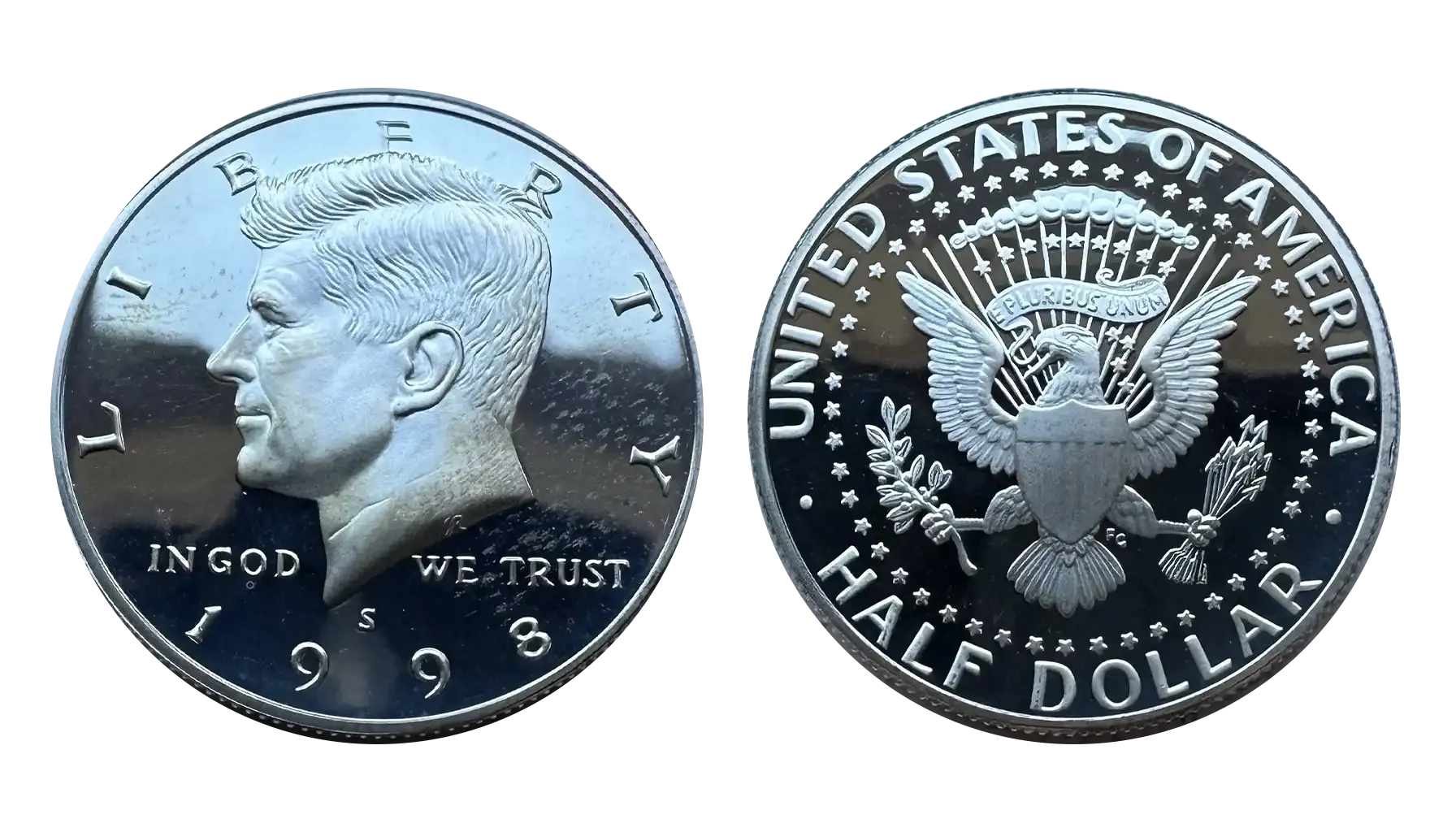
The anticipated acquisition strategy among collectors involves procurement through rolls, mint sets, and proof editions. Early market entry typically secures specimens exhibiting higher condition quality.
The 2026 half dollar designs will influence demand within modern collections. Market analysis reveals that future circulation strikes will enter the market at prices closely aligned with face value.
Meanwhile, proof coins and those featuring special finishes are expected to command notably higher premiums among collectors.
Top Valuable Kennedy Items
The half dollar 2026 average price depends on the year, but the cost spectrum ranges from $5 to $50. Of course, the action records have skyrocketing dollars and reaches thousand USD.
Item | Error | Auction Record |
1964-D | Regular Strike | $57,600 |
1972-D | Missing Designer Initials (FG) | $1,000+ |
1980-P | Overstrike | $22,325 |
1998-S | Matte Finish | $100–$500 |

 Facebook
  X (Twitter)
  Pinterest
  LinkedIn