Contents:
- The Historical Context of the 1967 Kennedy Half Dollar
- Design and Key Features of the 1967 Half Dollar
- Understanding the 1967 Kennedy Half Dollar Silver Content
- What Determines the 1967 Half Dollar Coin Value?
- 1967 Half Dollar Value Chart: A Detailed Price Breakdown
- The Special Mint Set of the Most Valuable 1967 Half Dollars
If coins could talk, the 1967 Kennedy Half Dollar would tell the stories of the time of revolution of both cultural and compositional meanings that had made up America’s money long ago.
The era of base metals in coinage was approaching, as long as silver was fading away. 1967 was one of the last years when numismatic creations adhered to the classic standards which were yet to change soon.
Why do collectors consider the 1967 silver half dollars special? What does it look like? How to check coin value and decide if it is a worthy addition to your collection or not?
Review the fate of these silver coins and learn more about their collector’s potential in our material.
The Historical Context of the 1967 Kennedy Half Dollar
Making the 1967 half dollar connects directly to big changes in the US money system caused by a lack of precious metals in the mid-1960s.
The Coinage Act of 1965 became the main legal document setting the rules for making these coins, as this law stopped using silver for 10 and 25 cent coins, choosing a mix of copper and nickel instead.
Lawmakers chose a middle path for the 50 cent coin, dropping the silver amount from 90% to 40%.
The total 1967 mintage for regular coins became the second largest for the 40% silver Kennedy series: it varies a lot from the later series, like, for example, the 1972 Half Dollar.
By the early '70s, the 1967 Kennedy Half Dollar value was so high it practically begged people to melt it down for a quick profit.
1948-1964 (90% Silver) → 1965-1970 (40% Silver Clad) → 1971-Present (Copper-Nickel Clad)
Design and Key Features of the 1967 Half Dollar
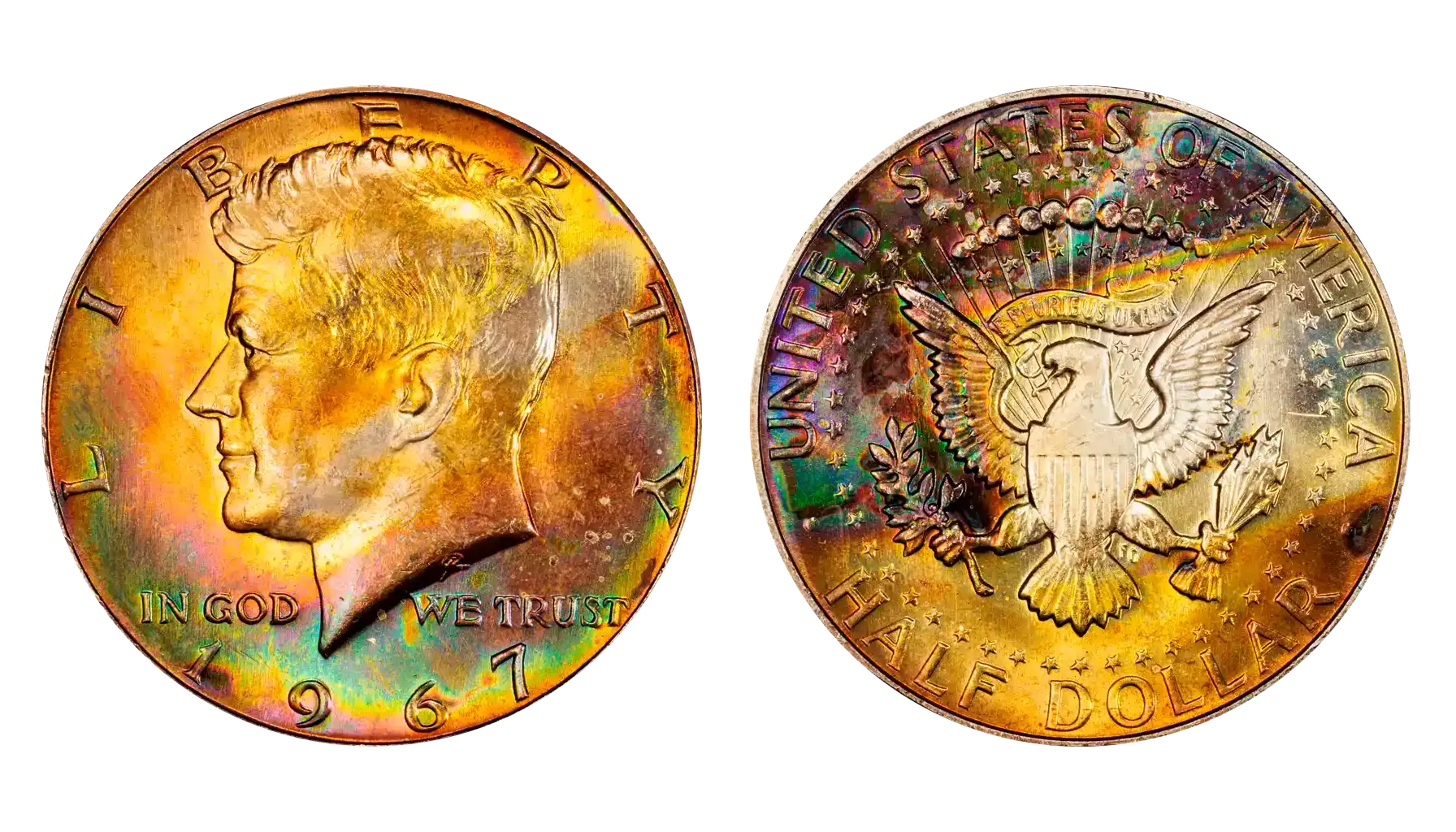
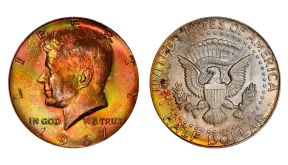
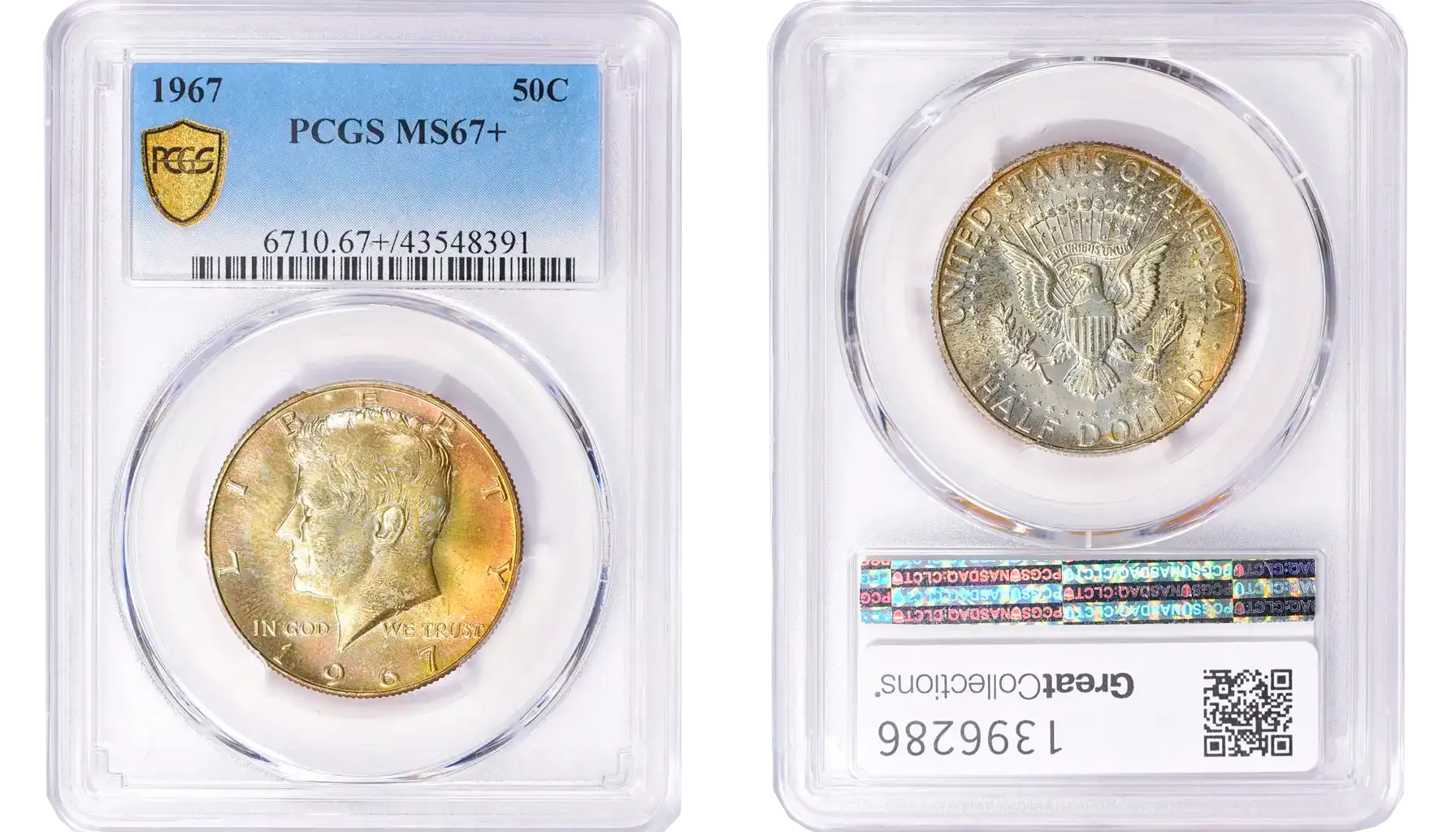
The visual appearance of the 1967 Kennedy coin doesn't just copy the 64 original — it forces high-art standards into a mass-produced relic.
Gilroy Roberts leveraged his classical training to carve a portrait that actually commands respect, placing a sharp, unapologetic profile of JFK looking left.
The LIBERTY text doesn't just sit there; it cuts across the top edge, with the upper hair strands boldly overlapping the letters to give the design some real depth.
IN GOD WE TRUST sits dead-center above the date, exactly where the Mint’s heavy hitters demanded it.
On the reverse, Frank Gasparro didn't play it safe, basing the design on the official Presidential Seal, featuring an eagle clutching both an olive branch and arrows, ready for peace or a fight.
Surrounding that bird, 50 stars form a perfect, relentless circle for every American state.
Even the edges don't quit; those 150 vertical reeds aren't just for show—they let you identify this beast by touch alone.
Note: Where is the mint mark on a 1967 Kennedy Half Dollar? The instances minted in 1967 do not have mint marks at all.
The Main Characteristics of the 1967 50C Issue | |
Composition | 40% silver, 60% copper (=outer layer of 80% silver, 20% copper clad to the core of 79% copper, 21% silver) |
Silver Content | 0.1479 troy ounces |
Weight | 11.50 grams |
Diameter | 30.61 mm |
Thickness | 2.15 mm |
Edge | Reeded |
Mint Marks | None |
Mint Types | Regular Circulation & Special Mint Sets (SMS)* |
*The US Mint released Special Mint Sets with a smoother, satin-like finish instead of conventional Proof coins. These were not as detailed as genuine Proof coins, but the higher quality was still guaranteed.
Understanding the 1967 Kennedy Half Dollar Silver Content
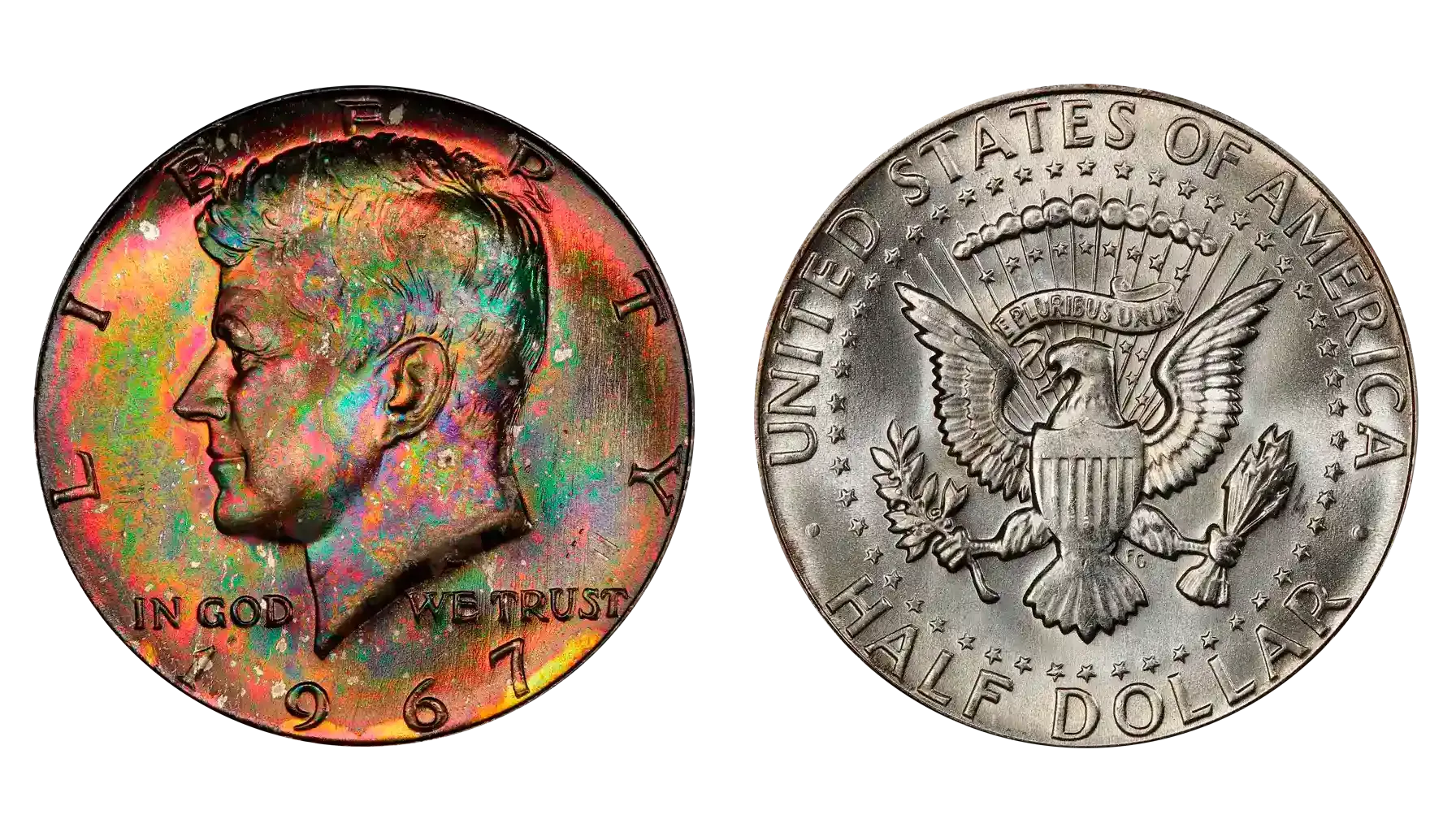
At first, this iteration contained 90% silver. This was the reason why it was more of a collectible rather than a circulating coin from the very beginning.
“The introduction of the Kennedy Half Dollar coincided with a rise in the price of silver, which led the U.S. Mint to cease issuing 90 percent silver dimes, quarters, and half dollars beyond those dated 1964 (some of which were struck in 1965 and maybe even in 1966).”
— Patrick A. Heller, recipient of the American Numismatic Association 2018 Glenn Smedley Memorial Service Award
Numismatic News
However, such an order of things was not favored by the government because of fraudulent activity and the rising silver rates.
By 1967, the half dollar contained only 40% silver-one of the last US coins to do so.
What Determines the 1967 Half Dollar Coin Value?
How much is a 1967 half dollar worth? A Kennedy Half Dollar 1967 price depends on physical features, minting conditions, and expert-verified state.
The US Mint didn't use mint marks this year, producing all coins in Philadelphia.
Metal content includes 40% silver and 60% copper, ensuring a basic melt 1967 silver half dollar value tied to silver market rates.
Circulation vs Special Mint Set (SMS)
Standard Proof sets weren't made in 1967.
Instead, the Mint produced Special Mint Sets (SMS) showing better strike quality compared to business strikes.
Feature | Circulation Strike | Special Mint Set (SMS) |
Mintage | 295,046,978 | 1,863,344 |
Surface Quality | Satin, potential marks | Mirror-like, no handling marks |
Investment Value | Low (mostly metal price) | High at grade MS67 and above |
SMS examples, possessing superior preservation, get higher scores from grading services more often.
Condition and Grade
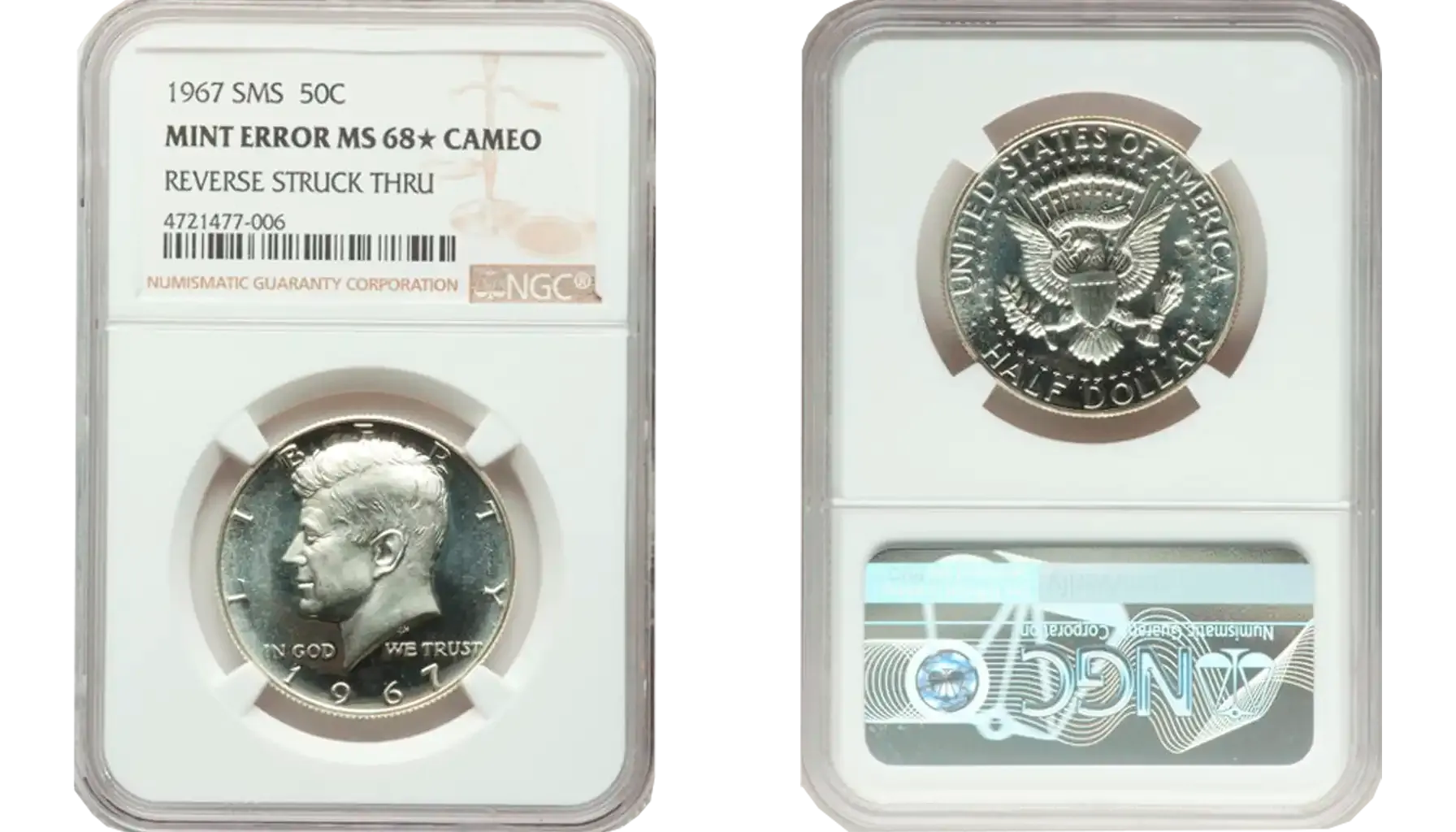
The value of 1967 Kennedy Half Dollar rises sharply, reaching the top of the Sheldon scale (1 to 70).
Coins below MS63 usually sell for their silver weight.
Auction sale statistics show the following trends:
MS63-MS64: $10-$25
MS65: $30-$50
MS66: $100-$200
MS67: What makes a 1967 Kennedy Half Dollar rare? There's a rare category costing from $500 to $1,500.
Record Sale: In 2019, one 1967 SMS graded SP69 by PCGS sold for $16,450.
Annual price changes for high-grade coins (MS67+) average 5-8%, but lower grades follow silver charts, showing up to 15% volatility.
CAM and DCAM Designations
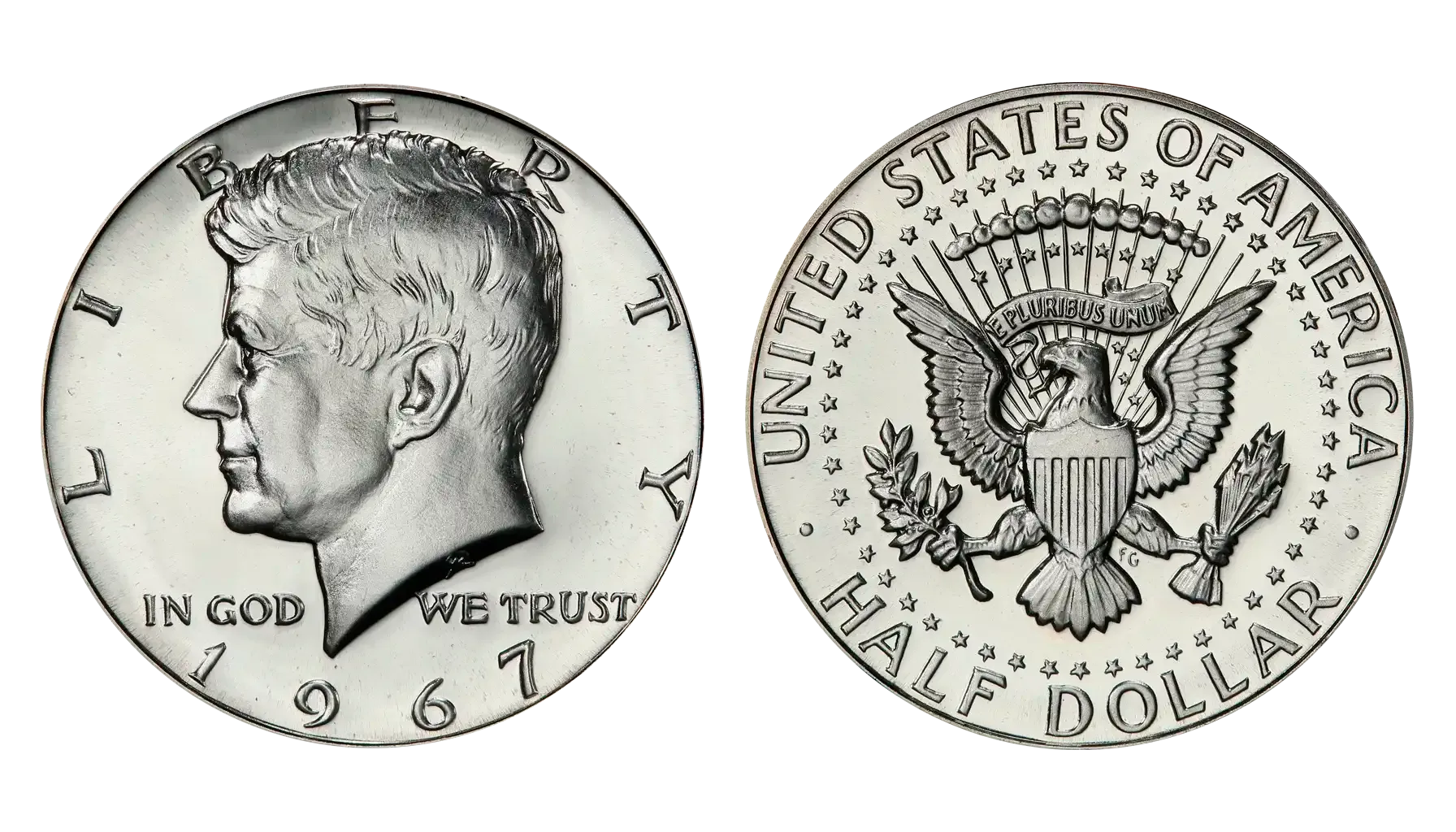
Experts checking SMS coins look for contrast between the shiny field and frosted design.
Cameo (CAM): Clear contrast, increasing the base coin 1967 Kennedy Half Dollar silver value by 50-100%.
Deep Cameo (DCAM): Extremely sharp contrast appearing very rarely for the 1967 issue.
DCAM-marked coins represent less than 0.1% of the total SMS mintage.
How much is a 1967 Kennedy Half Dollar worth? Having a DCAM status in grade SP68 can push the price to $4,000 or more, beating standard coins of the same grade by dozens of times.
Errors and Varieties
Minting mistakes confirmed by numismatic guides create extra 1967 half dollar value today.
Double Die Obverse (DDO): Doubled front elements like letters or the profile.
Missing Clad Layer: One alloy layer being gone, showing the copper center.
- Off-Center Strike: Image displacement from the blank's center.
1967 Half Dollar Error Price Indicators: Examples showing significant shifts (over 10%) sell for $150-$400.
Major DDO varieties in high condition add $200 to $600 to the coin's price.
1967 Half Dollar Value Chart: A Detailed Price Breakdown
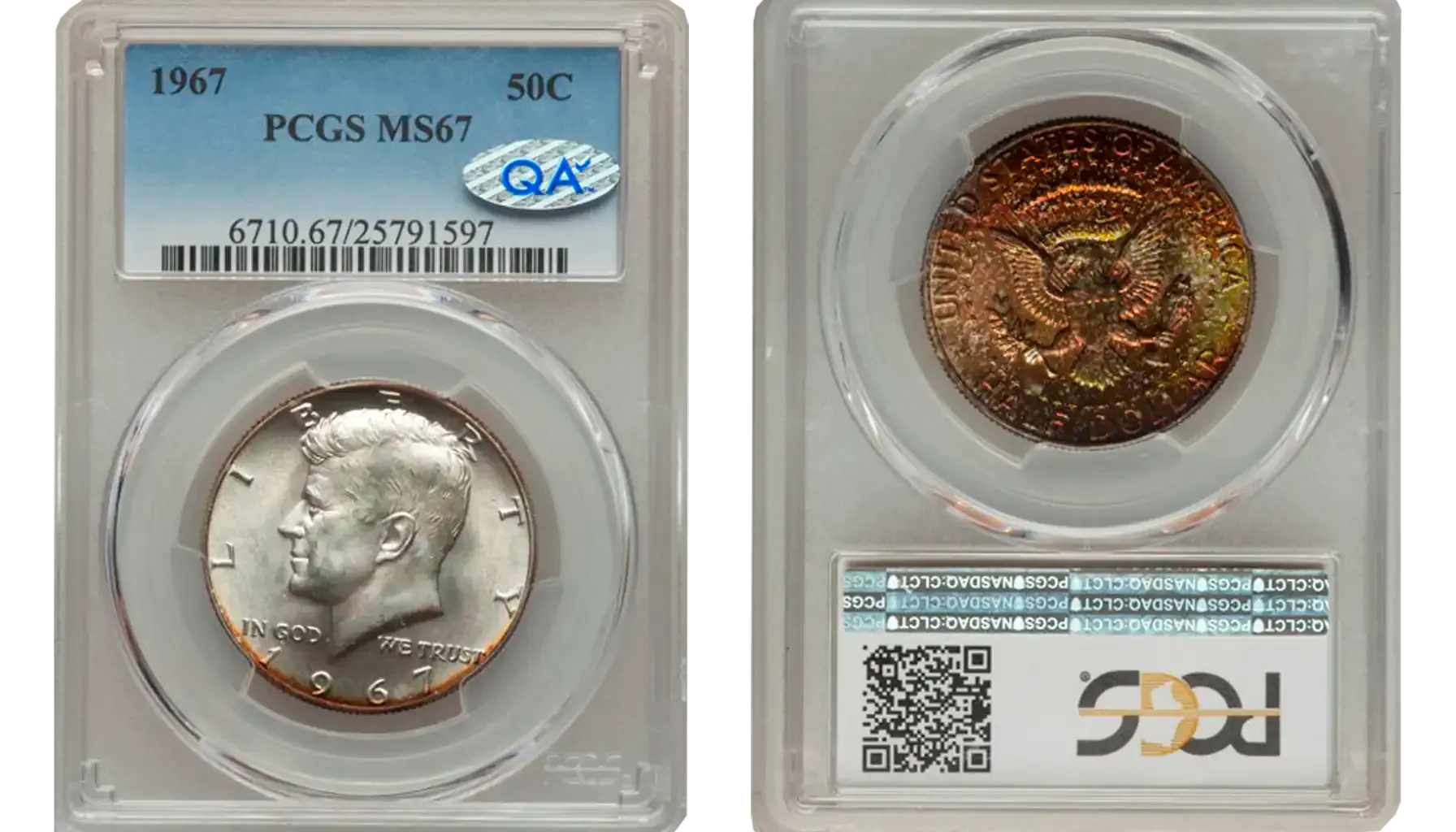
What is a 1967 Kennedy Half Dollar worth? The 1967 half dollar no mint mark isn’t just pocket change; its value is dictated by a calculated mix of grade, finish, and market demand.
Сirculated coins are mostly traded for their 1967 half dollar silver content, high-grade specimens and rare varieties belong in a different league entirely, commanding prices that the average silver stacker can't touch.
Coin Type | Condition | Approximate Value |
Regular Circulation Strike | Circulated (G-XF) | $5.50-$9.50 |
Uncirculated (MS60-MS65) | $12-$65 | |
Choice Uncirculated (MS66-MS67) | $110-$950 | |
High-Grade (MS67+) | $3,800-$5,200+ | |
Special Mint Set (SMS) | Standard SMS (MS60-MS66) | $8-$45 |
Cameo (CAM) (MS67-MS68) | $35-$550 | |
Deep Cameo (DCAM) (MS68) | $1,200-$9,800 | |
Ultra Cameo (UC) (MS69) | Up to $16,500 | |
Error & Variety Coins | Doubled Die Obverse (DDO) | $65-$1,200+ |
Off-Center Strike (10%+) | $150-$1,800+ | |
Clipped Planchet | $60-$650+ |
The half dollar 1967 value is subject to market fluctuations, grading quality, and demand. For an accurate valuation, consider professional numismatic tools like Coin ID Scanner that may identify, assess, and evaluate coins, even 2000 quarters, with the use of photos in an instant.
The Special Mint Set of the Most Valuable 1967 Half Dollars
The US Mint produced Special Mint Sets from 1965 to 1967 instead of regular Proof sets.
1967 SMS Half Dollar Value (SP, CAM, DCAM)
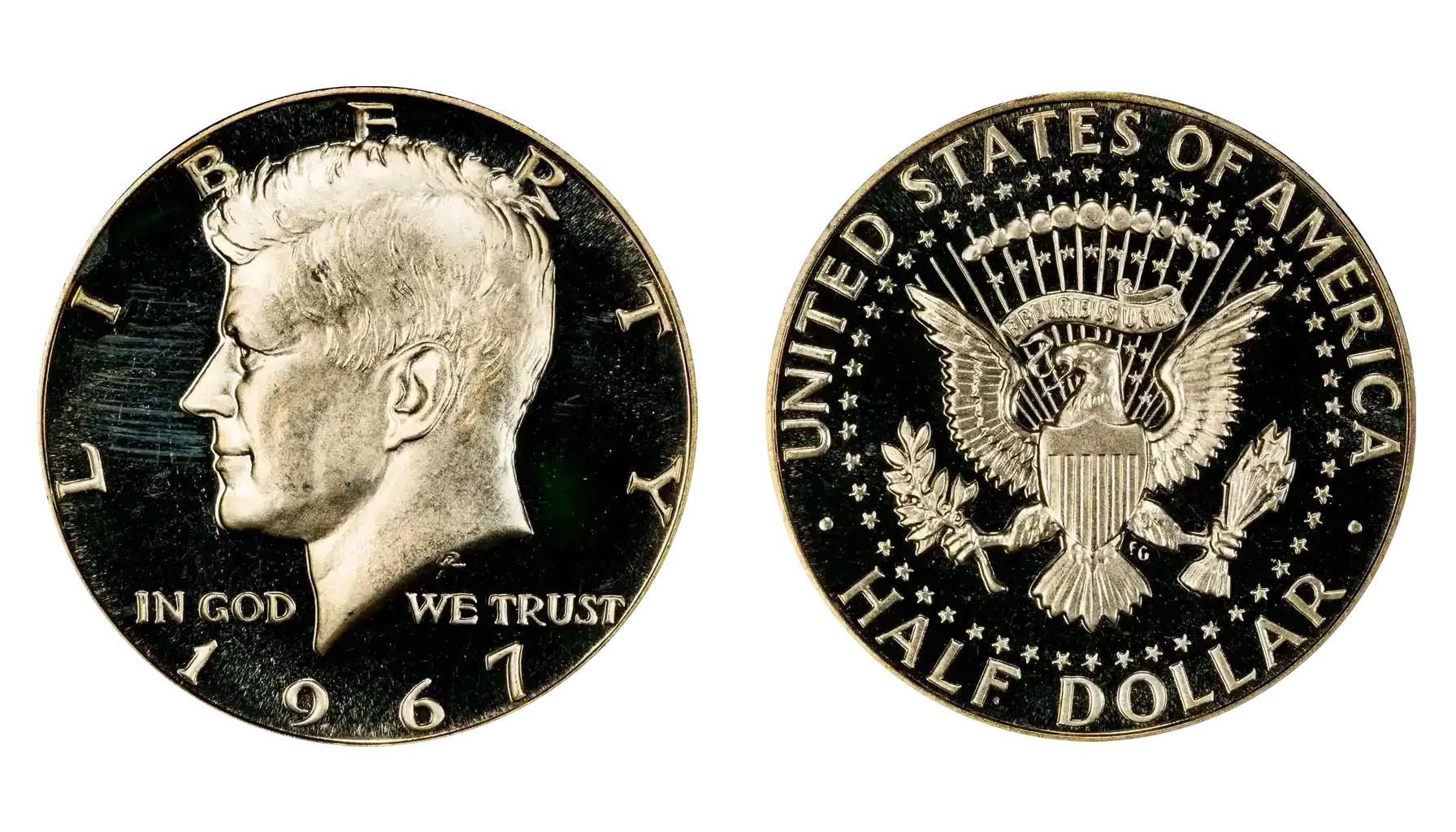
Experts grade SMS coins using the Special Preservation scale based on visual contrast levels.
For basic coins stay steady, but rare DCAM types grow 10-12% yearly when new certified items appear.
Grade | Price Range (2025-2026) | Record Price (Year) |
SP67 | $15-$45 | $180 (2023) |
SP68 | $100-$250 | $750 (2022) |
SP67 Cameo (CAM) | $150-$400 | $1,200 (2021) |
SP68 Cameo (CAM) | $800-$1,500 | $3,120 (2024) |
SP68 Deep Cameo (DCAM) | $4,000-$9,000 | $15,600 (2023) |
SP69 Deep Cameo (DCAM) | $14,000-$20,000 | $16,450 (2019) |
Deep Cameo specimens make up less than 0.05% of all checked SMS coins.
Market activity for SP69 DCAM stays low because there's only a tiny number of confirmed coins.
Doubled Die Obverse (DDO) Varieties
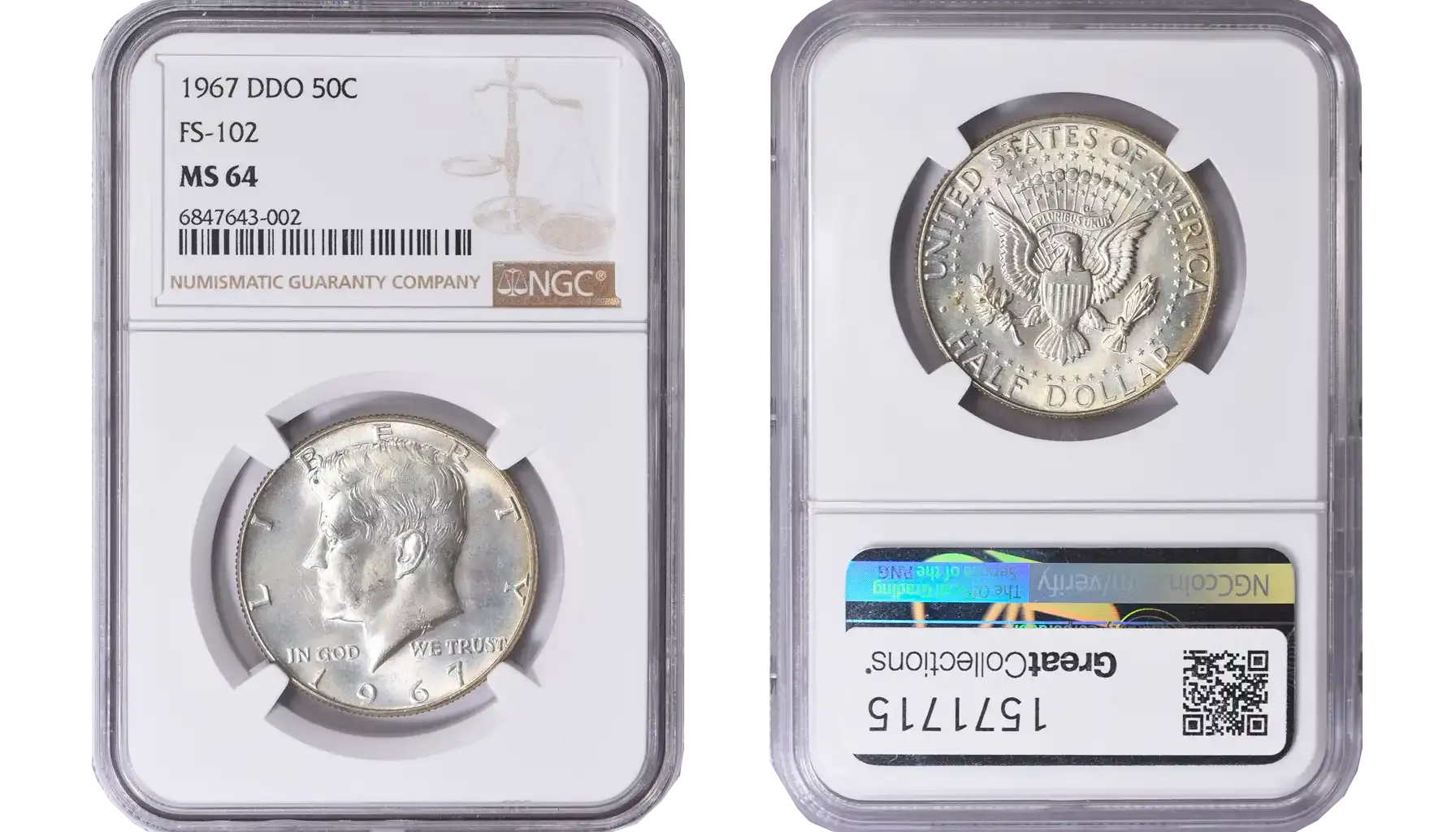
Minting 1967 Kennedy Half Dollar errors inside SMS sets happens less often than in regular money, increasing their market price.
The most famous 1967 variety involves a doubled die obverse, causing visible distortion on the words TRUST and LIBERTY.
Specific technical markers for DDO include:
Thickening of vertical lines in the IGWT motto
Shifted edges on the 1967 date numbers

 Facebook
  X (Twitter)
  Pinterest
  LinkedIn