Contents:
- How Much Is a 1981 Half Dollar Worth Today?
- 1981 Kennedy Half Dollar Value by Mint Marks
- 1981 Half Dollar Coin Value Chart
- Is a 1981 Half Dollar Silver?
- 1981 Kennedy Half Dollar Errors
- What Makes a 1981 Half Dollar Valuable?
- How to Identify a 1981 Half Dollar
- Are 1981 Half Dollars Worth Collecting?
- Where to Sell or Buy a 1981 Half Dollar
- FAQ
1981 was no different in terms of item production. The Kennedy series was still being struck in large quantities, with subtle mint mark differences and pristine uncirculated coins starting to influence the flourishing market. The price ranges from $0.50 to $150+ for rare anomalies.
How Much Is a 1981 Half Dollar Worth Today?
If you have an S mint mark coin, you must check the style of the S under magnification.
Type 1 Filled S: The mint mark looks blobby or filled in. This is the common version.
Type 2 Clear S: The S is crisp, with clear bulbous ends and a defined center. The MS-67+ Type 2 pieces in PR-70 DCAM have been known to reach auction records of over $4,000.
Since you utilize technical grading and magnification tools, keep an eye out for these 1981 half dollar P specific anomalies, which carry high premiums in 2026:
Doubled Die Reverse (DDR): Look for clear doubling on the letters and the eagle's feathers. These can be worth $2,000+ in top condition.
Off-Center Strikes: If the design is shifted by 10% or more, leaving a blank crescent, these typically sell for $150–$500.
Struck-Through Errors: If a piece of debris (like grease or wire) was between the die and the coin, it leaves a localized depression, $100+.
1981 Kennedy Half Dollar Value by Mint Marks
1981-P Kennedy Half Dollar Value 50C
Philadelphia Mint – 29,544,000 – $2,990 for MS-68
Large quantities are pretty obvious when it comes to the Philadelphia Mint and its mintage figures overall. As such, these usually appear as an average in comparison to earlier years, yet higher grades are still capable of boasting decent 1981 P half dollar values and rates.
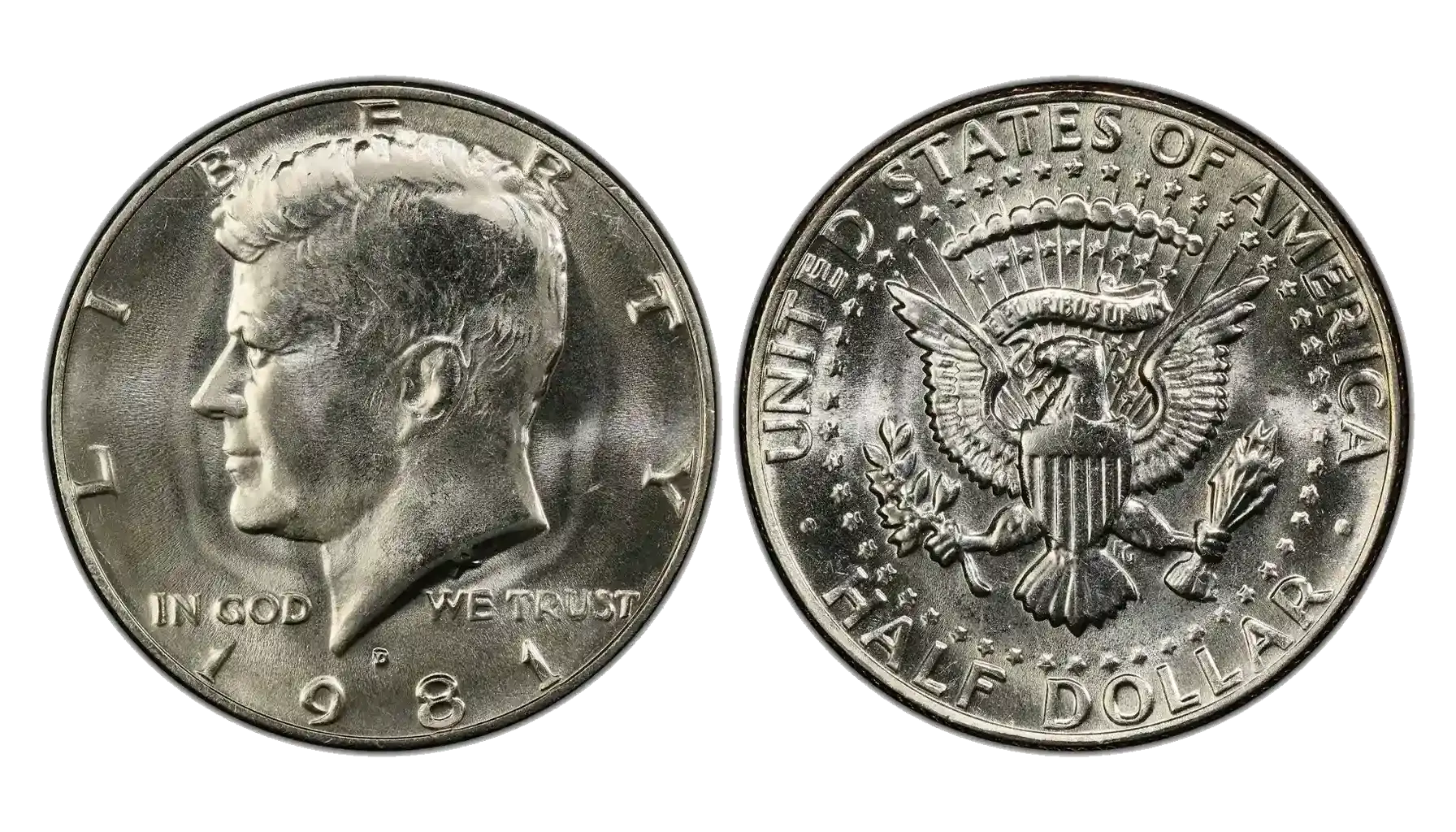
In fact, circulated examples and those up to MS-65 are relatively easy to find, yet in MS-66, the 1981 P Kennedy half dollar value, this instance becomes challenging to obtain, according to Jaime Hernandez from PCGS.
D 50C (Regular Strike)
Half Dollar 1981 Denver Mint – 27,839,533 – $1,880 for MS67
In comparison to the Philadelphia Mint, Denver produced a bit fewer coins that year, though the average auction records were lower in this case. Nevertheless, the 1981 half dollar D is always hard to spot in superb gem condition and is considered rare and highly collectible.
1981 Half Dollar Coin Value Chart
While you are sorting through your collection, pay special attention to the luster on P coins. Philadelphia specimens from this year are notoriously difficult to find in grades of MS-67 or higher.
If you find one that looks virtually perfect, it may be worth having it certified by PCGS or NGC, as an MS-68 can be a multi-thousand dollar coin. Is a 1981 half dollar worth anything in today’s market?
Mint Mark | Condition | Half Dollar 1981 Value |
P | Circulated | $0.50–$1.00 |
P | Uncirculated | $30.00–$40.00 |
1981 D Half Dollar Value | Circulated | $0.50–$1.00 |
D | Uncirculated | $20.00–$30.00 |
S Type 1 | Proof | $6.00–$10.00 |
S Type 2 | Proof | $65.00–$85.00 |
Which Grading Service Is Better?
P or D – PCGS
Registry Set Dominance. PCGS collectors are highly competitive for P and D business strikes. An MS-67 graded by PCGS consistently outsells an NGC MS-67 by 15–20 %.
1981 S Kennedy Half Dollar Value Type 2 (Clear S) – PCGS
Market Liquidity. While both services recognize the Type 2 variety, PCGS Deep Cameo (DCAM) labels are the gold standard for Proof Kennedy collectors.
S Type 1 (Filled S) – NGC
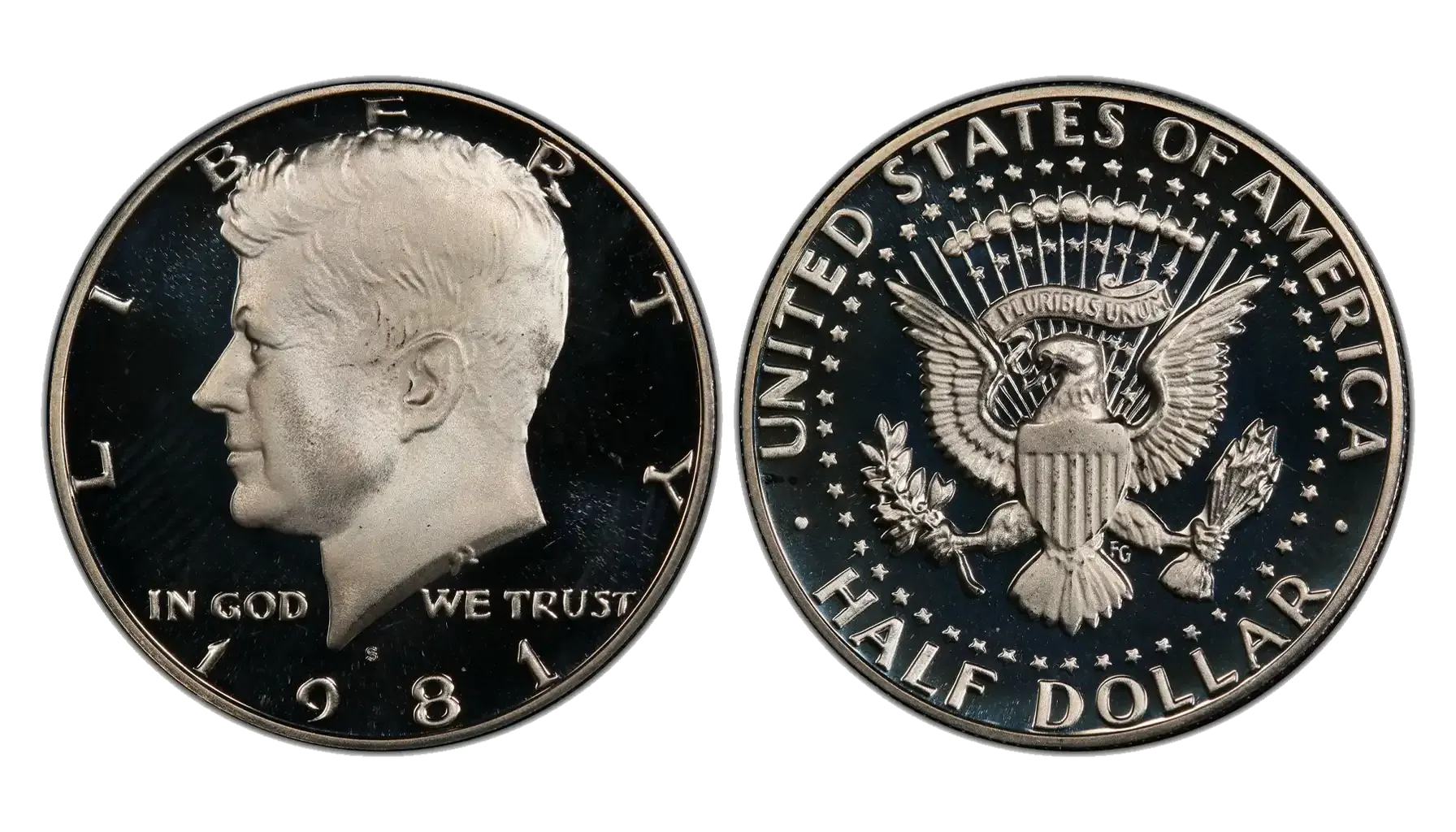
Cost Efficiency. Unless it is a perfect PR-70, the grading fees at PCGS might exceed the 1981 Liberty half dollar value. NGC offers excellent bulk or Modern tier pricing for these.
Is a 1981 Half Dollar Silver?
The U.S. Mint removed silver from items in stages:
1964 – the last year of 90 % silver pieces for circulation.
1965–1970 – pieces were 40% silver-clad (often called debased silver).
1971–Present – all circulating pieces are copper-nickel clad (no silver).
S 50C Type 1 (Proof, Filled S)
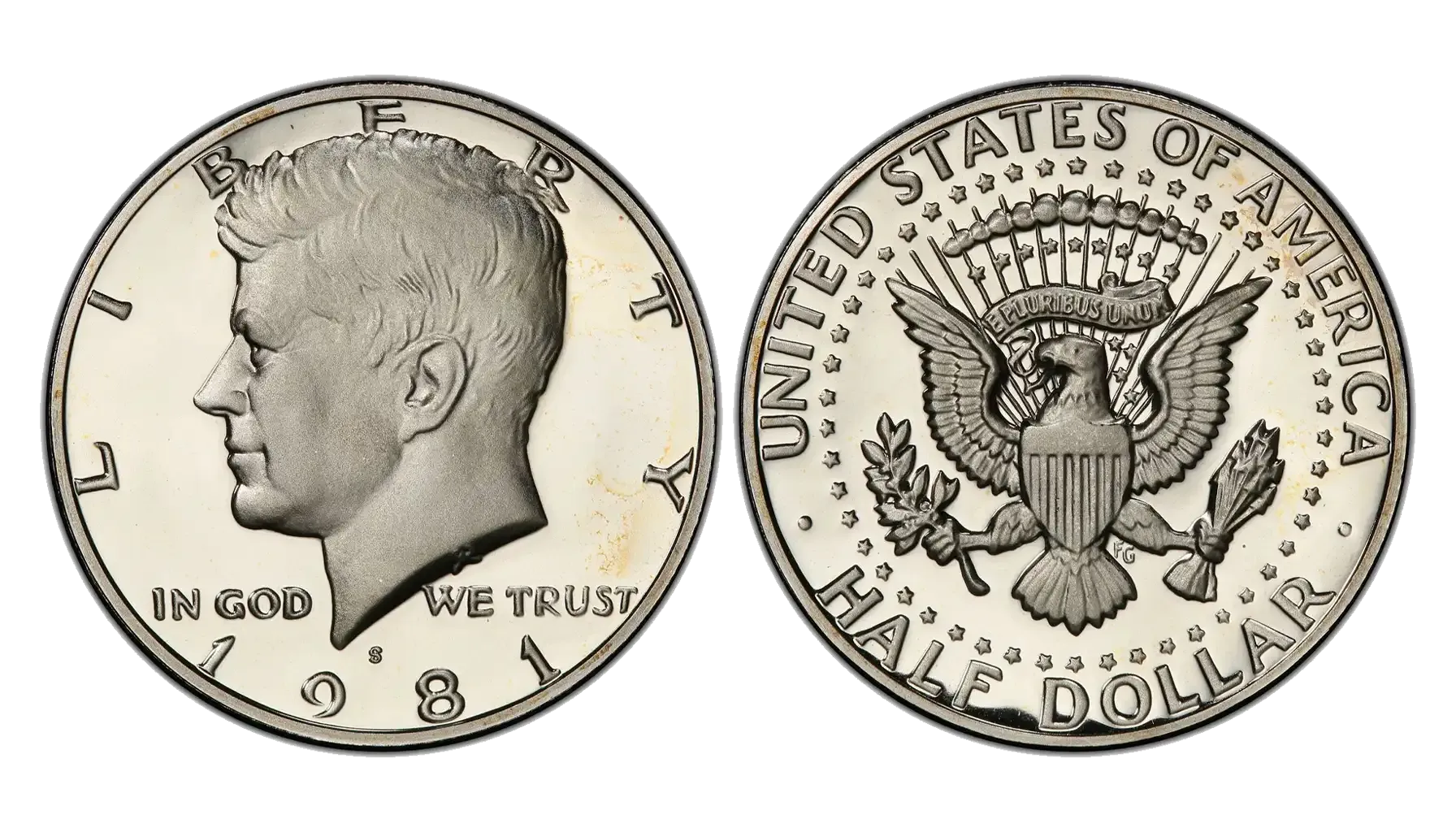
San Francisco Mint – 4,063,083 – $805 for PR-70
As for the proof editions, two wide varieties of the collector-focused coins, though it was not an intentional aspiration from the Mint. These are two of the same coins, yet Type 1 is characterized by the “S” mint mark being thicker and less defined. Besides, proofs were sold directly to collectors in annual proof sets, which is why they are far more available than business strikes in top grades.
S 50C Type 2 (Proof, Clear S)
San Francisco Mint – 4,063,083 – $4,025 for PR70
The Type 2 Proof, from its perspective, may demonstrate a sharper, more defined Clear S mint mark. Clear S by nature is scarcer than its “Filled S” variety, and, therefore, the 1981 silver half dollar value is the highest among the line.
"The 1981-S Type 2 is the clear winner in terms of rarity. While the Type 1 was the standard for most of the year, the Type 2 'Clear S' is the one that collectors pursue to complete their sets, as it is significantly scarcer and represents a distinct change in minting equipment mid-year."
– Ron Guth, numismatist
PCGS CoinFacts
1981 Kennedy Half Dollar Errors
DDO + DDR (Doubled-Die Obverse + Doubled-Die Reverse)
Estimated value: ~$2,040
Here is a true “variety” classic: a doubled die error that affects the appearance of the coin either from the obverse or reverse side. This usually occurs when the working die itself was mis-hubbed, so that the design elements are doubled on every strike produced by that die.
Indeed, the most valuable 1981 half dollar errors come down to the combination of DDO and DDR, for they literally double the worth, depending on how severe this deviation is.
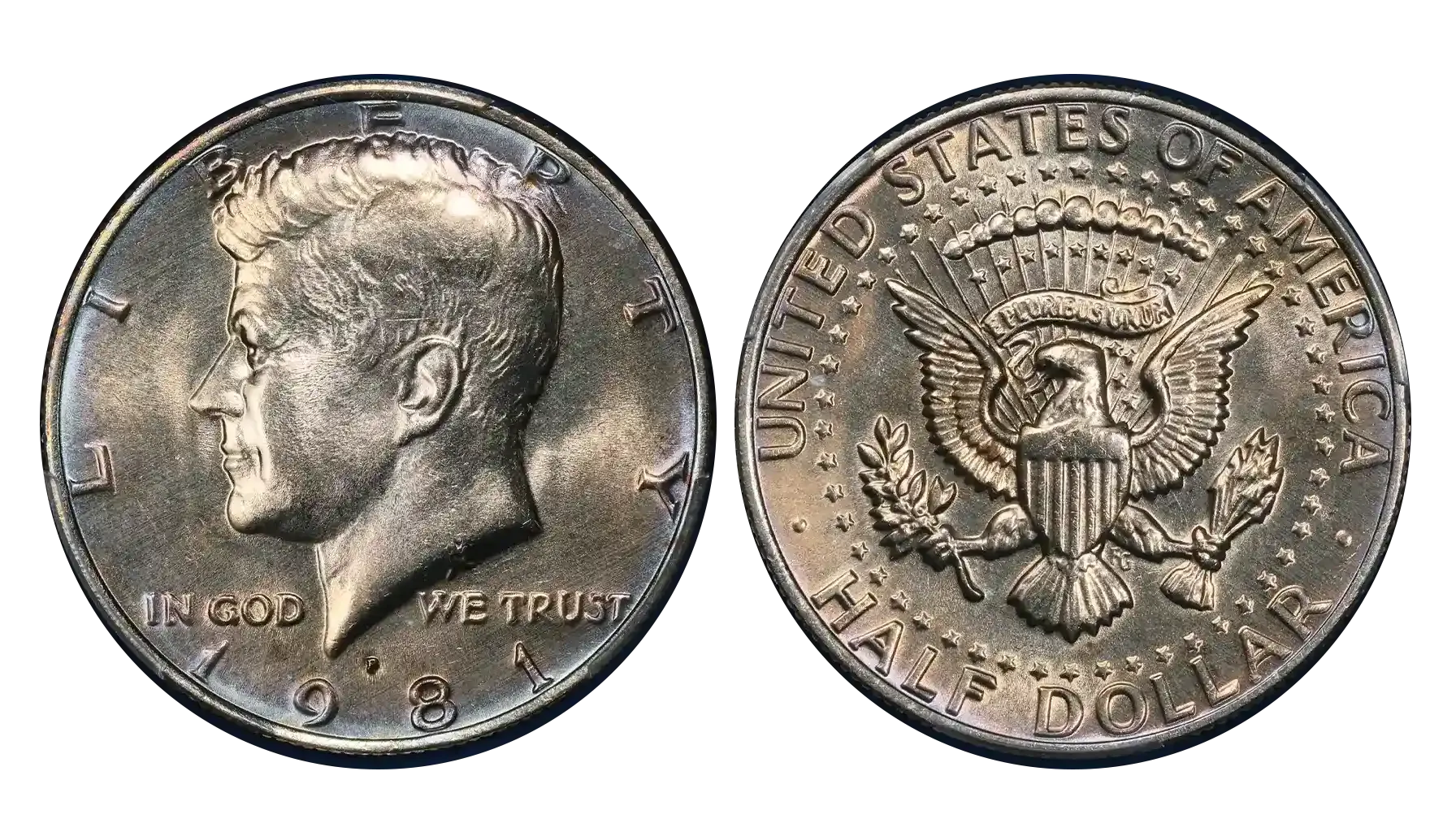
A quick note: look for clear, consistent secondary images on lettering (i.e., LIBERTY, IN GOD WE TRUST), the date, or on the eagle’s feathers and inscriptions on the reverse. These are usually visible without additional tools and special equipment.
Broadstruck + Off-Center Strike
Estimated value: ~$585
Sometimes, those combinations are too peculiar to be explored. Nevertheless, the numismatic market is full of classic pairs: among these is a broadstruck coin, accompanied by an off-center strike.
In particular, a broad strike appears when the collar (the ring that confines the planchet during striking) is absent or fails, hence leaving the metal flowing outward. An off-center strike, on its part, happens when the planchet is misaligned under the dies so one side of the design is struck incompletely.
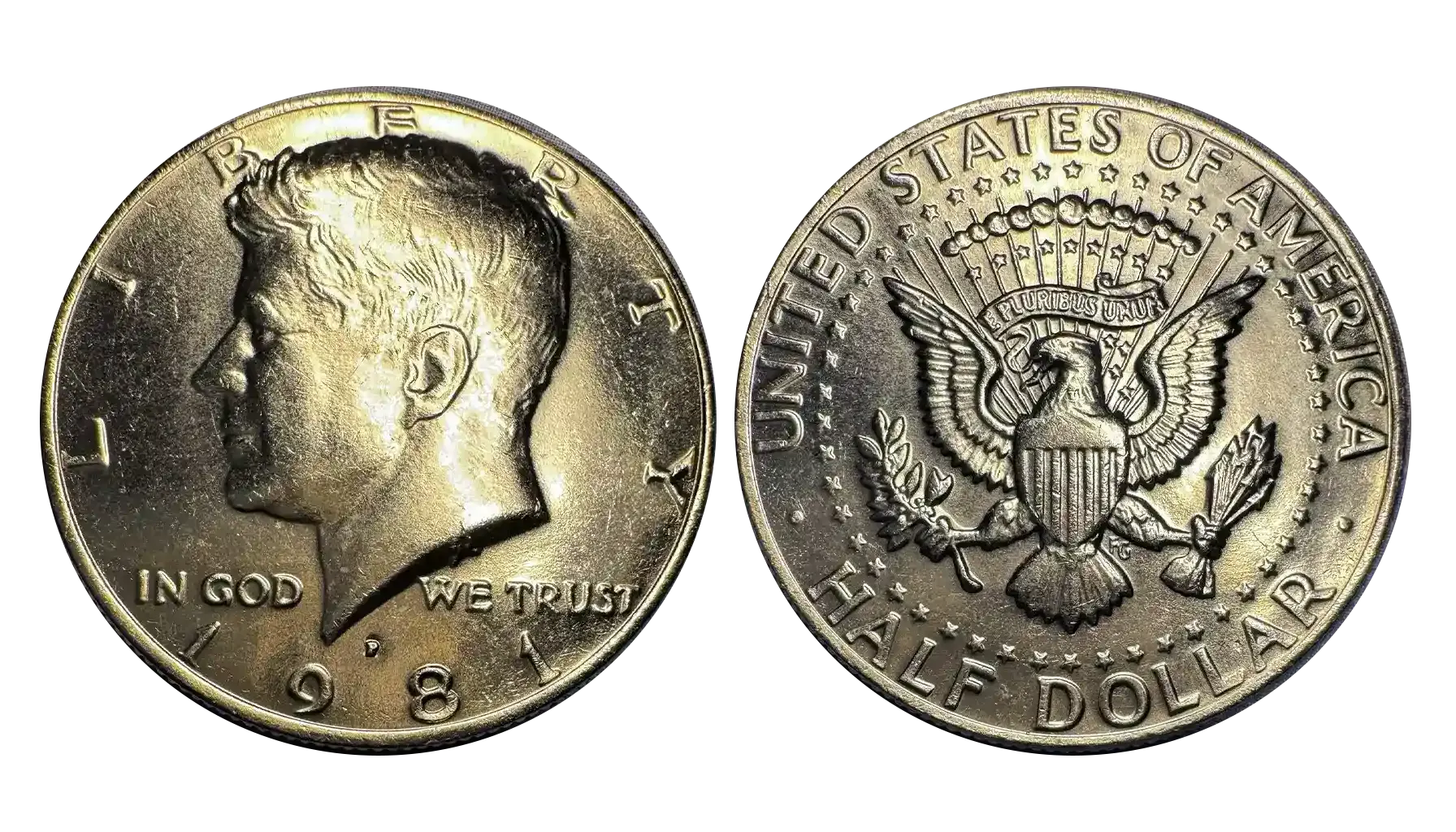
By the way, the degree is everything: a small off-center that shows only a tiny bit of missing design is common and minimally valuable. Instead, a broadstruck/off-center where 30 %–70 % (or more) of the design is missing, and the overall look may be worth thousands when certified and sold via reputable 1981 D Kennedy half dollar value auction platforms.
What Makes a 1981 Half Dollar Valuable?
Type 2 Clear S
Condition Rarity
Errors and Anomalies
For example, to identify a Repunched Mint Marks (RPM) defect, look for an S or D that appears doubled or tilted. A P mint mark that looks filled in or doubled is also highly collectible in the market.
Double Rim (Overlapping/Double Rim or Rim-Doubling from Collar Slip)
~$300
There are "umbrella" terms within the realm of numismatics that encompass a wide range of errors that share the same pattern or cause. One such example is a double rim," which describes noticeable secondary ridges around the 1981 JFK half dollar value perimeter.
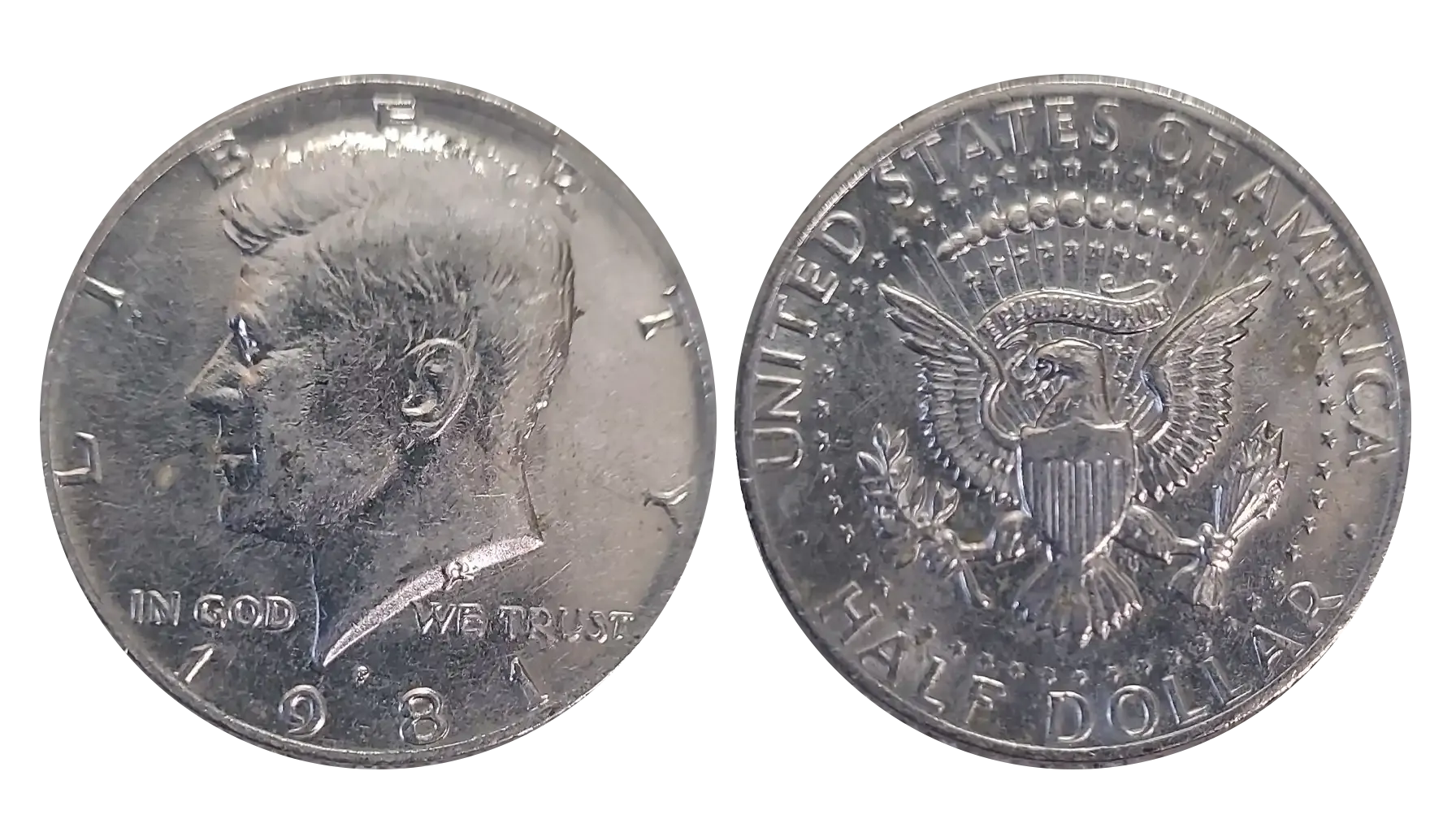
As for the appearance, one shall see an inner rim and an outer rim, or a partial extra ridge that follows the circumference. In some cases, this imperfection presupposes the presence of die breaks or cuds where the collar was damaged.
Struck-Through Error
~$100+
Certain errors are rather distinctive and easy to spot. But when the coin has a metaphoric meaning of deviation, it is indeed a treasure worth hunting. A struck-through error is generally produced when any foreign matter lies on the planchet surface during striking. Therefore, the dies cannot fully impress the design where that material was present, which forces an area to be raised.
How to Identify a 1981 Half Dollar
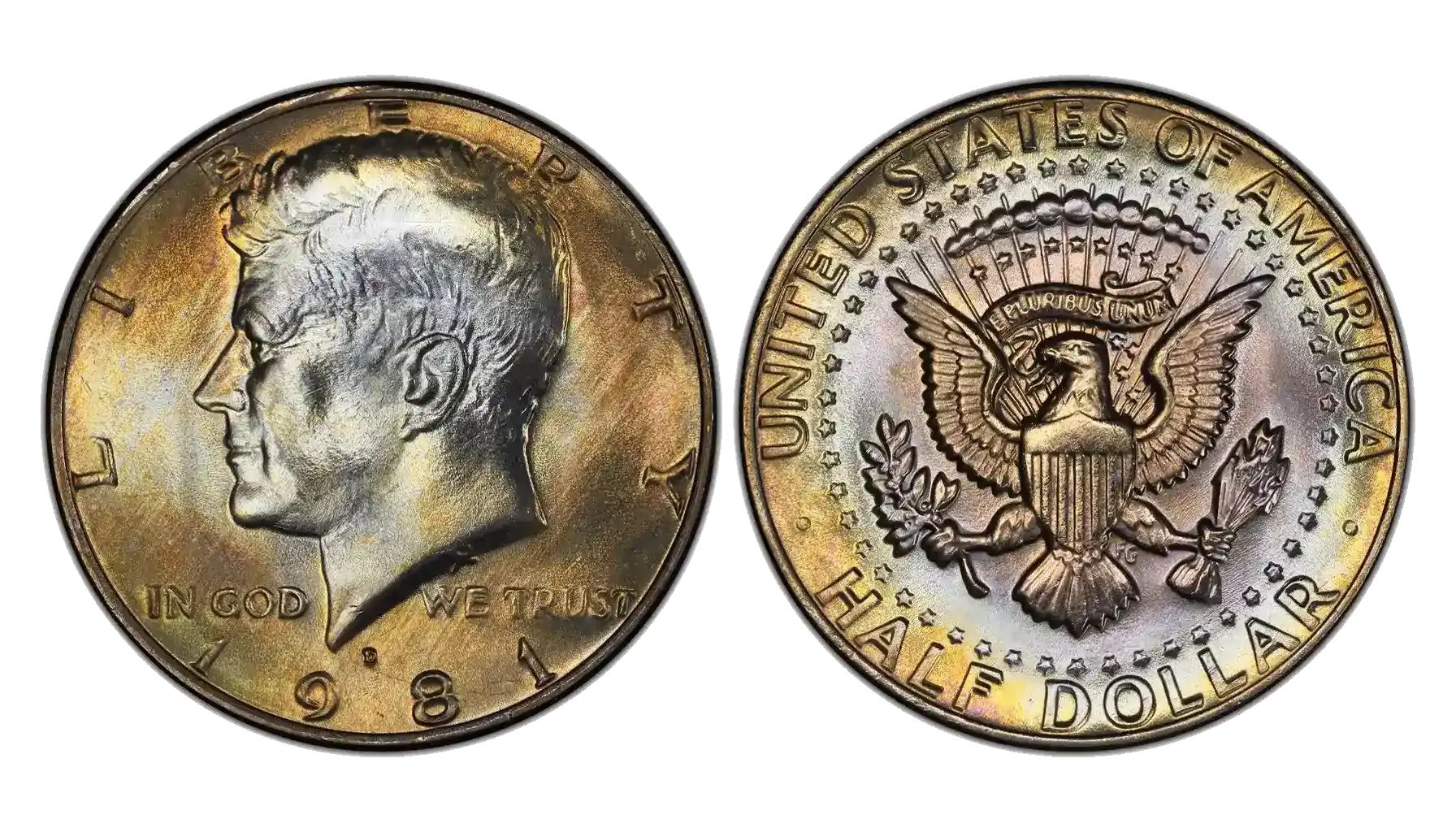
The obverse side shows:
The portrait of President John F. Kennedy
Inscriptions – IN GOD WE TRUST
The reverse shows:
On its part, introduces the Presidential Seal of the United States (i.e., the heraldic eagle with spread wings, an olive branch in the right talon and a bundle of errors in its left), a ring of stars (representing every state of the country), along with the inscriptions “UNITED STATES OF AMERICA” at the top edge, “E PLURIBUS UNUM” on a ribbon in the eagle’s beak, and the denomination “HALF DOLLAR” at the bottom.
Composition | Copper / Nickel |
Weight | 11.34 grams |
Diameter | 30.61 mm |
Thickness | 2.15 mm |
Edge | Reeded |
Modern clad coins rarely become overnight sensations. But how much is a 1981 Kennedy half dollar worth in twenty years? History suggests slow, steady appreciation for top-graded specimens. The MS-68 P that costs $75 today might reach $200 by 2045. Not a retirement plan, but a satisfying hobby with potential upside.
Are 1981 Half Dollars Worth Collecting?
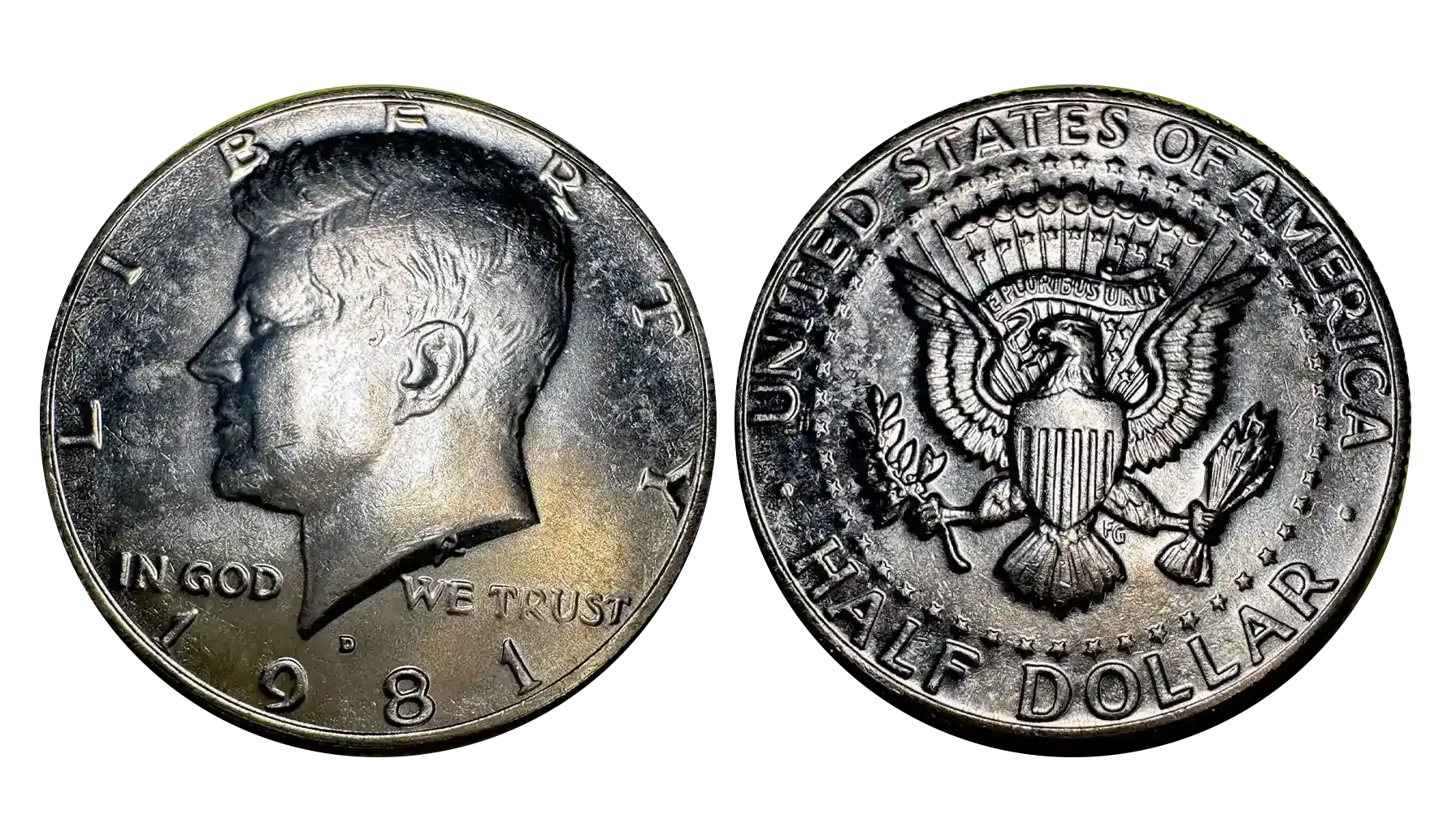
A complete set of P / D / S proofs costs under $50 in certified MS-65 condition. This low barrier to entry makes the series ideal for beginning numismatists.
For Budget Collectors
You can build a high-grade item collection without spending hundreds of dollars. Search bank rolls – many still contain uncirculated examples from sealed Federal Reserve boxes. A $500 box of items often yields several coins in MS-62 to MS-64 condition.
For Error Hunters
The Kennedy half dollar 1981 errors category offers affordable hunting grounds. Die cracks, minor clips, and off-center strikes appear occasionally in circulation. A weekend of searching $1,000 in rolls might produce one or two errors worth $10 to $25 each.
For Completionists
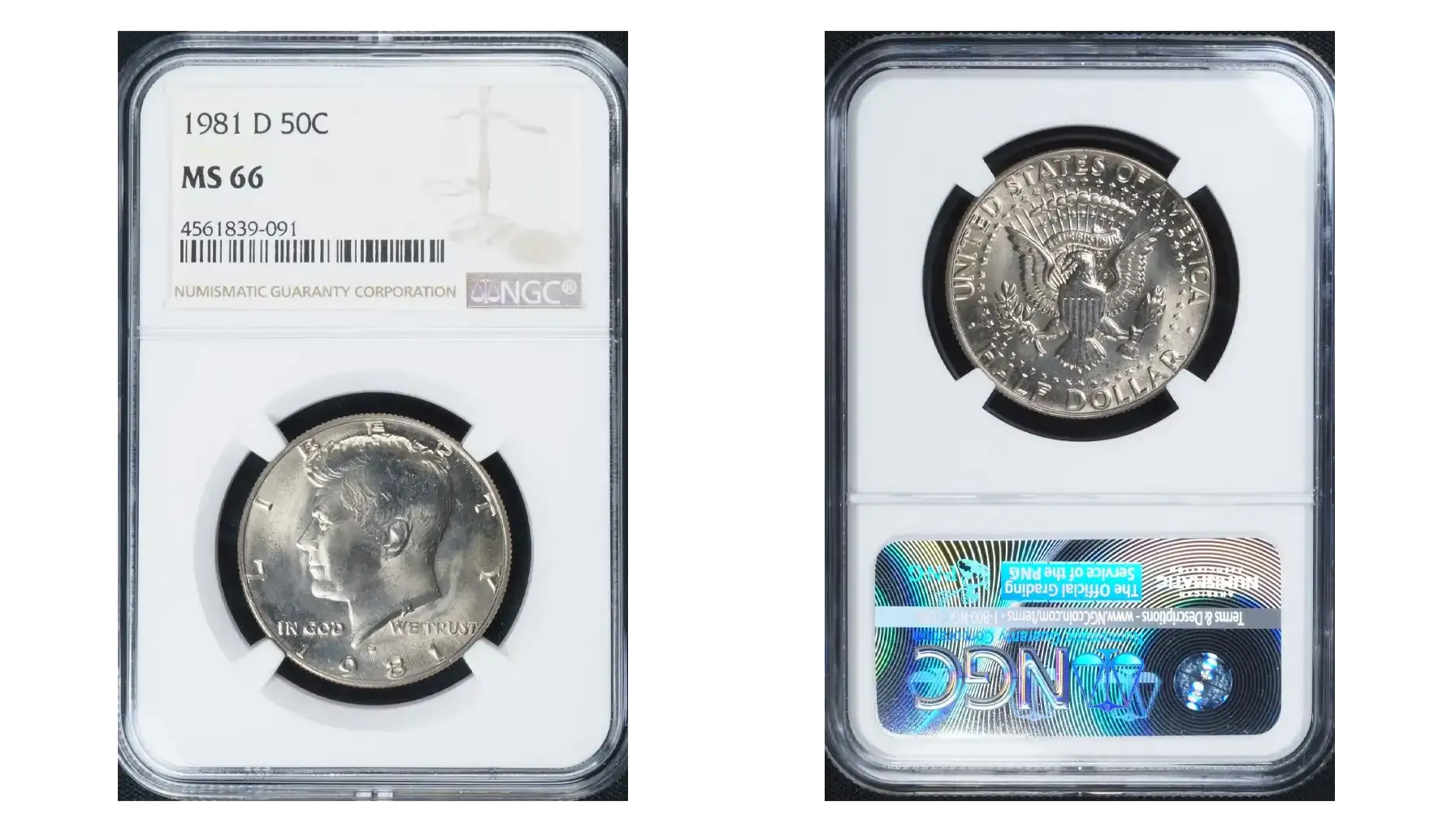
Every date-and-mint set of Kennedy halves requires issues. Without them, the collection remains incomplete. This ongoing demand creates liquidity. You can sell a high-grade half dollar coin 1981 quickly through online marketplaces or coin shows.
Attention: Check the 1980 dollar item.
Where to Sell or Buy a 1981 Half Dollar
For buy:
Auction Houses (Heritage, GreatCollections) – best source for high-grade certified examples. Buyer premiums add 15% to 20%.
Local Coin Shops – examine coins in person before purchasing. Build relationships with dealers who specialize in modern clad coinage.
Bank Rolls – the cheapest method for finding circulated examples. Ask for customer-wrapped rolls. The sets contain older coins more frequently than machine-wrapped rolls.
For sale:
eBay Auctions – list with clear photos showing both sides. Start bidding at $0.99 for common dates to attract interest. Factor in 13% final half dollar coin 1981 value fees.
Reddit – a no-fee community for buying and selling. Requires established account history.
Local Coin Shops – fastest payment (cash on the spot) but lowest offers – 50 % to 70 % of retail value.
FAQ
How much is a 1981 half dollar worth?
Ordinary items are worth $1 USD. The highest collection pieces are worth up to $2,000 or more.
What makes a 1981 half dollar rare?
Extraordinary condition – the Type 2 Proof items.
Are 1981 half dollars silver?
No, they have a clad composition of metal mix – Cu and Ni.
What type of half dollar is a 1981 S Kennedy?
Two types exist: Type 1 Filled S and Type 2 Clear S.
Where is the mint mark on a 1981 Kennedy Half Dollar?
On the obverse, above the center of the date, you can see a mark.
What is the 1981 half dollar?
Since 1964, it has been a President John F. Kennedy series.

 Facebook
  X (Twitter)
  Pinterest
  LinkedIn