Contents:
- Understanding Your 1980 Nickel: Basic Facts
- Mint Marks and Their Significance: P, D, S
- Grading Your 1980 Nickel: Condition is Everything
- Current Market Value: 1980 Nickel Price Chart
- Practical Identification Guide: Step-by-Step Process
- From Knowledge to Action: Next Steps for Collectors
- Frequently Asked Questions
Have you found a 1980 nickel and wonder about its true value? 5 cents or thousands of dollars — it all depends on the tiny details on the coin surface. Find out how to identify this coin with hidden value correctly and distinguish common examples from outstanding ones.
Understanding Your 1980 Nickel: Basic Facts
Before we reach the 1980 nickel value and its variations, let’s look at the basic features of this coin. Some of these characteristics can strongly affect the price, as we will see later.
Design Elements and Historical Background
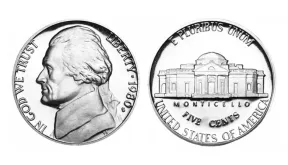
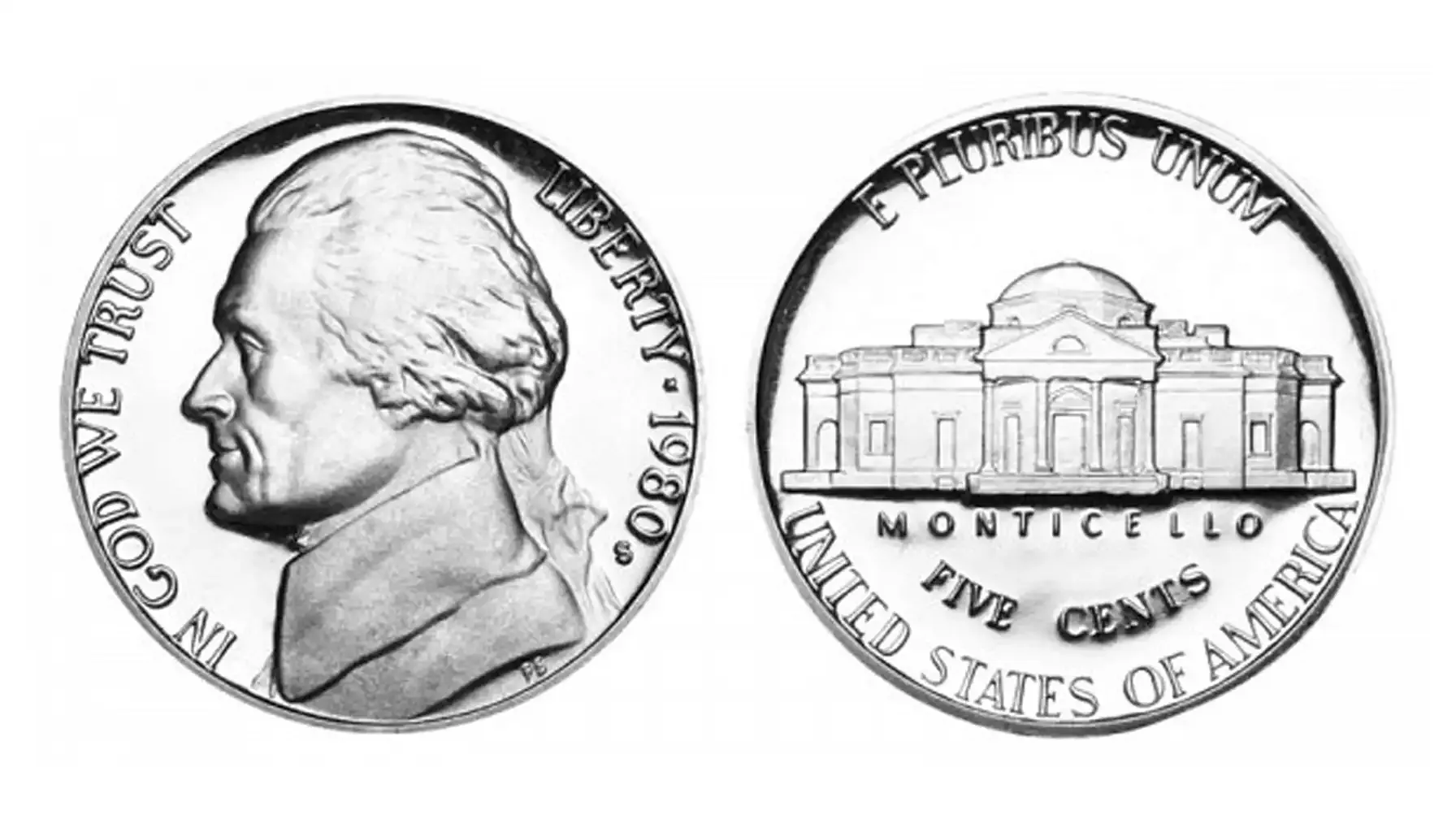
The 1980 Jefferson nickel is one of classic issues designed by Felix Schlag in 1938. The obverse shows Thomas Jefferson’s profile, and the reverse depicts Monticello, Jefferson’s Virginia home. This long-standing design remained unchanged and stable for decades.
Technical Specifications and Composition
All 1980 nickels share the same composition and dimensions used since 1946:
Composition: 75% copper, 25% nickel (no silver)
Weight: 5.00 grams
Diameter: 21.2 mm
Edge: Plain
The copper-nickel alloy makes the coin durable and bright just like silver. Its melt value averages $0.06, only slightly above face value. The 1980 nickel gains value not from intrinsic metal worth but from condition, rarity, and strike quality.
Mint Marks and Their Significance: P, D, S
Here comes the first part of the puzzle. To access your coin’s value, you should detect where it was produced.
How to Locate and Identify Mint Marks
The mint mark is located on the obverse, to the right of Jefferson’s portrait, directly below the year. Use a magnifier or loupe to check carefully, as weak or faint marks can be easy to miss. The three mint varieties are:
Philadelphia (no mint mark)
Denver (D)
San Francisco (S) — Proof-only issues
Production Numbers and Rarity Factors
Official U.S. Mint production totals for 1980 are:
1980-P: 593,004,000
1980-D: 569,472,000
1980-S (Proof): 3,554,806
Philadelphia and Denver variations are common in circulation, lowering the 1980 P nickel value, while the San Francisco proofs were struck exclusively for collectors and never intended for public use. As a result, most valuable 1980 nickels are either high-grade Full Steps coins or proof issues with deep cameo finishes.
Pro Note: Collectors often note that Full Steps examples are particularly difficult to find from this period due to weaker minting pressure. It makes them key targets for Jefferson nickel enthusiasts and raises prices.
Grading Your 1980 Nickel: Condition is Everything
The way your coin is preserved defines most of its final market price. Learn carefully how to rate your coin’s wear.
Circulated vs Uncirculated: Visual Comparison
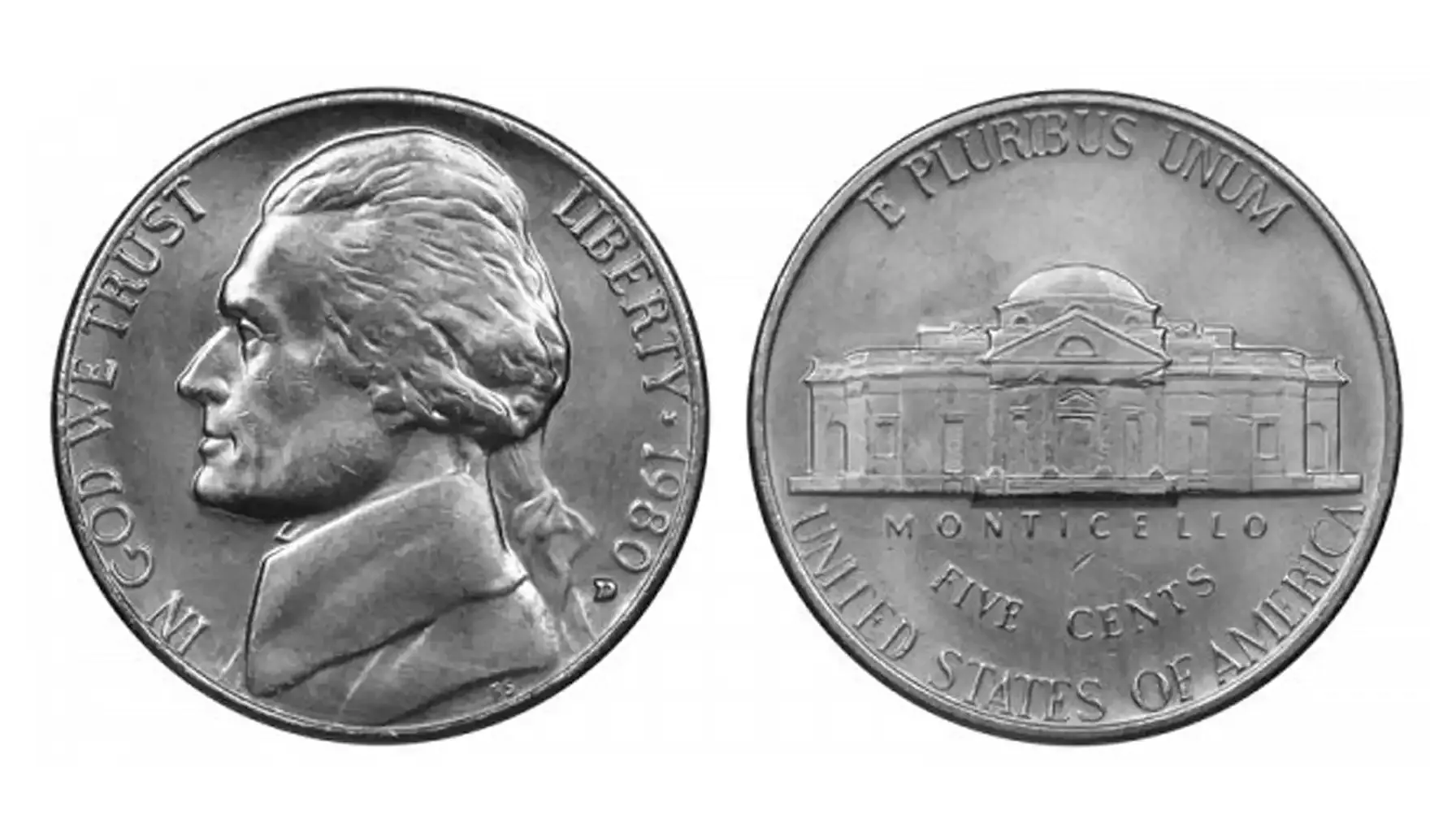
The biggest factor influencing your 1980 nickel’s value is condition. A circulated coin shows visible wear — Jefferson’s cheek appears smooth, his hair lacks texture, and the steps on Monticello blend together. These examples usually trade for face value or slightly beyond if the variation is rare.
In contrast, uncirculated varieties in higher grades retain sharp definition, metallic luster, and crisp details. Collectors typically pursue coins graded MS65 and higher, where the surface remains free of scratches or bag marks. A true gem-grade 1980 nickel displays full design clarity, even under magnification.
"According to the NGC Price Guide, as of October 2025, a Jefferson Nickel from 1980 in circulated condition is worth between $0.10 and $0.20. However, on the open market, 1980 D Nickels in pristine, uncirculated condition can sell for as much as $1,000."
— NGC Coin Explorer Editorial Team
From the Article on Appraising Jefferson Five Cents 1980
The "Full Steps" Designation and Why It Matters
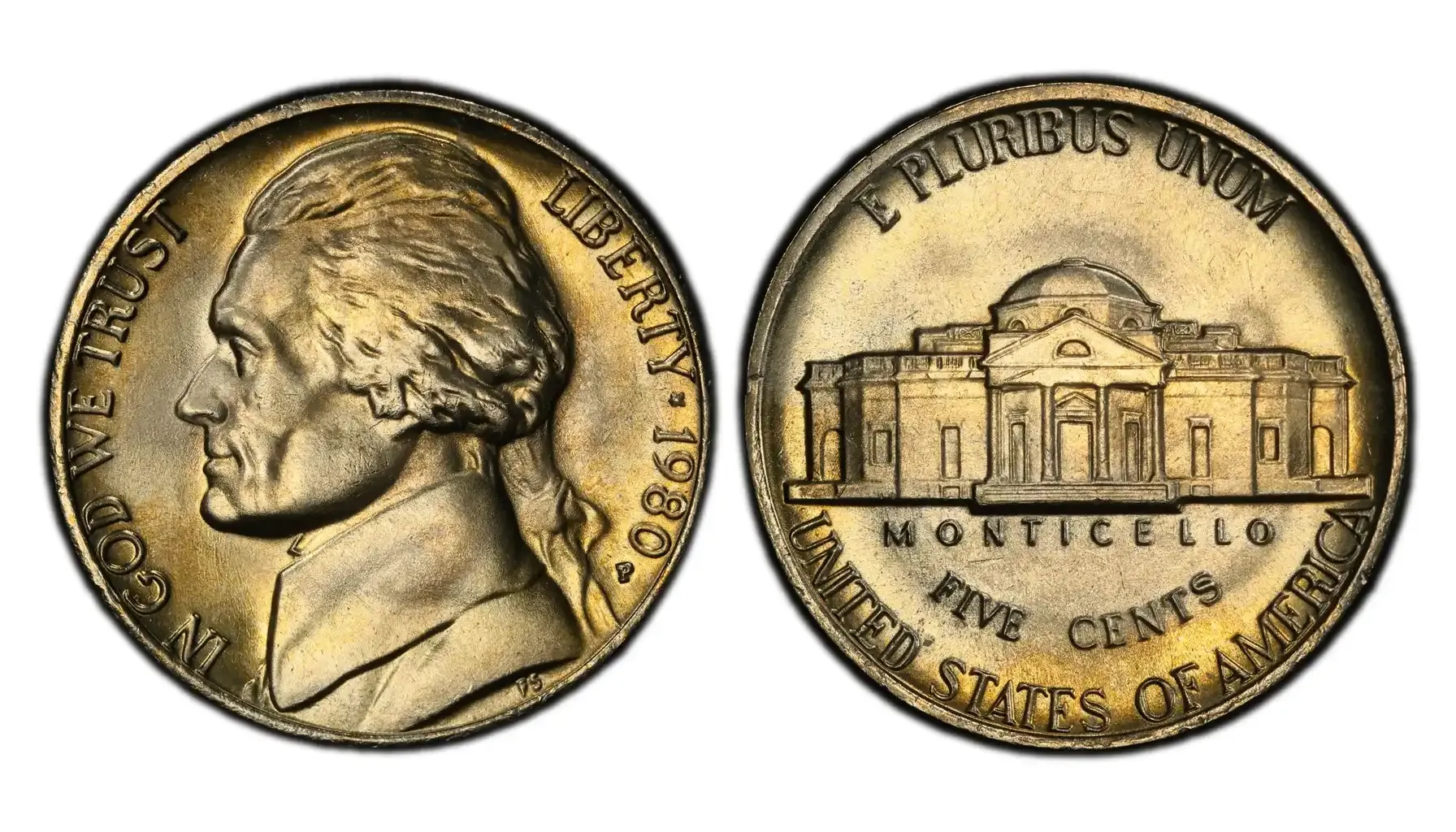
The Full Steps designation is the most desired strike characteristic among American collectors. It refers to the five or six horizontal steps at the base of Monticello being completely visible and separated. Achieving this requires a perfect strike, which is rare for 1980 nickels due to worn dies used at the mints.
Regular uncirculated examples: typically $5–$20
MS66 Full Steps examples: can exceed $100–$500, depending on mint
A 1977-D MS66 Full Steps nickel even sold for $4,320 at auction. While 1980 nickels have smaller premiums, Full Steps examples still stand out as top finds.
Current Market Value: 1980 Nickel Price Chart
The 1980 issue is relatively modern and generally has a modest price range compared to other varieties like a Buffalo nickel. Anyway, there are always outstanding examples.
Value by Mint Mark and Grade
Mint / Type | Circulated | MS60 | MS65 | Full Steps | Proof 69 | Proof 70 |
1980 (P) | $0.05 | $1 | $15 | $65 | — | — |
1980-D | $0.05 | $1 | $22 | $100–$500 | — | — |
1980-S Proof | — | — | — | — | $4–$6 | $10+ |
*Values reflect average U.S. retail prices from NGC, PCGS, and CoinWeek (as of 2025).
Even though Philadelphia and Denver coins were struck in huge numbers, most were poorly preserved. This makes 1980 D nickel value higher especially for MS66+ or Full Steps coins. Meanwhile, San Francisco Proofs remain collector favorites for their superior eye appeal.
Rare Varieties and 1980 Nickel Error List
Error examples from 1980 can be significantly more valuable than standard issues. Common 1980 p nickel error list features:
Off-Center Strikes – Parts of the design are missing or misaligned. Values range from $50–$300+, depending on how dramatic the error is.
Clipped Planchets – Coins with missing edges or metal fragments, typically worth $75–$150.
Double Die Errors – Doubling visible on “Monticello,” “E Pluribus Unum,” or Jefferson’s portrait. These are rarer and can reach $200–$1,000+, especially if confirmed by PCGS or NGC.
Tip for Collectors: While not as error-heavy as earlier decades, genuine 1980 errors are still sought after by niche collectors. Always document such finds and consider professional verification before selling.
Practical Identification Guide: Step-by-Step Process
Right after you get your hands on a Jefferson nickel, you can evaluate it quickly. Thanks to modern technologies, you don’t have to be a pro for completing this task.
Examining Your Coin: What to Look For
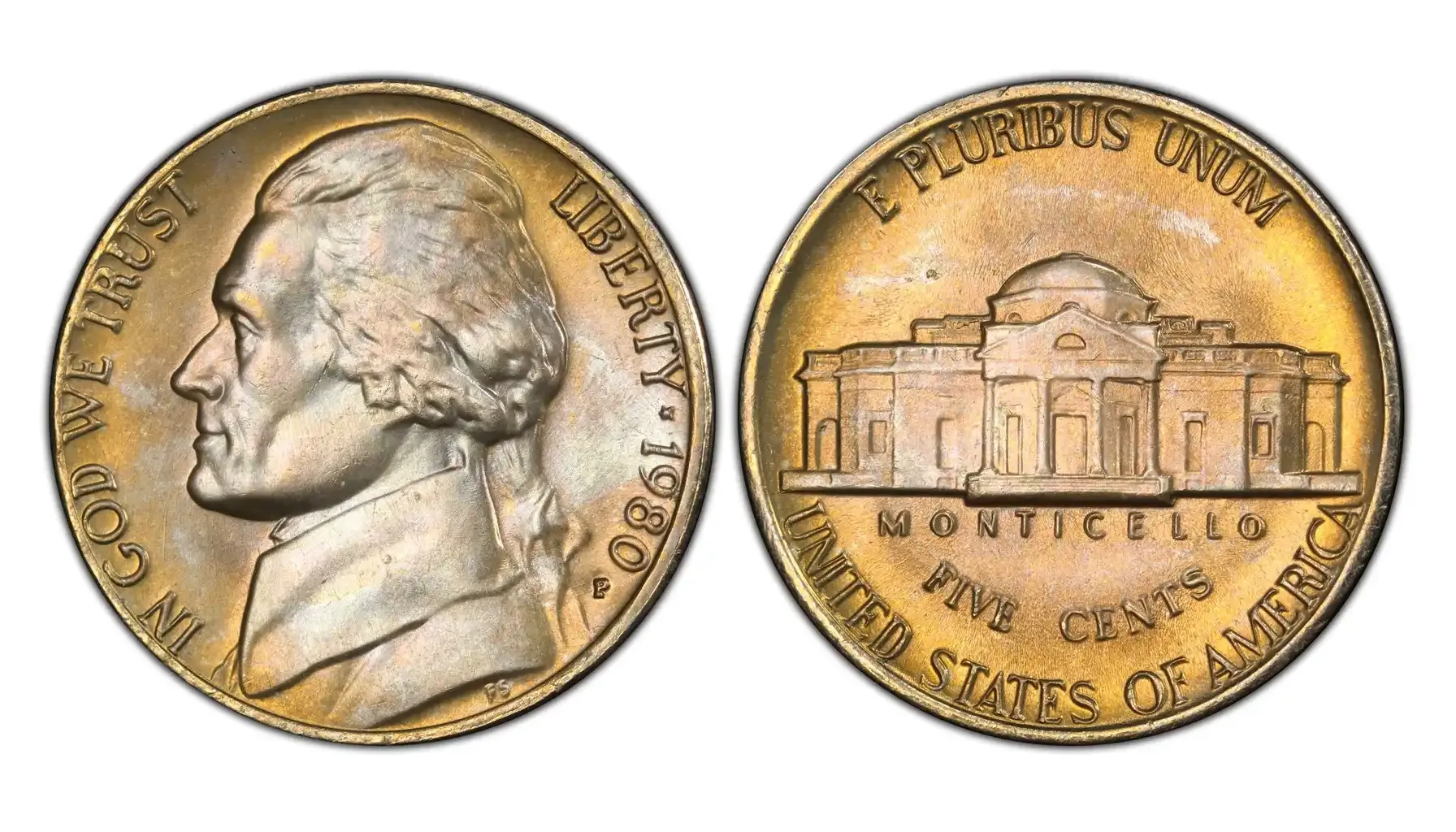
Inspect the date and mint mark placement. Identify if your coin is from Philadelphia (no mark), Denver (D), or San Francisco (S).
Analyze Monticello’s steps under magnification. Clear, unbroken lines mean higher value and the potential for a Full Steps designation.
Evaluate surface quality. Look for coins with full mint luster and minimal spotting or scratches.
Watch for minting defects. Doubling, die cracks, or off-center strikes can make your nickel far more valuable.
Compare with verified examples. Use platforms like Coin ID Scanner or NGC Coin Explorer to check grades and current market value.
Common Mistakes in Self-Assessment
New collectors often mistake wear for strike weakness or overestimate grade. Others damage coins through improper cleaning. Avoid polishing or wiping surfaces—it destroys original luster and reduces value (relates both to modern and old Hobo nickels). Always handle coins by the edges and rely on high-quality magnification or grading apps for accuracy.
From Knowledge to Action: Next Steps for Collectors
Now you notice that your Jefferson coin appears unusual in some ways. What are your next actions? A few options are below.
Professional Appraisal Options
If your 1980 nickel appears mint-state or displays a potential error, consider professional grading through PCGS, NGC, or ANACS. Certified grades authenticate your coin and secure its market value. Collectors and dealers trust encapsulated coins, and graded Full Steps often bring significantly higher prices at auction.
Using Technology for Coin Valuation
Modern apps streamline the identification and appraisal process of rare nickel varieties. Coin ID Scanner is highly recommended for its accuracy and advanced image recognition. You can create a completely digitalized numismatic space in it, both as a novice or an advanced collector:
Detect the mint mark and variety from a quick photo.
Assess surface wear and luster quality.
Estimate real-time market value from verified auction data.
Store and organize your coins digitally for portfolio tracking.
Frequently Asked Questions
Is a 1980 nickel worth more than its face value?
Most are worth 5¢, but Mint State and Full Steps coins can reach $50–$500+.
What is the metal composition of a 1980 nickel? Does it contain silver?
No—it's 75% copper and 25% nickel, with no silver content.
Where exactly is the mint mark located on a 1980 nickel?
On the obverse, just to the right of Jefferson’s portrait and below the year.
What are the different mint mark varieties (P, D, S) for the 1980 nickel?
1980-P (Philadelphia) and 1980-D (Denver) were circulation strikes, while 1980-S was Proof-only, made for collectors.
How much is a 1980 no mint mark nickel from Philadelphia worth today?
Typically 5¢ in circulation, up to $100+ for high-grade or Full Steps examples.
What is the value of a 1980-D nickel, and is it considered rare?
Common in circulated condition, but MS66 Full Steps coins are scarce and can exceed $500.
Careful examination is crucial to define the coin’s value. This process is especially important for modern coinage, where mintages are high and accessible. For better structure and correct appraisal of your coins, don’t hesitate to use modern digital tools and build your knowledge even stronger.

 Facebook
  X (Twitter)
  Pinterest
  LinkedIn