Contents:
Thomas Jefferson wrote the Declaration of Independence, served as the third President of the United States, and helped define ideas of personal freedom and limited government.
He appears on the nickel because of that legacy. In 1938, the U.S. Mint replaced the Buffalo series with a design honoring him as a founding statesman.
How much is a 1987 nickel worth? How to find value of coins for free?
1987 Jefferson Nickel Overview
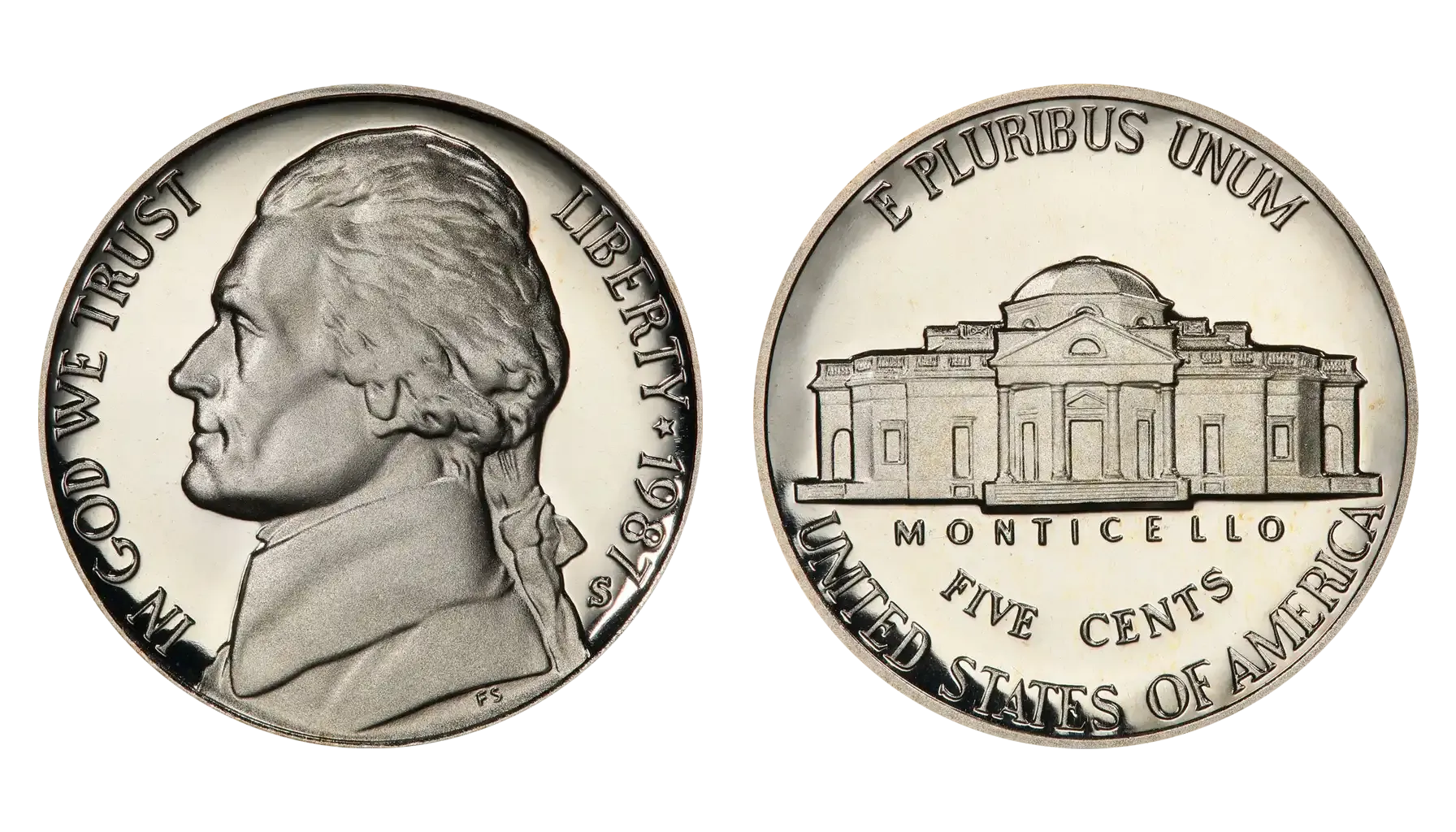
The piece is a United States 5-cent coin from the long-running Jefferson series, struck for regular circulation. It features Thomas Jefferson on the obverse and his Virginia home, Monticello, on the reverse — designs established in 1938 and used through 2003.
Coins of this year were produced at both the Philadelphia and Denver Mints, with an additional Proof issue from San Francisco for collectors.
A high mintage makes most pieces common, though high-grade, properly struck examples with complete details (e.g., “Full Steps” on Monticello) and pieces from the 1987 nickel error list draw interest among collectors.
Year | 1987 |
Denomination | 5 cents |
Composition | 75 % Cu, 25 % Ni (clad) |
Weight | 5.00 g |
Diameter | 21.21 mm |
Edge | Plain |
Identifying the 1987 Jefferson Nickel
Distinctive Features
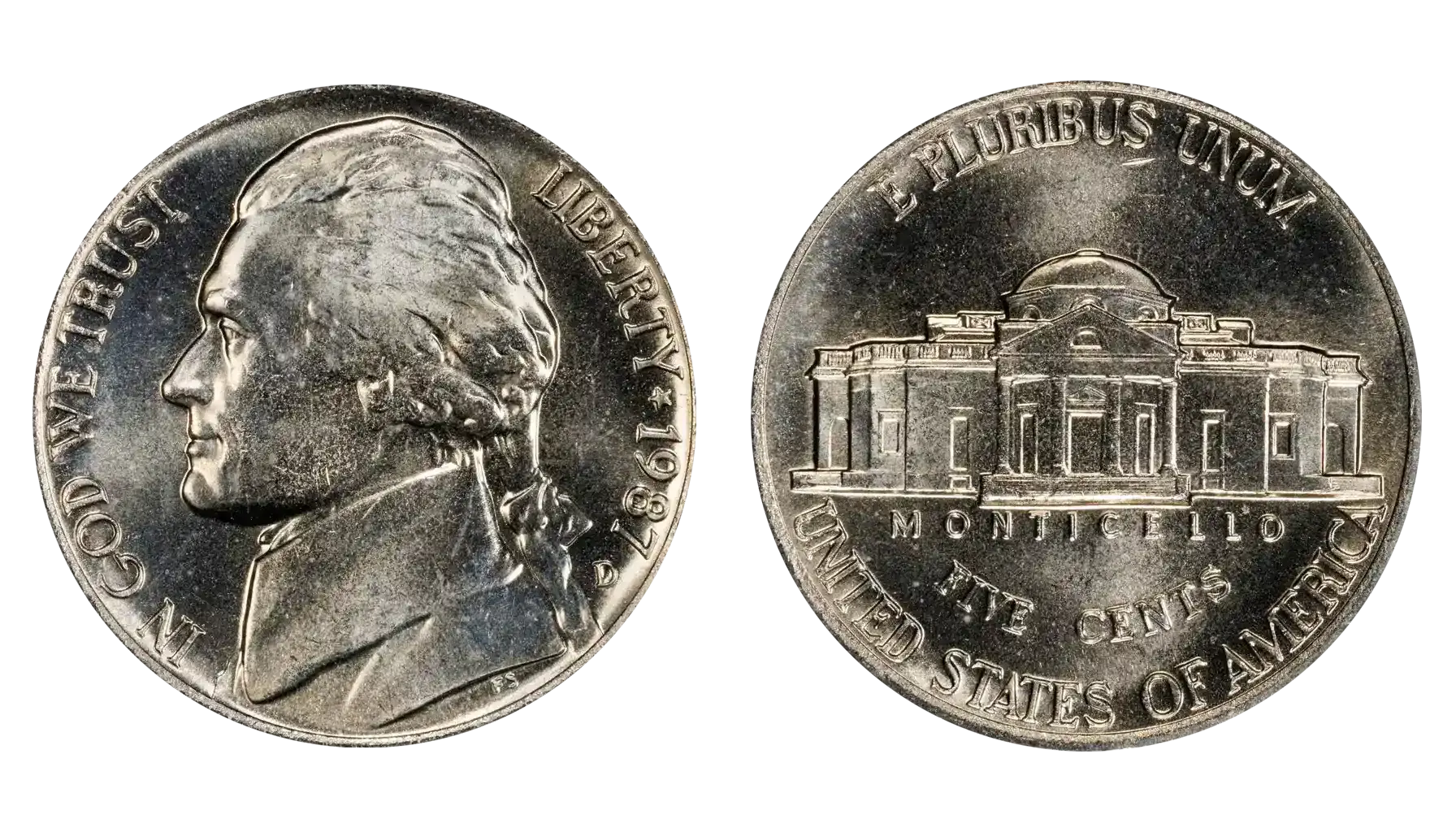
Obverse portrait: A left-facing bust of Thomas Jefferson with a relatively soft strike typical for late-1980s 5-cents. The word LIBERTY appears to the right, followed by the year 1987.
Mint mark placement: A small P or D sits to the right of Jefferson’s ponytail. Proof coins carry an S and show mirrored fields.
Reverse design: Monticello dominates the reverse. Look closely at the steps at the base — sharp, uninterrupted lines indicate a Full Steps strike, which is the main quality marker for this year.
Color and surface: Standard alloy gives a pale silver-gray tone. No silver content. Circulation pieces often show muted luster and light contact marks.
Edge: Plain, with no lettering or reeding.
How to Identify It
Check the date and portrait.
Find the mint mark. Look just right of the ponytail for P, D, or S.
Use magnification to see if the steps are fully separated or blended.
Measure basics. Diameter ~21.21 mm, weight ~5.0 g, plain edge — deviations may suggest damage or an error.
Verify with an app. A quick photo in Coin ID Scanner can confirm the coin type, composition, mint year, and basic specs.
Mint Marks and Varieties: P and D
Philadelphia (P)
The mint mark P is located to the right of Jefferson’s ponytail on the obverse. The 1987 nickel P is a regular circulation strike.
Common in circulated grades due to very high mintage. Examples with sharply defined Monticello steps are harder to find. The 1987 P nickel error list exists.
Denver (D)
The mint mark is D, in the same obverse position as the P. It is also a regular circulation strike.
It is also common overall, but Denver issues tend to show slightly stronger strikes. Better odds for Full Steps (FS) designation compared to Philadelphia. There is the 1987 D nickel error list as well.
Varieties and What Matters
Full Steps (FS)
The primary variety for these coins. To qualify, Monticello’s steps must show clear, uninterrupted horizontal lines. Most collectors look for at least 5 or 6 full steps.
Minor die markers
Small die chips, polishing lines, or light doubling may appear but are usually not premium varieties.
Design Features and Metal Composition of the 1987 Nickel
The specimen shows the familiar left-facing portrait of Thomas Jefferson. The date and the word LIBERTY sit to the right, with the mint mark placed just behind Jefferson’s ponytail.
On the reverse, Monticello fills the design.
The coin is made from the standard modern nickel alloy of 75 % Cu and 25 % Ni. There is no silver content, and the weight and dimensions match other Jefferson coins struck in the late 20th century.
1987 Jefferson Nickel Value by Condition and Mint
1987 P Nickel Value | 1987 D Nickel Value | 1987 S Nickel Value | |
G–VG | $0.05 | $0.05 | — |
F12–F15 | $0.05–$0.10 | $0.05–$0.10 | — |
VF20–VF35 | $0.10–$0.15 | $0.10–$0.15 | — |
EF40–EF45 | $0.15–$0.30 | $0.15–$0.30 | — |
AU50–AU58 | $0.30–$0.75 | $0.30–$0.75 | — |
MS60–MS62 | $0.75–$1.50 | $0.75–$1.50 | — |
MS64 | $6–$12 | $8–$15 | — |
MS65 | $15–$30 | $20–$40 | — |
MS65 Full Steps (FS) | $250–$600 | $400–$1,000+ | — |
MS66–MS67 (non-FS) | $40–$120 | $60–$200 | — |
Proof PR65–PR69 | — | — | $2–$6 |
Prices reflect typical retail and recent auction results and may vary.
Common Errors and Collector Tips for 1987 Nickels
Errors
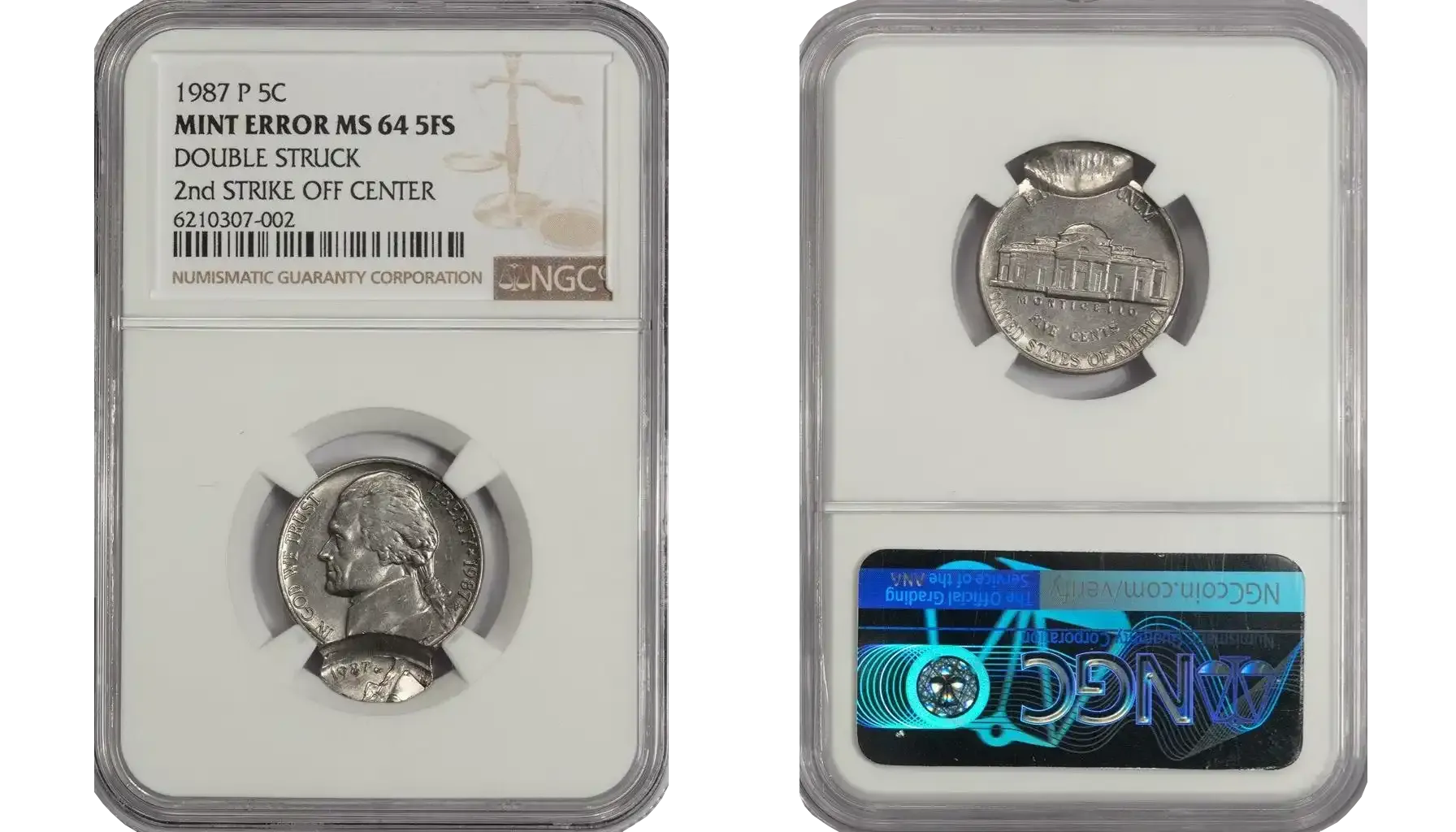
Genuine mint errors do exist. Each 1987 D nickel error value (as well as other mint marks) is higher than a standard one.
Off-center strikes
Clipped planchets
Broadstrikes
Struck-through debris
Collector Tips
For this year, condition outweighs rarity. Most pieces remain worth face 1987 nickel value unless they stand out clearly.
Focus on Mint State examples.
Examine Monticello’s steps. Broken or merged lines disqualify a coin from Full Steps status.
Start with Denver coins or 1987-P nickel error pieces. They are more likely to show stronger strikes.
Avoid cleaned pieces.
Weight, size, and edge should match normal characteristics.

 Facebook
  X (Twitter)
  Pinterest
  LinkedIn