Contents:
- How Much Is a 1971 Dime Worth?
- 1971 Roosevelt Dime Value Chart
- Why Some 1971 Dimes Have No Mint Mark
- Is a 1971 Dime Worth Anything Above Face Value?
- 1971 Dime Error List
- Rare 1971 Dime Errors to Look For
- 1971 Dime Specifications
- What Makes a 1971 Roosevelt Dime Valuable?
- How to Identify a Valuable 1971 Dime
- Where to Sell or Appraise a 1971 Dime
- FAQ
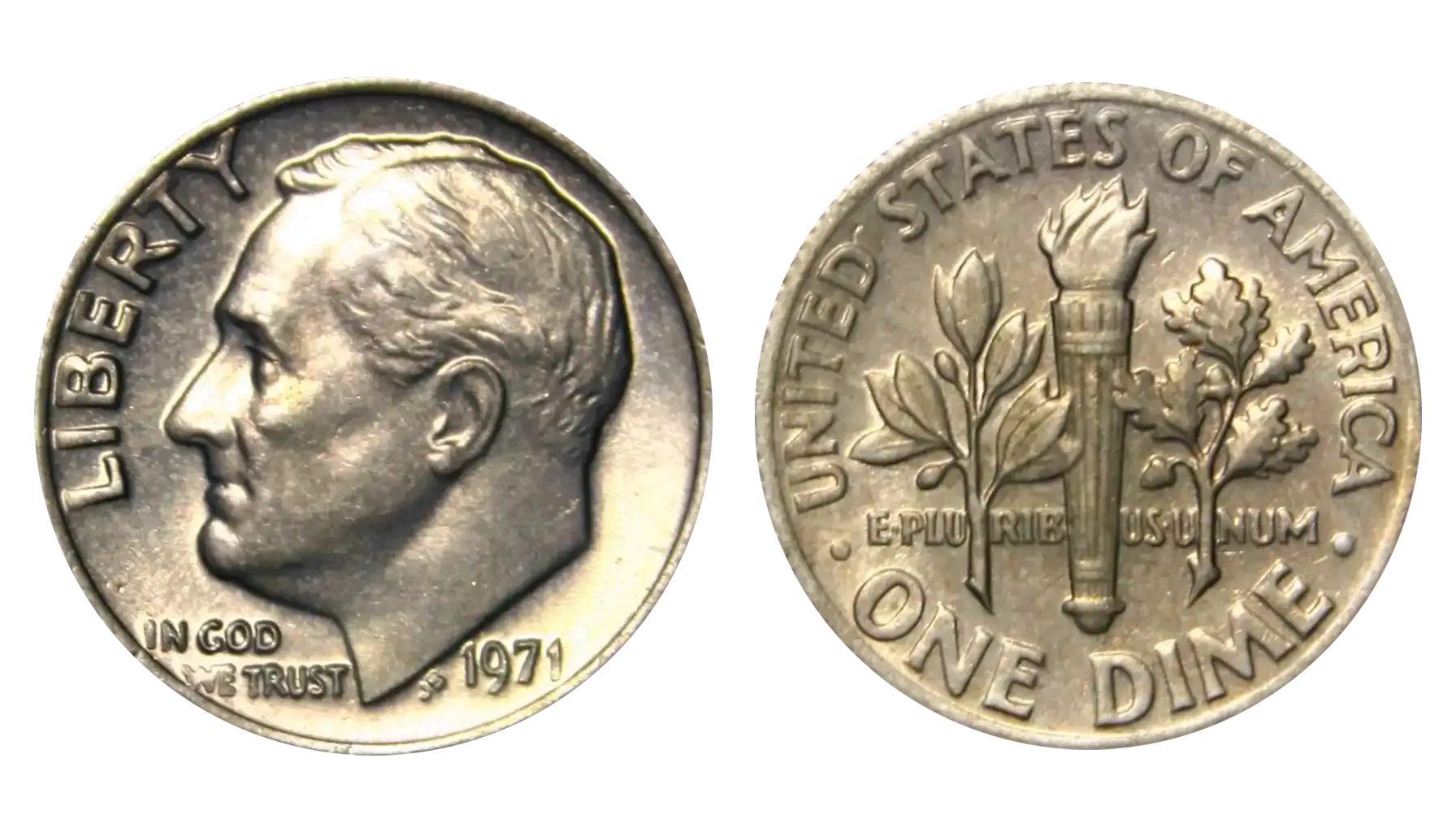
1971 was the year America completely eliminated silver from its coins. Six years after the Mint removed silver from items and quarters, coin metal became the new norm. The item worth in the cost framing from $2 to $400 dollars on the numismatic open market.
How Much Is a 1971 Dime Worth?
1971 dime values for standard issue are determined by:
The Mint State (MS) grade
The Full Bands (FB) presence on the reverse
The Full Bands
As an experienced numismatist, you know that the Full Bands designation is the holy grail for the most valuable Roosevelt dimes. Use a loupe to look at the horizontal bands on the torch (reverse). If the lines are perfectly separated with no blurring, you have a Full Bands coin. A D MS-67 FB can reach $1,000+ at auction, whereas the same coin without the FB designation might only sell for $100.
The No S Proof Error
There is one specific item that is worth thousands of dollars. In 1971, a small number of Proof pieces were struck at the San Francisco Mint but were missing the S mint mark.
How to identify?
This error only exists in Proof sets (mirror-like finish). If you find a proof-finish item with no mint mark, it is the rare No S variety. These currently trade for $3,500–$5,500, depending on the grade.
Attention: Do not confuse this with a standard Philadelphia piece and a 1971 Eisenhower dime. The No S must have the mirror-like Proof finish.
1971 Roosevelt Dime Value Chart
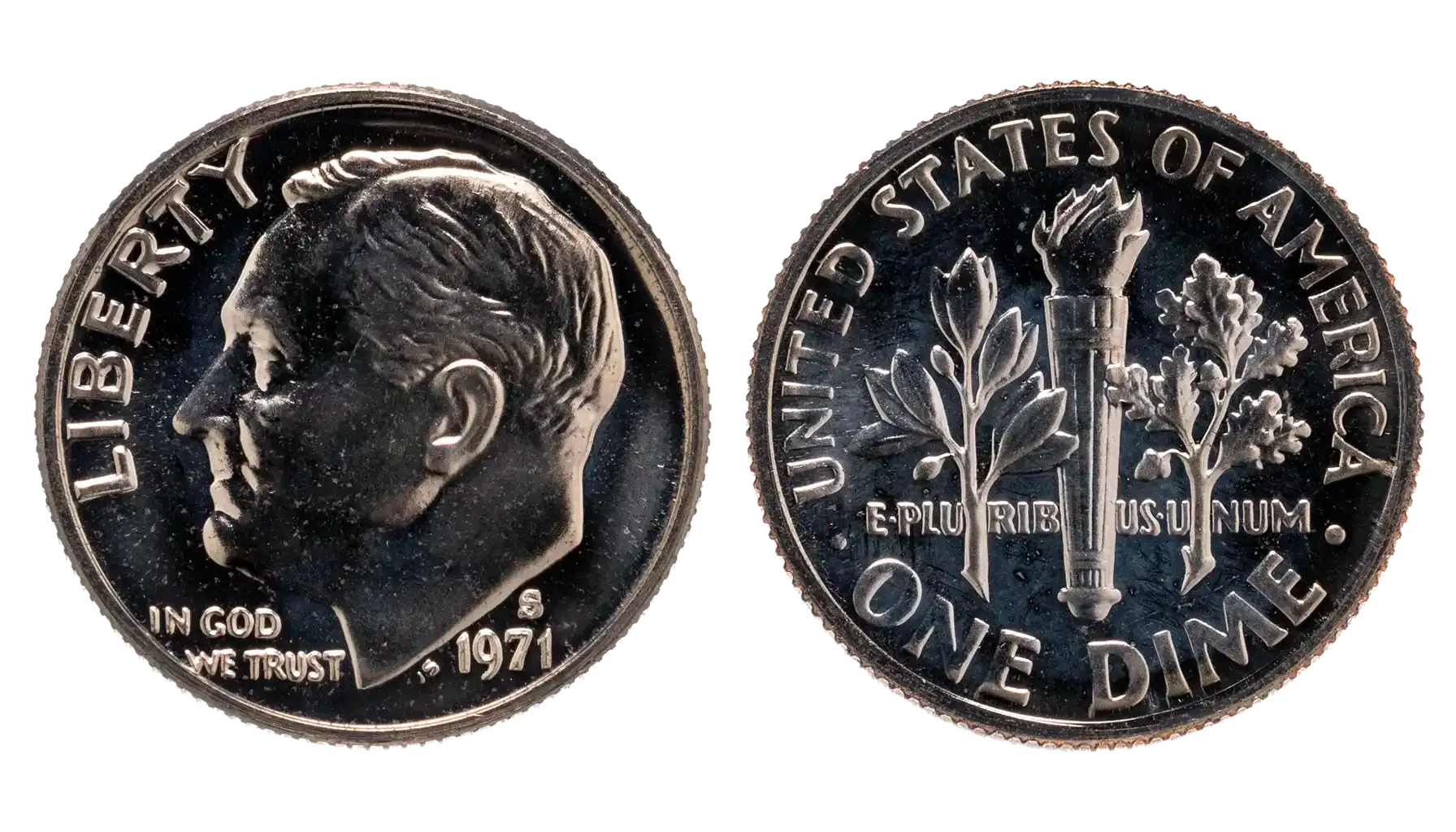
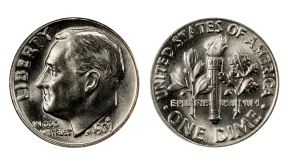
Generally, Philadelphia and Denver made pieces share the same value, even with different mintages. S pieces are all in uncirculated conditions, since they were made as proofs. A common S is more precious than a D and No marks, but in higher grades, the proof pieces are not as valuable.
Generally, the value is not exceptionally high, and the 1972 dime has a similar fate. With time, just like with any older piece, this coin will become valuable. It just needs a bit more time. Check the Philadelphia and 1971 D dime error list with pictures.
Grade | P | 1971 D Dime Value |
MS-63 / 64 | $2–$5 | $2–$5 |
MS-65 | $12–$25 | $10–$22 |
MS-67 | $150–$400 | $135–$350 |
MS-68 | $1,650+ | $1,400+ |
S – PR-69 DCAM – $18–$45
S – PR-70 DCAM – $200–$450
Why Some 1971 Dimes Have No Mint Mark
The three reasons exist:
No S Proof Error
Philadelphia Mint
Struck Through Grease
Philadelphia Mint
Most issues without a mint mark are simply business strikes from the Philadelphia Mint. Until 1980, the Philadelphia Mint did not put a "P" mint mark on Roosevelt items. Mintage is over 162 million.
No S Proof Error
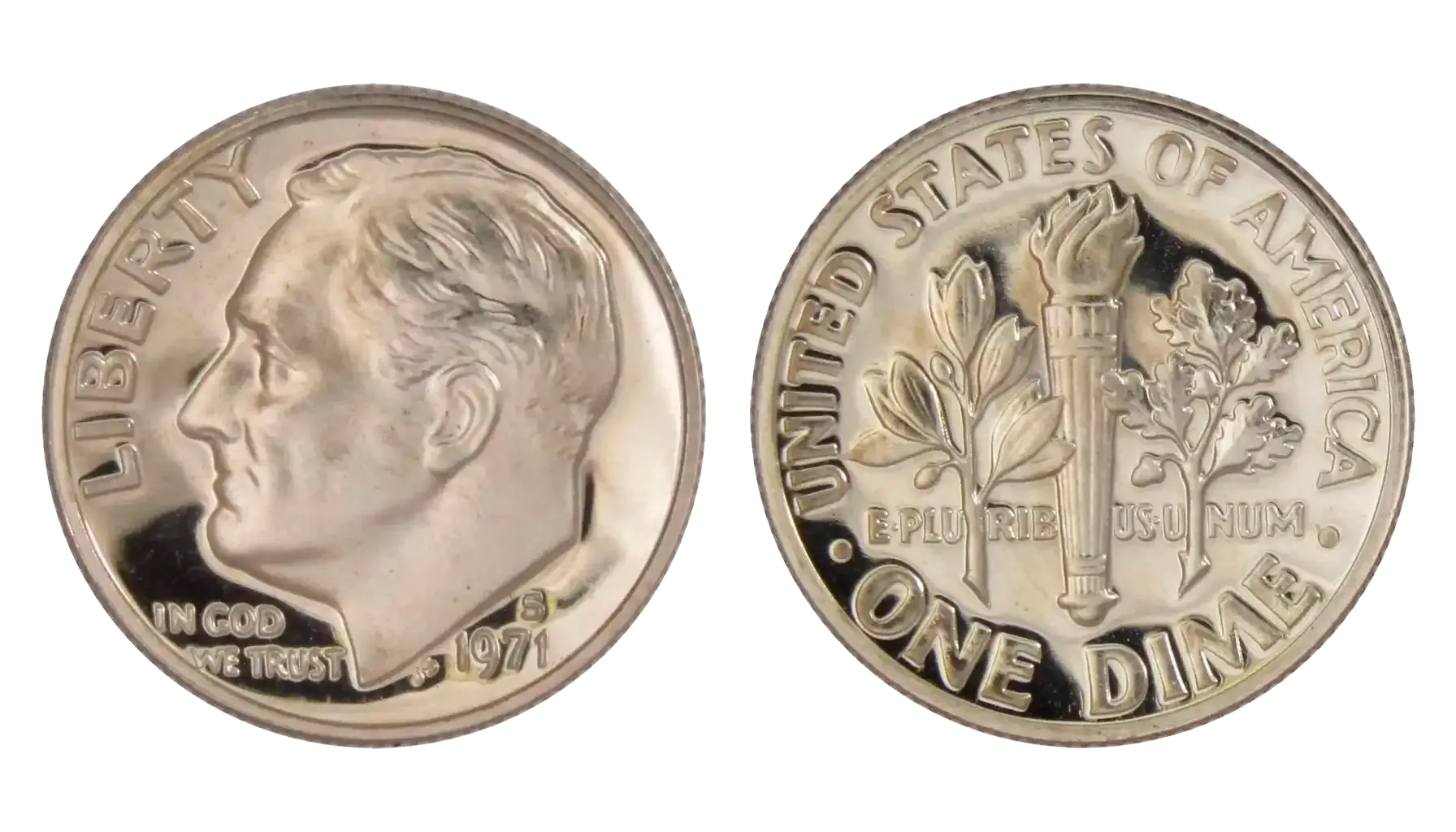
A small number of Proof dies were sent from Philadelphia to the San Francisco Mint without the S mint mark already engraved. These coins were struck with a mirror-like Proof finish but are missing the S mark above the date.
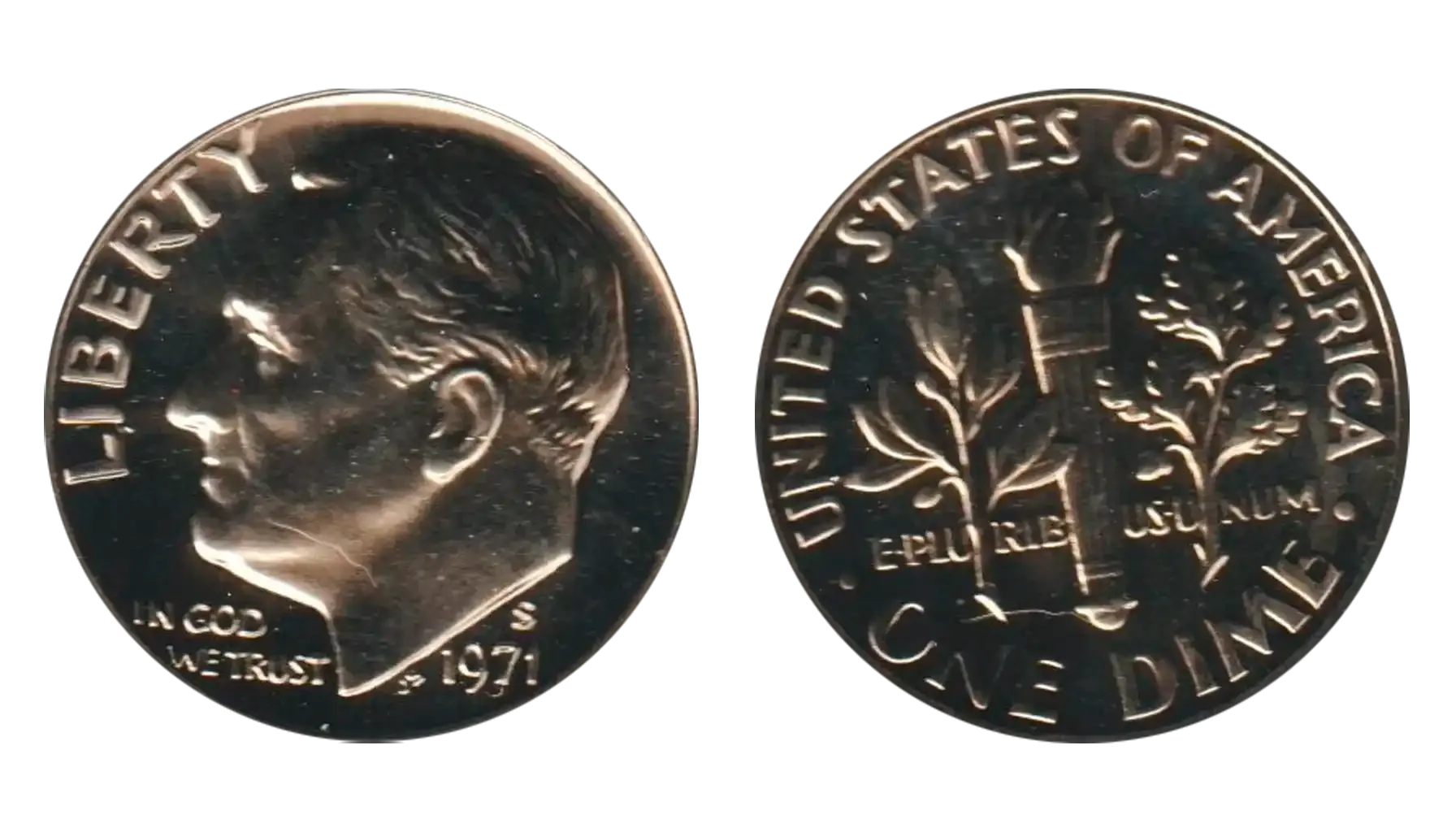
The coin must have a mirror-like, reflective background (field) and frosted details. If it looks like a normal, dull coin from a vending machine, it is not the No S error.
Is a 1971 Dime Worth Anything Above Face Value?
Now that we've seen general 1971 dime no mint mark value estimates for all the mint marks, it's time to understand the value factors. Grading or coin state has a big say when it comes to determining value.
From half-dollars to items, most coins are graded on the scale of 1 to 70, and the higher the number, the higher the price.
"We see intense competition for the 1971-D in MS-67 or higher. At this level, it’s a 'Registry Set' game."
– Ian Russell, numismatist
GreatCollections
Struck Through Grease
Sometimes, a 1971 D dime error value can appear to have no mint mark due to a common striking error. During minting, heavy machine grease can build up in the 1971 dime D cavity of the die. When the coin is struck, the grease prevents the metal from flowing into the mint mark shape.
Under a professional loupe, you will often see a very faint, ghostly outline where the D should be, or the area will look slightly blurry and flat compared to the rest of the coin.
1971 Dime Error List
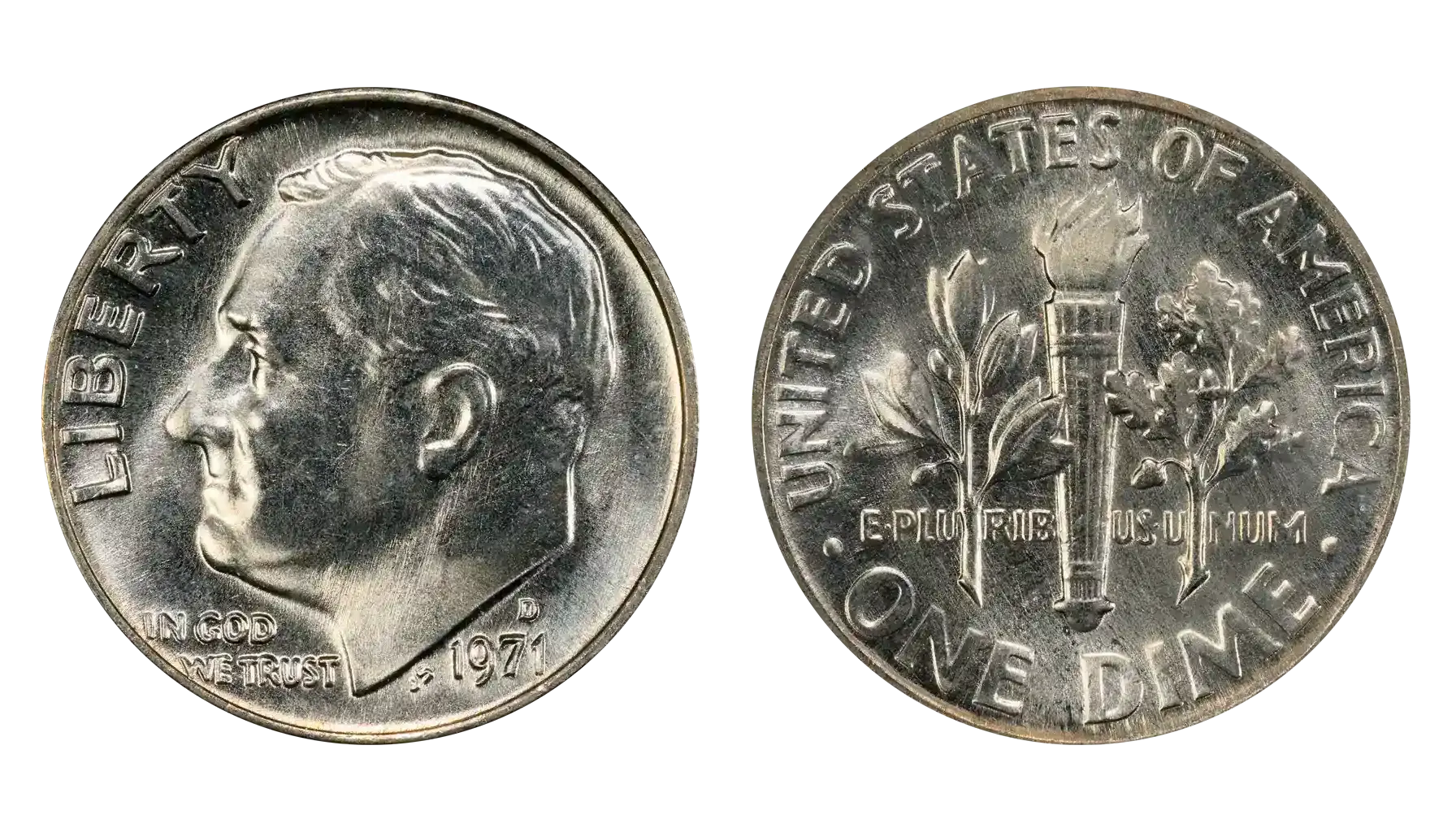
Off-Center Strike
This occurs when the 1971 dime no mint mark blank (planchet) is not properly centered in the press, causing only part of the design to be struck. A portion of the coin is blank and unformed.
$20–$450
Broadstruck Error
A broadstrike happens when the coin is struck without the collar. The coin looks wider and flatter than a normal one, and the edge will be smooth (no ridges/reeds). All design details must still be present on the coin.
$20–$100
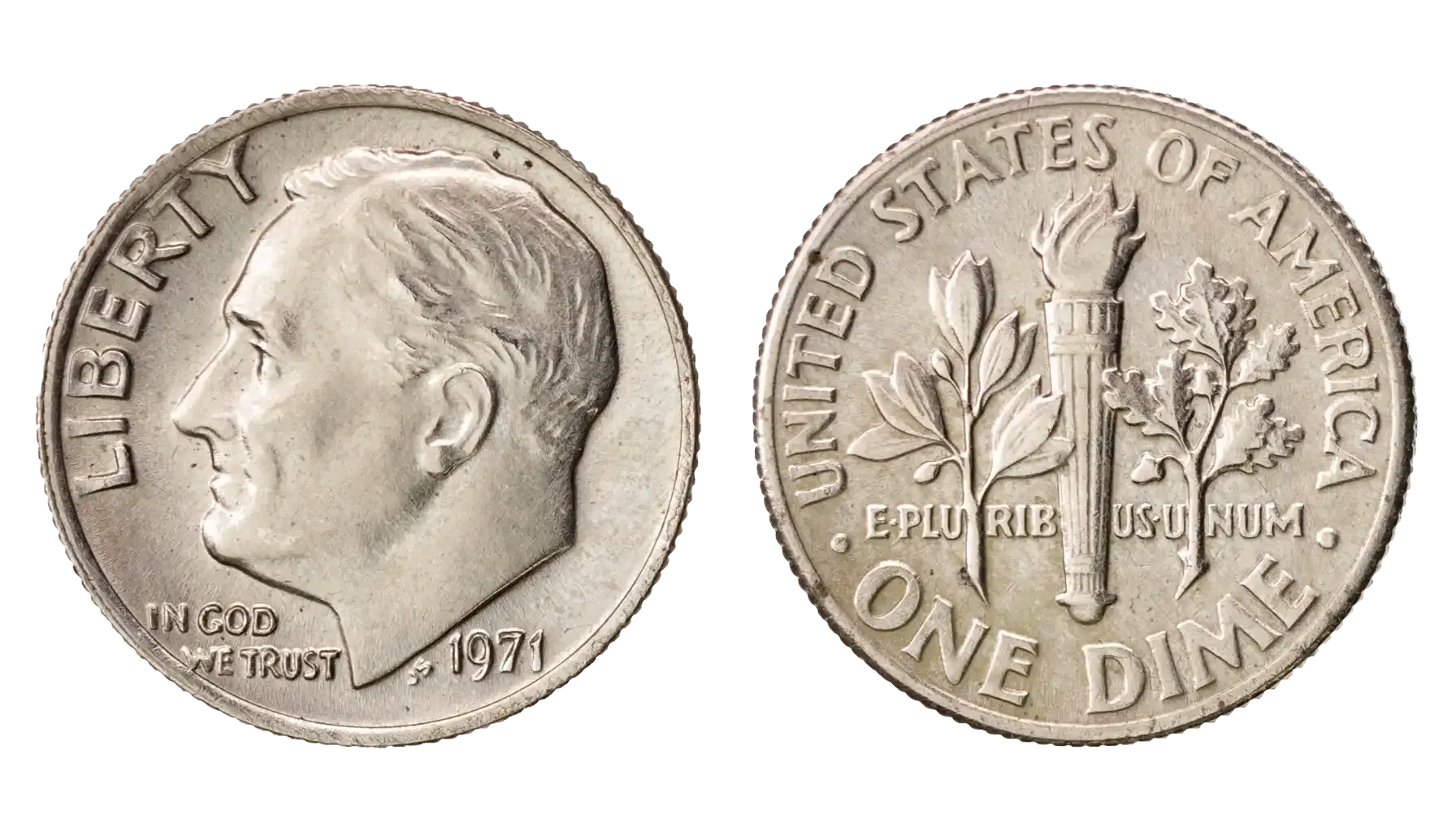
Die Breaks and Cuds
As dies wear out, they can develop cracks. When a piece of the die breaks off entirely, it creates a Cud. A Cud appears as a raised, blank blob of metal attached to the rim of the coin. Small cracks (Die Cracks) look like raised "lightning bolts" across the design.
$10–$50
Clipped Planchet
This error occurs during the production of the blanks. If the cutting machine overlaps with a hole already punched in the metal strip, a clip is created. A crescent-shaped or straight piece is missing from the edge of the coin.
$15–$100
Rare 1971 Dime Errors to Look For
While not technically an error, the Full Bands (FB) designation is the most sought-after strike quality for the year. A 1971 D dime error list MS-68 FB can command over $1,500, making it more valuable than most actual errors.
Error Type | Detailes | Rarity |
No S Proof | Mirror finish and no S mark | High |
Wrong Planchet | An item struck on a Penny (copper color and small) | High |
Double Die | Doubling in “Liberty” or the date | High |
Struck Thru | Blurry areas caused by grease in the die | Middle |
The No S Proof
A small number of Proof dies were sent to the San Francisco Mint without the S mint mark. The coin must have a mirror-like, reflective background. If it has a standard dull finish, it is just a common 1971 no mint mark dime.
$3,500–$5,500+
Missing Clad Layer Error
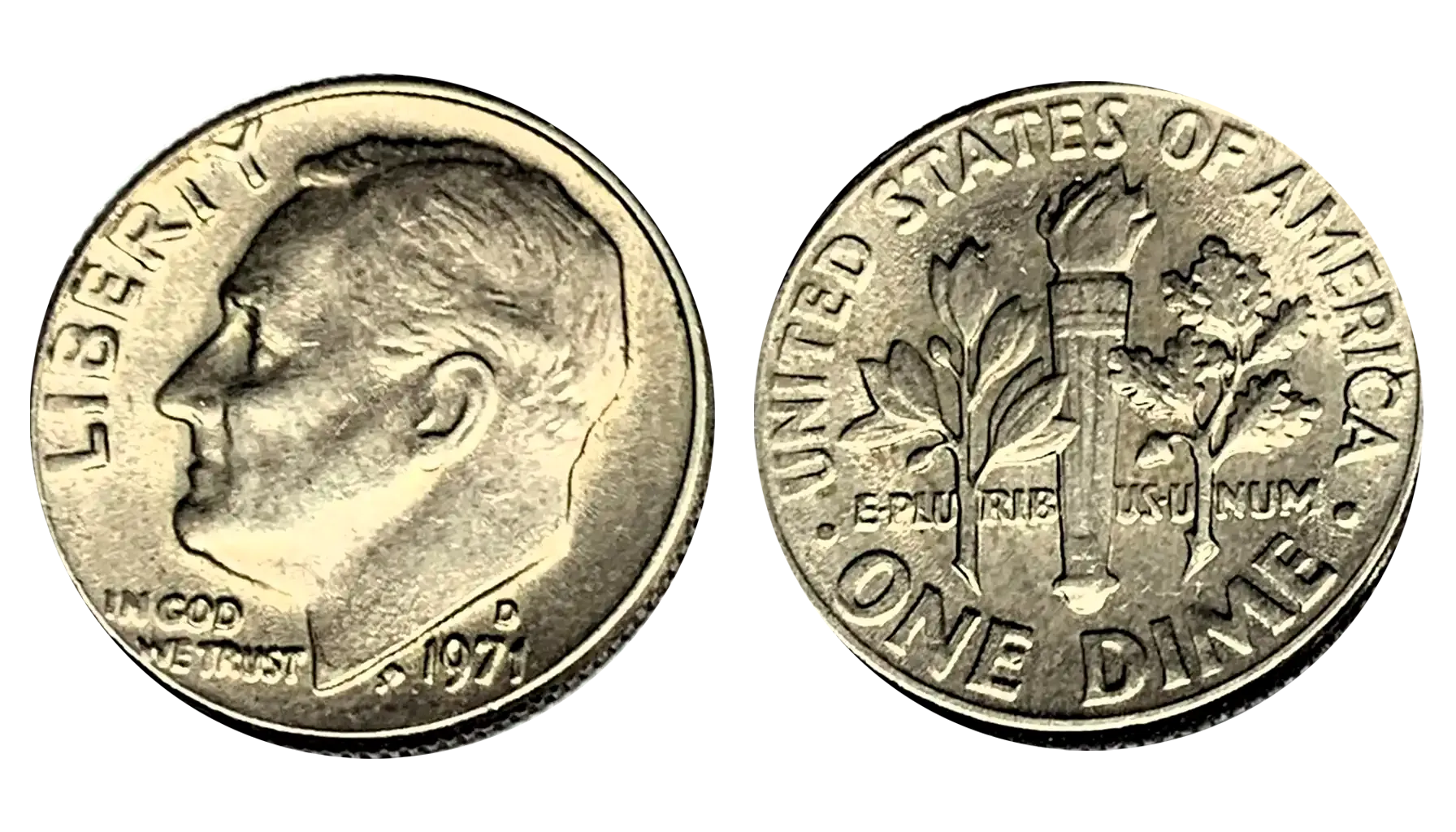
Pieces are a mix of copper-nickel over a copper core. Sometimes, the outer nickel layer fails to bond or peels off before or during the strike. One or both sides of the coin will appear bright copper-red, while the other side may look normal.
$100–$500
1971 Dime Specifications
Weight | 2.27 g |
Diameter | 17.90 mm |
Thickness | 1.35 mm |
Edge | Reeded |
Designer | John R. Sinnock |
Professional numismatists use a specific sequence to check these specs.
Verification Steps
The Weight Test – use a digital scale accurate to 0.01g.
If it weighs ~2.5 g, you might have an older silver planchet (1964 or earlier) struck with a 1971 die (virtually impossible but worth checking).
If it weighs ~1.9 g, it is likely missing a clad layer, exposing the copper core.
The Caliper Check – measure the diameter. If it is wider than 17.91 mm and the edges are smooth, it is a Broadstruck error.
The Edge Look – examine the reeded edge for a copper stripe. If the edge is solid silver-white with no copper core visible, it has been silver-plated or is a rare off-metal strike.
What Makes a 1971 Roosevelt Dime Valuable?
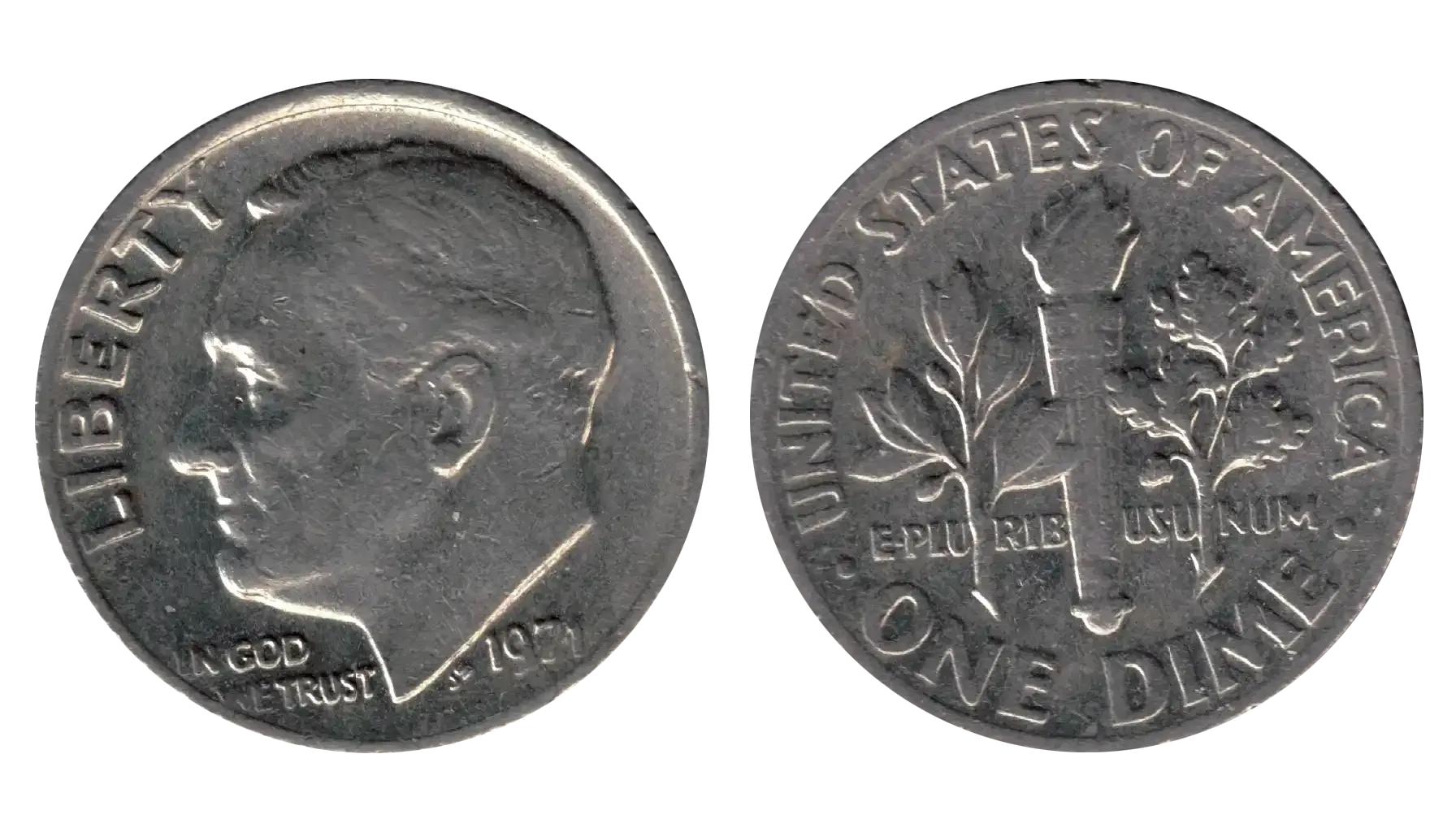
Identifying a valuable Roosevelt item in the actual market is a two-track process: beginners focus on spotting high-value errors, while professionals use technical grading to unlock condition rarity bonuses.
Beginner’s Checklist
No S Proof
Look for a coin with a mirror-like, reflective background. The trap can be if the coin is dull/satin and has no mint mark, it's just a common Philadelphia piece worth 10 cents. It must have that watery, reflective Proof finish to be the rarity.
The “Red” Item
Items have nickel-copper layers. Sometimes the outer nickel layer falls off. Look for a coin that is bright copper-red on one or both sides but has Roosevelt's face on it.
Professional’s Strategy
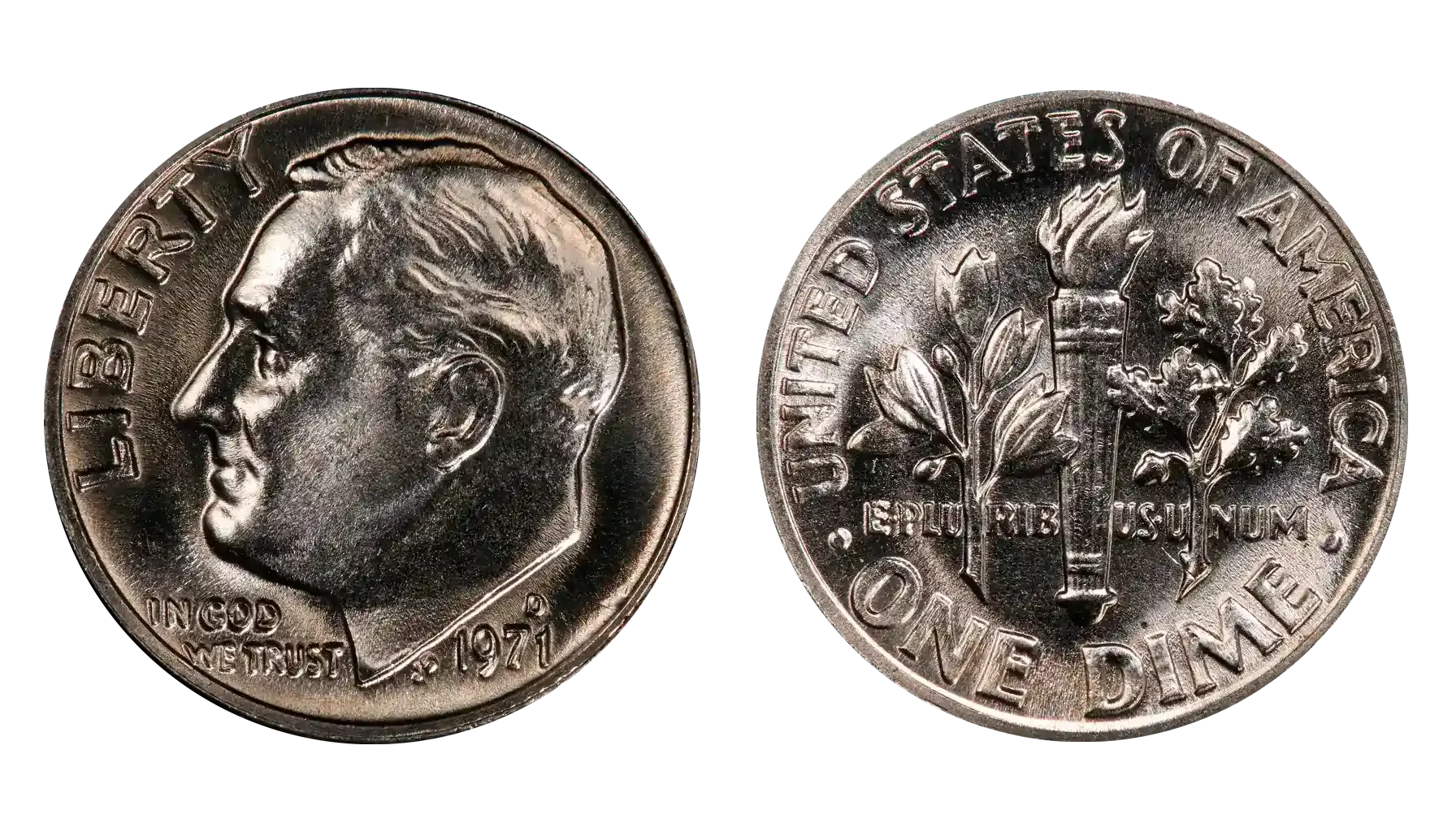
Mint Set
Professionals buy unopened 1971 Mint Sets usually in blue envelopes rather than searching circulation. Search these sets for top candidates with zero scratches on Roosevelt's cheek. Hit a grade of MS-68. Because the 1970s had poor quality control, an MS-68 is a true rarity that can command $1,600+ at auction.
Toning
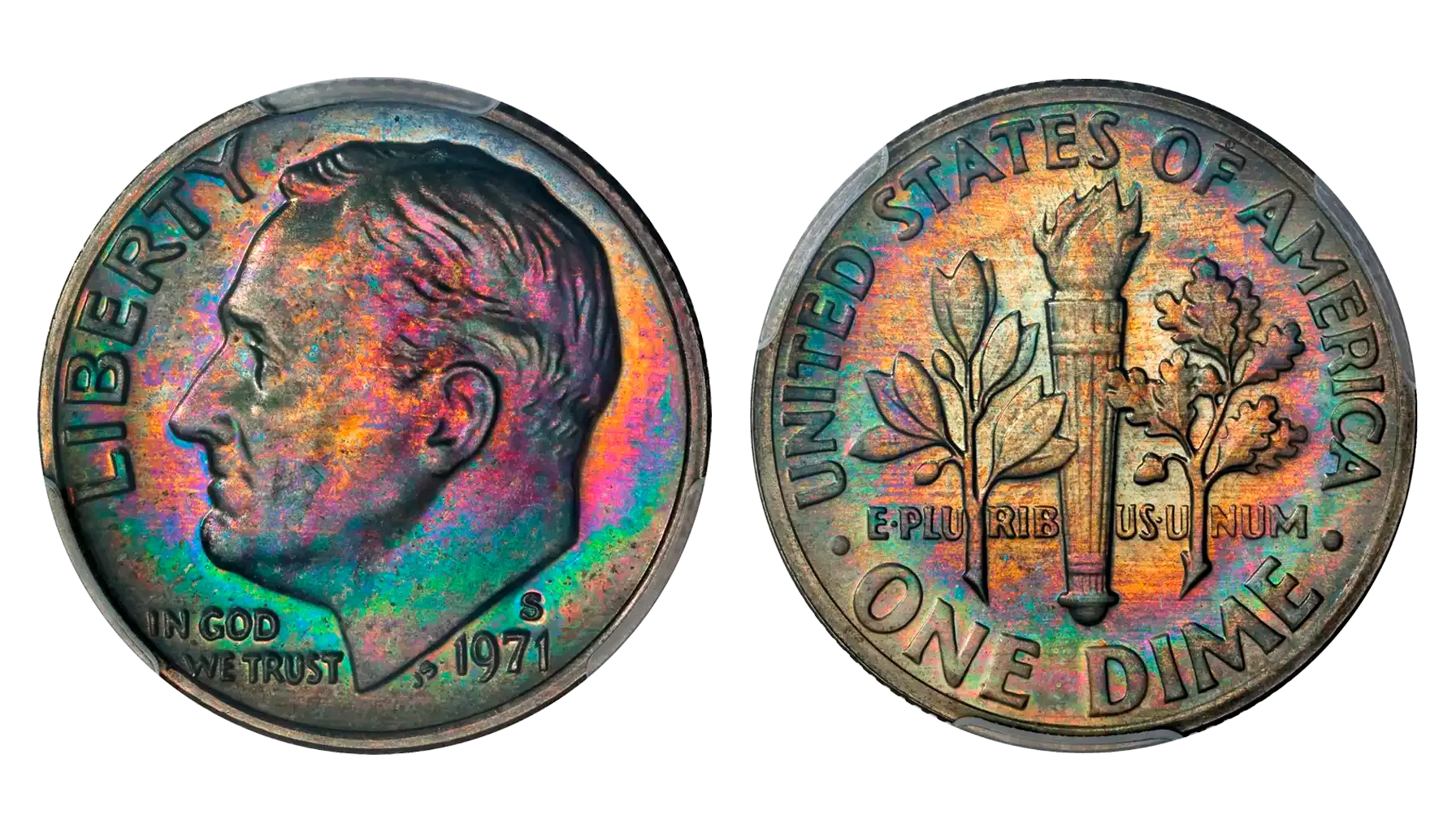
Look for coins with rainbow toning - vibrant blues or golds. Numismatists are paying 20–30 % more for coins with natural, attractive toning, even if the grade is slightly lower.
How to Identify a Valuable 1971 Dime
To move beyond basic hunting, a professional setup is required.
10x–20x Triplet Loupe – essential for checking Full Bands on the reverse torch and verifying doubling on the date.
Digital Scale (0.01g Accuracy) – standard weight is 2.27g. A coin weighing ~1.8g suggests a valuable missing clad layer.
Digital Calipers – used to verify the standard 1.35 mm thickness. Thinner coins with a copper color are likely errors.
Digital Microscope (LCD/USB) – the only reliable way to confirm the No S Proof or subtle Double Die varieties.
Nitrile Gloves – to prevent skin oils from damaging a potential MS-67+ piece.
Fake Silver Trap
Numismatists often find an issue that looks exceptionally white or silver and think it is an off-metal strike on a silver planchet. In reality, most silver-looking pieces are simply high-luster uncirculated coins or, more commonly, coins that were silver-plated in a science experiment or for jewelry.
You should make a test – look at the edge. An ordinary clad item has a visible copper stripe. If the edge is solid silver, weigh it. A standard clad one weighs 2.27g; a 90 % silver one weighs 2.50g. If it weighs 2.27g but looks silver, it's just plating.
Where to Sell or Appraise a 1971 Dime
GreatCollections
GreatCollections is an online auction platform that specializes in certified coins. They are currently a market leader for Roosevelt issues because they reach set collectors who are willing to pay thousands for a single point of grade. They handle all the imaging and financial transactions, and their fees are lower than those of larger heritage auction houses.
NGC or PCGS Authorized Dealers
Use the NGC Dealer Locator or PCGS coin grading service and Authorized Dealer directory to find a local expert. These shops have the technical equipment to verify if your 1971 dime is a genuine No S rarity or just a common Philadelphia strike.
A reputable dealer will provide a professional opinion and can submit the coin to a grading service for you. This is the safest way for a beginner to avoid collector traps.
Heritage Auctions or Stack’s Bowers
These are the world’s largest numismatic auctioneers. They hold massive, multi-day events often coinciding with major coin shows. They provide the most extensive marketing and global reach. If your item is the best, these houses will generate the maximum level of competition among the world's wealthiest collectors.
FAQ
Should a 1971 dime have a mint mark?
The item should have a mint mark, but only from Denver and San Francisco.
What is a 1971 dime with no letter?
The item is an ordinary piece from Philadelphia.
What makes a 1971 dime valuable?
The high mint 68 and pieces with the Full Bands are always more valuable.
Is there silver in a 1971 dime?
The item contains zero silver, only copper and nickel.

 Facebook
  X (Twitter)
  Pinterest
  LinkedIn