Contents:
Certainly, among each coin collection there are specimens that are more or less valuable and rare. The question is, what determines their rarity and is it possible to do it yourself?
Fortunately, if you are worried about your knowledge, the coin value checker online will be the basic guideline, but nevertheless, at offline auctions, true numismatists know how to determine everything by eye.
Historical Background of the 1901 Morgan Dollar
The Morgan Dollar was struck from 1878 to 1904, and then again in 1921, but the 1901 one belongs to the last striking period, preceding the temporary stop of production because of silver shortage under the Sherman Act.
Minting History in 1901 and Context
The year 1901 saw the U.S. Mint continuing work under the Bland-Allison Act of 1878 and the Sherman Silver Purchase Act of 1890 made the US government buy and strike a certain amount of silver into silver dollars every month.
And by the start of the 20th century, much of this silver was already used.
Striking in 1901 took place at two Mints: Philadelphia with no mint mark and New Orleans with mark O.
Among collectors, the 1901-P coin is famous because of its critically low survival rate in Uncirculated condition, most of the struck coins were either spent, leading to wear, or later melted under the Pittman Act of 1918, or poorly stored in government vaults.
The low striking quality of the 1901-O coin also limits the number of high-grade examples, having a weak strike and low luster often.
Design Elements, Silver Content, and Specs
George Morgan designed this rarest Morgan Dollar:
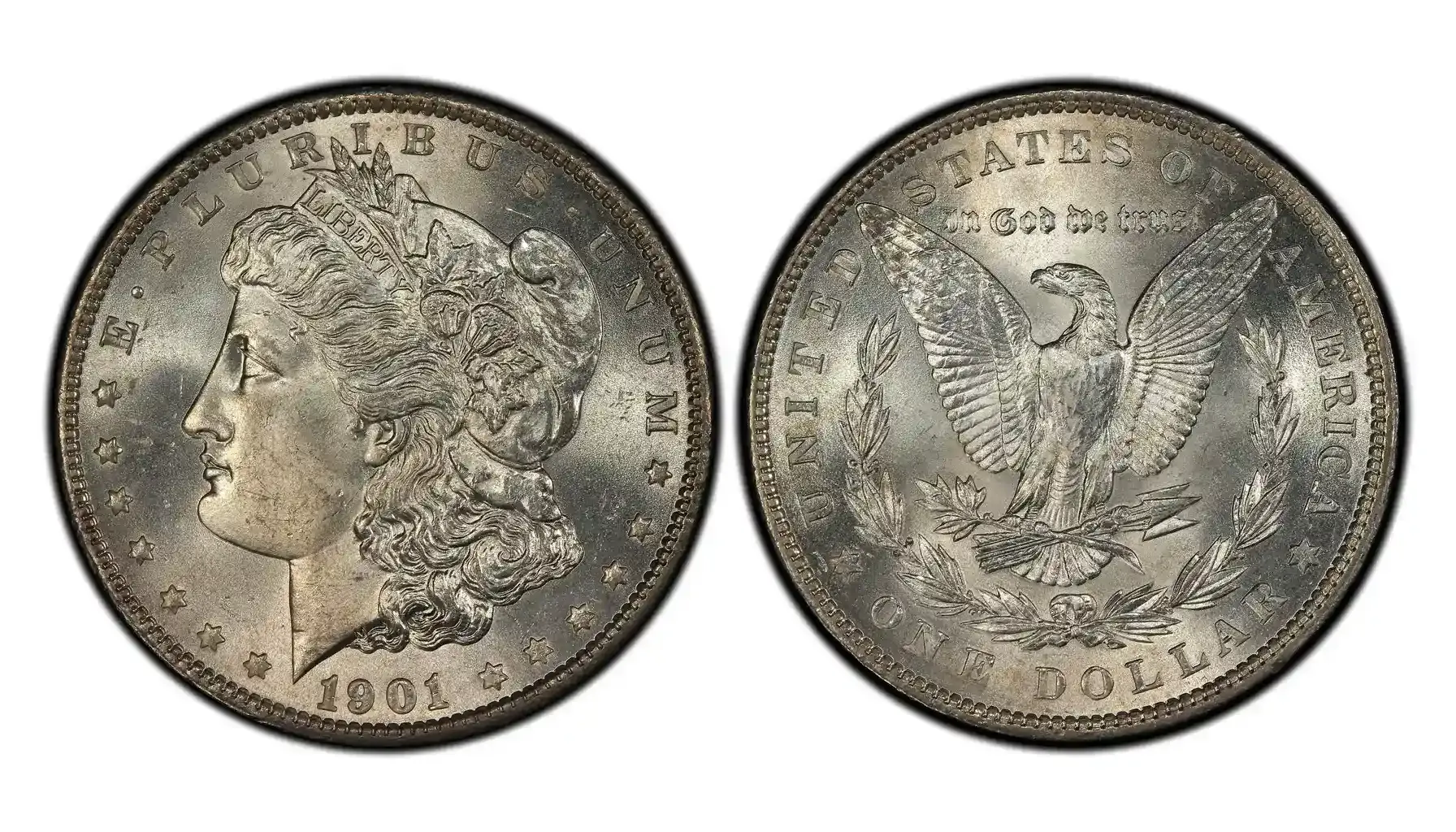
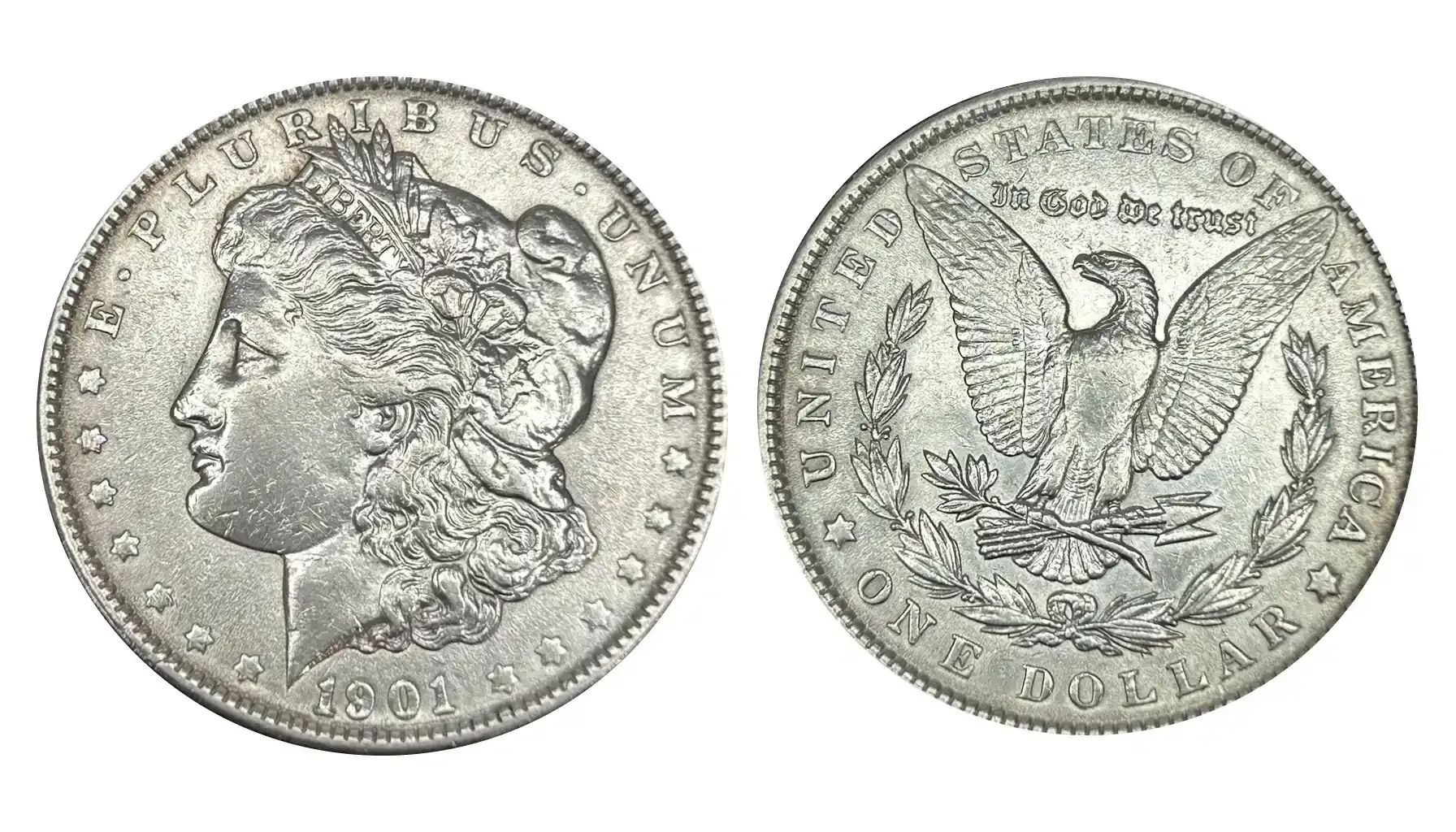
The obverse has a profile image of Lady Liberty, facing left, she wears a Phrygian cap decorated with cotton and wheat and with 13 stars above her head.
The E PLURIBUS UNUM are at the top edge.
The year is at the bottom.
At the same time, the reverse has a bald eagle with wings open holding the olive branches and arrows.
The UNITED STATES OF AMERICA and ONE DOLLAR are above the eagle.
Specs:
Metal Content: 90% silver, 10% copper
Weight: 26.73 grams
Pure Silver Weight: 24,05 grams
Diameter: 38.1 mm
Edge: Reeded
Mintage, Survival, and Distribution
Mint | Mintage |
Philadelphia | 6,962,000 |
New Orleans | 13,320,000 |
San Francisco | 2,284,000 |
Despite a large mintage, the actual number of coins surviving in MS-65 condition is one of the lowest in the whole Morgan series — numismatic experts estimate the total number of 1901-P coins certified MS-65 as less than 300 pieces.
However, the New Orleans Mint had technical problems, specifically a regular weak die strike — the design details, such as Liberty's hair strands and the eagle's breast feathers, were not fully struck, so, it lowers the number of pieces certified MS-65 and MS-66.
In addition to the main tokens, there is also a variation from San Francisco, the number of such coins is 2,284,000.
“Is it true that President Hayes was opposed to the Morgan silver dollar being issued?
The Bland-Allison Act was vetoed in early 1878 by President Rutherford B. Hayes (1877-1881) due to Hayes’ concerns that the bill would negatively impact the government’s ability to fulfill monetary contracts. Hayes said the silver coin’s value was overstated by 8 to 10 percent. Congress overrode his veto, then ensured Hayes was presented with the first strike.”
— Richard Giedroyc, a professional journalist with more than twenty-five years of experience in coin collecting
Numismatic New
Mint Marks & Identification of 1901 Coins
Finding the striking location is vital for setting the value of a 1901 Liberty Silver Dollar.
Where Is the Mint Mark on 1901 Dollar Coin
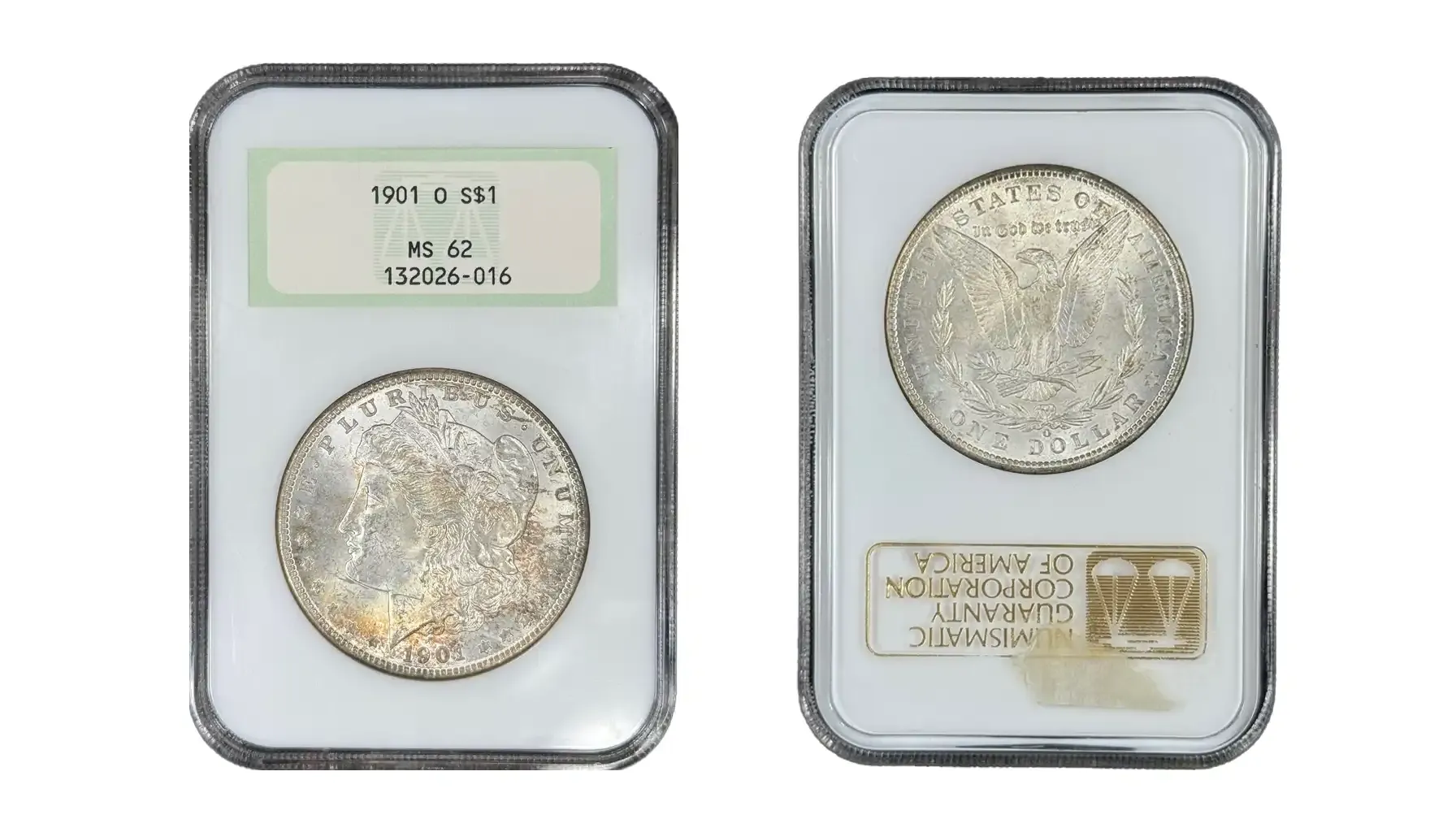
The Mint Mark on all Morgan Dollars is on the reverse side below the wreath, located above the eagle.
It is right over the letters D and O in the word DOLLAR.
Identifying 1901 Coins:
Philadelphia: Those were not marked
New Orleans: Has a clear O
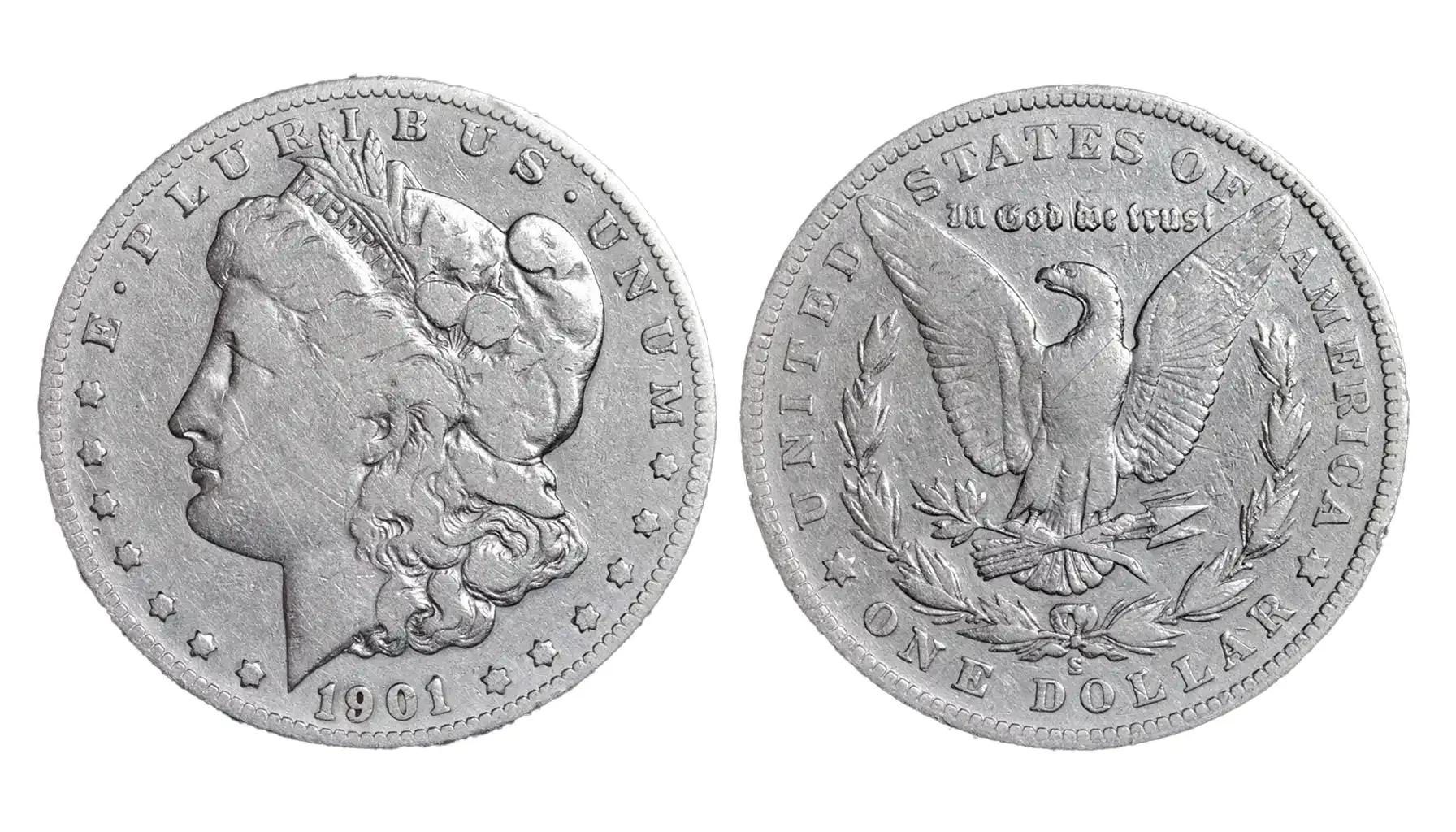
San Francisco: Has S
1901-P and 1901-O Differences
Philadelphia usually has a stronger, clearer strike compared to New Orleans tokens, except in areas where the dies became worn. Problems with this date are more about the actual physical survival of the mintage, not the initial striking quality.
New Orleans coins often look like soft details on the front and, more clearly, on the back because of this strike problem, getting a high grade (like MS-65) for the 1901-O is hard.
Visual Examples
If the token has been used up, the wear will be noticeable in the highest places of the pattern: on the hair above the forehead, on the cheekbone and on the eagle feathers on the reverse.
Some without circulation should have a strong sheen, reminiscent of a wheel that turns when you tilt the piece slightly in the light.
As for the 1901 coin, pay attention to the details of the eagle image. If the feathers on the chest look flat or blurred, this is a sign of a weak stroke.
1901 Morgan Silver Dollar Value by Mint & Grade
Remember that no matter how much a coin you have identified or bought does not look beautiful, it must correspond to the school of assessment. Sometimes even shiny coins with the slightest scratch drop in price, and this is nominal for numismatics.
Market Value
Grade | 1901 | 1901-O |
G-4 Good | $40 | $40 |
VF-20 Very Fine | $60 | $55 |
AU-58 About Unc | $150 | $120 |
MS-63 Mint State | $500 | $300 |
MS-65 Gem BU | $7,500 | $2,000 |
MS-66 | $40,000 | $8,000 |
MS-67 | $150,000+ | $20,000+ |
The 1901 silver dollar value can change based on market demand, condition, grading, and the specific characteristics of individual tokens.
1901 vs 1901-O value
For the Low Grades the value difference is small because the pieces are easy to find.
Speaking on MS-63 and MS-64 Grades — the 1901-P coin is more expensive, reflecting its general rarity in uncirculated condition compared to the larger mintage of the 1901-O.
An MS-65 coin issued in 1901 can cost 3-5 times more than an MS-65 issued in 1901, because despite the fact that both coins are difficult to obtain in MS-65, the actual certified number of pieces issued in 1901 in MS-65 is one of the most the lowest in the entire Morgan series.
As for the 1901‑S Morgan Silver Dollar, a token in a heavily worn condition costs from $15 to $25.
High-quality pieces can be priced at $10,000 or more, but as a rule it is simply impossible to find such.
Recent Auction Results
In 2023, a 1901 certified PCGS as MS-66 sold at a big auction for $145,000. In 2024, another MS-66 piece sold for $132,000.
In 2024, an 1901-O MS-66 example (NGC) sold for $10,500.
In 2024, stable sales were seen for 1901 in the $7,200 – $8,000 range. At the same time, 1901-O MS-65 coins sold in the $1,800 – $2,200 range.
Grading Tips for 1901 Dollars
In any assessment, attention to detail is important and there is little average picture. Many professionals use special devices and even microscopes just to verify the grade of their token.
Key Factors
Liberty's hair strands above the ear and forehead; the eagle's feathers on the chest and wings; the letters in In God We Trust.
A weak strike automatically keeps the coin out of the highest grades.
Signs of wear as dullness on high spots will lead to an AU grade or lower.
For MS-65 grade, the coin should have a minimum number of small, hard-to-see marks.
Checklist Before Sending to Grader
Before sending the coin to one of the main grading companies (NGC/PCGS), use a strong, direct light source to find the luster and marks.
Look at the high-relief spots — if the shine is dull or the metal looks flat, it is circulated.
Make sure the feathers on the eagle's chest have clear lines, as if they are not fully struck, the coin likely will not get MS-65, even if it looks perfect.
NGC/PCGS Certification
You should only send a coin for professional certification if it has the chance to get a grade where the price premium is higher than the cost of the service.
Sending them for grading is usually not smart, unless the coin is a key date or has a rare variety, and 1901-P and 1901-O in these grades don't need certification.
If your check shows the coin has MS-63 potential or higher, certification is strongly advised.
Rare Varieties and High-Value Examples
As you know, the value of the variation largely depends on the mint, which is logical, because coins with a huge circulation are easy to find, but the public is ready to compete for rare pieces.
Known Die Varieties
The 1901 No Mint/S coin is hard to find in high grades, and it doesn’t have many famous and valuable varieties.
The 1901 dollar coin value is mostly set by the date and grade, not the variety.
Errors Boost Value
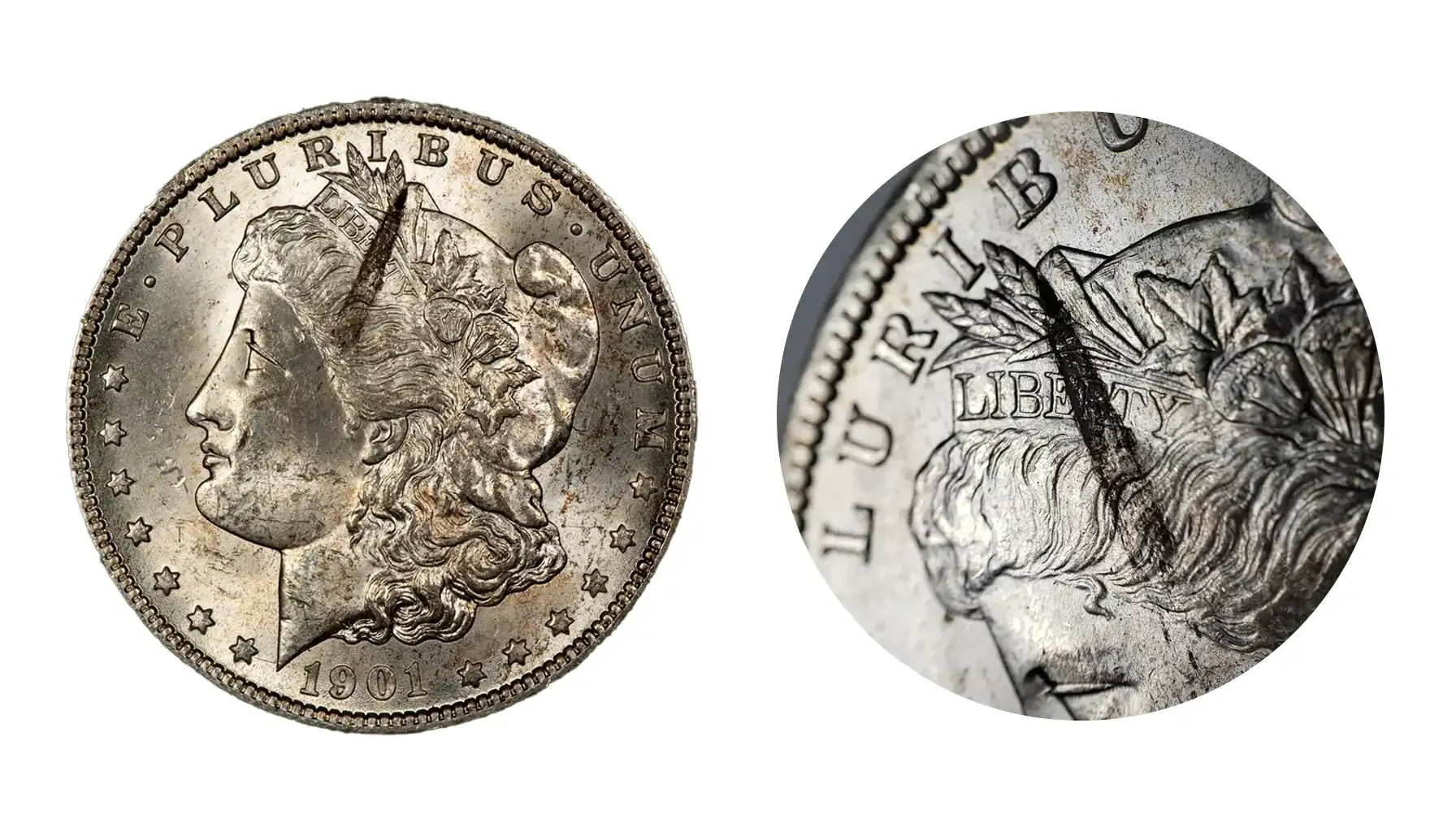
Off-Center Strike: The coin was struck off the center of the planchet, and the more the coin is off-center, the higher its value becomes.
Clipped Planchet: A small part of the planchet is missing, making the coin look like a half-moon, and the final value depends on the size of the missing part.
Struck Wrong Planchet: The coin was mistakenly struck on a blank meant for other money, and if found, such a 1901 example will be extremely valuable.
Double Die: The coin was hit by the die two times, causing an overlapping image of the design.
Notable from Auctions
1901-P MS-67 grade coins sell for prices over $150,000 often. In 2021, one of the best-known examples sold for $168,000.
1901-O Prooflike/Deep Mirror Prooflike coins are not technically "proof" coins, but they have reflective fields.
1901-O examples with a strong DMPL contrast in MS-64 or MS-65 can sell for a big premium over standard coins of the same grade.
For example, a 1901-O DMPL MS-65 can cost up to $4,000, being twice the price of a standard MS-65.
FAQ
How much is a 1901 silver dollar worth today?
The value goes from about $40 to over $150,000, and ones in average AU-58 condition cost about $120–$150.
Is the 1901-O Morgan dollar rarer than 1901-P?
No. Looking at the total mintage and survival in circulated condition, the 1901-O is not rarer.
Where is the mint mark on a 1901 dollar coin?
The mint mark is on the reverse, below the wreath — it is over the D and O in the word DOLLAR.
What is the silver content of the 1901 Morgan Dollar?
The total weight of the token is 26.73 grams, corresponding to 24.05 grams of pure silver.
Which 1901 coins command the highest premiums?
1901-P examples in MS-66 grade are among the most expensive in the series.
How to authenticate my 1901 Morgan dollar?
If the piece looks unreleased and has no obvious defects, it is better to send it for professional certification to NGC or PCGS to check its authenticity.
Should I submit it for grading?
You should send the token for grading if you think its condition is MS-63 grade or higher. With the 1901 one dollar coin value of an MS-65 one being much more than $2,000 for 1901-O and $7,500 for 1901-P.

 Facebook
  X (Twitter)
  Pinterest
  LinkedIn