Contents:
There exists a Holy Trinity of American numismatic creations of the past: the 1913 Liberty Head nickel, the 1804 silver dollar, and the 1894 S Barber dime. Of these three, the dime is the one surrounded by rumors, mysteries, and a near-mythic aura that turns a regular coin into something with an astonishing legacy and price.
An extremely small mintage, obscure origin, the low rate of survival, fiercely documented provenance – these are the key factors that separate it from the rest. But why exactly are 1894-S dimes so extraordinary? What are the auction records, and where to check coin value so as not to make a bad bargain?
The History Behind the 1894 Barber Dime
The 1894-S dime belongs to the era of Barber coinage, designed by U.S. Mint Chief Engraver Charles E. Barber. In fact, it was introduced in the 1890s across dimes, quarters, and half dollars, and the first 10-cent coin in the series was the 1892 Barber dime. Although the main part of these numismatic creations was rather mundane, the 1894-S variety, produced by the San Francisco Mint, was different.
According to statistics, only 24 pieces were struck, but why so? There exist a few theories that cannot be either proven or refuted (this is the mystery numismatists have been talking about for years):
As per the report of the Mint's superintendent, John Daggett, these were struck to balance the San Francisco Mint’s books after an audit revealed a $2.40 discrepancy (24 dimes × 10¢).
Another theory suggests that the dimes were made as special presentation gifts for prominent bankers or other influential associates.
According to other rumors, they might have been produced as a small die trial or Proof test run.
A Guide Book of United States Coins also mentions that the dimes might have been meant for assay and administrative needs, which is why the run may have been partly procedural rather than commercial.
By the way, here is a famous anecdote: some believe that John Daggett gave a few examples to his daughter, Hallie, with the purpose of saving them. However, she spent one on ice cream and sold the others years later. Now, this story is part of the coin's identity: no matter the legacy, these are only pieces of metal used in trade.
Design Features and Specs
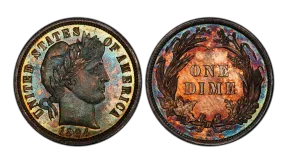
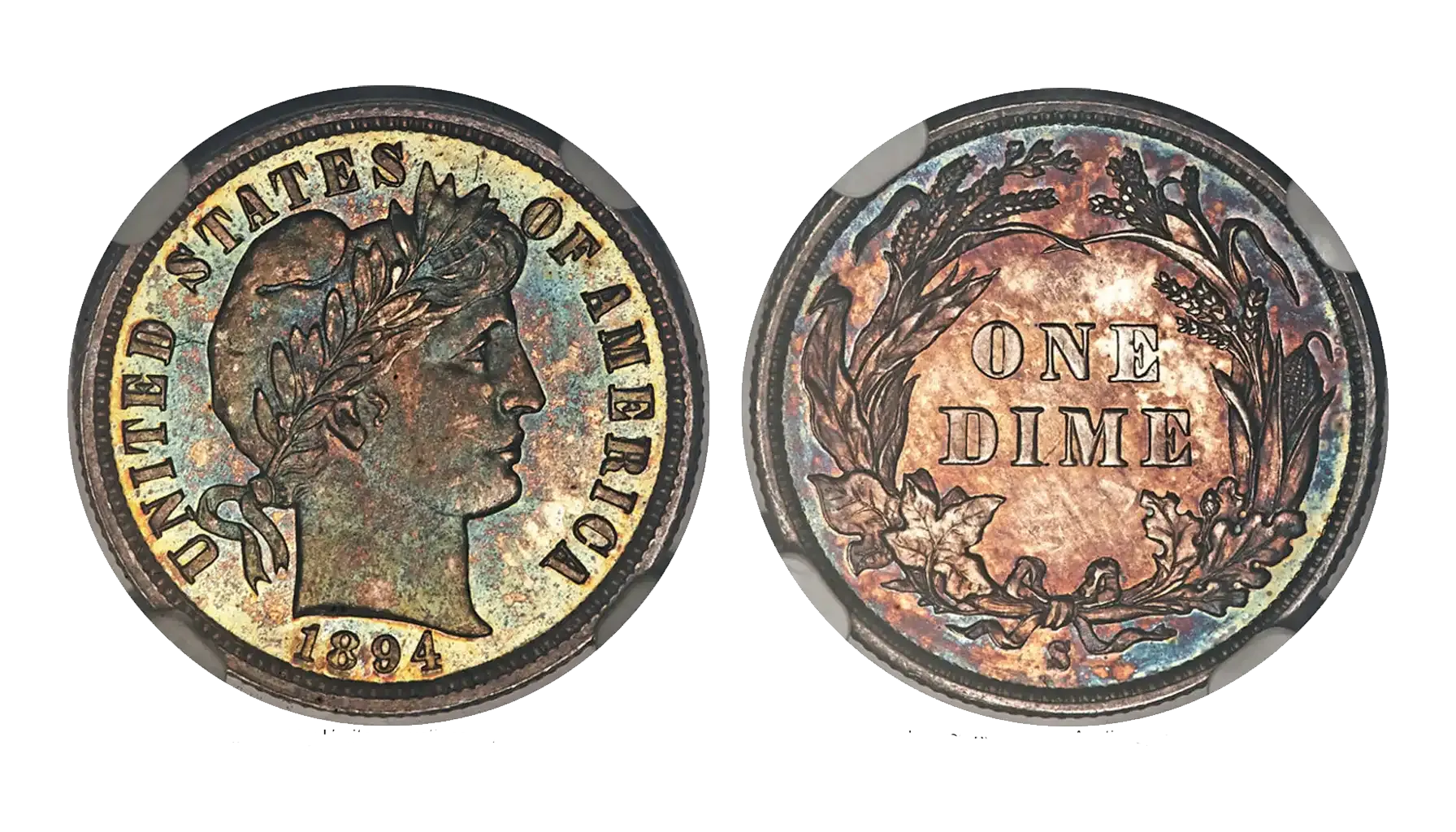
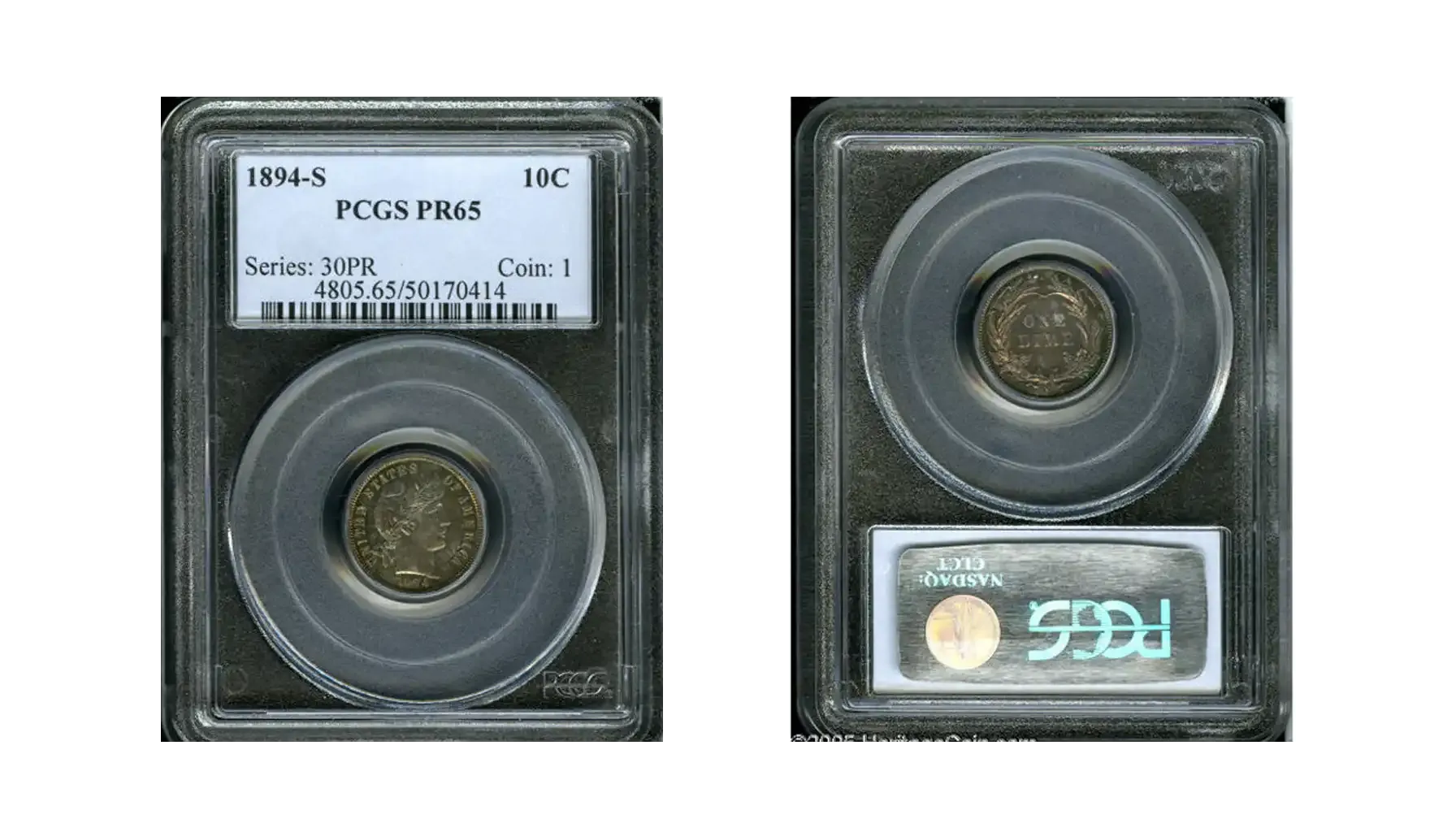
Obverse: The front side features the classic bust of Liberty (her hair is tucked beneath a Phrygian cap and crowned with a laurel wreath), as well as the inscription “LIBERTY” located on the narrow headband across the forehead, “UNITED STATES OF AMERICA” along the upper rim (almost full circle), and the year of mintage "1894" below.
Reverse: The back, on its part, demonstrates the denomination “ONE DIME” surrounded by an agricultural wreath composed of corn, wheat, maple, and oak leaves, along with the mint mark "S" at the "6 o'clock" position.
The Main Features | |
Denomination | 10 cents |
Composition | 90% silver, 10% copper |
Fineness | .900 |
Weight | 2.50 g |
Diameter | 17.90 mm |
Thickness | 1.35 mm |
Edge | Reeded |
Strike Type | Proof |
1894-S Dime Mintage and Survival Rate
Recorded mintage: 24 pieces
Mint records suggest that the San Francisco Mint released only 24 pieces, and all of them were made as a proof type.
Survival: about nine confirmed today
The mintage of 24 units of currency does not mean that all of them were preserved and kept in private/governmental hands. In turn, most numismatists state that there are only nine examples confirmed to exist (though two of them are heavily worn due to intense circulation).
“...In various catalogs, Stack's has kept track of pedigrees that have been published each time they offered one of these specimens. Each of the Breen references gave a pedigree listing of 12 different coins. David Lawrence listed 10 examples, and now it is believed that just nine of these coins actually exist, and even one or two of those are suspect…”
— Ron Guth, respected numismatist, licensed Certified Public Accountant
PCGS CoinFacts
1894-S Barber Dime Value at Auction
Since there are only 9 specimens reported to exist today, it is hard to track the most accurate and equitable 1894 dime value – the same variety could have been sold for a few times in a row. What one should know is the fact that the prices of the same 1894-S barber dime for sale may change (and they are likely to grow).
Auction record = highest public price shown, but the 1894 S Barber dime value may be higher anyway.
Year (Month) | Auction house | Specimen/identifier | Grade (as reported) | Price realized |
1996 (May) | Bowers & Merena (Eliasberg) | Eliasberg sp. | Proof 65 (as cataloged) | $451,000 |
2005 (Jan) | Heritage (FUN) | “Daggett”/“Lawrence” sp. | Proof 65 (reported) | $1,035,000 |
2005 (Mar) | David Lawrence (Richmond Collection, Part III) | Richmond sp. | (reported in pedigree sources) | $1,322,500 |
2007 (Oct) | Stack’s (72nd Anniversary) | Gillespie sp. | PR64+ (reported) | $1,552,500 |
2016 (Jan) | Heritage (FUN) | Finest-known example (widely cited) | PR66 PCGS CAC | $1,997,500 |
2019 (Aug) | Stack’s Bowers (ANA) | “Buss/Morgan” sp. (often cited) | PR63 PCGS CAC | $1,320,000 |
2020 (Sep) | Heritage | (notable high-grade example) | (reported) | $1,500,000 |
2020 (Dec) | Stack’s Bowers (Miller Collection) | Eliasberg-related pedigree line (often cited) | (reported) | $1,440,000 |
2025 (Jan) | Heritage (FUN) | Record-setting PR66 example (as reported) | PR66 PCGS CAC | $2,160,000 |
How to Identify a Genuine 1894 S Dime
So as to define the 1894 S dime value, it is important to make sure that the coin is genuine and not a counterfeit. And this usually comes down to correct diagnostics and credible certification/provenance.
Starts with the specs
The most obvious step is to verify the compliance with the reported specifications, i.e., composition (90% silver and 10% copper), weight (2.50 g), diameter (17.90 mm), and a reeded edge. Any deviation should be treated as a red flag, though wear and minor variations may still take place.
Check the date and design details
Focus on date shape and spacing – these should be consistent and natural-looking, especially when compared to other Barber dimes. Besides, do not forget that this coin is meant to be Proof, so it should feature a reflective field, crisp rims, sharp details, and the like.
Confirm the "S" mint mark placement
On a 1894-S dime, the mint mark is always positioned on the reverse, beneath the wreath. That location is non-negotiable.
Appeal to third-party grading services
The easiest way to check the origin of the coin is to consult reputable grading services like PCGS, NGC, or ANACS. Besides, this is when the 1894 Barber dime value becomes stronger, thanks to the official documents attached.
Quick Check with Coin ID Scanner
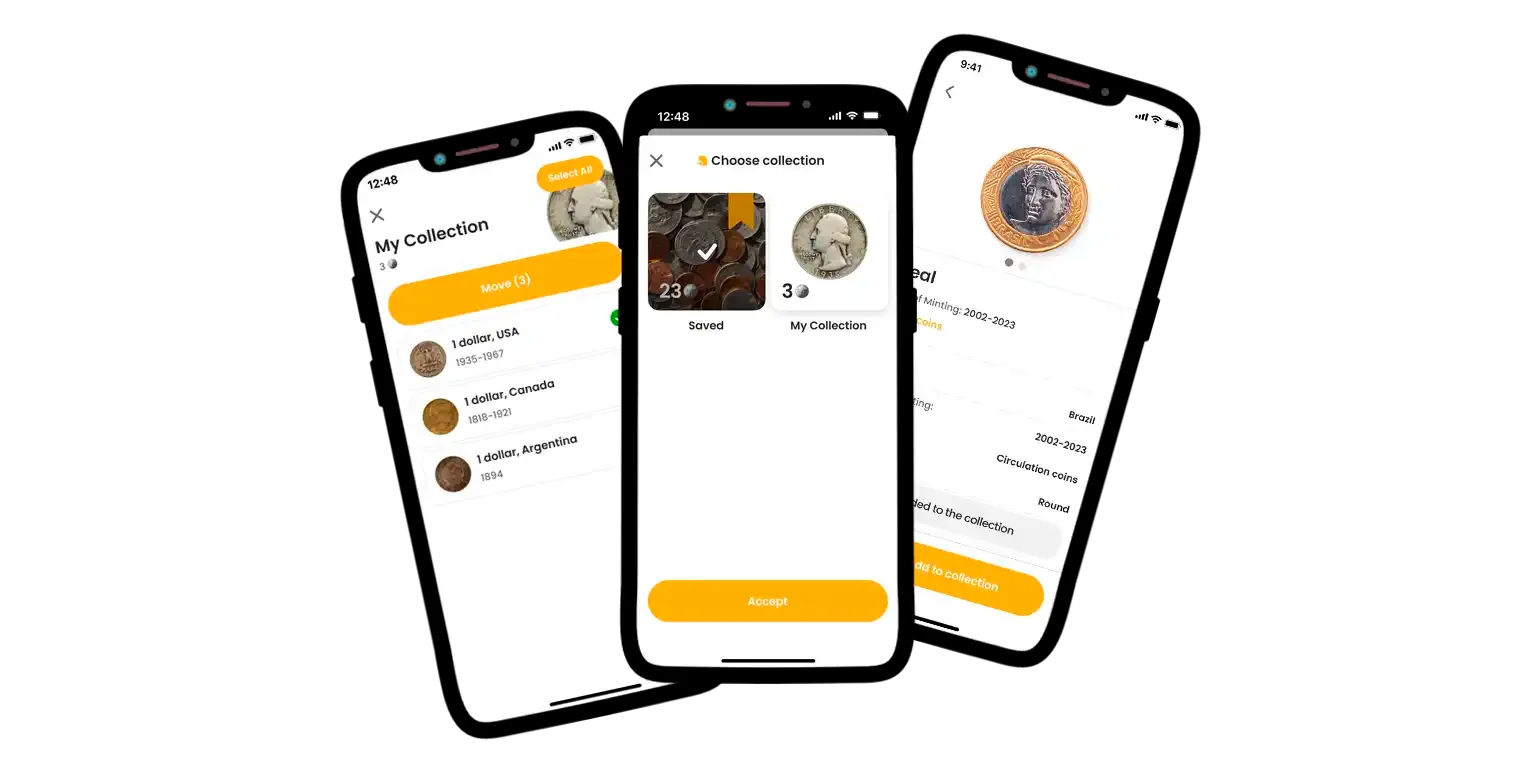
Should you want a fast first pass before you talk to a dealer, try digital assistants like Coin ID Scanner. These are the things our app can do after you take a photo of the coin to check:
Identify the type (Barber dime) and confirm the key design elements from a photo
Help you compare the mint mark placement and style
Provide an average value guide based on typical market data (helpful context only).
Note: Coin ID Scanner cannot replace professional authentication. It is only a supportive tool to screen and organize your findings, not a true confirmation resource. Rely on certification – examine via Coin ID Scanner first.

 Facebook
  X (Twitter)
  Pinterest
  LinkedIn