Contents:
US quarters were among the first numismatic creations of the United States at the dawn of its nationhood. They first appeared with the 1796 Draped Bust quarter design, which would later transform into Capped Bust (1815–1838) and, eventually, the notorious Seated Liberty (1838–1891).
The latter, as well as many other 19th-century motifs, faced a recurring critique: though the early reception was generally favorable, detractors argued it felt tasteless, “too Britannia”. Nonetheless, the design remained in production for more than 50 years, went through a few notable modifications, and left behind numerous peculiar issues that remain collectible up until these days.
Let us today take a look at the edition with one of the highest mintages in the entire series – the 1876 Seated Liberty quarter, check coin value, and briefly cover how to acquire it in 2026.
1876 Seated Liberty Quarter Overview
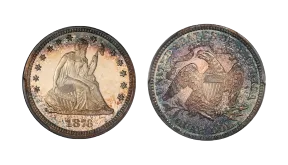
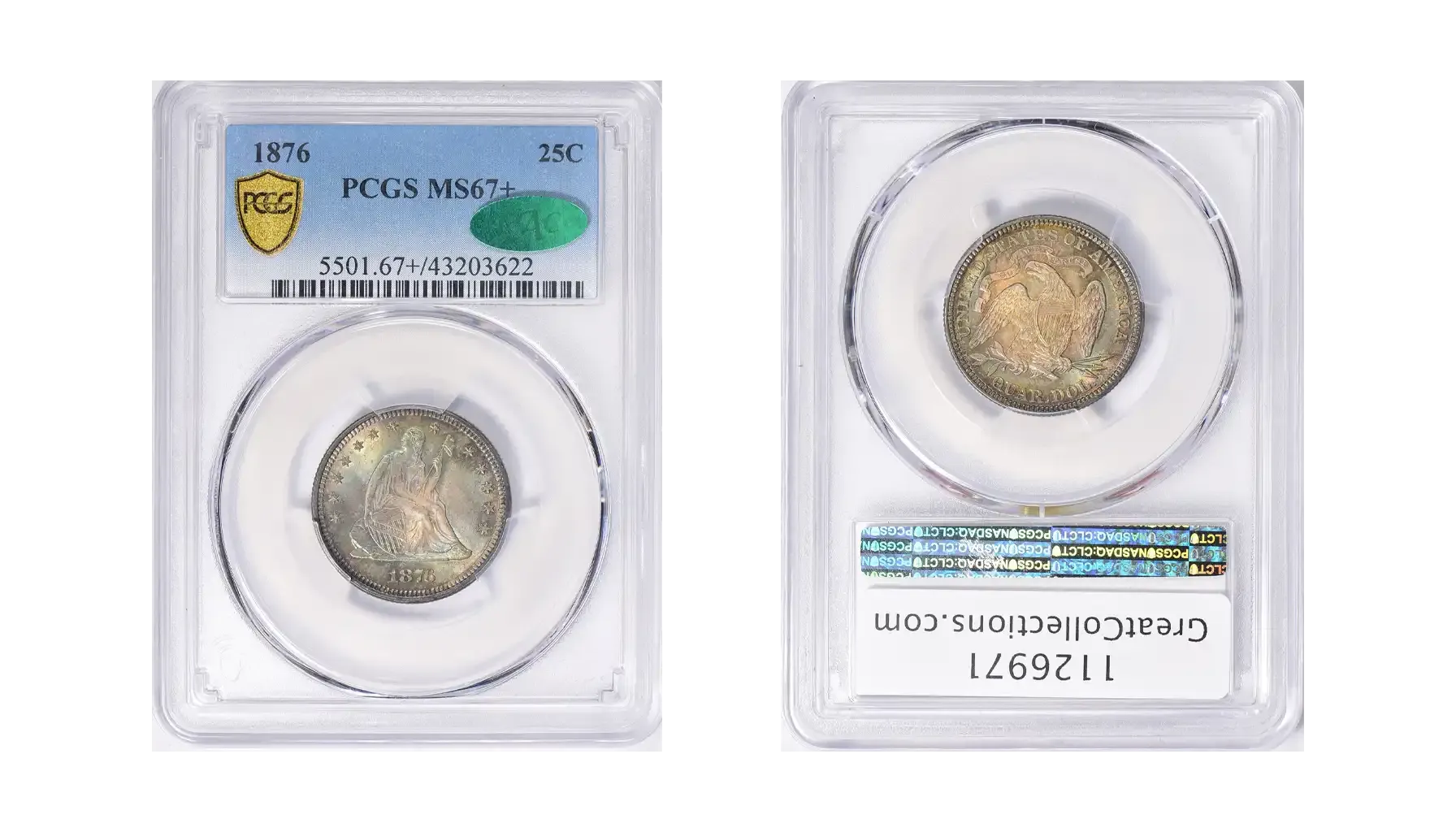
Obverse: The front side exhibits the silhouette of a robed Liberty sitting on a rock, holding a liberty pole topped with a cap, and resting her other hand on a shield, inscribed with the word “LIBERTY” (horizontally). The design is accompanied by 13 stars placed all along the rim (referring to 13 original colonies) and the year of mintage “1876” below.
Reverse: The back of the coin, on its part, features a heraldic eagle with its wings spread and a shield on a chest, holding arrows in one talon and a sold olive branch in the other, as well as the inscriptions “UNITED STATES OF AMERICA” along the top (closer to the rim), the motto “IN GOD WE TRUST” placed on the ribbon above the eagle, a mint mark positioned below the eagle, and the denomination “QUAR. DOL.” beneath.
The Main Features | |
Denomination | 25 cents |
Type + Subtype | Seated Liberty Quarter, With Motto, No Arrows (at date) |
Composition | 90% silver, 10% copper |
Weight | 6.30 g |
Diameter | 24.30 mm |
Thickness | ~1.75 mm |
Edge | Reeded |
Designer | Christian Gobrecht (some references also attribute modifications to another US coin designer, Robert Ball Hughes) |
Mint marks | None for Philadelphia “CC” for Carson City “S” for San Francisco |
Note on types: Due to numerous modifications, the Seated Liberty design can be divided into a few subtypes, i.e., Type 1 No Drapery; Type 2 No Motto; Type 3 Arrows & Rays; Type 4 No Motto, Arrows at date; Type 5 With Motto, No Arrows; and Type 6 With Motto, Arrows at Date.
Varieties and Rarity of the 1876 Seated Liberty Quarter
1876 25C
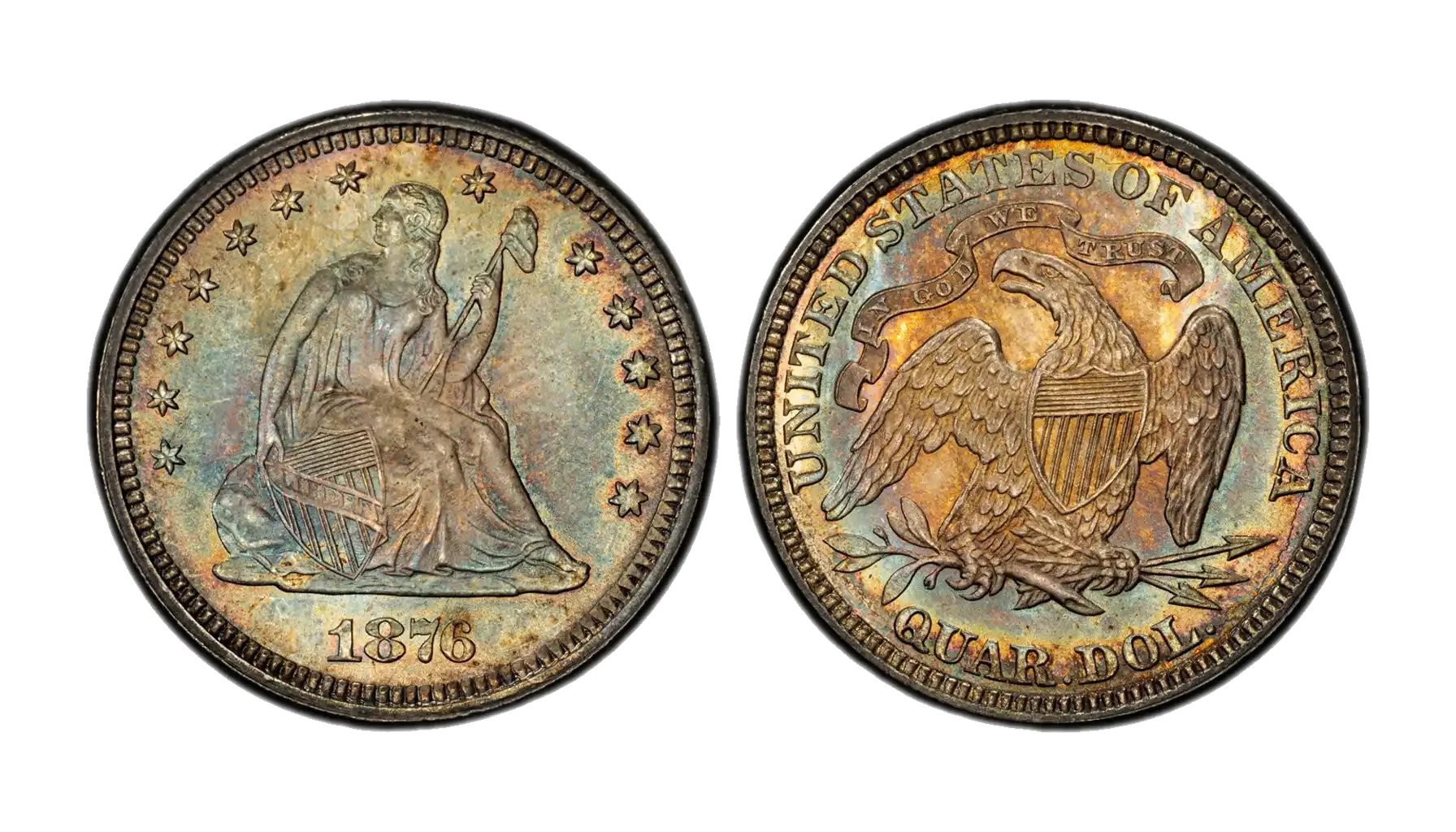
Produced by: Philadelphia Mint
Mintage: 17,816,000
Auction Record: $12,925 for MS67+
The 1876 quarter from the Philadelphia Mint is literally a production giant: it may boast the highest mintage of any quarter from 1796 until 1920. Hence, it is easy to locate across circulated grades and unusually approachable even in Mint State. The very top of the grading ladder is scarce: the only MS67+ example is known to exist.
1876-CC 25C
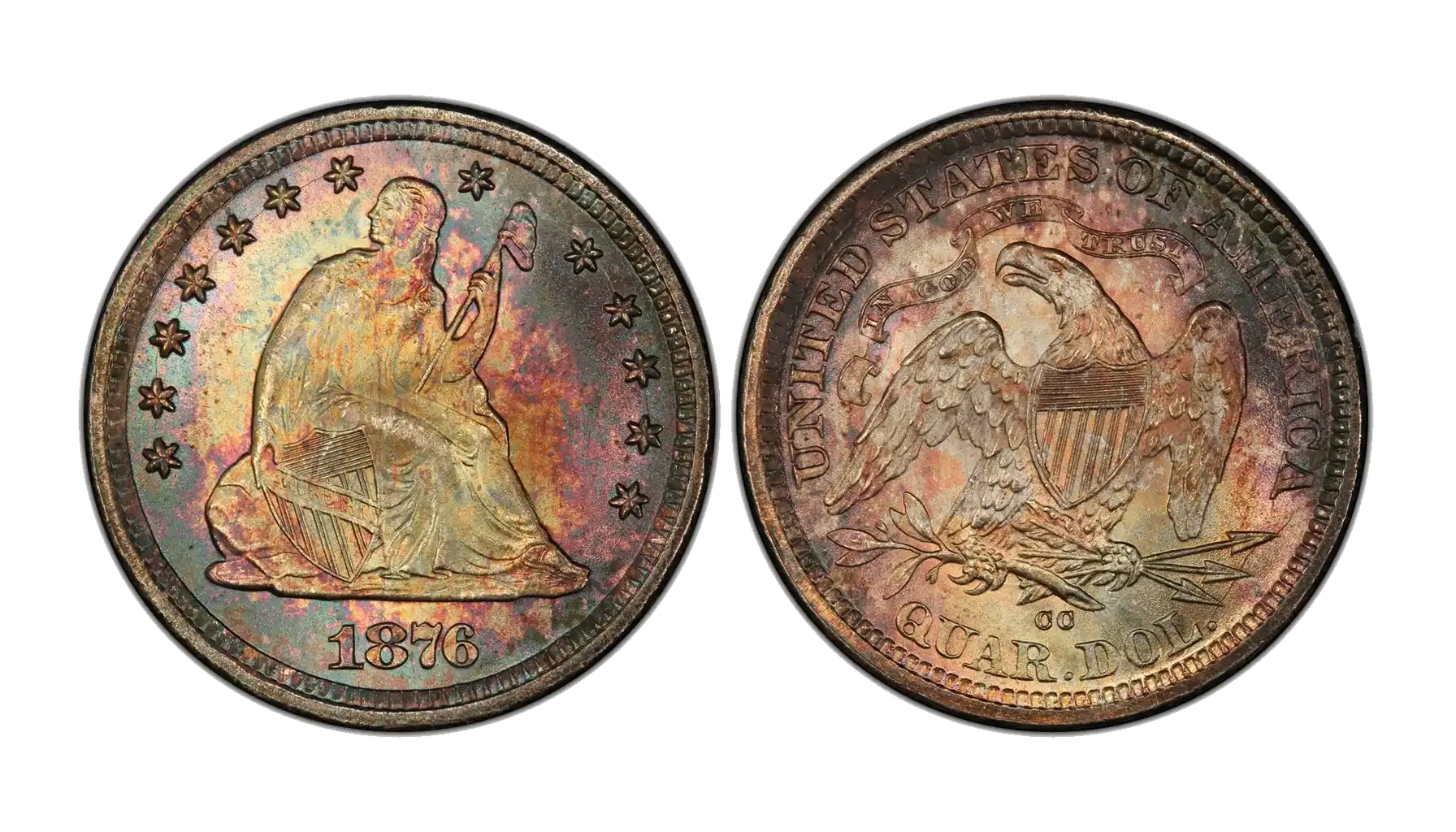
Produced by: Carson City Mint
Mintage: 4,944,000
Auction Record: $18,000 for MS67
As for the 1876 CC quarter value, it is surprisingly not too high, given the fact that other iterations from the Carson City Mint are far scarcer and are routinely worth a lot. Coins in circulated grades are rather widespread, yet MS67 examples exist only in very small numbers, and the 1876 CC Seated Liberty Quarter value rises sharply once you approach the top.
1876-S 25C
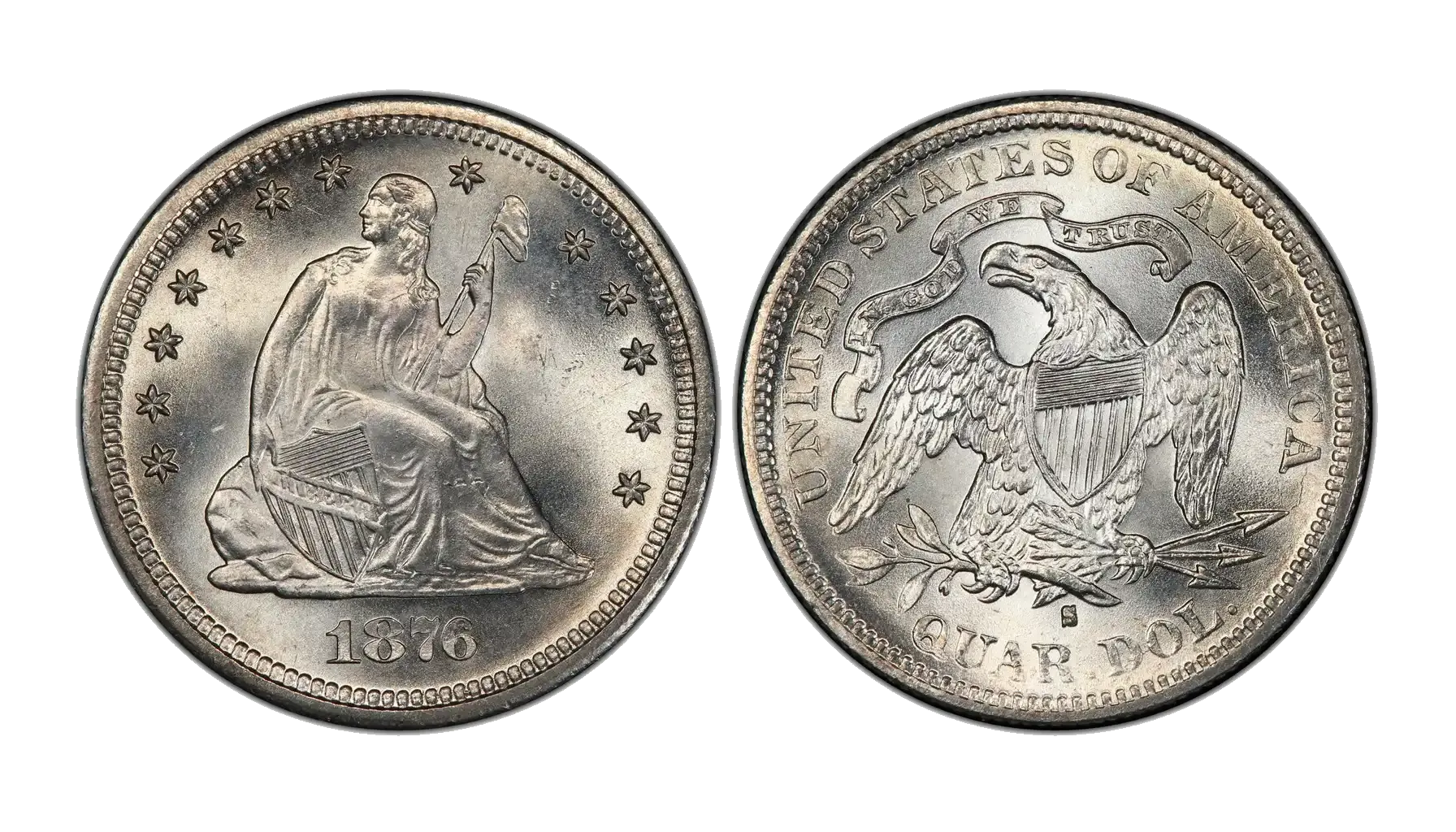
Produced by: San Francisco Mint
Mintage: 8,596,000
Auction Record: $5,640 for MS66
The 1876 S Seated Liberty quarter is a practical choice for those who need a coin with a West Coast mint mark and a reputation for sharp presentation. Certified examples are frequently found in MS63–MS64; MS65, with a modest 1876 S quarter value, is not a rarity as well.
1876 25C (Proof)
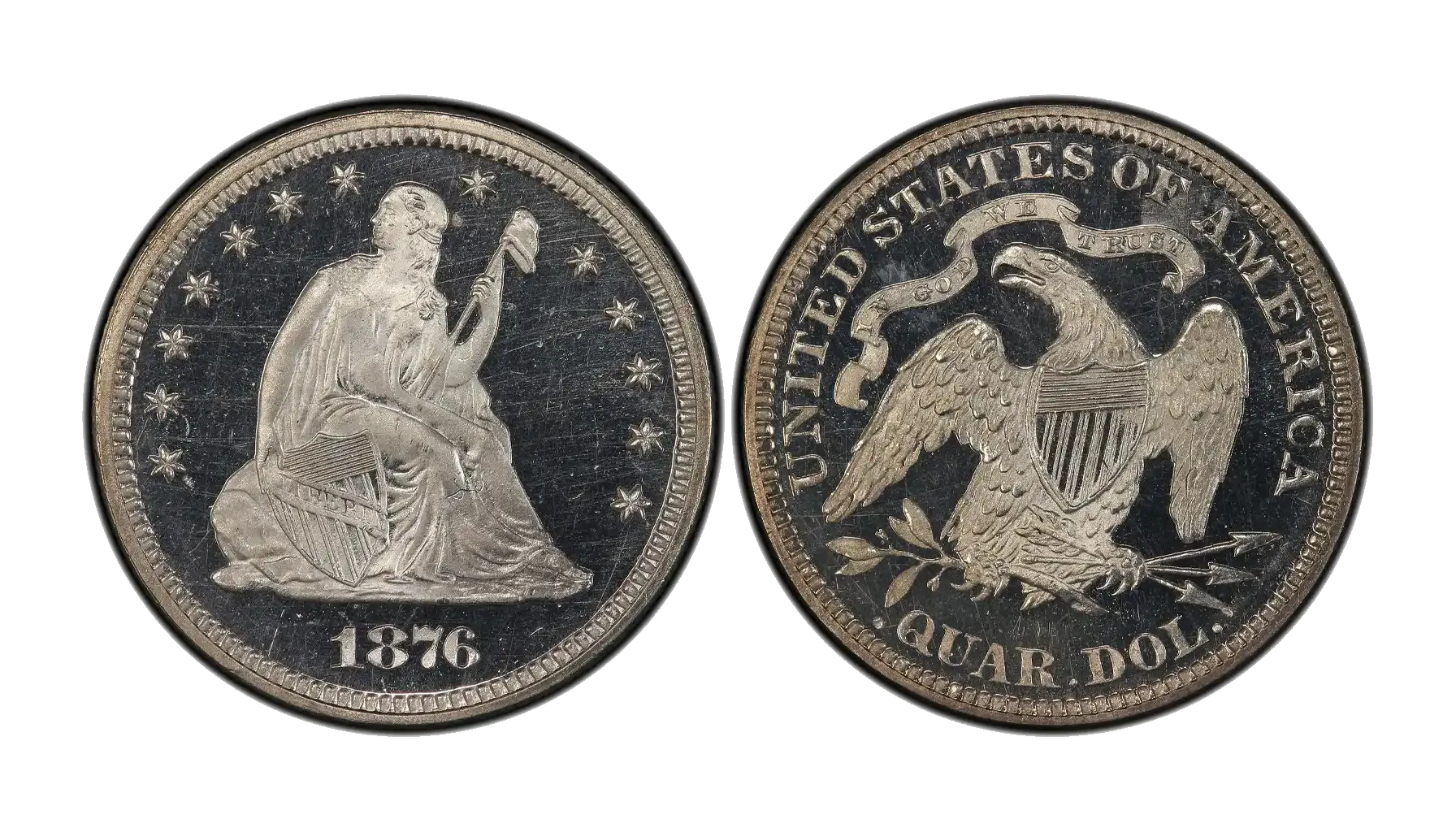
Produced by: Philadelphia Mint
Mintage: 1,150
Auction Record: $47,000 for PR68*
Despite the limited mintage, the 1876 quarter proof is one of the more available dates in the series, which is exactly why it is so popular with type collectors. In general, they are well-produced, and many, if not all, show an especially attractive finish (the prices are quite elevated).
“Cameo examples represent slightly more than a fifth of the total population, and Deep Cameos are only a tiny fraction. The best example (and the holder of the price record for this date) is the NGC PR68* from the Eric P. Newman Collection.”
— Ron Guth, renowned numismatist, licensed Certified Public Accountant
PCGS CoinFacts
1876 Quarter Value by Mint and Grade
The worth of the quarter cannot be fixed, since it is subject to constant fluctuations, according to mint marks and their grades. Explore the general value ranges per grade for problem-free coins (errors are also excluded).
Grade band | 1876 (P) | 1876-CC | 1876-S | 1876 (Proof) |
G4–VG8 | $45–$55 | $95–$125 | $45–$55 | – |
F12–VF20 | $65–$85 | $160–$200 | $65–$85 | – |
XF40–AU50 | $160–$225 | $350–$475 | $160–$225 | – |
MS63/PR63 | $625–$825 | $1,800–$2,000 | $625–$825 | $3,250–$3,750 |
MS65/PR65 | $1,650–$2,150 | $6,000–$6,750 | $1,725–$2,500 | $4,500–$5,750+ |
MS66+/PR66+ | $4,000–$12,000+ | $7,750–$32,500+ | $5,500–$8,000+ | $7,500–$10,000+ |
Factors Affecting the 1876 Liberty Seated Quarter Worth
Mint Mark Demand: Carson City coins are inherently valuable, simply because of the place of production, even when the date itself is not rare.
Grade and Condition Rarity: Circulated grades are common; Mint State is the key.
Original Surfaces vs. Cleaning: A lightly cleaned coin can look “bright” but still trade at a major lower level compared with an original example.
Proof Designations (Cameo/Deep Cameo): For proofs, contrast designations are vital (DCAM is the most valuable option).
Certification and Extras: Certificates from PCGS, NGC, ANACS, CAC approval, and provenance boost the prices, too.
Collector Tip and Where to Buy 1876 Quarters
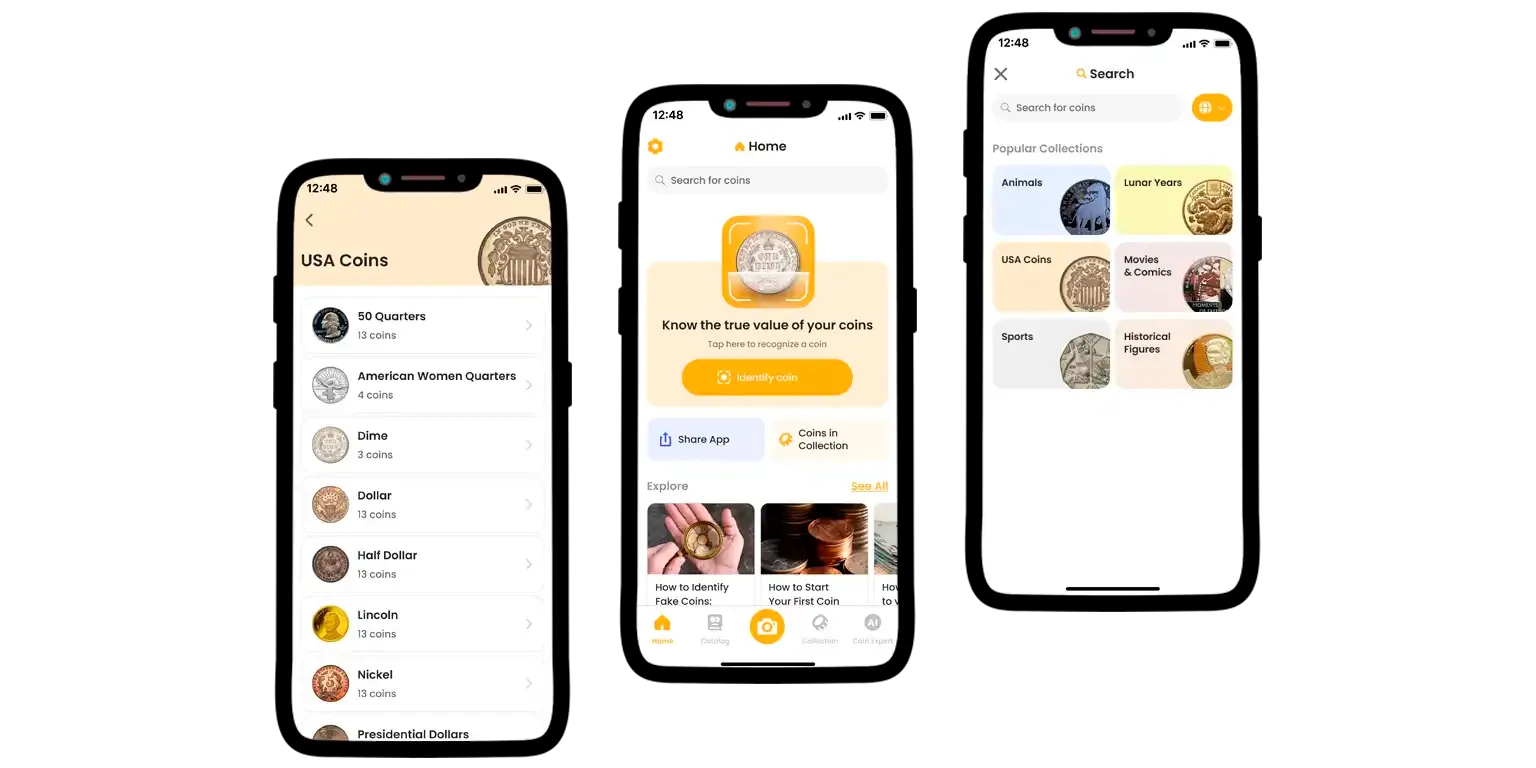
Collector tip: Use additional tools like Coin ID Scanner to identify coins before making decisions, explore related value guides, learn more about numismatic basics, and manage collections whenever you want. A beneficial instrument for those who collect "antiques".
Where to buy: Start with PCGS/NGC-certified examples from major coin auctions and reputable dealers. Otherwise, stick to sellers with clear return policies and photos of the fields and mint mark.
Know the coins you are looking for – the value is in the details.

 Facebook
  X (Twitter)
  Pinterest
  LinkedIn