Contents:
By the time of its emergence, it had been the smallest, the lightest coin ever produced by the United States Mint. Times have changed, but the position of the series in American numismatics remains the same – a tiny denomination as a fine reflection of postal reform and the evolving economy of the mid-19th century. And it was yet to vanish anyway.
These days, the 3 cent coin value is the vault that preserves the legacy of America’s legendary numismatic creation, with stories to tell and potential to embrace. More than 35 years of its history – barely do series like this exist for so long, let alone their enduring aesthetic appeal and fragile nature.
But what lies behind the making of this small yet remarkable unit of currency? Which iterations to look for, what is the 3-cent coin value in general, and which features identify this coin as exceptionally unique?

What Are 3-Cent Coins?
3 cent US coins are small-denomination numismatic creations minted in broader terms between 1851 and 1889, which were meant to simplify transactions and match the new 3-cent postage rates (switched to the denomination of the very coin). During the time span of more than 35 years of history, there were produced two major types of the same level, i.e., the silver “trime” (1851–1873) and the later nickel 3-cent piece (1865–1889).
Please do not confuse these with the 3 dollar gold coin – their denominations are different.
Inception and Evolution of a 3C Piece
The idea of three-cent numismatic creations was first introduced in 1851 when everyday commerce and postal reforms demanded a lighter, more practical unit of currency at their disposal. The small change was scarce, which is why the US Mint saw the urgent need for something more convenient to use.
In response, Congress authorized the minting of a tiny silver coin, designed by Chief Engraver James B. Longacre, which would soon become the smallest and lightest piece (consisting of 75% silver and 25% copper) ever issued by the United States Mint. The original composition was not eternal: 1854 was the year when the silver content was raised to 90% so as to encourage wider circulation and justify the efforts taken by the government.
However, hard times brought new issues, for the Civil War coins (1861-1865) triggered ubiquitous hoarding of silver pieces, and this eventually forced the Mint to find a new solution for small transactions, which were still vital. In 1865, the three-cent nickel was finally released: it was a bit larger than the silver iteration. Its lifespan was not meant to be long, though the coin remained in production until 1889, long after its original purpose had faded away.
The Main Features of the American 3 Cent Coin
Silver 3C Piece (1851–1873)
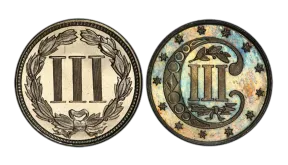
Obverse: The obverse features a national shield on a six-pointed star, surrounded by the inscription “UNITED STATES OF AMERICA” along the upper rim and the year of mintage below.
Reverse: The reverse represents a simple Roman numeral “III”, framed by a cincture of thirteen stars (the number of the original states of the Union), along with a sprig of olive leaves above the numeral and a bundle of arrows beneath (the 1854 redesign).
Nickel 3C Piece (1865–1889)
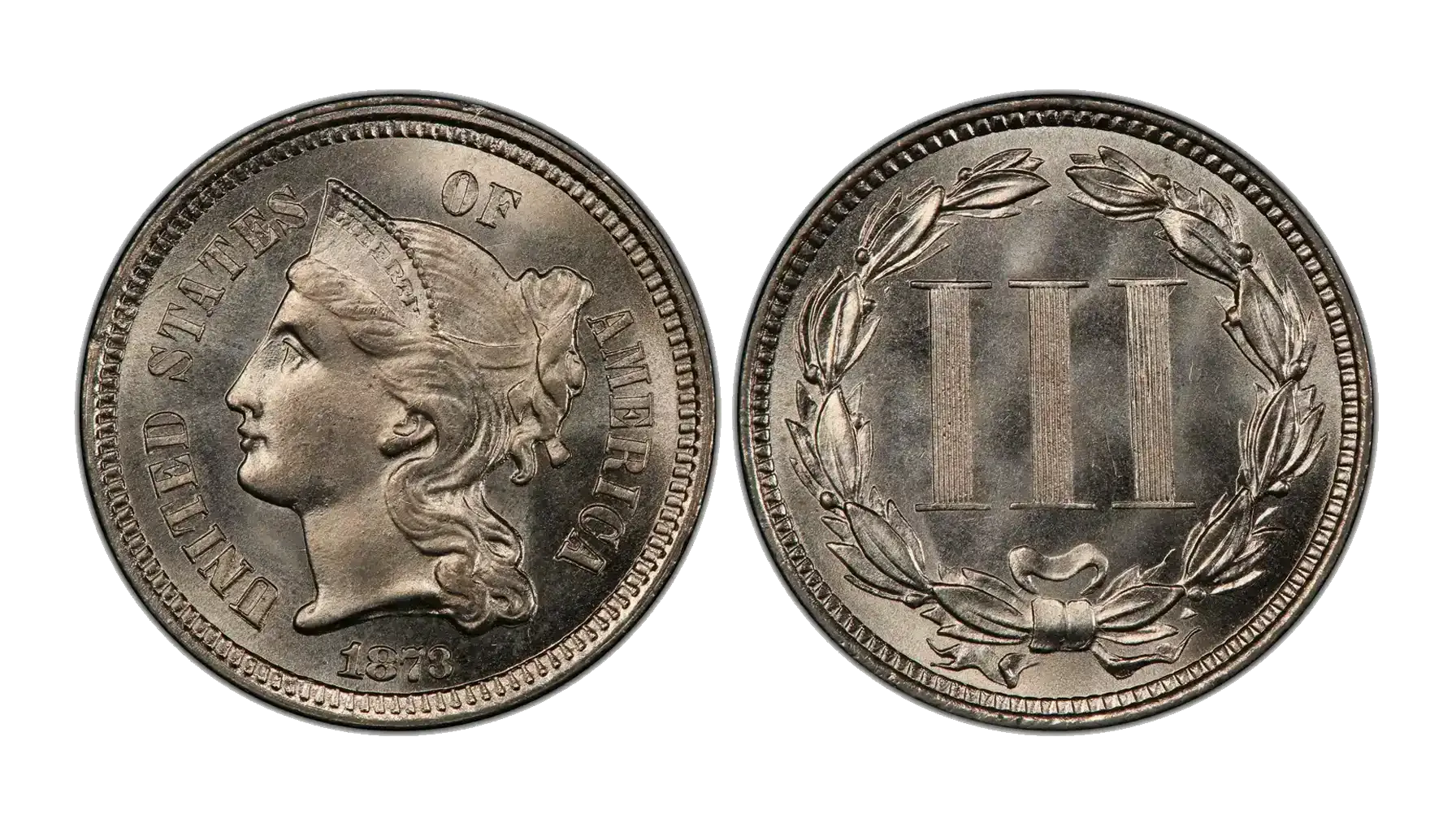
Obverse: The obverse demonstrates a left-facing bust of Liberty, crowned with a coronet inscribed “LIBERTY”, along with the inscription “UNITED STATES OF AMERICA” along the upper rim and the date of mintage at the bottom.
Reverse: The reverse introduces the traditional Roman numeral “III” set within a laurel wreath.
Silver 3¢ Piece | Nickel 3¢ Piece | |
Designer | James B. Longacre | James B. Longacre |
Composition | 75% silver, 25% copper (1851–1853) 90% silver, 10% copper (1854–1873) | 75% copper, 25% nickel |
Weight | 0.8 g (1851–1853) 0.75 g (1854–1873) | 1.94 g |
Diameter | 14 mm | 17.9 mm |
Thickness | ~0.6 mm (varied slightly by year) | ~1.1 mm |
Edge | Plain | Plain |
Mintmarks | None for Philadelphia “O” for New Orleans | None for Philadelphia |
Years of Mintage | 1851–1873 | 1865–1889 |
The Worth of the 3 Cent Coin for Sale
Coins and their prices can be different: the 1866 3 cent coin value, for instance, can be a bit more astonishing than the rest, though other years are no less interesting to explore. But why? In fact, prices usually depend on several factors, which include the coin’s type (silver or nickel), year of issue, mintmark, and grade of preservation. So, how much is a 3 cent coin worth?
3 Cent Silver Coin Value
The trime 3 cent coin has originally been seen as a store of value, thanks to its precious composition, though it is not the only factor that defines the worth. The 1852 3 cent coin value, along with one of the 1851 and 1853 varieties, is usually decent, though later issues are more attractive due to demand. The size is not the limit: the worth of the 3 cent coin US goes far beyond its physical characteristics after all.
Grade/Condition | Common Dates (e.g., 1851–1853) | Scarcer Dates (1855–1862) | Rare Dates/Proofs (1863–1873) |
Good (G-4) | $20 – $30 | $35 – $50 | $100+ |
Very Good (VG-8) | $25 – $40 | $45 – $65 | $120 – $180 |
Fine (F-12) | $30 – $50 | $60 – $90 | $200 – $300 |
Very Fine (VF-20) | $40 – $70 | $85 – $130 | $300 – $450 |
Extremely Fine (EF-40) | $60 – $100 | $120 – $180 | $450 – $700 |
About Uncirculated (AU-50) | $100 – $160 | $170 – $250 | $700 – $1,200 |
Mint State (MS60–MS65) | $180 – $350 | $300 – $600 | $1,200 – $2,500+ |
Proof (PR63–PR65) | – | – | $1,000 – $4,000+ |
3 Cent Nickel Coin Value
The 3C nickel is generally more durable and available than its silver counterpart, but it should not be seen as a definitive factor in price formation. To be more precise, there are iterations that may boast immense figures uncirculated and proof grades.
Grade/Condition | Common Dates (1865–1876) | Scarcer Dates (1877–1881) | Low Mintage/Proof Issues (1882–1889) |
Good (G-4) | $10 – $15 | $18 – $25 | $30 – $40 |
Very Good (VG-8) | $12 – $20 | $20 – $30 | $35 – $50 |
Fine (F-12) | $15 – $25 | $25 – $40 | $45 – $65 |
Very Fine (VF-20) | $18 – $30 | $35 – $55 | $60 – $90 |
Extremely Fine (EF-40) | $25 – $40 | $50 – $75 | $90 – $130 |
About Uncirculated (AU-50) | $40 – $70 | $75 – $120 | $130 – $200 |
Mint State (MS60–MS65) | $80 – $200 | $150 – $300 | $250 – $600+ |
Proof (PR63–PR65) | – | – | $400 – $1,000+ |
Note: The tables above reflect general retail and market averages, but they do not capture the full range of premium sales achieved at auction. High-grade certified examples can exceed these estimates by a wide margin. For more accurate details on your particular coins, it is reasonable to appeal to the grading services like NGC or PCGS.
Rare & Valuable 3 Cents (Year by Year)
1851-O 3CS
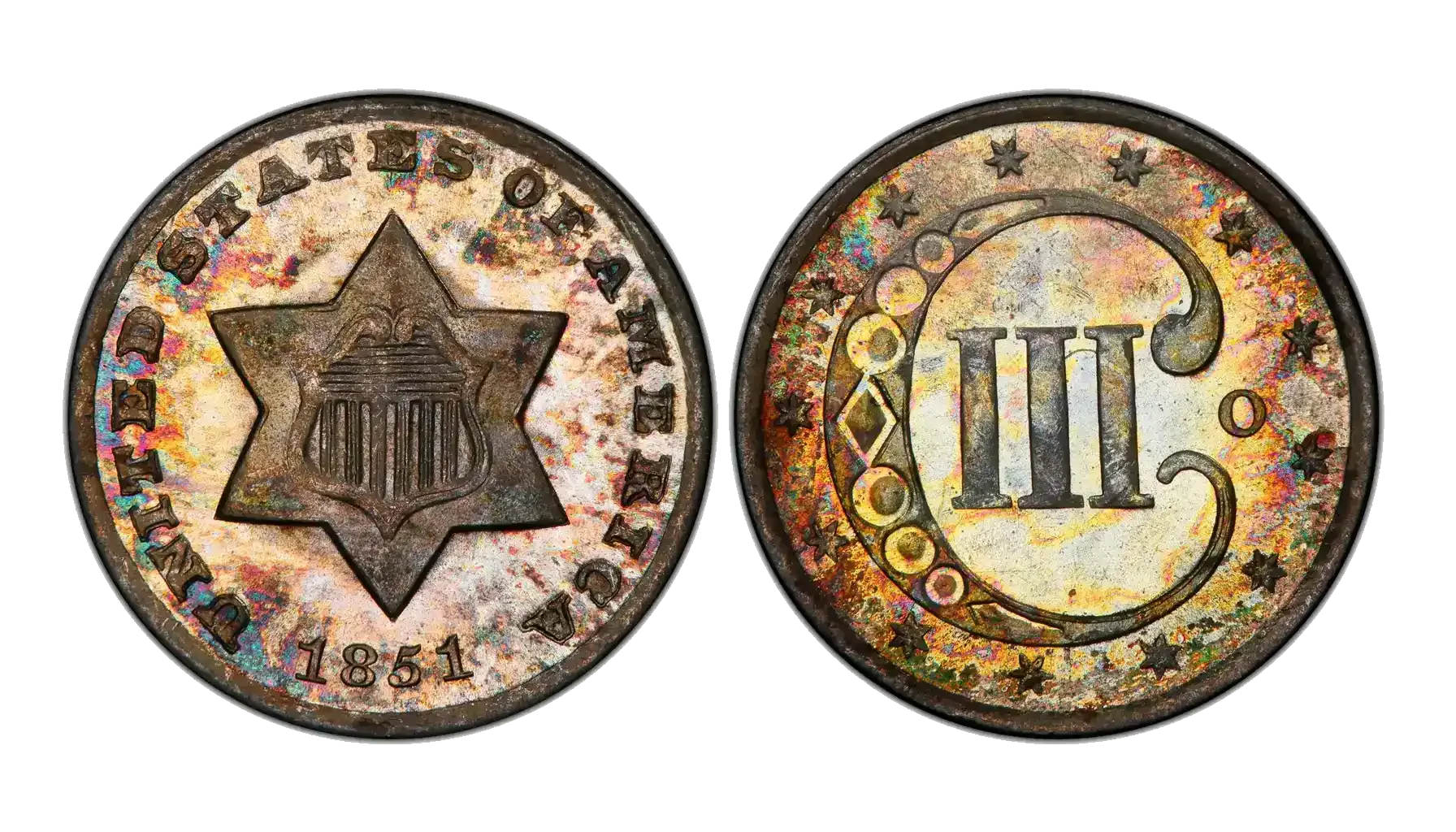
Produced by: New Orleans Mint
Mintage: 720,000
Auction Record: $22,800 for MS67
The 1851 3 cent coin is one of the most distinctive issues in the entire series, for it is the only example ever struck outside Philadelphia and the sole coin in the series bearing a mint mark. In fact, it is the rarest Type 1 trime, desired for its southern origin and limited production – the 1851 3 cent coin value is the testament for this fact!
1851 3CS (Proof)
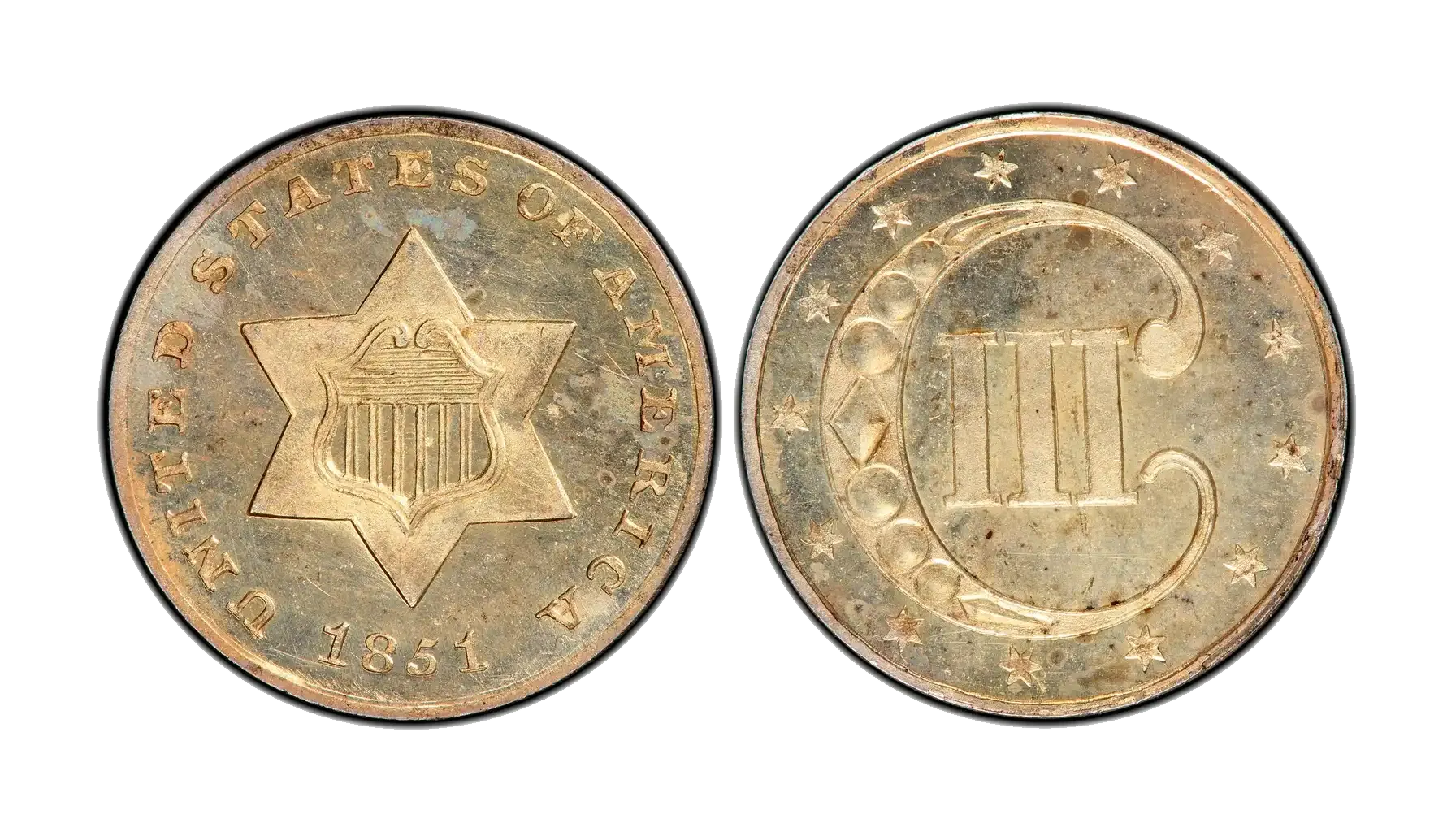
Produced by: Philadelphia Mint
Mintage: 4
Auction Record: $176,250 for PR66
The 1851 3CS Proof is among the greatest numismatic rarities in American history, originally believed to have been struck to commemorate the coin’s debut (only 4 pieces exist!). These proofs demonstrate an extraordinary level of art, as they feature deeply mirrored fields and sharp details that make them stand out. As Jaime Hernandez noted, the famous Eliasberg specimen, now graded PR66, remains one of the finest known.
1853 3CS
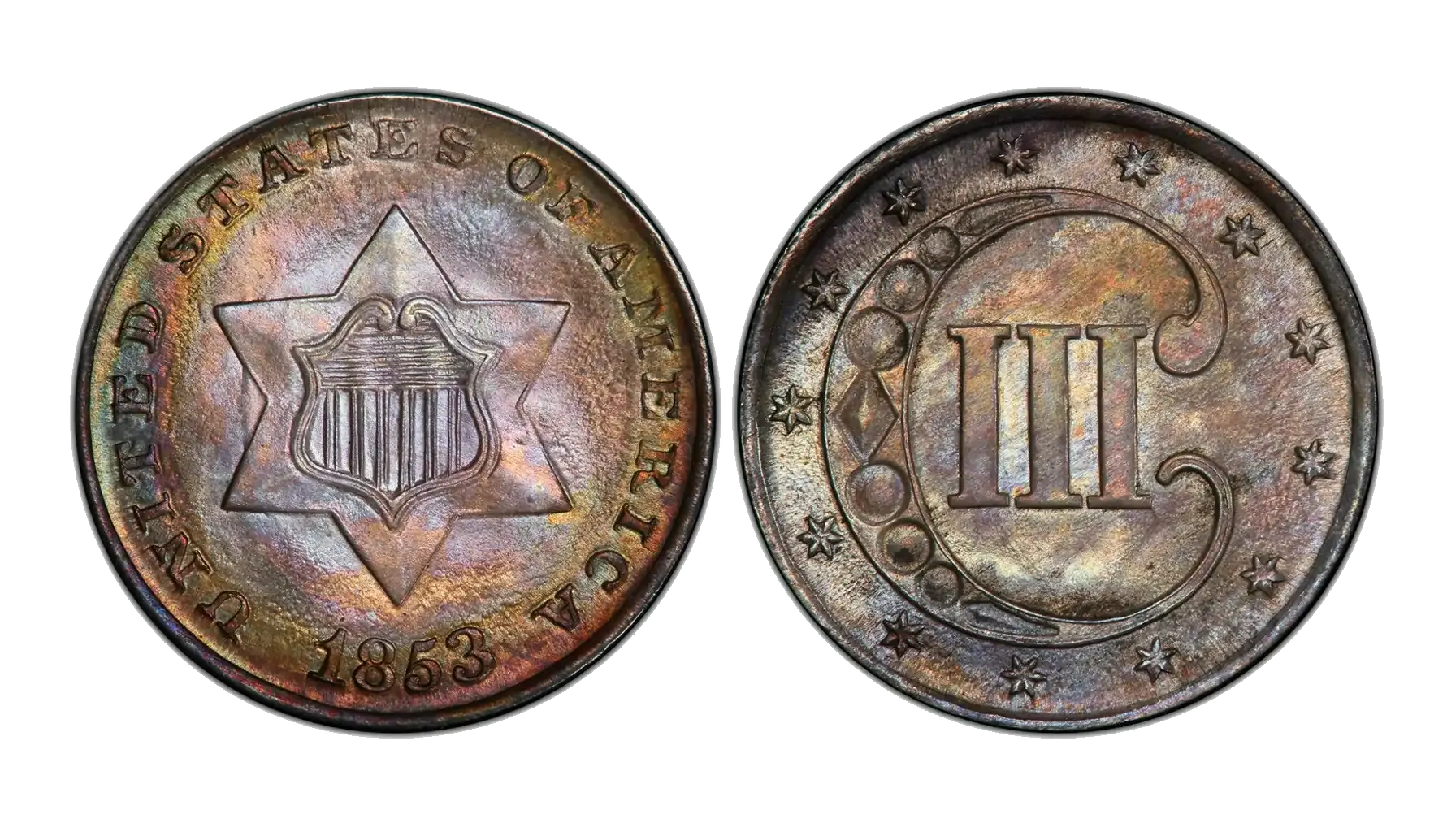
Produced by: Philadelphia Mint
Mintage: 11,400,000
Auction Record: $38,400 for MS67+
Sometimes, coins with high mintage figures may also be quite decent, for the abundance usually causes the lack of preserved pieces (intentions are limited due to unlimited offerings). Hence, the examples that display strong central detail and full luster are rather common.
1854 3CS
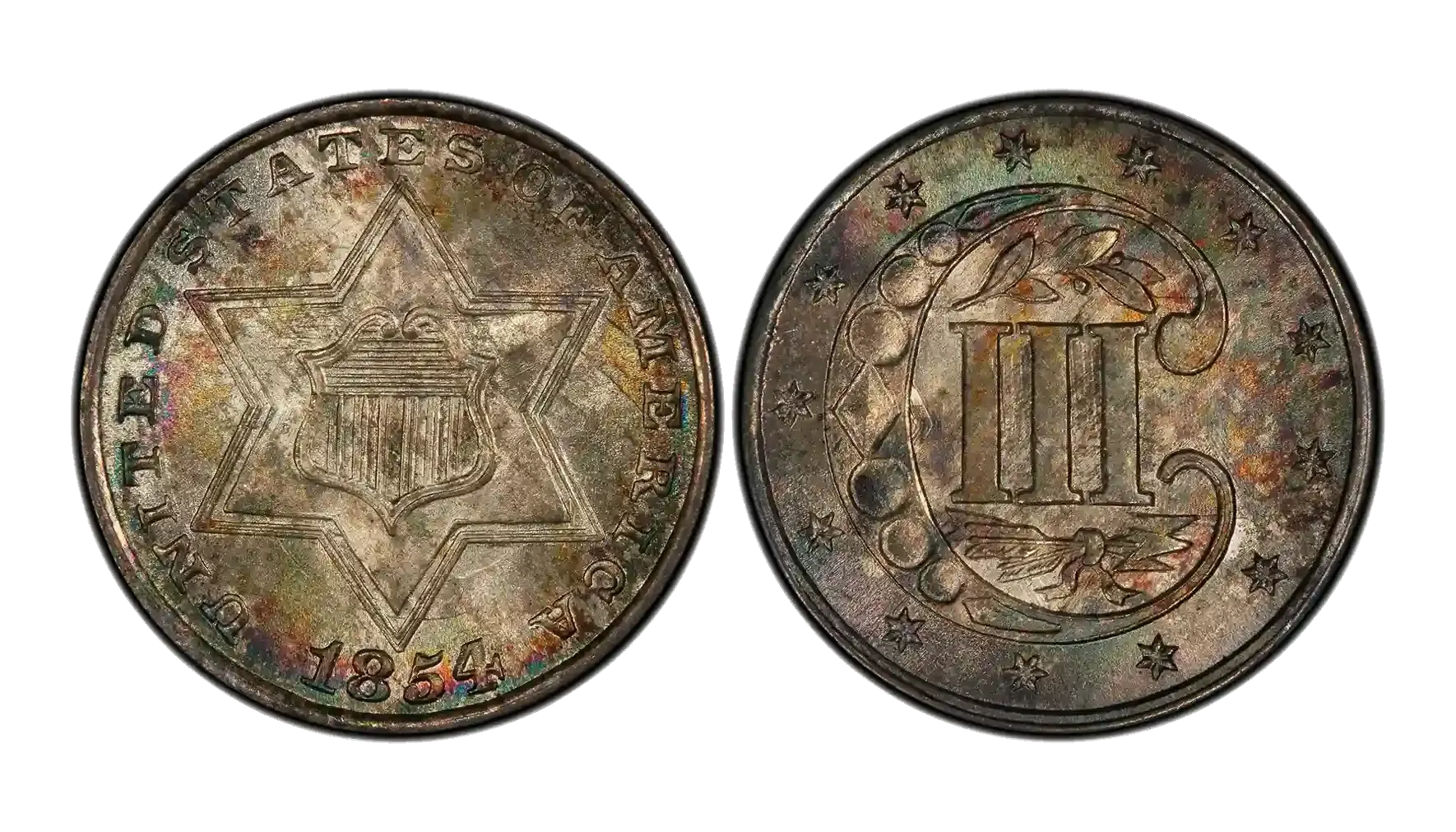
Produced by: Philadelphia Mint
Mintage: 671,000
Auction Record: $84,000 for MS68
The 1854 3CS introduced a major design and compositional shift as part of the Mint’s response to the Coinage Act of 1853. To align with this law, the Mint increased the coin’s silver purity to 90% but reduced its overall weight to maintain the same bullion worth. Though it is technically a new subtype, very few noticed the distinction, which is why not so many coins were saved as a result. Fully struck examples are uncommon, and their presence in the collection is a treasure to cherish after all.
1865 3CN
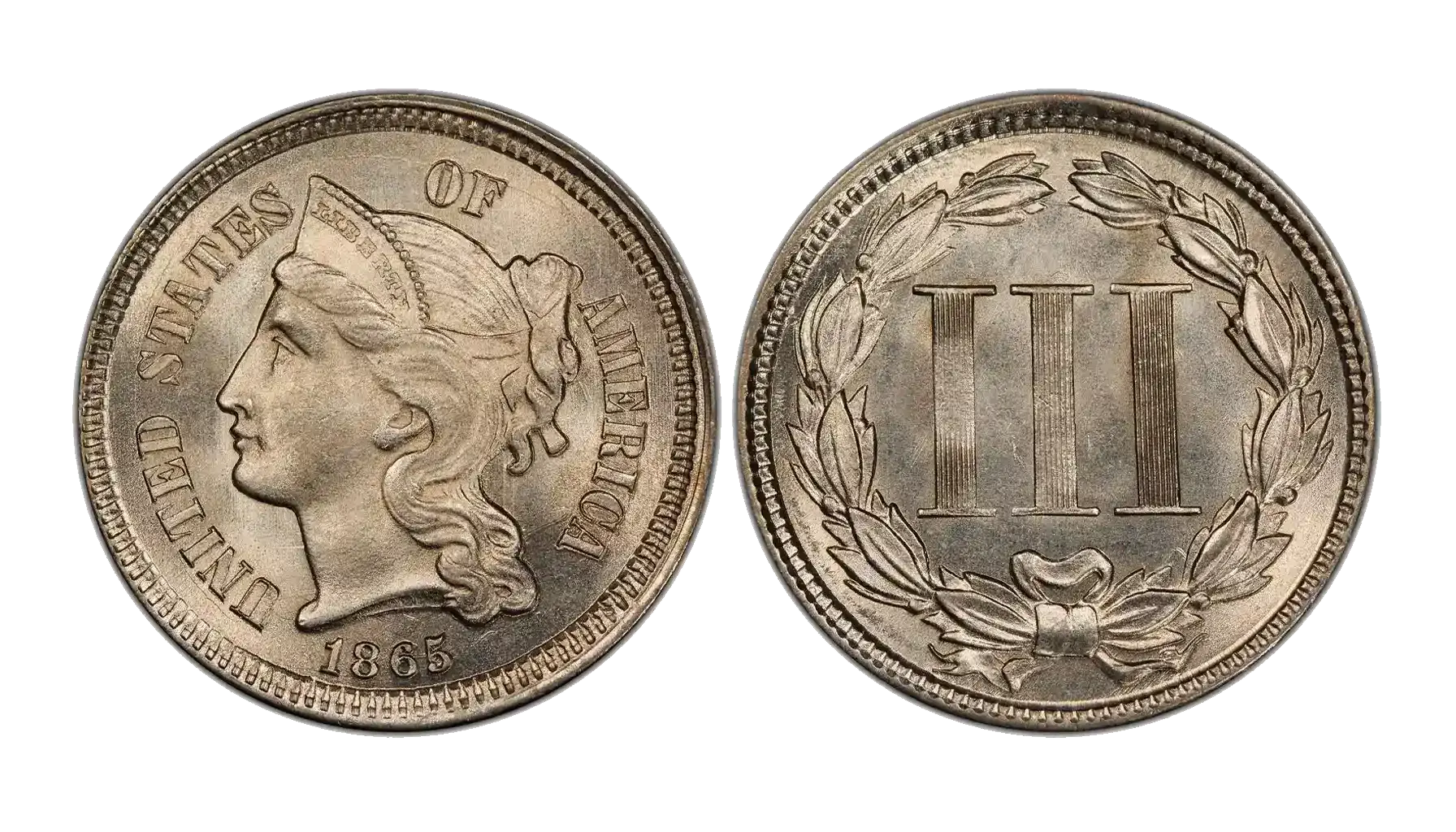
Produced by: Philadelphia Mint
Mintage: 11,382,000
Auction Record: $19,800 for MS67
The first coin of this type was issued in 1865, and the 1865 3 cent coin value indicates how vital this numismatic creation is. In fact, the first year was characterized by over eleven million pieces produced. Although it can be considered common, this date is especially treasured, thanks to its historical importance as the debut of a new alloy and design (as well as the 1853 3 cent coin value, which is of the same status and position within the series).
1868 3CS
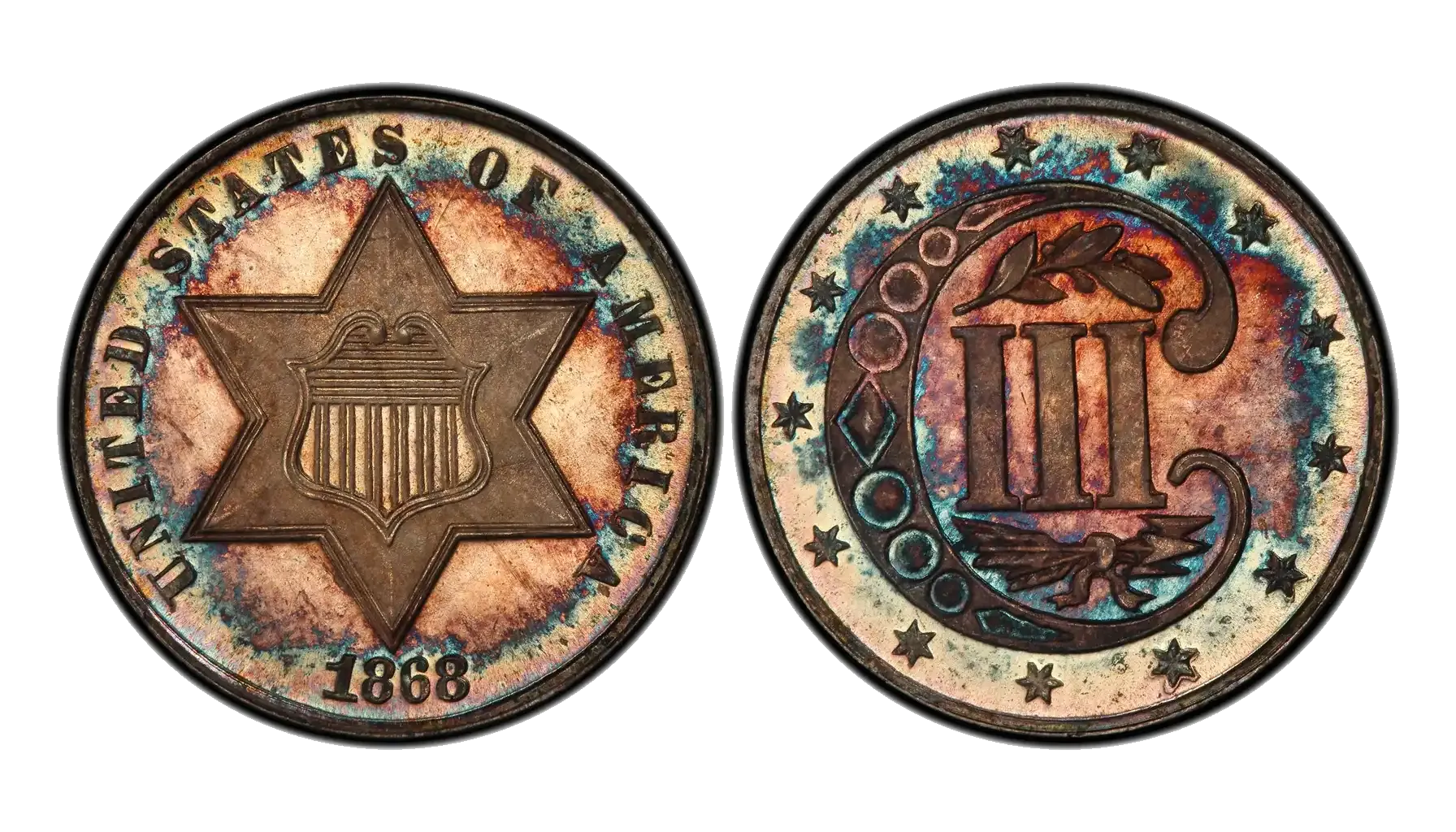
Produced by: Philadelphia Mint
Mintage: 3,500
Auction Record: $66,000 for MS67+
The 1868 3 cent coin value is an illustrative indicator of how the final-era examples may turn into collectibles over time. Indeed, it is one of the rarest dates, and each creation of this year exhibits reflective, prooflike surfaces, which makes authentication essential (genuine Mint State pieces are vastly more valuable than proofs). All in all, only a few certified Mint State coins exist, which inevitably makes the 1868 variety the elite issue of the series’ closing years.
1883 3CN
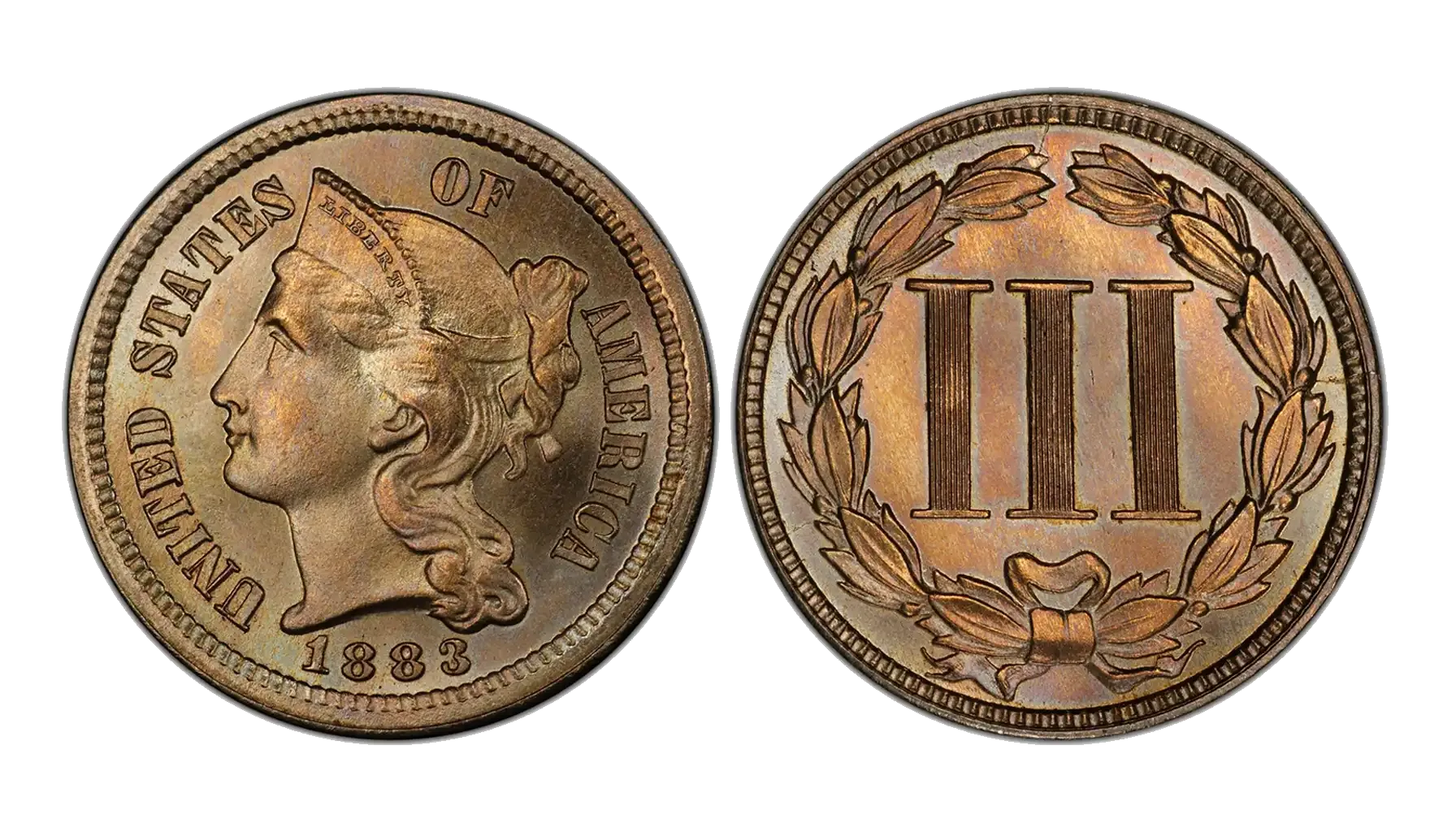
Produced by: Philadelphia Mint
Mintage: 4,000
Auction Record: $36,000 for MS67
By 1883, production of 3CN was gradually lowered, having resulted in 4,000 circulation strikes per year. What is interesting is the fact that this was the first year in which proof coins outnumbered regular business strikes. These days, the 1883 3CN is notoriously hard to locate in any grade, with proofs being more common and less costly.
1884 3CN
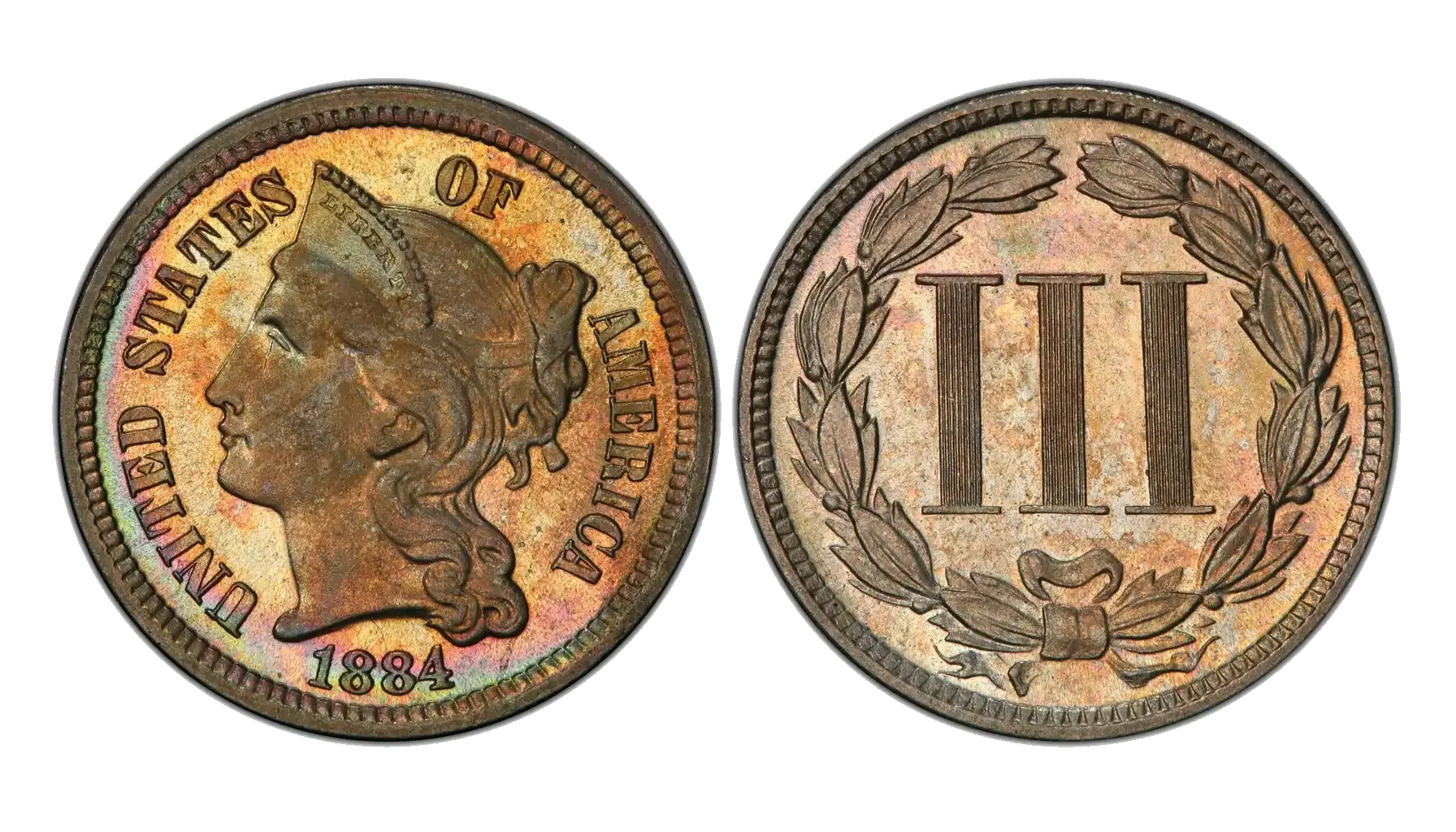
Produced by: Philadelphia Mint
Mintage: 1,700
Auction Record: $42,300 for MS66
The 1884 3CN ranks as one of the lowest-mintage circulation strikes in the entire 3CN series, being second only to the following year’s issue. According to Ron Guth, since there were only 1,700 pieces released, they can be mistaken for proofs (and the value gap between the two can be dramatic). Look for authentic certified pieces, for they belong to the rarest 19th-century nickels ever minted.
1885 3CN
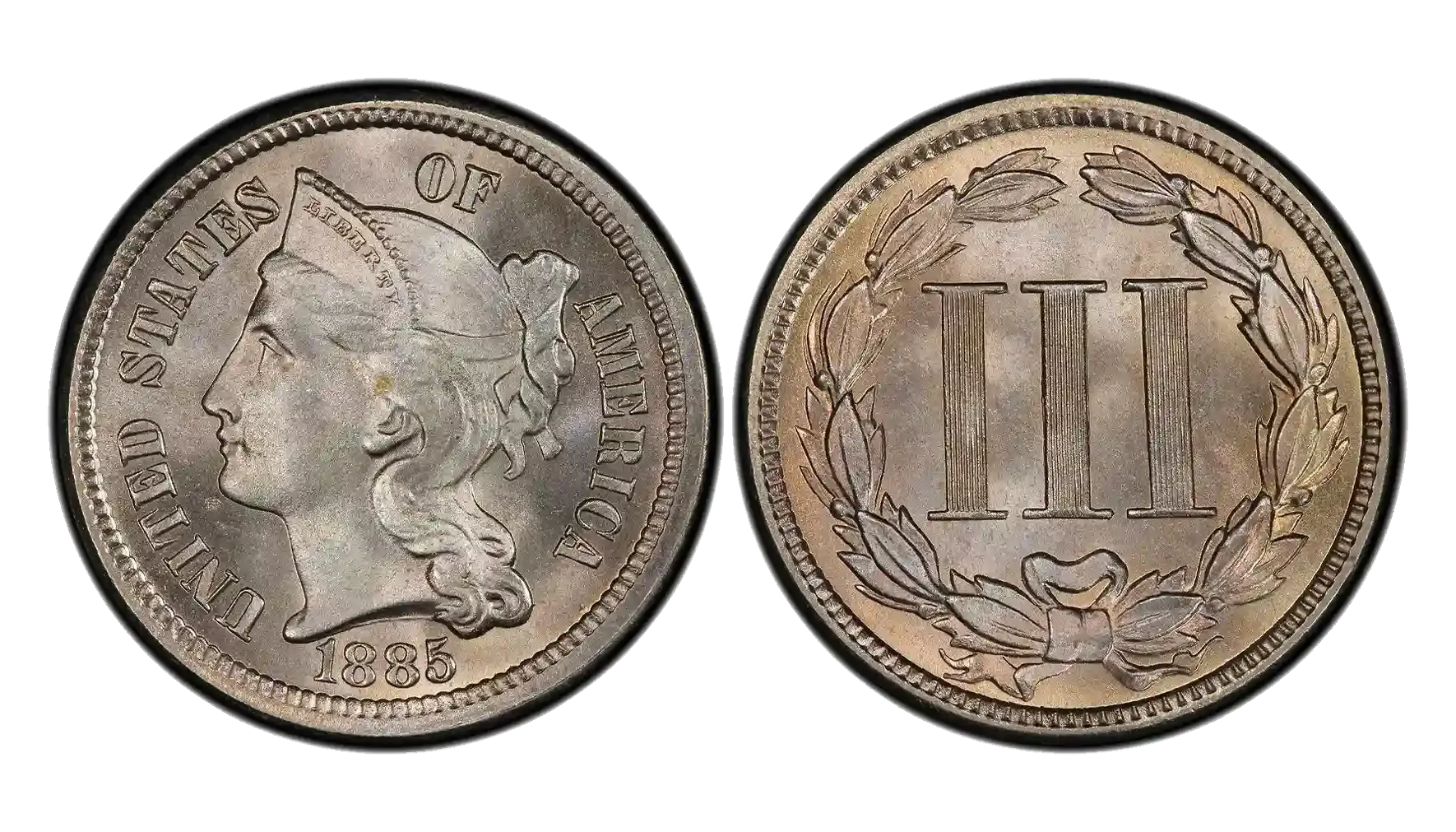
Produced by: Philadelphia Mint
Mintage: 1,000
Auction Record: $38,400 for MS65
Finally, here comes the lowest-mintage issue in the entire three-cent nickel series, which may boast only 1,000 coins struck. It represents a fine combination of absolute rarity, historical finality, and overall aesthetic appeal. As per Ron Guth again, these coins command top prices whenever high-grade examples appear at auction.
So as to explore the most peculiar instances, one does not need to pay thousands of dollars – everything you need is in your hands!
Coin ID Scanner is a top-notch numismatic assistant that grants access to over 150,000 worldwide, allows on-the-spot identification of errors and coins themselves, and lets one manage collections under the same digital roof.
Do not miss a chance to make your coins thrive – let Coin ID Scanner do it on your behalf.

 Facebook
  X (Twitter)
  Pinterest
  LinkedIn