Contents:
Haiti's money is certainly not the kind we hear of daily. This brings an opportunity. Every currency has its standouts, and even the dullest bits have a legacy behind them. Today, we will give Haitian gourded currency a proper overview.
What is the symbol of this currency, and what kinds of coins and banknotes does it have? Let's find out.
Rare coins are hard to come by, but perhaps you already have a rarity inside a pile of change. Identify rare coins with apps, and perhaps you will come across a precious bit.
Haitian Gourde Coins and How They Circulate
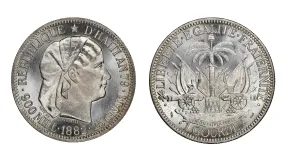
Let’s start with the basics. What is Haitian money called? They are called gourdes. Their name comes from "pesos gordos", which means a “hard piece of eight”.
The Haitian gourde symbol is “G”, the first letter in this currency. The funny thing is that we all have heard of the dollar but don’t even know where the dollar sign came from. Unlike dollars, with the gourde it is simple.

The gourde has a subdenomination called centimes, and one gourde coin is exactly one hundred centimes (100c). Haiti deals with these coin denominations primarily:
5c
10c
20c
50c
G 1
G 5
Due to decades of inflation and rising prices, centimes are seldom used. 1- and 5-gourde coins are used most commonly. Only banknotes are used more often.
One more comparison to the popular currencies. When in the U.S., there are multiple Mint facilities, like the Philadelphia Mint, Denver Mint, etc. Haiti has only one issuer, the Bank of the Republic of Haiti (BRH). Since 1979, BHR has been the sole publisher for Haiti’s currency: both banknotes and coins.
New Haitian Money and Recent Banknote Designs

Tъhe Bank of the Republic of Haiti, like any other state issuer, strives to make its coins and banknotes more secure and effective at circulation.
Currently, Haiti has banknote denominations like:
G 10
G 25
G 50
G 100
G 250
G 500
G 1,000
The last “new” edition came over two decades ago, when Haiti introduced the 2004 commemorative banknotes, celebrating 200 years of independence. The new commemorative issue came with security updates:
Security Feature | What It Prevents |
Watermark | Stops basic copying because the watermark is hard to replicate. |
Security Thread | A machine-detectable element. |
Microprinting | Blocks digital forgery, as tiny text becomes blurry on counterfeits. |
Holographic Patch | The reflective effect is difficult to replicate. |
Color-Shifting Ink | Prevents scan reproduction because the ink changes color at angles. |
UV Fluorescent Patterns | Stops counterfeiters lacking specialized ink visible only under UV light. |
Those were only a few of the added security measures, which made the monetary system much healthier. Many countries lately have been upgrading their banknotes to polymer, but like the Indian rupee, the Haitian gourde decided to stay in paper, for now.
Old Haitian Money and Historical Gourde Notes

The gourde has a long history. The first gourde was introduced in 1813 and largely depended on the colonial currency system. Before BHR, multiple private banks issued coins and banknotes.
Many older bits from the 19th century and mid-20th century are traded on collector markets and auction sites. Their value mostly depends on condition and rarity. Most experts do agree that some of the old timers are very valuable:
“While they may not be on the radar of many collectors, the notes from Haiti from the 1950s and 1960s include some incredibly different types…”
— The Spring 2025 Maastricht Auction Notes
Stack’s Bowers Galleries
Here are some of the best sellers:
Denomination & Year | Description / Issuer | Auction House | Result / Notes |
1 Gourde (1979, Tyvek) | Experimental Tyvek polymer-style note | one.bid | Sold for approx. €142 |
1 Gourde (1827, issued 1859–1867) | Early Haitian note | one.bid | Sold for approx. €26 |
100 Gourdes (1979, Tyvek) | Rare Tyvek test issue (polymer) | Stacks-Bowers | Listed in Spring 2025 catalog. Likely will be sold for €100+ |
Conclusion
Please note that while old Haitian money might be valuable today, it also lacks many security features that today’s banknotes have. You should learn how to identify fake coins and deal only with the most trustworthy traders.
The Coin ID Scanner app can teach you a lot about proper collecting and trading. The app comes with an AI Assistant and over a hundred different blogs and numismatic news. The main attraction, however, is the scanning features. The app can identify most coins and give you an overview of each.

 Facebook
  X (Twitter)
  Pinterest
  LinkedIn