Contents:
The Bailiwick of Jersey, as one of the dependencies set under the British Crown and its immense monetary system, introduced the first 2-pence coin in 1971, on the exact date of Decimal Day. As the United Kingdom decimalized, so did Jersey, having introduced 5 versions of the regular-circulation coins and one non-circulating commemorative type.
The prices for circulated pieces rarely exceed €1.50 (for it is mainly the prerogative of the proof class), but the intrinsic worth of the most expensive coin in the line may reach the price of €15.83 and grow further, as the numismatic appeal rises. Nevertheless, price formation is even more complex.
So, are there coins worth money within the denomination group? What is the medium price for the most collectible pieces, and how to identify them right away?
Types of the 2p Bailiwick of Jersey Coins
The circulation period of the 2p can be divided into several stages, according to the type of the coin produced, i.e., the portrait, reverse design, and metal composition.
1971–1980: New Pence 2p
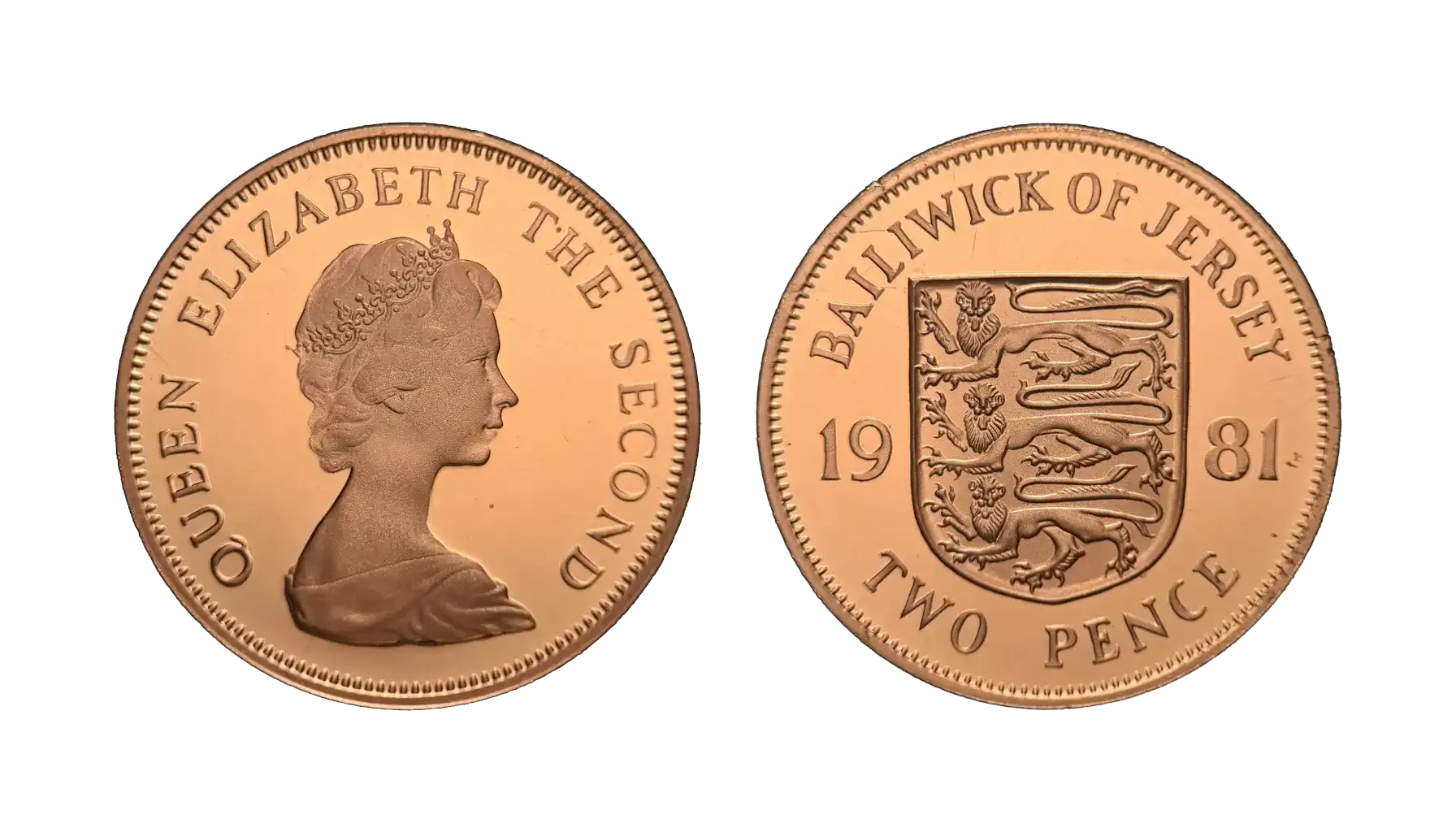
1981: Shield reverse
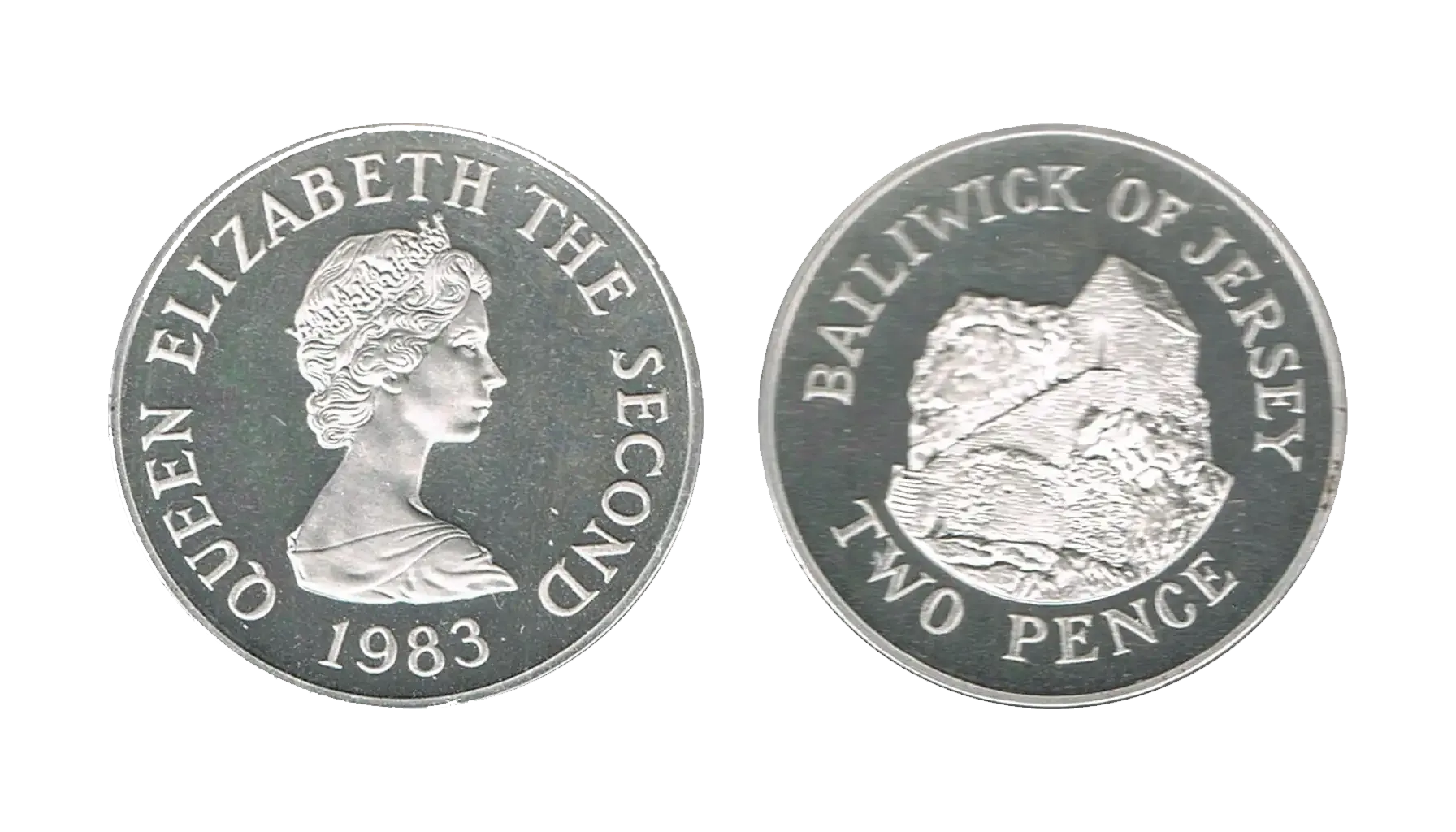
1983–1992: Hermitage of St. Helier reverse
1983: Silver commemorative
1992–1997: Copper-plated steel variety
1998–2016: 4th portrait type
Overview of the Bailiwick of Jersey 2p Coin
The history of the 2p coins started with the switch to the decimalized currency system in the United Kingdom. Although there were early attempts to introduce a new monetary framework with the UK florin coins, the real process commenced with the Decimal Currency Act of 1967, which would later lead to Decimal Day on 15 February 1971. This is when the 2p coins were finally introduced.
As a Crown Dependency, the Bailiwick of Jersey turned to the same denomination patterns that year. The first units of currency bore the name "New Pence", though the word "new" was omitted with the second iteration of the coin. Over the years, the Jersey 2p developed into a distinct local issue, but the standards of minting and design were the same across the British decimal coinage system.
“Clauses 2 and 3 deal with new coinage. There are to be three bronze coins – the new halfpenny, the new penny and the new two penny piece. <...> The new bronze coins will be smaller and less heavy than the present coins, <...> so that the new two penny piece will weigh twice as much as the new penny…”
— Mr. James Callaghan, The Chancellor of the Exchequer
Decimal Currency Bill, Volume 743: debated on Wednesday, 22 March 1967
Design and Specifications
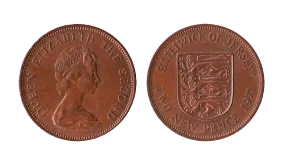
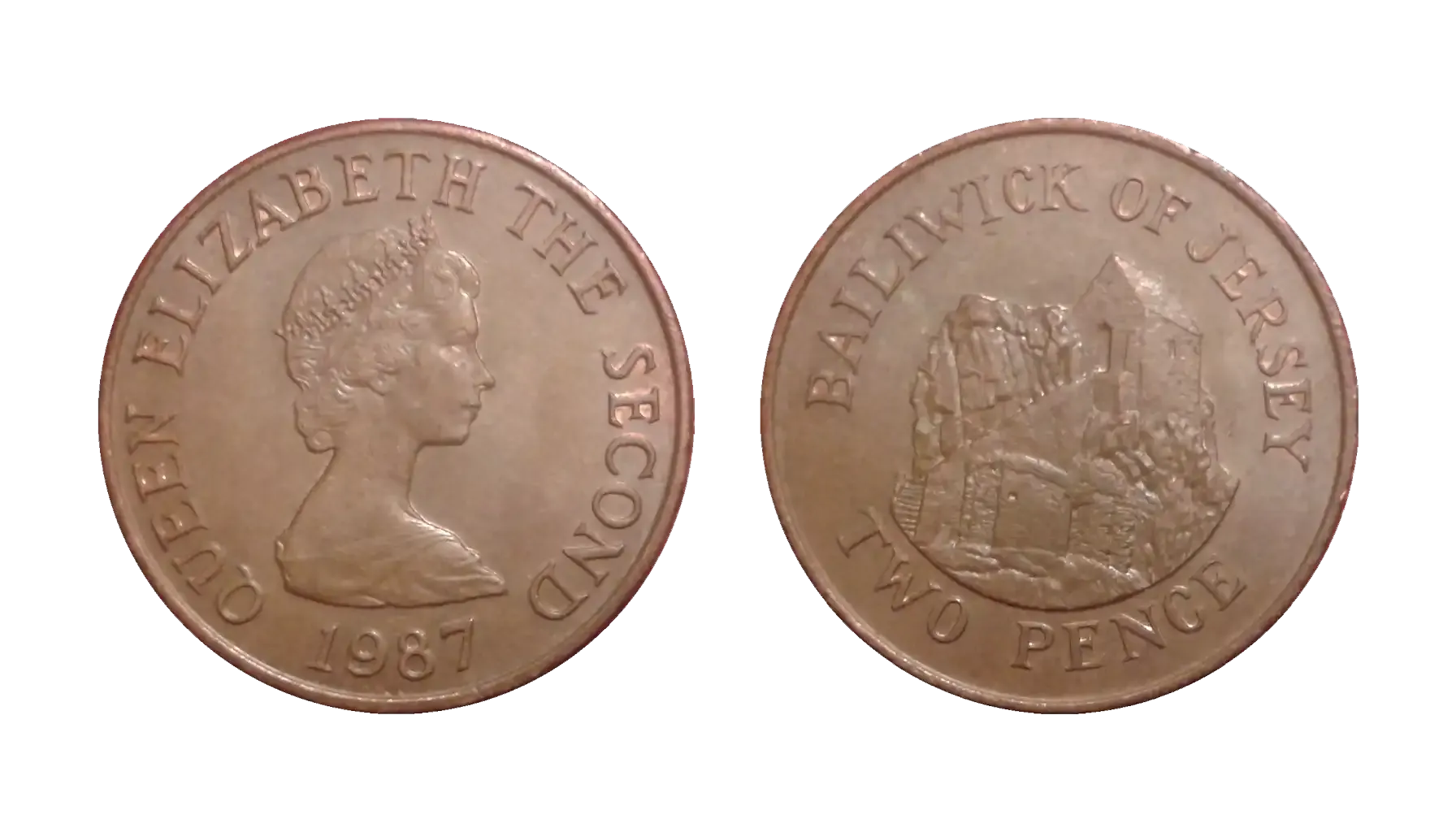
Obverse: The obverse design of the 2p coins was rather consistent, as it has always remained the monarch's side. As such, it featured the portrait of Queen Elizabeth II (the second portrait by Arnold Machin or the fourth portrait by Ian Rank-Broadley, respectively), as well as the title “QUEEN ELIZABETH THE SECOND” along the rim.
Reverse: The reverse side, on its part, changed during the series. The first standard type showed the Jersey coat of arms, i.e., a shield with three lions passant on it. From 1983, the Mint has used the depiction of the Hermitage of St. Helier. The only things that were shared by all types are the inscriptions “BAILIWICK OF JERSEY” along the upper rim, the date at the center, and the denomination “TWO PENCE” at the bottom.
The Main Features | |
Denomination | 2 Pence |
Years first issued | 1971 |
Currency | Jersey pound (decimalised) |
Shape | Round |
Composition | Bronze |
Weight | 7.21 g (1971–1980 type); ~7.1 g on later bronze issues |
Diameter | 25.91 mm |
Thickness | 1.8 mm to 1.9 mm |
Mint | Royal Mint, Llantrisant |
Metal change | Copper-plated steel introduced for some issues from 1992 |
Is the Jersey 2p Rare?
Rarely do coins of general circulation become rare, but some cases still do exist. The 2p denomination cannot be considered exclusive or extraordinary when it comes to common circulation years. However, some dates showed lower mintage figures, which made them a bit more valuable than the rest.
The most distinctive key day is 1981, with a mintage of 56,000 pieces in total (this coin is always seen as a separate type). Later, in 1997, the Mint released a very limited series of 2p coins that came in sets only, and its mintage of 5,500 also made it quite expensive and harder to obtain (3% frequency rate).
Key types: 1983 silver commemorative (5,000), 1997 set-only issue (5,500), 2003 (10,000)
Quite scarce: 1981 (56,000)
More widespread types: 1985 (250,000), 2012 (320,000), 2014 (360,000), 2005 (400,000)
Bailiwick of Jersey 2p Worth Today
The 2p coins do not demonstrate high values, as common pieces tend to be worn and well-preserved because of their age. Nonetheless, grades affect the way the numismatic creation sells. Circulated examples are usually worth up to €1, but better-preserved, certified coins in higher grades reach around €1–€1,5 on average.
How Much Do 2p Coins of Jersey Cost?
Grade | Average value |
G | €0.23 |
VG | €0.22 |
F | €0.47 |
VF | €0.54 |
XF | €0.72 |
AU | €1.02 |
UNC | €0.95 |
Should you wish to learn more about these and other numismatic creations of Jersey, do not hesitate to do so with Coin ID Scanner on your phone. Scan coins, analyze their origins, and learn more about values all at once.

 Facebook
  X (Twitter)
  Pinterest
  LinkedIn