Contents:
Banknotes might be seen as relics of the past: more and more people opt for cashless operations with the help of various cards or digital wallets. Nonetheless, despite this shift, certain instances are still valuable and peculiar to explore, especially when they boast cultural, historical, and even collectible significance in the first place.
To most Australians, though, a new Australian 5 dollar note is a necessity, for it remains the most commonly used denomination for everyday transactions. However, each iteration also carries different portraits, symbols, and spirits taken from the history of the country, but how? Let us briefly cover the evolution of these Australian notes, explore their features, and learn how to detect counterfeits on the spot.
The Introduction of the Australian 5 Note
Any unit of currency needs to be both practical in everyday use and secure against counterfeiting – these are only a few main requirements that should ensure the durability, reliability, and efficiency in circulation. The 5 dollar note Australia, along with other denominations like the Australian $100 note, was created as part of the country’s initiative to improve the monetary system with the introduction of the decimal currency in 1967.
Originally, it was developed by Gordon Andrews, the influential Australian designer who also had a hand in the creation of all decimal currency pieces (i.e., the Australian $50 note is also included), with the revolutionary approach for its time: bold colors, abstract patterns, and symbolic motifs that represented Australia's identity from the deep down.
From the very beginning, it could be characterized by its distinct designs, but they, on their part, were subject to fluctuations and alterations over time. The last iteration, for instance, was launched in 2016. However, the passing of the monarch (who appears to be the head of state of the United Kingdom and the leader of the Commonwealth) inevitably raised questions about future design updates and the continuation of royal imagery on Australian banknotes.
“As times change, so do our banknotes. The $5 note is being redesigned and we want to use this as an opportunity to represent what makes this country so special: aboriginal and Torres Strait Islander cultures and history.”
Reserve Bank of Australia
Reimagine the $5 Project Page
Rare and Collectible Australian $5 Dollar Notes
1967 $5 Banknote
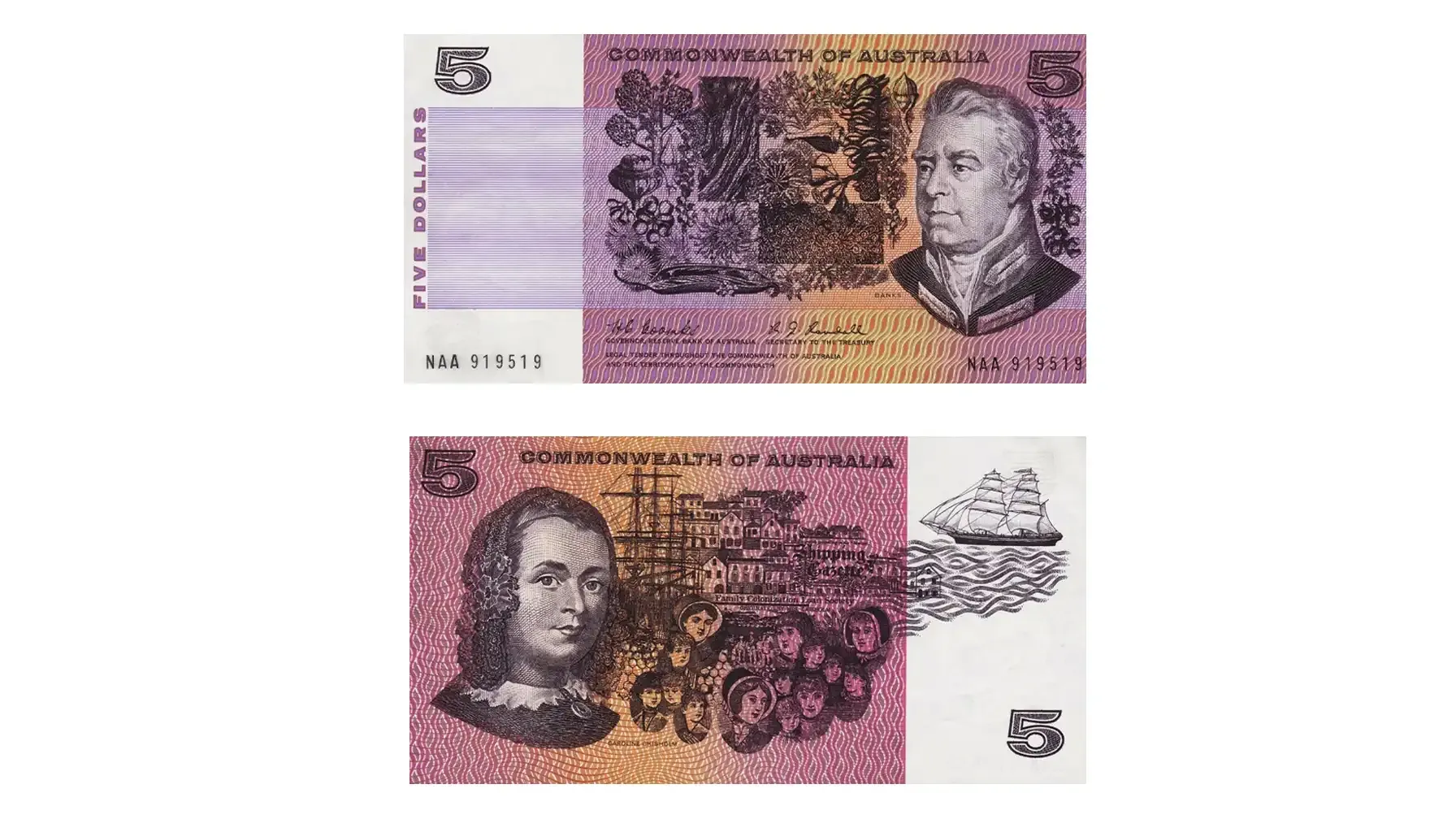
Market Average: $450
This is the first Australian $5 note, which was developed by Gordon Andrews, i.e., a graphic and industrial designer who, according to Rita Shaw, led the decimal "revolution" in the Commonwealth of Australia at that time. As such, the banknote features Sir Joseph Banks and Caroline Chisholm and is highly valuable, thanks to its position in the series.
1972 $5 Banknote
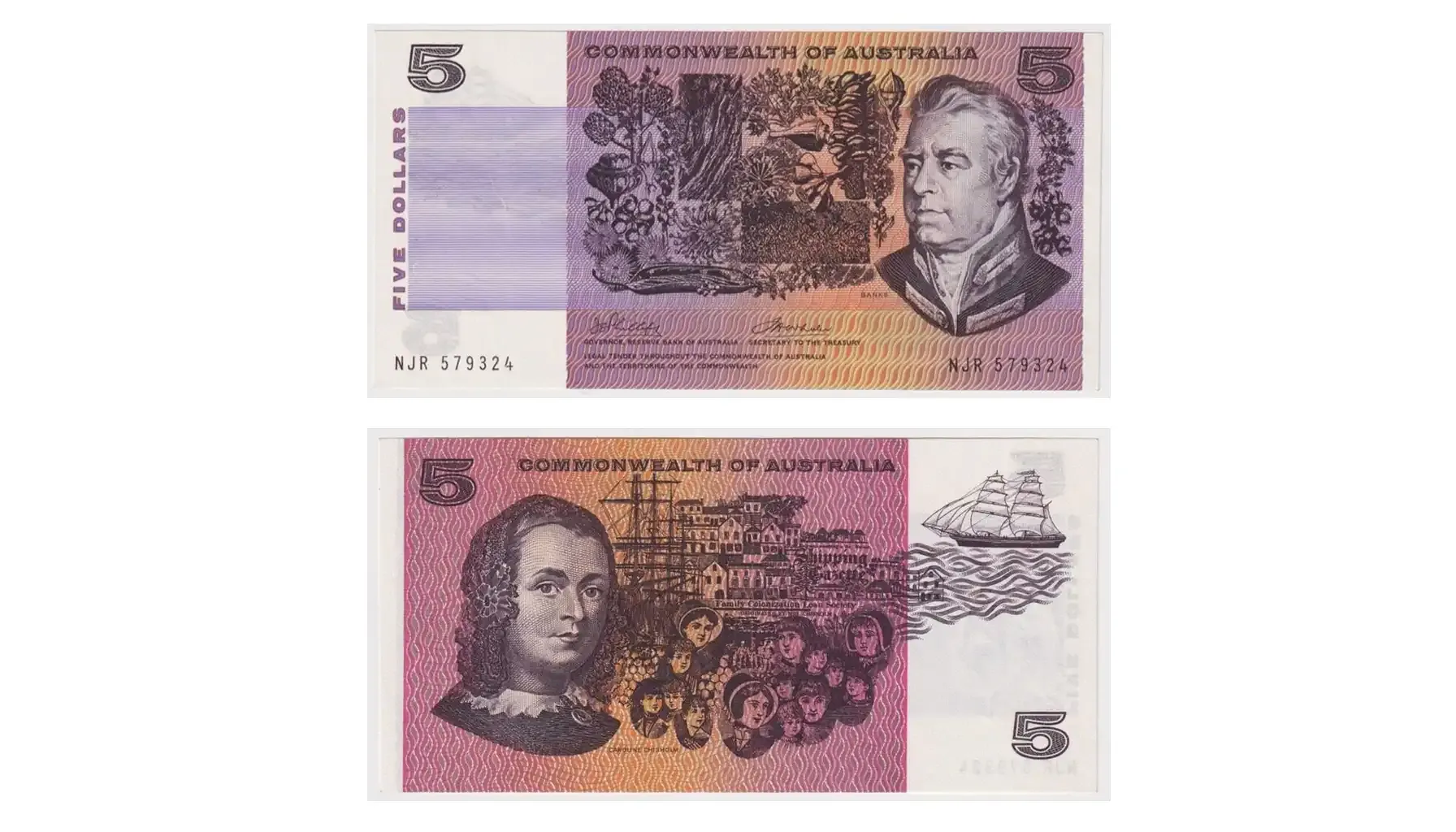
Market Average: $250
Is the Australian $5 dollar note rare and highly collectible? The 1972 iteration, however ordinary it may seem, was notable because of its low print numbers and rare star replacement notes, i.e., the limited substitute for misprinted banknotes, identifiable by a star in the serial number. Nothing special, but a star on it.
1992 $5 Banknote
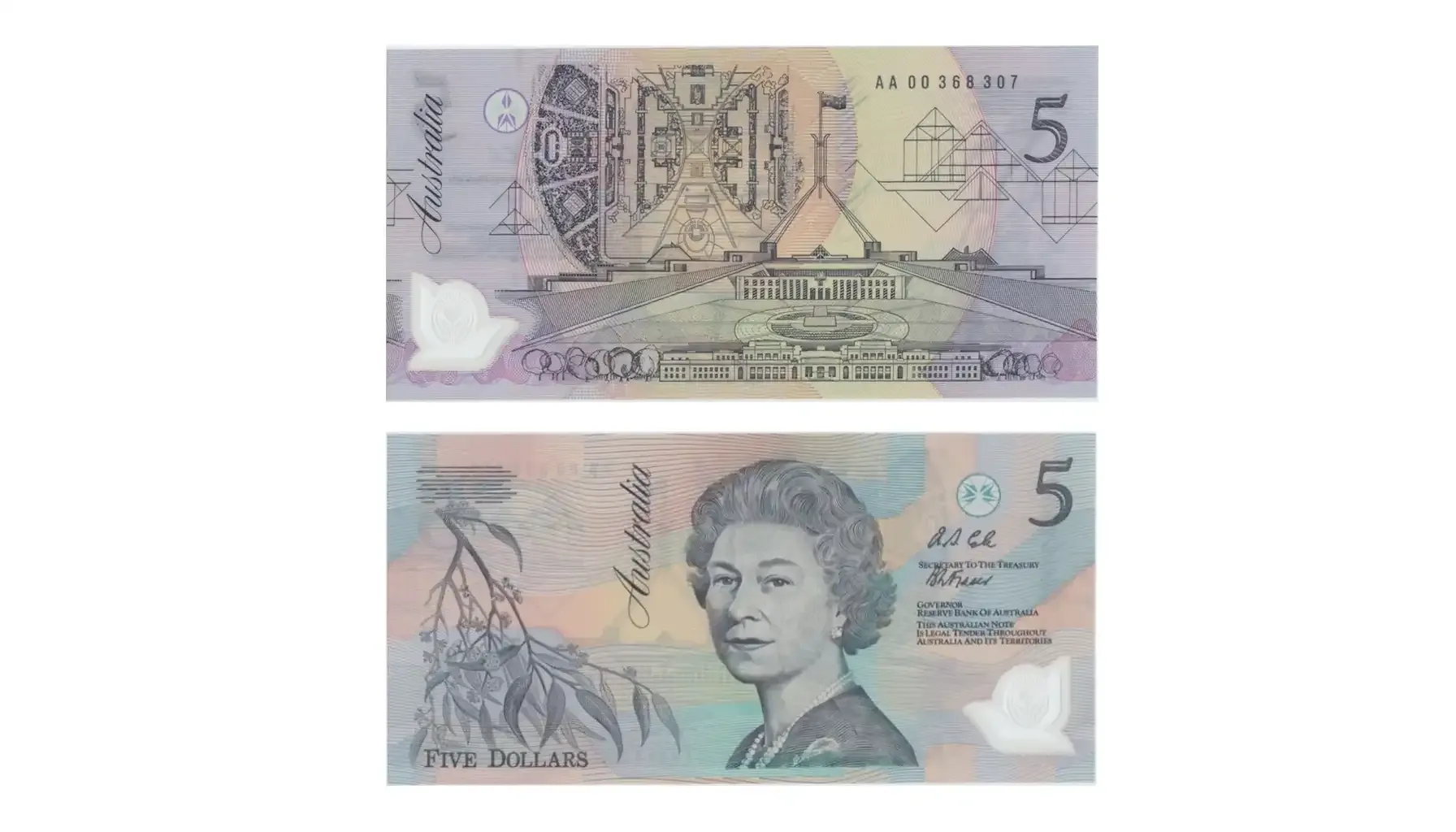
Market Average: $200
In 1992, there was released the first polymer banknote in the world, and Australia became the hub for this initiative to emerge. It was a new standard, aimed at enhancing durability, preventing counterfeiting, and preserving the quality of notes in circulation for much longer than paper could allow.
2021 $5 Banknote
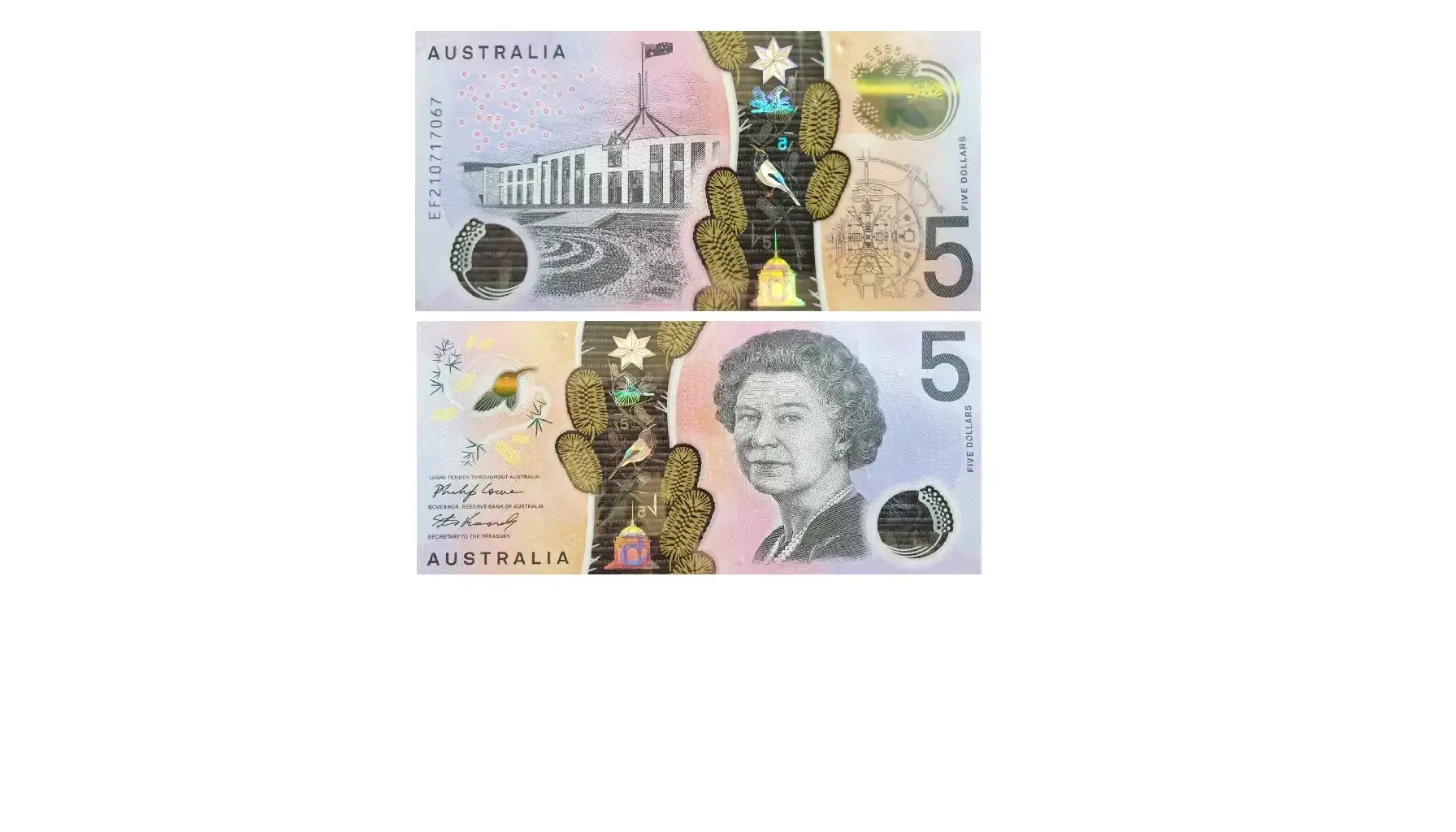
Market Average: $15
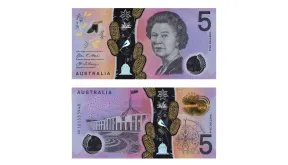
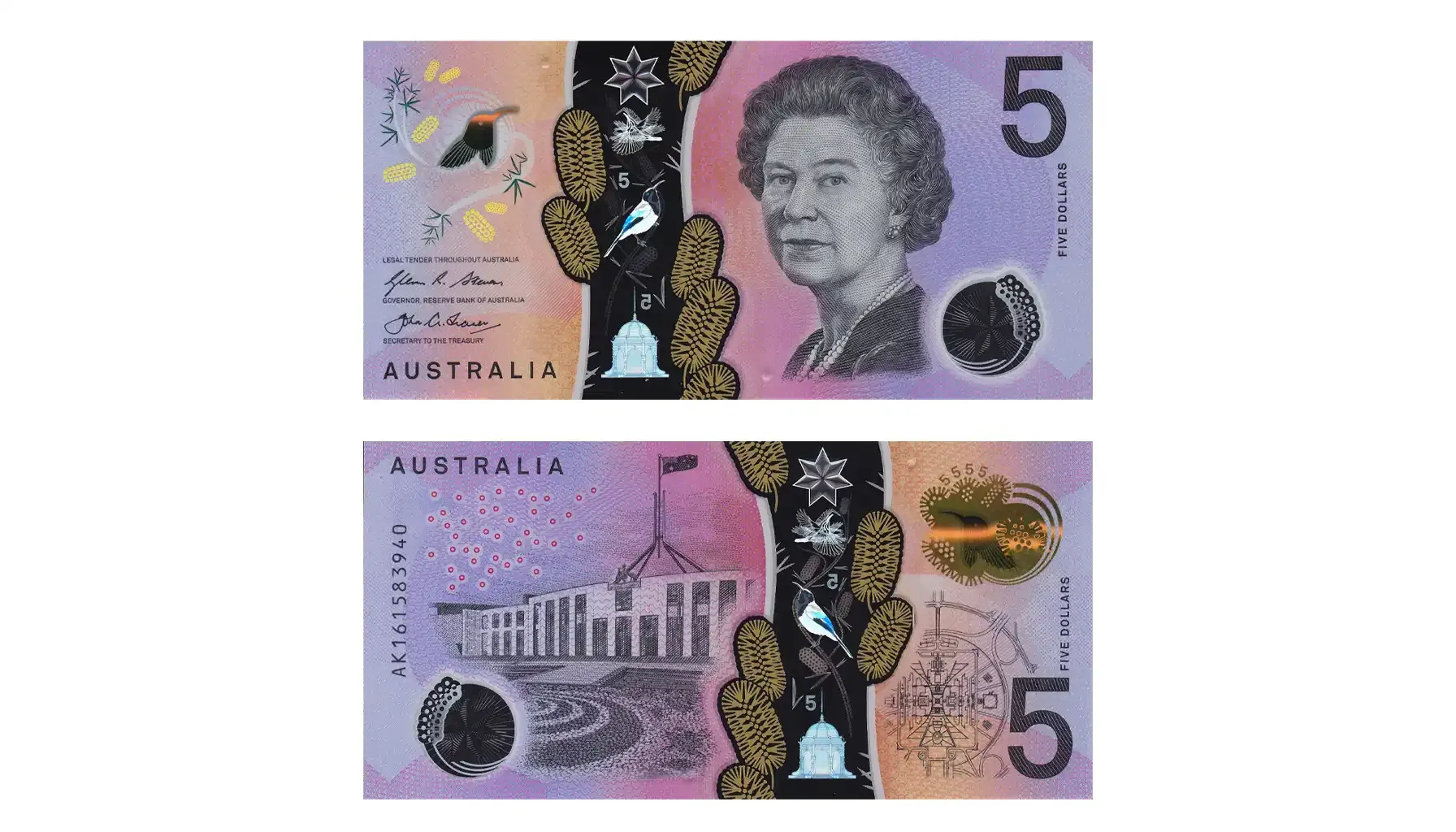
One of the most notable new 5 dollar notes is the 2021 issue, featuring Queen Elizabeth II on one side and the Parliament House on the other. It was the last unit of currency before the transition to new designs following the monarch’s passing.
Security Features of the Australian New $5 Note
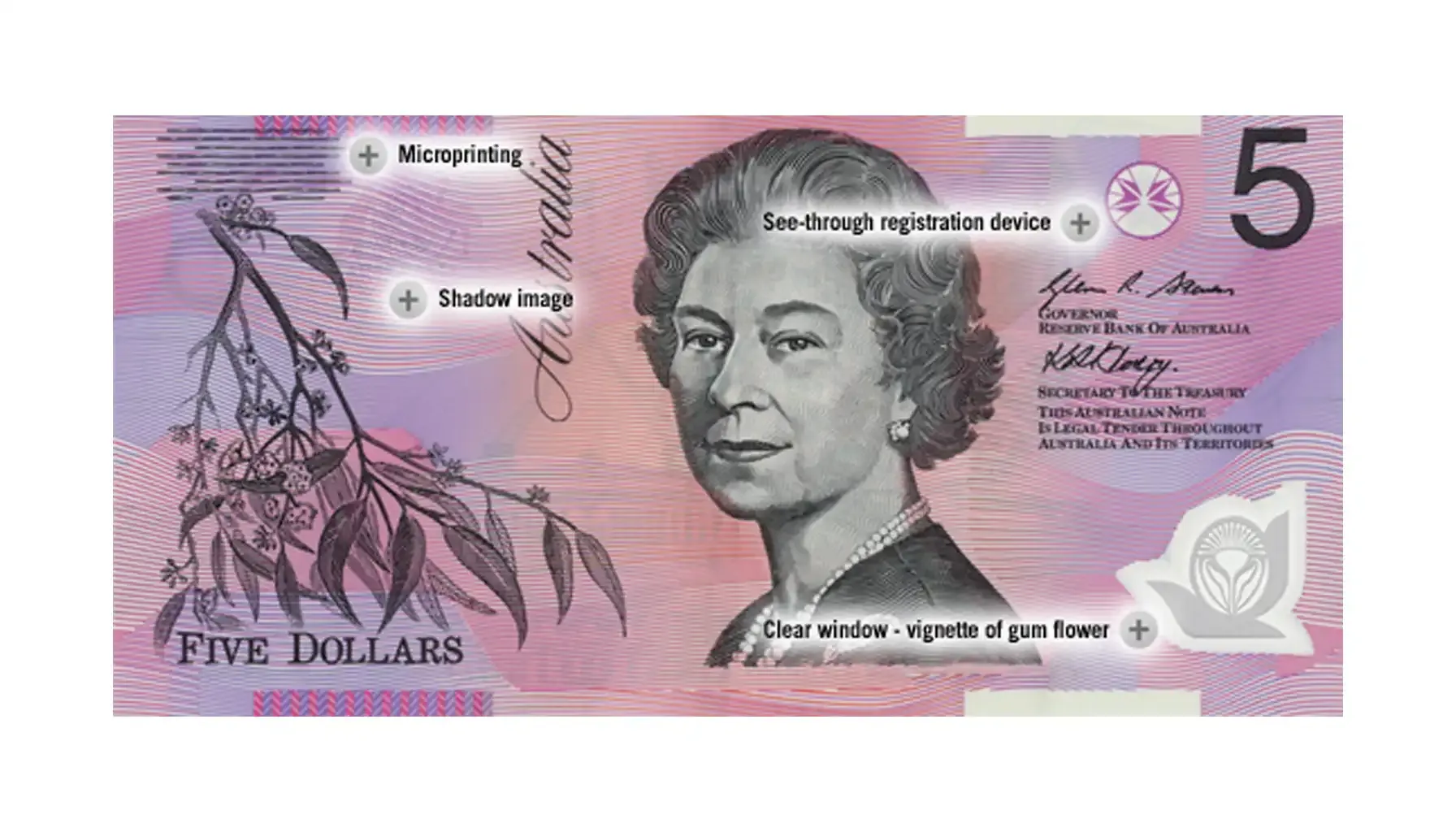
The latest note, part of the Next Generation Banknote (NGB) series (since 2016), introduced a few more advanced security features to make counterfeiting extremely difficult and less apparent, not to mention. Here is what one should pay attention to when determining the authenticity of the unit:
Top-to-bottom clear window: A transparent vertical strip running the full height of the note.
3D Federation Star: A five-pointed star, positioned within the clear window, that shines in three dimensions under light.
Flying bird image: A depiction of the Eastern Spinebill that flaps its wings when the note is tilted.
Color-changing ink: The numeral “5” in the window, changing color and intensity under different viewing perspectives.
Raised print: A tactile feel, characteristic of the raised areas like the portrait, the denomination, and the word “Australia”.
Microprint: Tiny, sharp text, printed around the portraits and patterns (can be discerned under magnification).
UV fluorescent elements: Certain parts of the design, glowing under ultraviolet light.
The Value and Legacy of the $5 Note
The evolution of the 5-dollar banknotes in Australia is quite diverse, but not all of these creations are valuable or collectible as they are. In fact, only the most outstanding pieces, i.e., those with errors or of low-mintage issues, may be worth anything, and this is vividly displayed in the table below.
Type | Market Average (UNC) |
Early Paper Decimal $5 Notes | $400–$500 |
Star Notes and Replacement Notes | $500–$700 |
Polymer $5 Notes (1992–Present) | $150–$250 |
Next Generation $5 Note (2016–Present) | $15–$30 |
Some banknotes are too common to be collectible. However, even the most mundane pieces can be quite valuable to own – try it on your own!

 Facebook
  X (Twitter)
  Pinterest
  LinkedIn