Contents:
Among Australian banknotes and coins, the 20 dollar note Australia holds a special place. Its history shows how Australia was the first in the world to adopt polymer technology and set the standard for other countries.
This banknote is notable for how its role has evolved. First, it was simply a means of payment, then it became a collector's item. Older paper issues are increasingly valuable, while newer banknotes impress with their intricate security features and artistic design.
The History of the Australian 20 Dollar Notes

The first banknote appeared in 1966, the year of the transition to decimalization. It took the place of the old ten-pound note and soon turned into one of the country’s most familiar banknotes.
The front features John Flynn, founder of the Royal Flying Doctor Service. The back shows Mary Reibey — once convicted, later known as a successful businesswoman and philanthropist. Together, they reflect what mattered most in Australia at the time: initiative, independence, and a sense of public responsibility.
Until 1994, banknotes were issued on paper. The earlier paper notes wore out quickly — they tore, faded, and lost color with use. Because of this, Australia became the first country to adopt polymer banknotes. The new material lasted longer, resisted moisture, and made it possible to add stronger security features.
The new 20 dollar note from Australia, released in 2019, includes several updates:
a transparent window with a holographic image;
microprinting and a thread that changes color;
tactile marks for the visually impaired;
refined microgrids that strengthen anti-counterfeiting protection.
Version | Material | Year of Issue | Features |
Paper (1966–1993) | Paper | 1966–1993 | Wears out quickly, collectible value depends on condition |
Polymer (1994–2018) | Polymer | 1994–2018 | First plastic banknote, basic security elements |
Updated (2019–present) | Polymer (second series) | 2019– | Tactile marks, hologram, extended lifespan |
Prices are current at the time of writing.
Rare $20 Dollar Note Australia and Collectibility
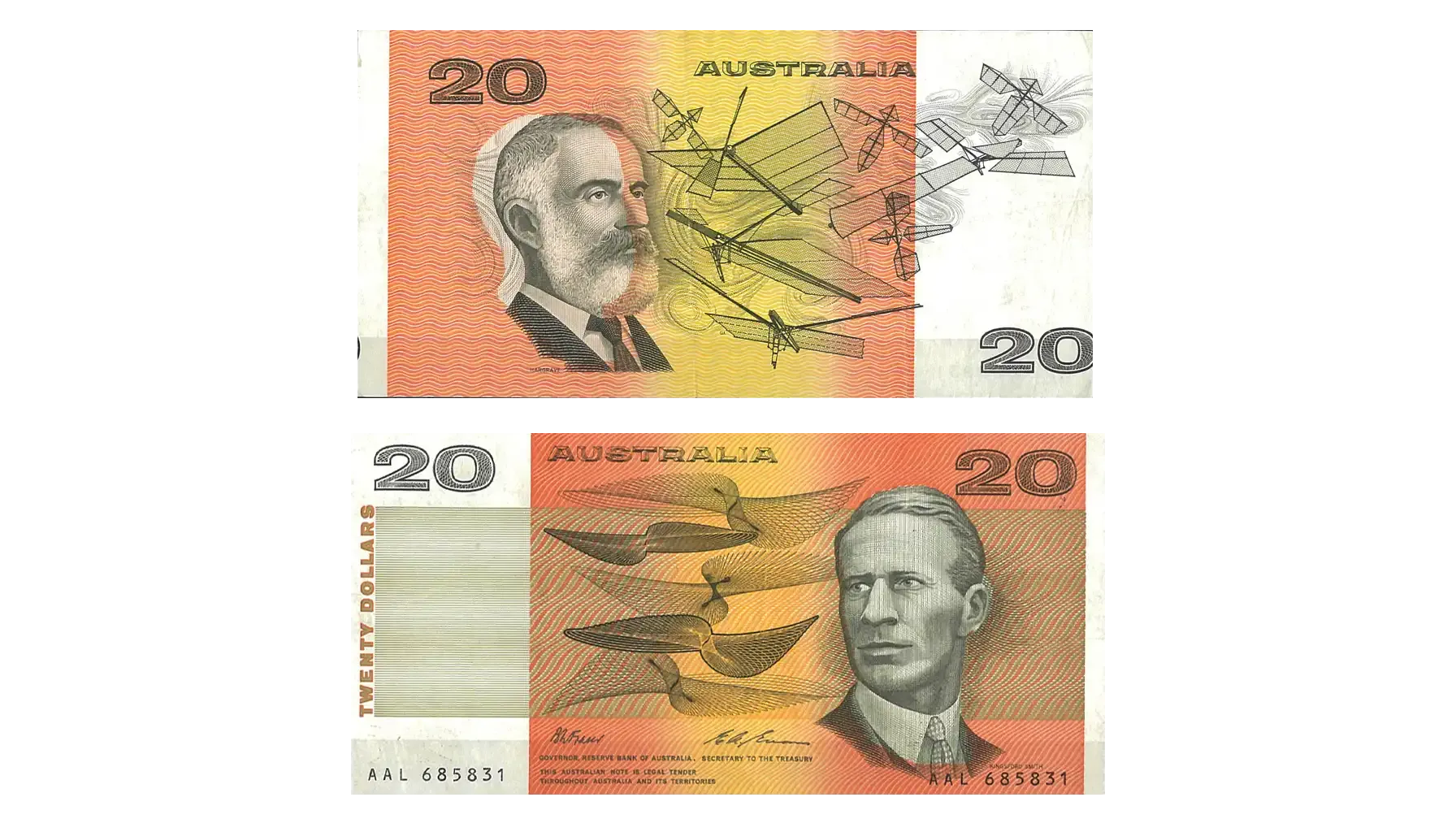
Rare banknotes are valued by more than just price. Their worth depends on several technical and production details. For collectors, one thing matters most: the rarer the prefix or serial number, the higher the note’s value.
The following are of particular interest:
The first paper issues of 1966–1967 were early series with the prefixes "AA," "AB," and "ZF."
Printing errors include double imprints, misaligned watermarks, or improper sheet cutting.
Trial Specimen notes, intended for banks and museums.
Rare numbers include repeating (e.g., 333333) or sequential (123456).
“A rare coin is like a rare piece of fine real estate. The more interest there is in it, the more money it will go for.”
— Joshua McMorrow-Hernandez, numismatic expert
Nasdaq website
Collectors also consider the condition: banknotes without folds or stains (UNC grade) can fetch up to five times the price of circulated ones. Many rely on auction catalogs from Noble and Downies, which record real market prices.
To assess rarity, collectors often compare it to the Australian $1 note, as older banknotes reflect demand for paper issues.
The Role of the 20 Dollar Note in Australian Currency

This banknote has always been one of the most widely used in the country. It holds a significant place in circulation and at the same time remains a collector's item.
Millions of $20 notes remain in circulation, although older and rarer issues are becoming increasingly rare due to wear and tear and withdrawals.
The modern banknote reflects a balance between technology and tradition:
it remains a practical means of payment,
while each new issue adds security innovations,
and the design maintains historical continuity.
Interestingly, the 20 dollar note Australia is one of the most "lively" banknotes in circulation, second only to the $50. It is also actively studied by design researchers.
To check a banknote’s value or authenticity, try the Coin ID Scanner app. Take a quick photo, and it will show the note’s approximate worth, series details, and rarity level.
Particular attention should be paid to:
storing in sealed capsules with silica gel;
avoiding direct sunlight (polymer can become cloudy);
temperature and humidity control—sudden changes cause microcracks.
The new Next Generation series has proven that the Australian 20 dollar note is part of the country's visual identity.
According to the RBA, polymer banknotes last significantly longer than paper ones—for example, a $20 note in Australia lasts approximately 10 years, and a $50 note lasts approximately 15 years. The rate of banknote counterfeiting in the country has been declining since 2015, continuing the legacy of innovation seen in the Australian $5 note.

 Facebook
  X (Twitter)
  Pinterest
  LinkedIn