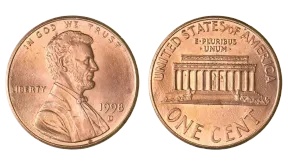
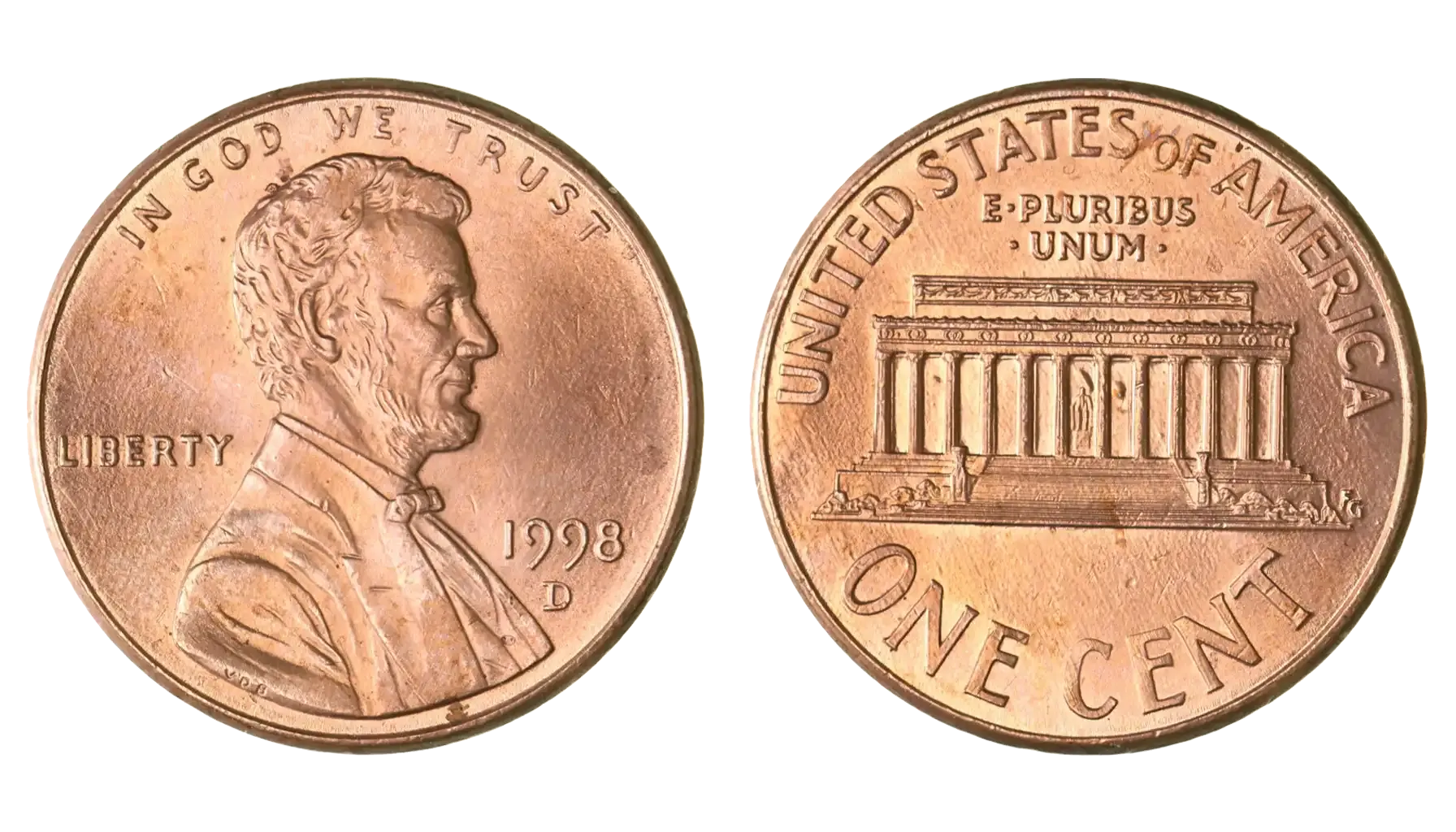
A 1998 D penny is a Lincoln Memorial Cent struck at the Denver Mint in 1998. It is part of the long-running Lincoln cent series that began in 1909 and, in this period, featured the Lincoln Memorial on the reverse design.
The obverse shows Abraham Lincoln’s profile, designed by Victor David Brenner, while the reverse displays the Lincoln Memorial, designed by Frank Gasparro. The coin is made primarily of zinc (97.5%) with a thin copper plating (2.5%), a change that began in 1982 when the Mint switched from mostly copper cents to copper-plated zinc cents. It weighs 2.5 grams, measures 19.05 mm in diameter, and has a plain edge.
How much is a 1998 D penny worth? The Denver Mint produced billions of these coins, so they are extremely common in circulation. In worn condition, a 1998 penny D is worth only its face value. However, coins in pristine mint state with full red luster can be worth a few dollars, and coins graded at the very highest levels by professional grading services may bring $20–$50 or more.
Let’s find out together how to check the value of coins.
Specification | Detail |
Type | Lincoln Memorial Cent |
Year | 1998 |
Mint | Denver (D) |
Designer (Obverse) | Victor David Brenner |
Designer (Reverse) | Frank Gasparro |
Composition | 97.5% zinc, 2.5% copper plating (NOT a 1998 silver penny) |
Weight | 2.5 grams |
Diameter | 19.05 mm |
Edge | Plain |
Mintage | Over 5.2 billion |
Historical Background
The 1998 Lincoln cent belongs to the Memorial reverse series, which had been in use since 1959. By this time, the design showing the Lincoln Memorial on the back had become a familiar part of American coinage. The coin was still honoring Abraham Lincoln’s centennial legacy, with Victor David Brenner’s portrait on the front unchanged since 1909.
In terms of composition, 1998 pennies were struck on copper-plated zinc planchets, a standard introduced in 1982 to cut costs when copper prices rose. This change made the cent lighter than its earlier copper counterparts, dropping its weight from 3.11 grams to 2.5 grams.
Production in 1998 was massive, with billions of cents struck at both the Philadelphia (1998 penny no mint mark) and Denver Mints. These coins were made to meet the demand for circulating cents in the U.S. economy, which still heavily relied on pennies for everyday transactions in the late 1990s.
The year is also special for collectors because of a minting variety: a small number of 1998 cents were struck with the "Wide AM" reverse design. This was not intended for circulation but came from reverse dies meant for proof coinage being used on regular business strikes. The result was a collectible modern variety that drew attention to what would otherwise be a very common coin.
Close vs. Wide AM
1998 Penny Close AM
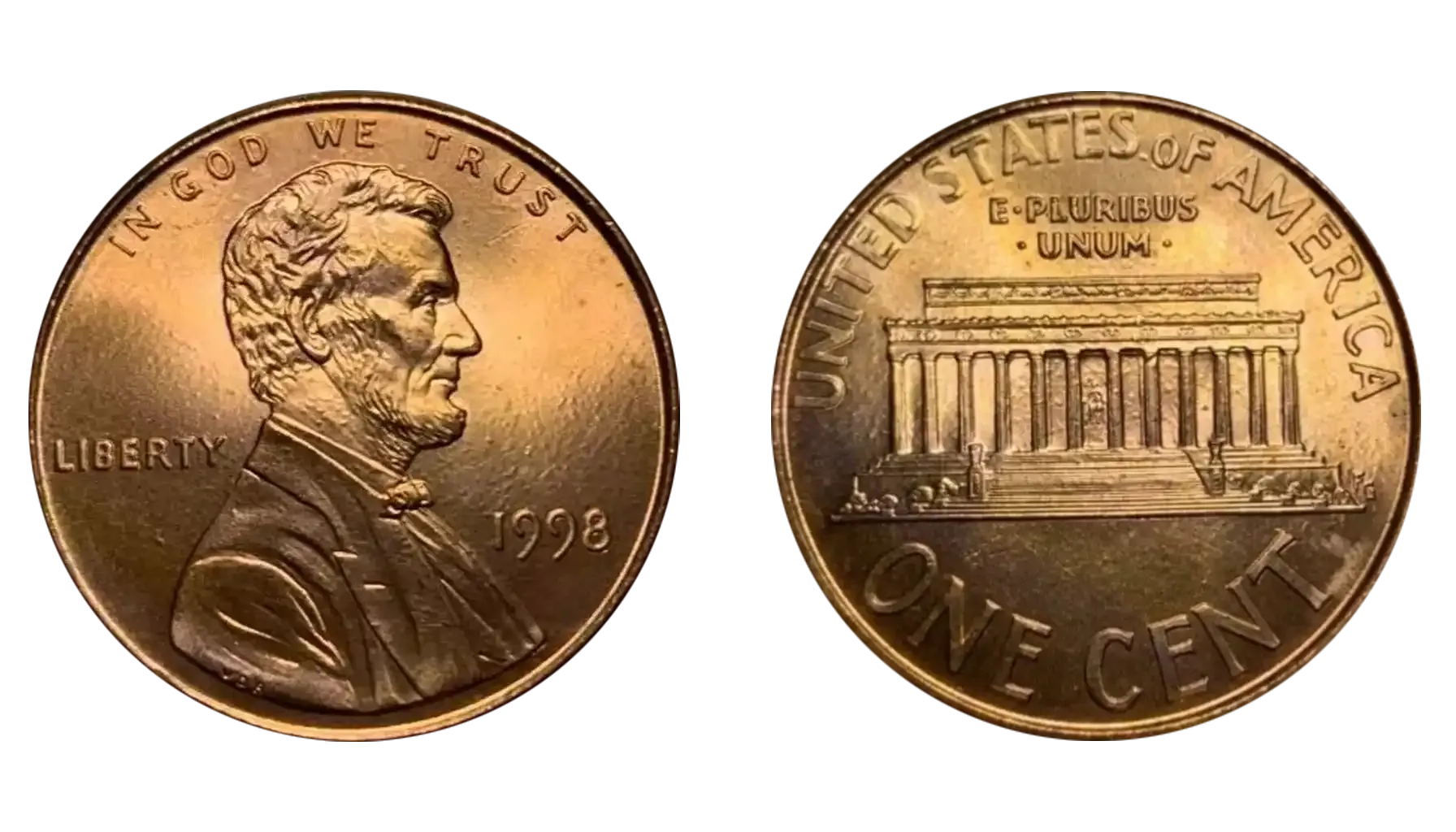
A 1998 penny with Close AM refers to the standard design used on nearly all business-strike Lincoln Memorial cents from that year. On the reverse, in the word AMERICA, the bottoms of the letters “A” and “M” are very close together, almost touching. This “Close AM” spacing is what collectors consider normal for circulation strikes dated 1998, 1999, and 2000.
The reason this detail matters is that in 1998 a small number of coins were accidentally struck with the proof-style reverse, where the “A” and “M” are set farther apart. By contrast, the Close AM is the common version, and it exists by the billions.
In circulated condition, a 1998 Close AM penny value is equal to only face value. Even in mint state, most examples are worth just a few cents to a dollar unless they are certified in the very highest grades.
1998 Penny Wide AM
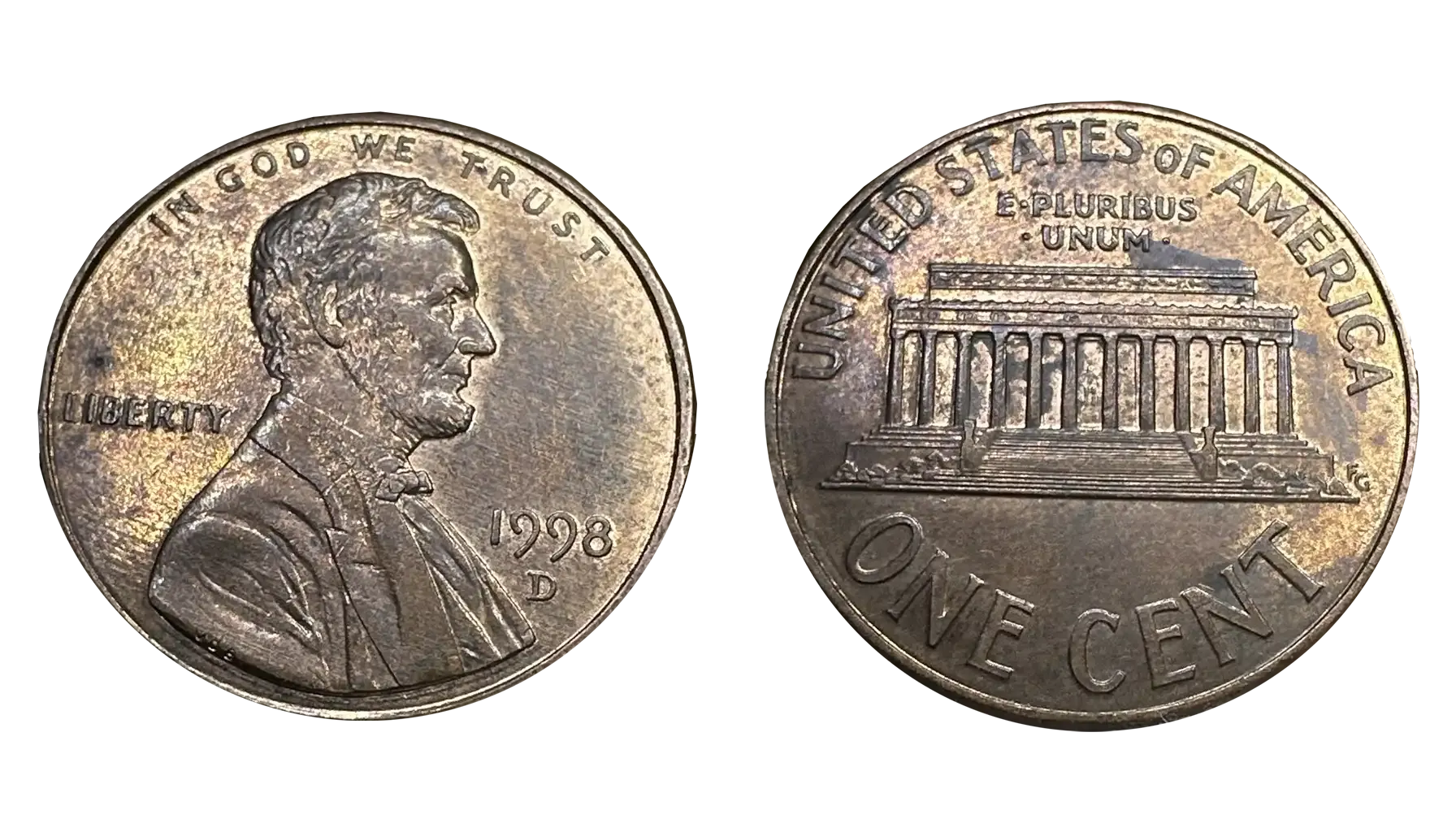
It is one of rare 1998 penny errors. On the reverse, in the word AMERICA, the letters “A” and “M” are spaced noticeably apart, leaving a clear gap between them. This is different from the normal 1998 penny, where the letters are so close they almost touch (the “Close AM”).
The Wide AM variety happened because the U.S. Mint accidentally used proof-style reverse dies on a small number of business-strike coins in 1998. These cents were released into circulation alongside billions of normal Close AM coins. That’s why the Wide AM is a scarce find for collectors.
How much is a 1998 Wide AM penny worth? In circulated condition, it can be worth $20 to $50, depending on grade. In uncirculated mint state, values often climb to $100–$500 or more, with top-graded examples reaching even higher prices at auction.
This 1998 error penny is one of three “transitional reverse” coins in the Lincoln Memorial cent series, along with the 1999 Wide AM and the 2000 Wide AM, and all are actively sought by collectors. This explains higher 1998 Wide AM penny value sums.
1998 Penny Value
Note: The dollar values are approximate and depend heavily on grading, color (Red / Red-Brown / Brown), eye appeal, certification, and collector demand.
Coin | Grade | Estimated Value (USD) |
1998 no mint mark penny — Close AM (normal issue) | Good / Circulated | ~$0.10 to $0.30 |
Fine / VF | ~$0.30 to $1.00 | |
About Uncirculated | ~$1 to $3 | |
Mint State (MS-60 to MS-63, Red or Red-Brown) | ~$5 to $15 | |
Higher Mint State (MS-65+) | ~$20 to $100+ | |
1998 D penny Close AM | Good / Circulated | ~$0.05 to $0.20 |
Fine / VF | ~$0.20 to $1.00 | |
About Uncirculated | ~$1 to $4 | |
Mint State (MS-60 to MS-63) | ~$10 to $30 | |
Higher Mint State (MS-65+) | ~$40 to $120+ | |
1998 S penny (San Francisco) — Proof / DCAM | Proof Low Grade | ~$2 to $10 |
Proof Mid Grades | ~$10 to $30 | |
Proof High (PR-69 / PR-70 DCAM) | ~$50 to several hundred | |
1998 (Philadelphia) — Wide AM | Circulated / Low Grade | ~$10 to $30 |
Mid-Grade Mint State (MS-60+) | ~$30 to $150 | |
High Mint State / Red (MS-65 to MS-67+) | ~$300 to $1,000+ | |
1998 S Proof with Close AM (error / rare proof variety) | Very Low Proof Grades | ~$50 to $200 |
High Proof Grades | Several hundred to over a thousand | |
Others from the 1998 penny error list with pictures (e.g. doubled die, off-center, die cracks, BIE, etc.) | Minor Circulated Errors | ~$5 to $20 |
More Dramatic Errors / Premium Specimens | ~$50 to several hundred or more |
Notes
The Wide AM variety in 1998 is a proof reverse die accidentally used on business strikes, making it a transitional variety that carries a premium especially in uncirculated grades.
In high grades, Wide AM specimens in red (bright original copper color) can command very strong prices.
Proof coins (especially from the S mint) are graded with designations like DCAM (Deep Cameo) that affect their value.
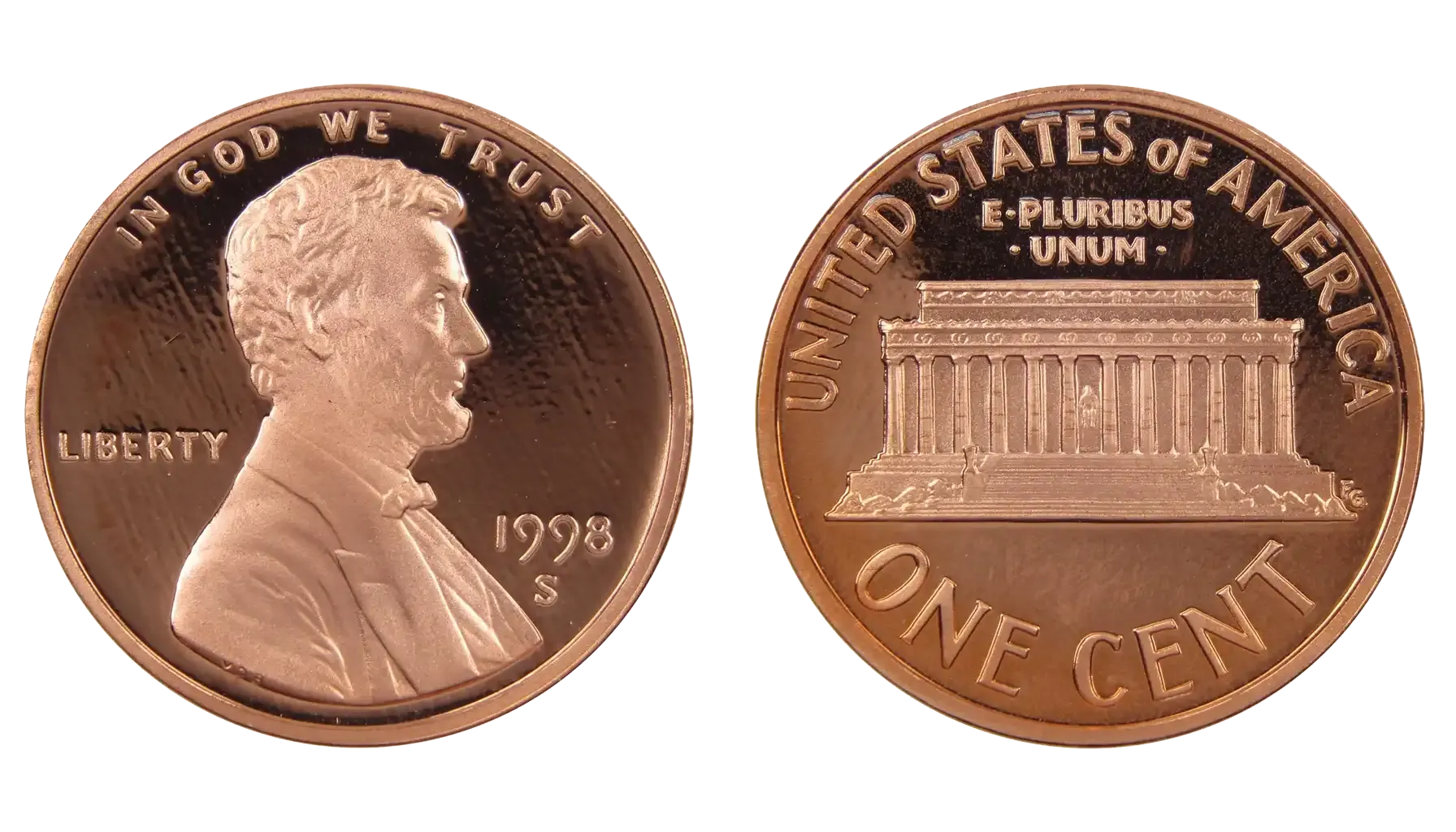
Values of coins from the 1998 D penny error list with pictures (off-center strikes, doubled dies, die cracks, etc.) vary widely; major, well-documented errors can fetch high premiums, but slight or common errors may only bring modest additional value.
The condition and color of the coin (whether it retains original red color or has toned to brown) make a large difference in the 1998 D penny value today.
Certified examples (graded by PCGS, NGC, etc.) command higher, more stable prices.

 Facebook
  X (Twitter)
  Pinterest
  LinkedIn