Contents:
The question about the value of coins always interests numismatists when they examine specimens for their collections. Thanks to modern and reliable scanners, you can find out the base market price of a specific coin in a matter of seconds.
But the exact answer and numbers still require knowing specific nuances, secrets, and minting details of a coin. For example, how much is a 1998 50 cent coin worth?
1998 50 Cent Coin Overview
To know the 50 cent 1998 coin value, let us check the historical context and the specifics of this year's issue.
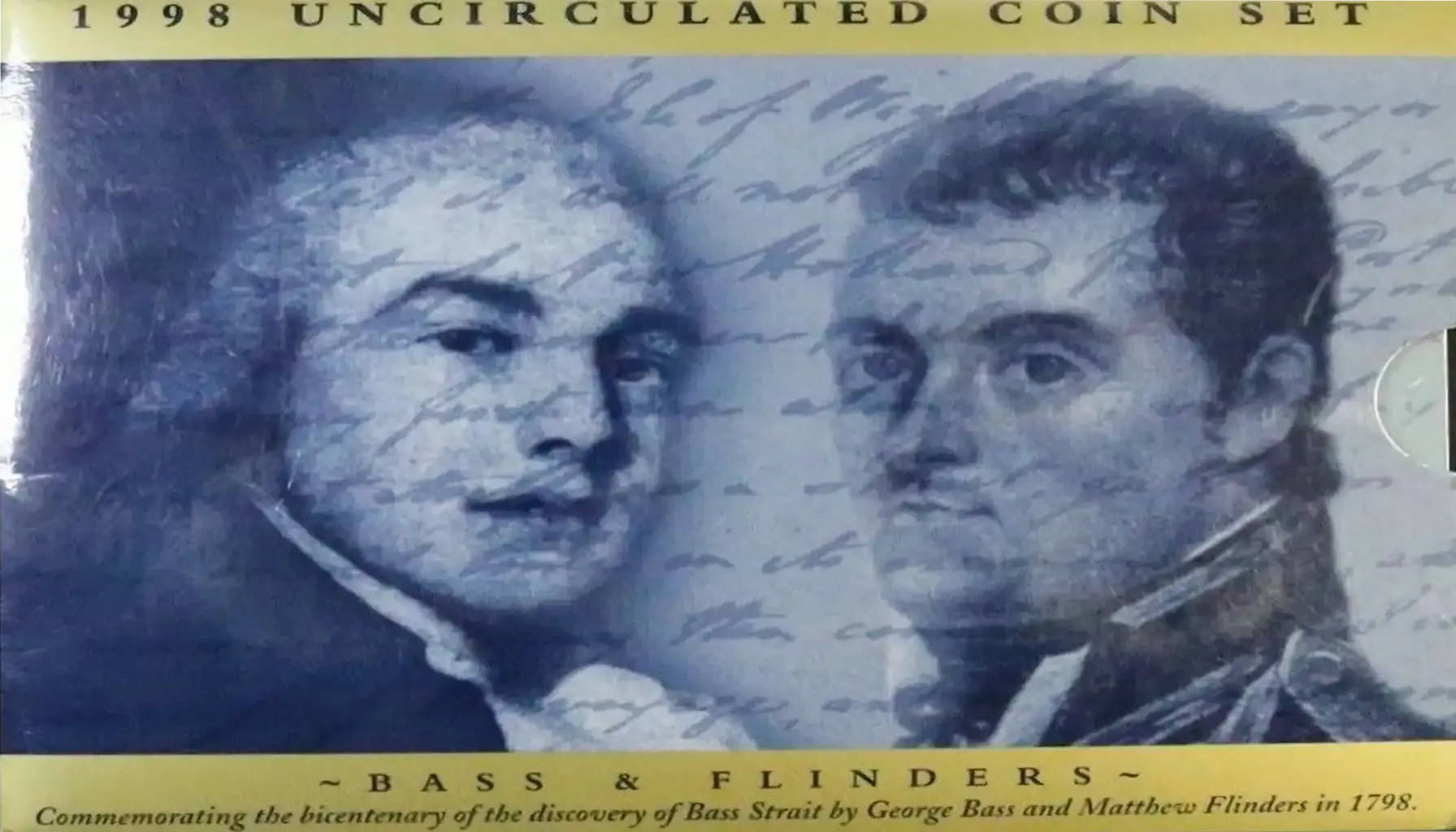
1998 50 cent coin Bass and Flinders was issued by the Australian Mint to celebrate the bicentenary of the voyage made by George Bass and Matthew Flinders. Their 1798 expedition officially confirmed the island status of Tasmania, previously considered part of the mainland.
“In 1795, Flinders was posted to Port Jackson (now known as Sydney Harbour) on HM ship Reliance, where he became a friend of George Bass, the ship's surgeon…Their major coup was the discovery that Van Diemen's Land (present-day Tasmania) was an island and not part of the mainland.”
— Matthew Flinders
Royal Museums Greenwich, Maritime history
This commemorative release replaced the standard coat of arms design in mass circulation. Thus, collectors should distinguish between ordinary circulating examples and special sets produced in limited quantities.
Circulation and Collector Versions
The bulk of the mintage was intended for daily cash transactions across the country.
Besides regular money, the Canberra Mint prepared several premium formats.
Standard and "Baby" proof sets are housed in hard display cases
Mint sets (Uncirculated) containing coins with no trace of handling
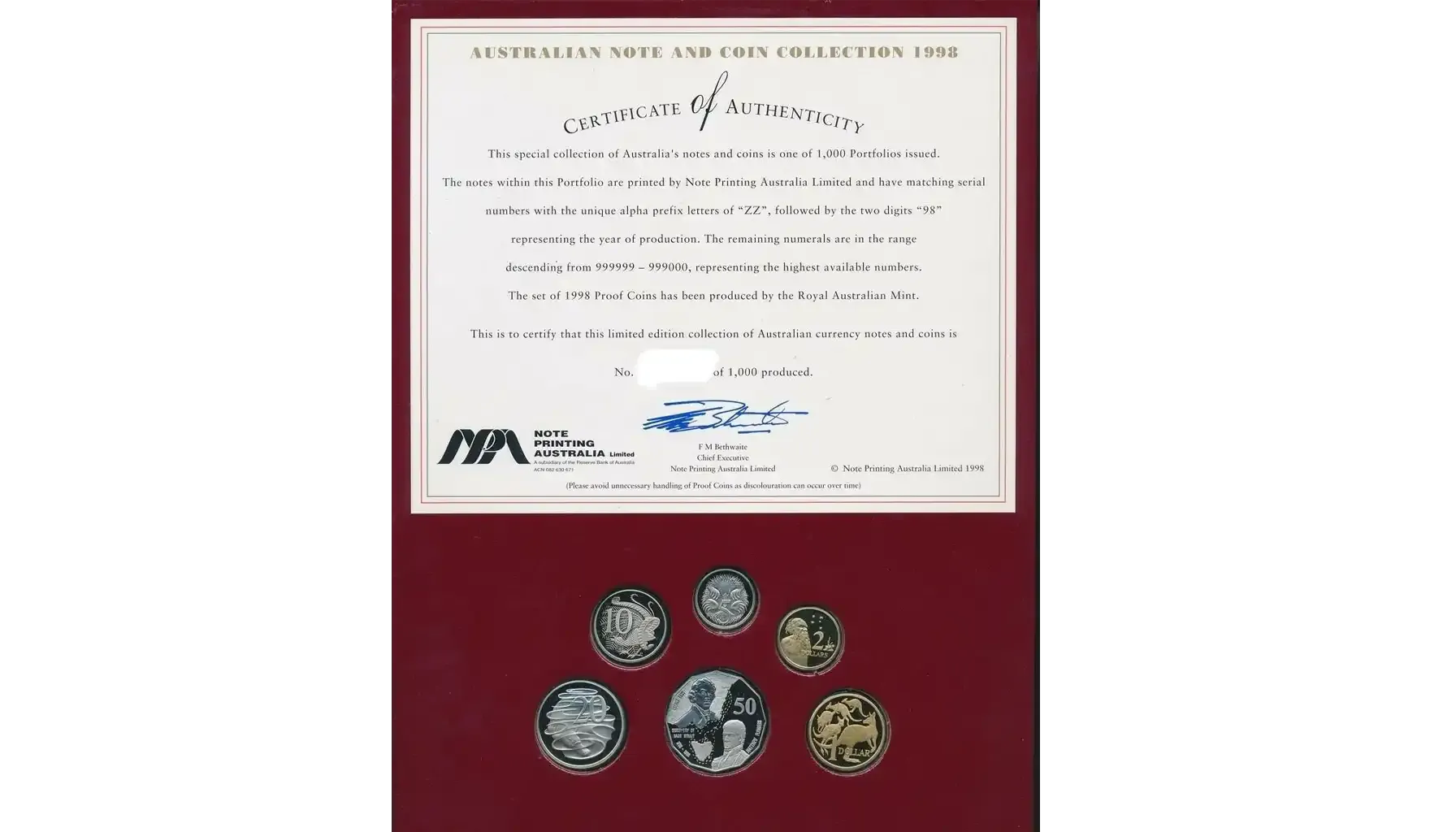
Special portfolios from Note Printing Australia featuring both notes and coins
Spirit of Discovery sets sold during the ANDA Coin Show in Sydney
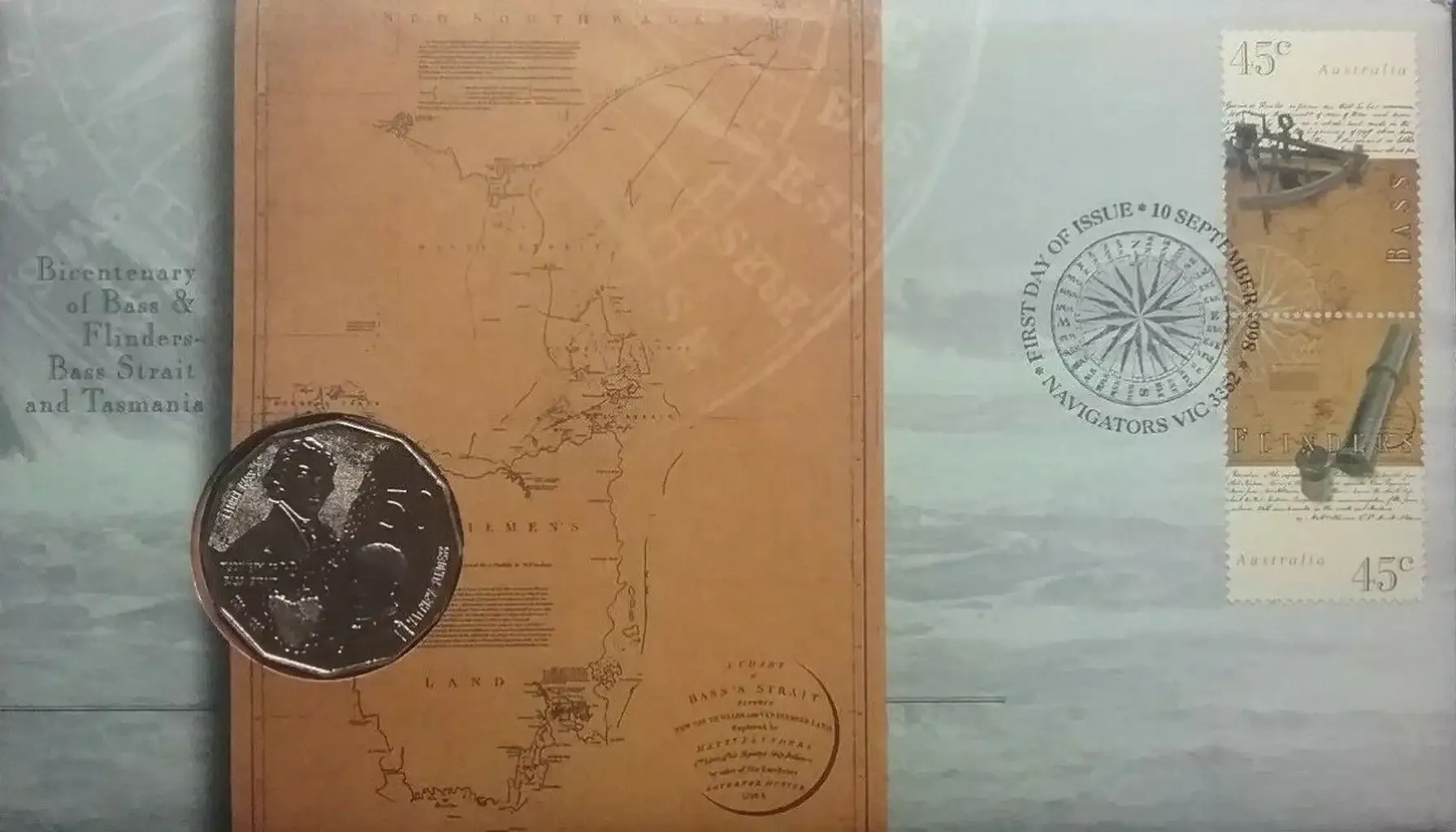
First Day Covers issued jointly with the Australia Post service
The Baby Proof sets included a special medallion with a blank side for engraving a child's name.
As for the secondary market, there collectors can find unofficial commemorative collections assembled by private dealers using various issues. But be careful: the value of the 1998 50 cent coin, as well as improvised sets, also varies greatly.
Coin Design
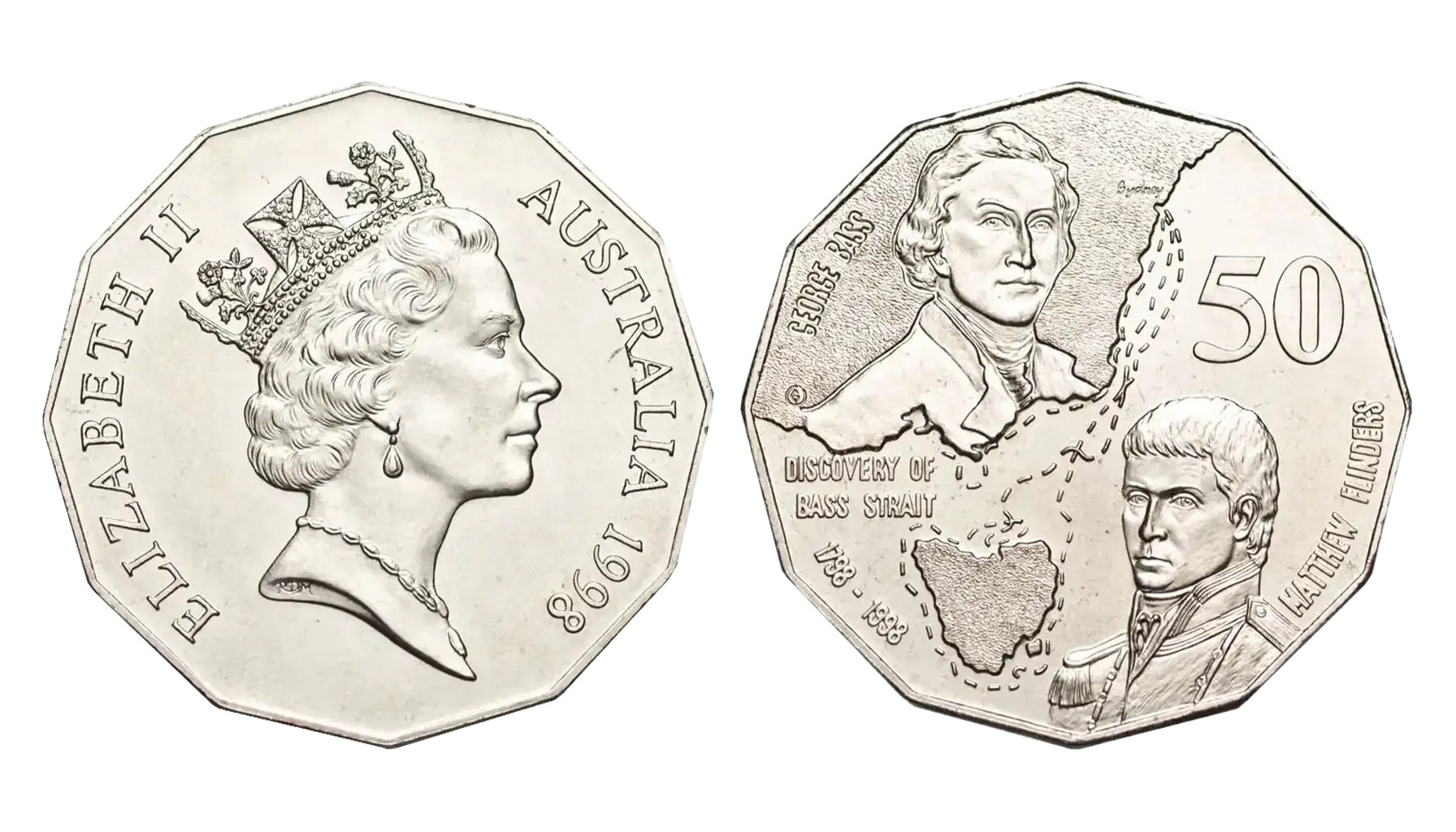
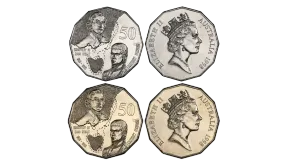
Vladimir Gottwald designed the commemorative reverse. The center shows a maritime map displaying the route of the 1798 voyage. Profile portraits of George Bass and Matthew Flinders overlap this map.
Portraits of George Bass and Matthew Flinders are placed above the cartographic image. The reverse legend contains the inscriptions, confirming the significance of the find:
Sydney
GEORGE BASS
MATTHEW FLINDERS
50
DISCOVERY OF BASS STRAIT
1798 - 1998
The obverse shows the third official portrait of Queen Elizabeth II created by Raphael Maklouf. The portrait is facing right, wearing the King George IV State Diadem.
The lettering on this side includes the monarch's name, the country, and the year of minting: ELIZABETH II; AUSTRALIA 1998; RDM.
Minting Details
The technical parameters of the coin are strictly regulated and comply with the state standard.
The 1998 issue retains the traditional twelve-sided format used since 1969. A distinctive feature of the issue is its smooth, plain edge.
Please check the main characteristics of the 1998 50 cent coin value Australia in the table below.
Parameter | Detailed Information |
Year | 1998 |
Mint | RAM, Canberra |
Mint mark | None (all specimens of this period have no mint mark) |
Mintage | 22,389,200 pieces |
Composition | 75% Copper, 25% Nickel |
Weight | 15.55 g |
Diameter | 31.51 mm |
The total mintage is more than 22 million pieces, making the Australian 50 cent coin 1998 value moderate and accessible for beginning collectors.
High production numbers limit the price growth of examples having damage from long-term circulation. However, coins from mint sets, proof sets, or PNC covers have higher collector appeal.
1998 Bass and Flinders 50 Cent Coin Value
The 1998 australian 50 cent coin value depends on several important factors that determine collectors' interest in a particular specimen.
The majority of coins from this year were put into mass everyday use, which led to the presence of many worn specimens.
Thus, the final price of the exemplar depends greatly on the following factors:
Preservation of the metal surface and absence of deep scratches, i.e., the piece's condition
Presence of original mint luster (for Uncirculated condition)
Type of issue (regular coin from circulation or specimen from a gift set)
Availability of a certificate of authenticity for collectible versions and special packaging for the set
You can also compare these parameters with other Australian 50-cent coin values to better understand the current decimal market.
As for the reference 1998 Bass and Flinders 50 cent coin value ranges, please check the table below.
Condition | Estimated Market Value |
Circulated for mass use | ~$0.50 AUD |
Very Fine / Extremely Fine | ~$2.00 — $4.00 |
Uncirculated (from the set) | ~$8.00 - $15.00 AUD |
Proof | ~$25.00 - $40.00 AUD |
Silver Proof | ~$60.00 - $90.00 AUD |
* The prices listed are not final and may vary depending on market demand and the point of sale.
Some specimens may be significantly more expensive because of rare minting errors.
But it is important not to confuse a unique manufacturing defect with normal wear and tear or mechanical damage during circulation.
1998 50 Cent Coin Errors
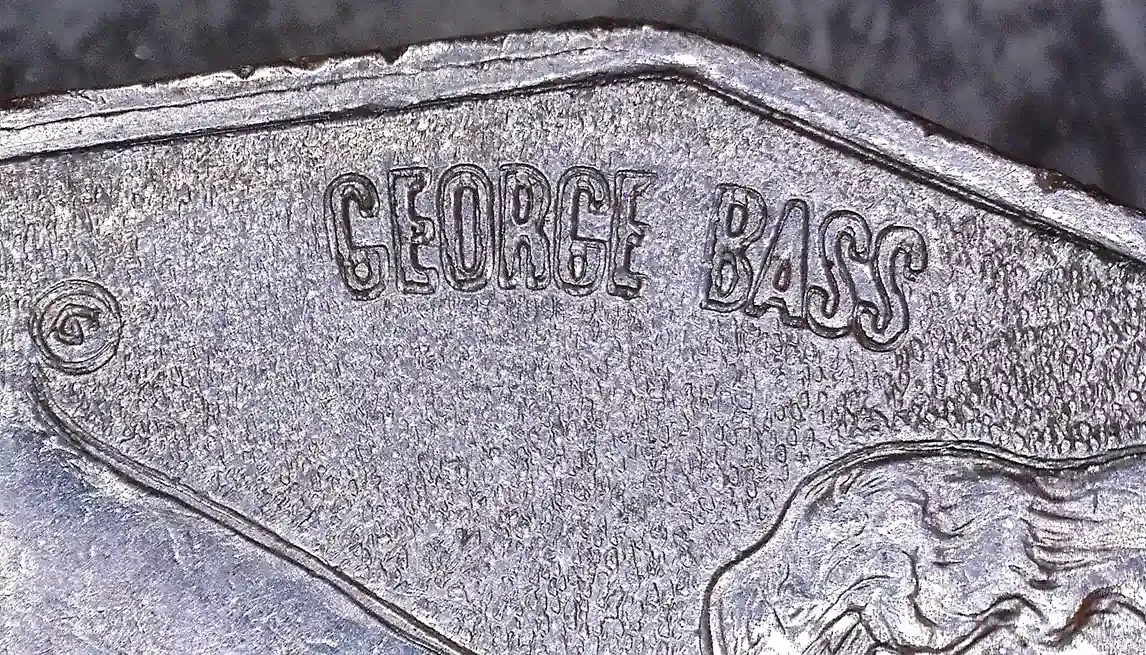
Unlike some Australian commemorative issues, the 1998 Bass and Flinders fifty-cent piece has no widely recognised major varieties.
However, a small number of mint-related striking errors were found by collectors, for example:
die fill errors
weak or off-centre strikes
occasional rim anomalies
For example, numismatic societies are discussing a 1998 50 cent coin error with a double frame and doubled elements (like inscriptions) that are clearly visible on the reverse.
On online platforms such as eBay, there are lots with a visual doubling of the outline of Queen Elizabeth II's face. This defect, reminiscent of a DDO (Double Die Obverse), sells for around $50.
But most examples found on the market are normal circulation pieces rather than true mint varieties.
Thus, before you buy an expensive specimen (supposed to be an error exemplar), it's a good idea to check it out closely under magnification, discuss the piece with a professional, or even submit a piece for professional coin grading and verification.
Collectability and Investment Potential
The investment potential of the issue is modest. The mintage exceeding 22 million pieces makes this issue not rare. The 1998 Bass and Flinders 50 cent coin value is moderate and highly accessible for beginners.
The main value for collectors may be specimens in perfect condition (MS65 and above). Else:
Collectors eagerly purchase Baby Proof sets due to their limited circulation.
Silver versions are in steady demand due to the value of the precious metal.
Exemplars in official Australia Post (PNC) cards retain their value better than loose specimens.
Standard-circulated pieces have minimal long-term financial growth potential. Serious numismatists focus entirely on pristine examples separated from general circulation. Thus, the main appeal lies in completing series sets rather than pursuing high-yield investments.
Investing in coins is not an easy walk, so explore a universal strategy to invest across various numismatic assets and precious metals to gain long-term value.
Tools to Decide If a Piece Is Worth Collecting
Identifying the exact data about the piece’s variant requires reliable data. Today, to find the 1998 50 cent coin discovery of Bass Strait value (or the worth of any other piece), collectors can rely on mobile tools like the Coin ID Scanner app.
Take a simple photo or upload the one in the app to receive a detailed card with results, matched against a database of over 187,000 pieces (including old and foreign).
The app also offers collection management, smart filters, and even an AI virtual helper. All for the collector’s convenience in one app.

 Facebook
  X (Twitter)
  Pinterest
  LinkedIn